

TL;DR
- Identify the interchangeable core family before comparing keys, finishes or prices.
- SFIC and LFIC describe different physical formats; they are not interchangeable order descriptions.
- Keep the core-to-housing interface separate from the housing-to-lock interface.
- Verify the exact keyway, keying authority and approved sample before releasing replacement stock.
Quick answer: how do SFIC vs LFIC cylinders differ?
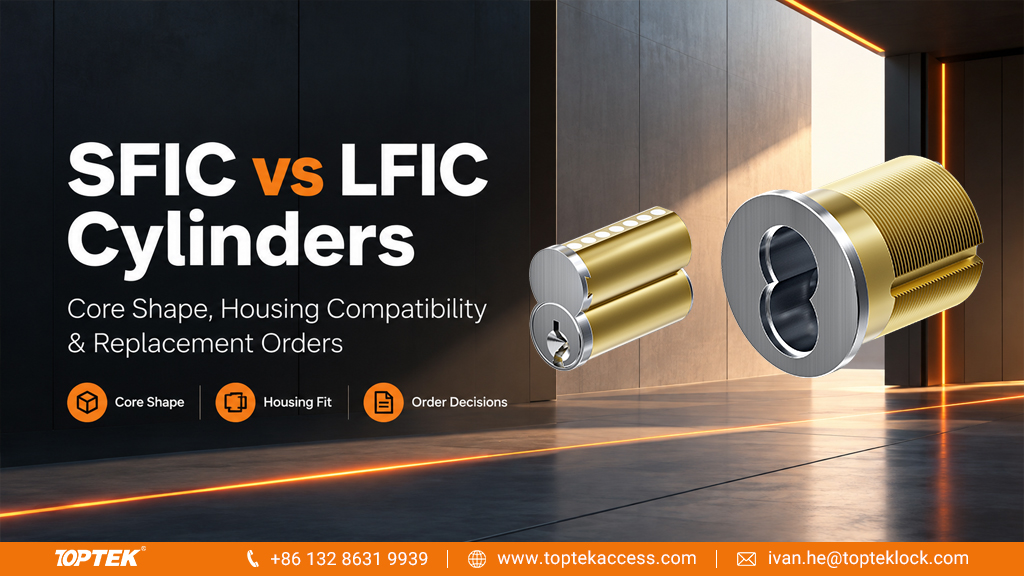
SFIC means small format interchangeable core; LFIC means large format interchangeable core. The names describe core formats, not a universal security ranking. SFIC uses a broadly shared preparation, while larger interchangeable core systems require identification by manufacturer and family. A core must match its housing, and the housing must match the lock. Before ordering, identify both interfaces, the keyway and the required operating and control keys. Do not assume that a similar face shape, a shared key label or the word interchangeable makes two systems compatible.
Start with the core, housing and lock as separate parts
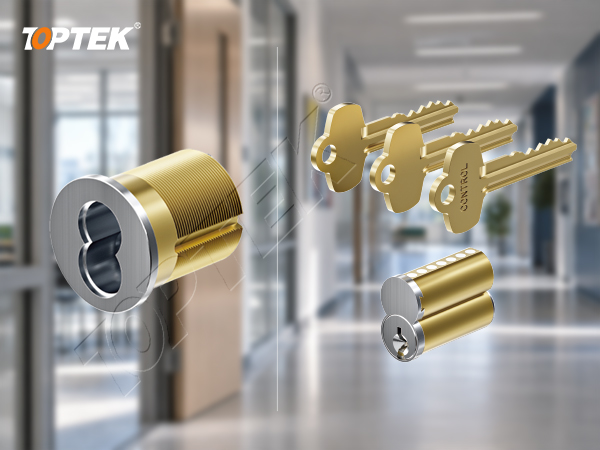
The removable core contains the key-operated mechanism. Its housing holds it within a particular cylinder or lock arrangement. That housing then interfaces with the lock through its own mounting geometry and operating components. Keeping these three items separate makes a replacement enquiry much easier to evaluate.
A request for an SFIC core is therefore different from a request for an SFIC mortise cylinder housing, and both differ from a request for a complete assembled cylinder. An order can contain the correct core family but still omit the housing, or include a housing that does not suit the lock. State the required scope on every line of the schedule.
The TOPTEK construction cylinder range includes different formats for different lock arrangements. Use the range to identify candidates, then compare drawings and samples for the specific opening. A building-wide purchasing standard should still allow separate hardware configurations where the installed locks require them.
Compare formats without assuming universal interchangeability
Allegion’s compatibility guidance distinguishes dimensionally similar SFIC preparations from manufacturer-specific large or full size interchangeable cores. It also explains that Schlage uses the term FSIC for its full size format. That terminology does not make all products called LFIC or FSIC interchangeable.
| Question | SFIC enquiry | LFIC or FSIC enquiry |
|---|---|---|
| Which core family? | Identify the small format core and exact configuration | Identify the manufacturer and particular large or full size family |
| Which housing? | Check the intended SFIC preparation and operating arrangement | Check the housing specified for that manufacturer’s family |
| Which keys? | Confirm keyway, system and authorised keying requirements | Confirm the same items for the identified family |
| What is being purchased? | Core only, housing only or complete assembly | State the same scope explicitly |
| How is fit accepted? | Compare drawings and test the exact sample combination | Use the family-specific documentation and sample combination |
Apply these distinctions to the actual order rather than using a generic compatibility claim. Matching a physical preparation does not establish that an existing key operates a new core or that the new cylinder belongs to the owner’s key system. Those questions require separate confirmation.
Identify the existing system before requesting replacements
Begin with the lock schedule, previous purchase records and manufacturer markings. Record the lock model and the cylinder or housing reference. Photographs should show the face, the installed housing and any accessible identification, with a scale where useful. A photograph can narrow the search, but it should not replace a dimensional comparison.
Ask the authorised locksmith or responsible maintenance team to identify the installed core family. Keep removed parts associated with their door references during any approved survey. Mixing similar components from several openings can make the later sample comparison unreliable.
Record whether the requirement is a like-for-like spare, a change to a different keyway or a wider system migration. These are different purchasing decisions. A like-for-like spare may retain existing hardware; a migration can require new housings or additional lock changes. Define the scope before comparing unit prices.
Do not use the operating key as the sole identification method. A key label may describe a door group rather than the underlying system. Sensitive key-system information should be exchanged only with the authorised supplier and responsible project contact.
Check the housing-to-lock interface independently
For a mortise cylinder arrangement, compare the housing length, mounting details, collar requirements and the operating component specified for the lock. A core that seats correctly in a housing can still be part of a cylinder assembly that does not operate the lock correctly. Confirm the full chain from key operation to the intended lock function.
Other lock arrangements require their own housing and drive details. Do not reuse a mortise cylinder order description for a rim or lever lock application without checking the manufacturer’s documents. The phrase SFIC identifies the core family; it does not supply the missing lock interface information.
For a replacement programme, group openings by actual lock and housing configuration. Keep common keying requirements in a separate field. This allows the procurement team to see which components can share stock and which must remain distinct even when the doors belong to one access group.
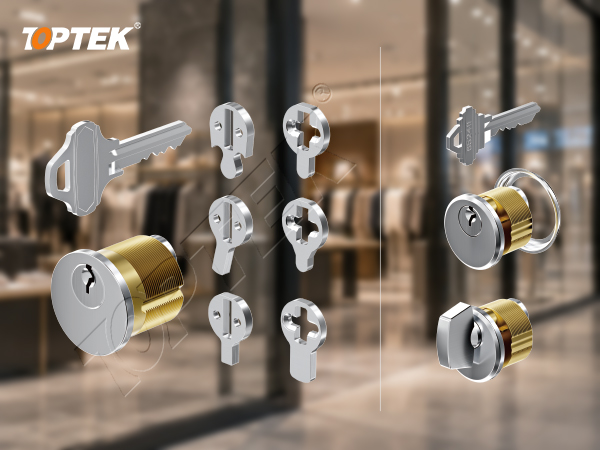
Keyway compatibility concerns the key and the cylinder’s key entry system. Access permission concerns which approved keys operate which doors. Control authority concerns who is authorised to manage removable cores and the associated control keys. Record all three rather than compressing them into a single note saying master keyed.
The owner’s access schedule should identify the required door groups and any exclusions. A supplier then needs to confirm whether the proposed components can support the specified arrangement. Physical compatibility alone cannot establish continuity with an existing master key system.
For project planning, the project cylinders and master key systems guide provides a broader scheduling framework. Use a controlled keying schedule for the actual order, with a named owner for approval and change management. Avoid distributing sensitive key details in general quotation emails.
Define the TOPTEK product scope in the enquiry
The TOPTEK 2026 catalogue identifies small format interchangeable cores and SFIC mortise cylinder housings. It shows the core and housing separately and lists configurations that require selection. This supports an enquiry for an SFIC assembly, but it does not establish that every existing SFIC installation is a confirmed match.
Use the TOPTEK SFIC mortise cylinder product reference when requesting drawings and samples. State whether you need a core, an empty housing or an assembled cylinder. Ask the supplier to identify the proposed keyway, housing, operating component and included keys in the quotation.
For an existing LFIC or FSIC installation, provide the manufacturer and family reference before discussing a replacement. Do not treat the TOPTEK SFIC range as proof of an LFIC offering or a direct conversion path. Any alternative arrangement needs its own documented compatibility review.
Approve a sample and avoid common order errors
Use the actual intended core, housing and lock combination for the trial. A loose core shown beside a housing is not enough to demonstrate an installed assembly. Agree who will carry out the trial and who will sign the acceptance record.
- Compare the supplied part references and drawings with the approved schedule.
- Have an authorised technician check core seating and retention using the specified procedure.
- Verify the intended operating keys and excluded keys against the approved access schedule.
- Confirm the cylinder operates the required lock functions without binding.
- Check the control-key arrangement under the owner’s authorised procedure.
- Record the configuration, result and any exceptions before releasing quantities.
Common errors include ordering only a core when a complete cylinder is required, specifying LFIC without a manufacturer family, and assuming that all doors with the same key label use the same housing. Another is releasing spare cores before the owner has confirmed the keying system. Each error can leave apparently correct stock unusable at installation.
Plan the transition for occupied buildings. Record which openings retain the existing system, which receive new components and where spare stock will be held. Keep the handover schedule aligned with the actual installation sequence so a mixed system does not become an undocumented permanent arrangement.
RFQ checklist and why TOPTEK
- Existing manufacturer, core family, lock model and housing reference.
- Door quantities grouped by physical hardware configuration.
- Required supply scope: core, housing, complete cylinder or agreed components.
- Drawings, photographs, housing dimensions and lock operating details.
- Keyway and keying requirements communicated through the authorised contact.
- Operating and control-key quantities, labelling and handover responsibilities.
- Sample acceptance criteria, spare-stock plan and delivery stages.
TOPTEK’s cylinder range provides a basis for discussing project supply and component selection. Ask for configuration-specific evidence through the quality management enquiry, including how the approved sample and order references will be maintained. Avoid substituting a broad family description for the exact assembly being purchased.
For a coordinated commercial door hardware order, connect the cylinder schedule to the lock schedule and delivery plan. That gives the supplier a concrete basis for quoting compatible components and makes differences between offers easier to identify.
Frequently asked questions
Are SFIC and LFIC cylinders interchangeable?
No. They identify different core formats. Confirm the exact core family, housing and lock interface before selecting a replacement.
Does FSIC always mean the same product as LFIC?
No. Naming varies by manufacturer. Identify the manufacturer and family rather than assuming that large and full size interchangeable cores share one preparation.
Will an SFIC core keep the existing master key system?
Not automatically. Physical fit does not establish keyway compatibility or the correct keying arrangement. Obtain confirmation from the authorised system supplier.
Is a conventional mortise cylinder an LFIC cylinder?
No. A conventional mortise cylinder and a housing for an interchangeable core are different configurations. Identify the actual assembly rather than relying on the outside cylinder shape.
What should a replacement sample demonstrate?
It should demonstrate the approved core and housing in the intended lock, correct operation with authorised keys, appropriate retention and the agreed control-key arrangement.
Request a cylinder compatibility review
Resolve SFIC vs LFIC cylinders by identifying the core family first, then checking the housing, lock and keying requirements. Send the non-sensitive hardware references to request a compatibility review. After the sample and access schedule are agreed, submit quantities and delivery stages for a formal quotation.