

ANSI Grade 1 Mortise Lock Certification Checklist: How Buyers Verify a True Commercial Mortise Lock
TL;DR
An ANSI Grade 1 mortise lock certification review should connect the claimed standard and grade to the exact lock series, function, trim, cylinder interface, strike and intended door application. A large lockcase or a “heavy-duty” description does not prove Grade 1 performance. For a fire-rated opening, ANSI/BHMA A156.13 evidence and UL 10C-related evidence answer different questions, and neither document by itself approves the complete door assembly.
- Confirm the applicable edition of ANSI/BHMA A156.13 and the stated operational and security grades.
- Trace the certificate, listing or test report to the manufacturer, model family and ordered configuration.
- Check whether substitutions in function, trim, cylinder, strike or construction remain within the documented scope.
- For fire doors, verify the hardware listing or report conditions together with the door, frame and installation requirements.
- Do not use an ISO management-system certificate as a substitute for product-performance evidence.
Quick Answer: What Proves a True ANSI Grade 1 Mortise Lock?
A true commercial mortise lock is identified by its lockcase being installed in a mortised pocket in the door edge, but its Grade 1 status is proved by applicable product evidence—not by construction alone. The buyer should verify a controlled certificate, listing or test report for ANSI/BHMA A156.13, check the named product and grade, and confirm that the ordered function and components are covered.
“True mortise lock” is useful buyer language, not a formal certification class. It separates a full mortise lockcase from a bored or tubular lock that may use visually similar lever trim. It must not be treated as a replacement for the standard, grade or certified-product scope.
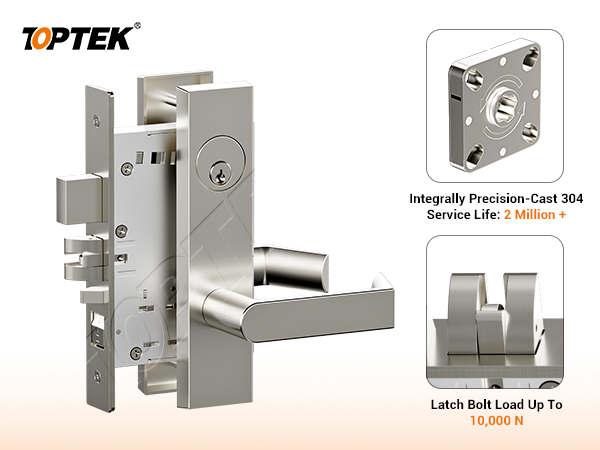
TOPTEK’s ANSI Grade 1 mortise lock product hub presents the TKAM9200 platform in round-rose and escutcheon trim configurations. Project approval should still be based on the controlled documents for the exact item being quoted.
Start with the Buyer’s Intended Use, Not the Certificate Name
Certification requirements follow the opening. A distributor building a general commercial range, a door manufacturer supplying a rated assembly and a contractor replacing an existing lock may all ask for “ANSI Grade 1,” yet their evidence packages are not identical.
| Buyer situation | Primary evidence question | Additional project check |
|---|---|---|
| Commercial product program | Does the exact series meet the specified operational and security grade under ANSI/BHMA A156.13? | Functions, trims, cylinders, finishes, templates and production consistency |
| Fire-rated door package | Is the lock or latch configuration covered by applicable fire-door hardware evidence? | Door, frame, label, hardware category, rating, installation instructions and local approval |
| Canadian project | Does the controlled record include the required Canadian certification route? | Correct mark, geographic scope, model and fire-door conditions |
| Replacement or retrofit | Is the proposed lock both compliant and physically compatible? | Door preparation, backset, case and faceplate dimensions, strike, cylinder and trim fixing |
| OEM/private-label order | Whose name and model appear in the evidence, and may the proposed marking be used? | Authorization, label control, change control and traceability from sample to production |
What ANSI/BHMA A156.13 Does—and Does Not—Establish
The current published edition is ANSI/BHMA A156.13-2022. BHMA’s public summary describes operational, strength, security, cycle, finish and dimensional requirements for mortise locks and latches. It also directs purchasers to certified product listings when that certification route is required.
Three boundaries matter in procurement:
- The standard is product-specific. Evidence for a bored lock, panic device, cylinder or electrified locking system is not automatically evidence for a mechanical mortise lock.
- The grade statement needs precision. The A156.13 framework distinguishes operational performance from security performance. A purchase specification should state what grade is required, rather than accepting an unexplained “Grade 1” badge.
- Laboratory results are not an installation warranty. Door preparation, alignment, maintenance, environment and component selection can change field performance.
If a tender specifically requires a BHMA Certified product, a laboratory report described as “tested to ANSI/BHMA” is not automatically equivalent. Ask the supplier to identify the certification route and provide a verifiable listing or certificate that meets the tender wording.
The 8-Point ANSI Grade 1 Mortise Lock Certification Checklist
1. Standard edition and product type
Confirm that the document names ANSI/BHMA A156.13 and identifies mortise locks or latches. Record the edition. If the project specification names an older edition, ask the specifier whether the current edition or the specified edition governs the submittal.
2. Document issuer and evidence route
Identify whether you have a certification listing, a certificate, a full test report, a summary report or a manufacturer declaration. Record the issuing organization, laboratory, document number, issue date and any validity or surveillance information. Each document type has a different evidentiary value.
3. Manufacturer and applicant identity
The legal manufacturer or applicant on the document must connect to the supplier and product being purchased. For private-label programs, request the authorization or multiple-listing route that permits the proposed brand and model identification. A factory’s ISO 9001 certificate can support quality-system review, but it does not prove A156.13 product performance.
4. Model family and construction
Match the tested or listed model family to the quotation, drawings, bill of materials and sample marking. A shared series name is not enough when the lockcase, latch, deadbolt, spring structure, armor front or critical operating parts differ.
5. Function and grade scope
Check the specified function: office/entry, classroom, storeroom, apartment entrance, privacy, passage or another project function. The standard contains rules for qualifying related functions, but buyers should not assume every function is covered without reviewing the report or certification scope. Also confirm whether the claimed grade applies to operational performance, security performance or both.
6. Trim, cylinder and strike combinations
A commercial mortise lock is a system. Lever trim, escutcheon or sectional roses, cylinder format, spindle, thumbturn, strike and fasteners can affect operation and security. Confirm permitted options and verify that the ordered hardware matches the door schedule. TOPTEK publishes separate pages for the TKAMRR9200 round-rose lever trim and TKAMEC9200 escutcheon lever trim; the project document set should identify which configuration is being supplied.
7. Fire-door evidence, when required
ANSI/BHMA Grade 1 does not automatically make a lock suitable for every fire door. UL explains that locks and latches are certified under specific fire-door hardware categories and that the complete opening combines the door, frame, hardware and accessories. Review the UL Doors, Windows and Related Hardware Application Guide, then verify the exact listing, rating, model, mark and installation conditions for the project.
A reference to UL 10C describes a positive-pressure fire-test route. It is not permission to transfer one lock result to every door construction, size, rating, trim or field modification.
8. Traceability and change control
Ask how the approved sample, controlled drawings and production bill of materials are linked. Confirm what happens if the supplier changes a spring, casting, latch, coating, screw, cylinder interface or subcontractor. Certification risk often appears after sample approval, when an undocumented substitution enters mass production.
Buyer Decision Matrix: Accept, Hold or Reject?
| Supplier statement | Buyer action | Decision |
|---|---|---|
| “Heavy-duty true mortise lock” with no A156.13 document | Request the applicable certificate, listing or report and exact model scope | Hold |
| A156.13 report for a different series or applicant | Request a documented technical and legal link to the quoted item | Hold or reject |
| Clear A156.13 evidence matching model, grade and configuration | Complete dimensional, function and production-control review | Proceed to sample approval |
| UL 10C logo or marketing image without a listing reference | Request the controlled fire-door hardware record and installation conditions | Hold |
| ISO 9001 certificate offered as Grade 1 proof | Separate management-system evidence from product evidence | Reject as product proof |
TOPTEK Evidence: What Buyers Can Review
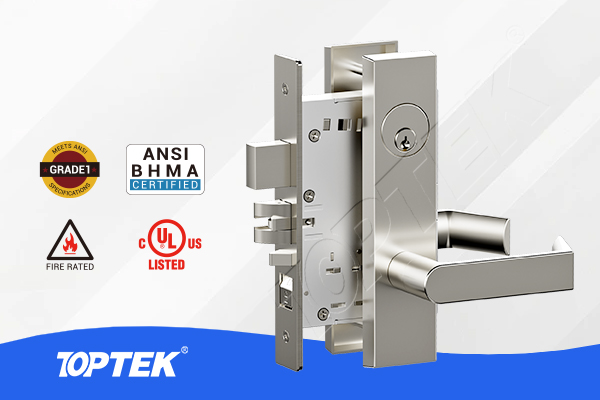
TOPTEK’s public product pages identify the TKAM9200 platform, ANSI/BHMA A156.13 Grade 1 positioning and UL 10C/cUL fire-door options. The TOPTEK certification and test-document page separately lists an ANSI Grade 1 mortise lock certification and fire-rated mortise lock documentation. Buyers should request the controlled file set that matches the quotation rather than relying on the public table alone.
TOPTEK also operates an in-house laboratory for development, batch checks and production consistency. Those internal results are useful for quality control, but they are not presented as a replacement for third-party certification. This distinction should remain visible in every technical submittal.
For a broader supplier assessment covering engineering, functions, door preparation and OEM/ODM controls, use the existing guide on how to choose an ANSI Grade 1 mortise lock manufacturer. The present checklist has a narrower purpose: deciding whether a claimed certification package is usable for a specific purchase.
Common Certification Mistakes
- Buying the badge: accepting a logo on a brochure without the underlying controlled record.
- Checking only the lockcase: ignoring function, trim, cylinder, strike and fastener scope.
- Confusing tested with certified: using the terms interchangeably when the tender requires a specific certification program or listing.
- Assuming fire approval transfers: applying one fire result to an unreviewed door, frame or hardware combination.
- Using ISO as product proof: treating a management-system certificate as an A156.13 performance certificate.
- Approving a sample without change control: failing to lock drawings, materials and critical components before production.
Buyer Checklist Before Sample Approval
- Copy the exact standard, edition and grade language from the project specification.
- Record the document issuer, number, applicant, manufacturer, date and product family.
- Map every quoted model and function to the document scope.
- Confirm operational and security grade statements separately when required.
- Match lockcase, faceplate, strike, trim, cylinder, spindle and fasteners to drawings.
- Check door thickness, backset, handing, edge preparation and frame strike preparation.
- For fire doors, verify the rating, hardware category, mark and assembly conditions.
- Approve controlled drawings and define notification rules for material or design changes.
- Retain the approved sample and define incoming and batch inspection points.
ANSI Grade 1 Mortise Lock RFQ Checklist
Send the following information so that suppliers quote the same technical scope:
- Target country, project type and applicable specification section
- Required standard edition and operational/security grade
- Whether BHMA Certified listing, independent laboratory report or another approval route is mandatory
- Fire-rated or non-rated opening; required rating and local approval route
- Door and frame material, thickness, handing and available preparation drawings
- Function code and a plain-language description of inside and outside operation
- Round-rose, sectional or escutcheon trim; lever design and finish
- Cylinder format, keyway, interchangeable-core and master-key requirements
- Backset, case, faceplate, strike and critical center dimensions
- Quantity, sample plan, packaging, branding and required spare parts
- Documents needed for tender, customs, submittal and final handover
FAQ
Is “true mortise lock” an ANSI or BHMA certification term?
No. It is informal language for a lockcase installed in a mortised pocket in the door edge. ANSI/BHMA A156.13 and the documented grade provide the performance framework.
Does ANSI Grade 1 automatically mean the lock is fire rated?
No. ANSI/BHMA A156.13 addresses mortise lock performance. Fire-door hardware evidence follows a separate test and certification route, and the complete opening must remain within its approved conditions.
Is a test report the same as a BHMA Certified listing?
Not necessarily. A test report records test work and results; a certification program may also require listing, authorization, surveillance and mark control. Follow the exact project wording and verify the required route.
Can one tested function cover every mortise lock function?
The standard provides qualification rules for related functions when construction and operating parts meet defined conditions. Buyers should confirm the actual certification or report scope rather than making the extension themselves.
Why must the trim and cylinder be checked?
Trim, cylinders, spindles and strikes interact with the lockcase and may affect operation, security, door preparation and certified scope. The bill of materials must match the approved configuration.
What can I send if I do not have a complete door schedule?
Send door-edge and door-face photos, door and frame materials, door thickness, backset or basic dimensions, the existing lock model if known, target market, required quantity, function description and whether the opening is fire rated. TOPTEK can identify the remaining questions.
How should private-label buyers verify certification?
Confirm whose legal name and model appear on the record, whether the private label is authorized, which marks may be applied and how changes are controlled. Do not assume a factory certificate automatically covers a new brand or model name.
Conclusion: Verify the Evidence Chain, Not the Marketing Label
The safest buying decision connects four things: the intended opening, the applicable requirement, the exact product configuration and the controlled evidence. A mortised lockcase confirms the product type; it does not confirm Grade 1. A certificate title confirms that a document exists; it does not confirm that every quoted function, trim or private-label model is covered. A fire-test reference confirms an evaluation route; it does not approve an unrelated complete door assembly.
Use the checklist before price comparison. It exposes incomplete scope early, protects the submittal and gives the factory a precise basis for model selection, sampling and quotation.