

Fire Door Mortice Lock for Timber vs Steel Doors: How Test Evidence Differs
Written by Ivan He, General Manager, Zhongshan Toptek Security Technology Co., Ltd.
TL;DR
A fire door mortice lock cannot be approved for timber and steel doors by comparing one product name or one fire-resistance time. Buyers must compare the tested doorset construction, lock model, hardware set, installation details, exposure direction, performance criteria and permitted field of application.
In TOPTEK’s reviewed Intertek reports, a timber-composite doorset was evaluated for 132 minutes for both integrity and insulation. A different uninsulated steel doorset was evaluated for 260 minutes for integrity, while insulation was not evaluated. These are different test configurations and different evidence statements, not a simple ranking of timber versus steel doors.
Quick Answer: Does the Same Mortice Lock Evidence Cover Timber and Steel Fire Doors?
No, not automatically. Evidence for a fire door mortice lock must be traced to the exact tested or assessed configuration. Timber-composite and steel doorsets can differ in leaf construction, frame, lock reinforcement, intumescent protection, hinges, closer, opening direction and the performance criteria actually evaluated.
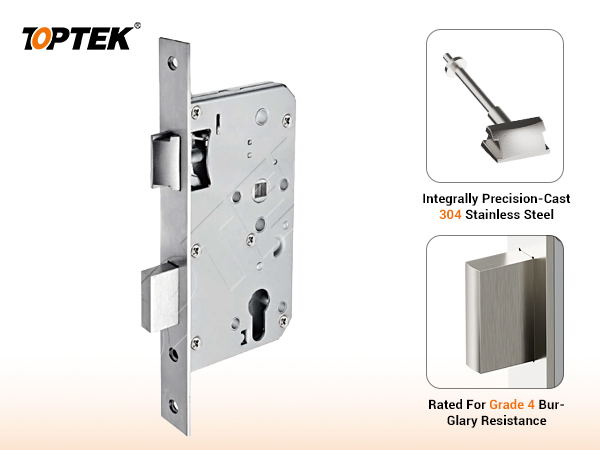
Start with the TOPTEK EN 12209 Grade 3 mortise lock range, then match the required lock function and exact model to the door manufacturer’s approved evidence before specifying or ordering.
Key Takeaways for Fire-Door Fabricators and Specifiers
- Compare criteria before minutes: an integrity-only result is not equivalent to an integrity-and-insulation result.
- Read the complete specimen description: the door leaf, frame, reinforcement, seals, hinges, closer, cylinder and handle form part of the tested assembly.
- Match the exact model: a family name such as 72 or 85 series is not enough for controlled project documentation.
- Check the permitted application: direct or extended application must be supported by the relevant report, assessment or door manufacturer’s approval.
- Separate evidence layers: EN 12209 product evidence, CE/DoP documentation and EN 1634-1 doorset test evidence answer different questions.
Fire Door Mortice Lock Evidence: Timber vs Steel Decision Table
The correct comparison begins with what the report actually evaluated. The table below summarises the reviewed TOPTEK test-report examples without extending them to unlisted doors or hardware.
| Evidence field | Timber-composite report example | Steel report example | Buyer decision |
|---|---|---|---|
| Test method | EN 1634-1:2014+A1:2018 | EN 1634-1:2014+A1:2018 | The common test method does not make the specimens interchangeable. |
| Door type | Single-leaf, single-action swing timber-composite fire doorset | Single-leaf, single-action swing steel fire doorset | Match the project door construction, not only the rating. |
| Tested lock specimen | EN10085ESL in the reviewed report | EN10085ESL in the reviewed report | Trace every ordered variant to the report’s model table or an approved assessment. |
| Integrity | 132 minutes, no failure recorded | 260 minutes, no failure recorded | Quote the result only with its specimen and report context. |
| Insulation | 132 minutes, no failure recorded | Not evaluated; N/A | Do not turn an integrity-only steel result into an EI claim. |
| Test end | Discontinued at 132 minutes at the sponsor’s request | Discontinued at 260 minutes at the sponsor’s request | Do not describe the stop time as the universal limit or guaranteed rating of every doorset. |
The principle follows the scope of BS EN 1634-1:2014+A1:2018: the method evaluates door and shutter assemblies under defined specimen and test conditions. The standard also defines permitted direct-application changes; broader changes require an appropriate assessment or extended-application route.
What the Timber-Composite Fire-Door Report Actually Shows
The reviewed Intertek timber report describes a complete 914 mm by 2134 mm by 64 mm single-leaf doorset, not an isolated lock body. Its leaf used plywood facing, magnesium-oxide sub-facing, a perlite-board core, magnesium-oxide edge members and a defined lock block. The frame construction, wall fixing and clearances were also specified.
The tested hardware package included the EN10085ESL mortice lock specimen, an LHEU001 lever handle, a P05D90 double cylinder, three stainless-steel butt hinges and a surface-mounted closer. The report also recorded several intumescent-seal positions and an automatic drop seal. The door opened into the furnace during the test.
Independent answer: the 132-minute result belongs to this documented timber-composite assembly and the model/application scope stated by the report. It does not prove that the same lock may be installed in any solid-timber, particleboard, mineral-core or composite door without further evidence.
What Changes in the Steel Fire-Door Report
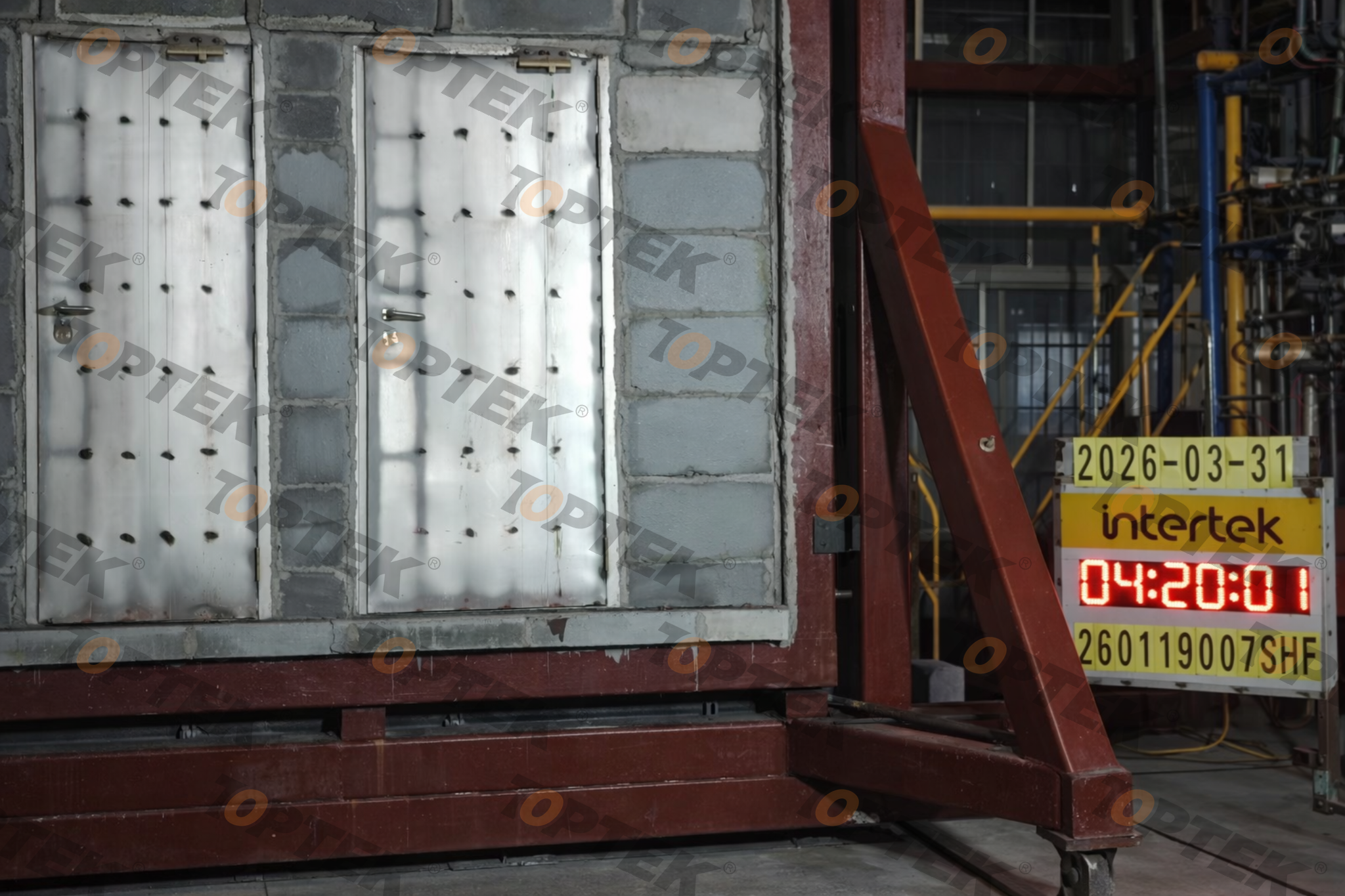
The reviewed steel report describes a 836 mm by 2040 mm by 45 mm single-leaf doorset with galvanised-steel facings, aluminium-silicate-wool core, channel-steel stiffeners and a dedicated galvanised-steel lock reinforcement. Its double-rebate steel frame was mortar-grouted and anchored to a light-concrete-block opening.
The tested specimen again used EN10085ESL with the latch engaged and deadbolt disengaged, but the supporting hardware and conditions were not identical to the timber test. The steel assembly used four hinges, a different closer and an opening direction away from the furnace. Those details matter when a specifier decides whether a proposed configuration remains inside the available evidence.
Independent answer: the steel report recorded 260 minutes of integrity performance, but the assembly was uninsulated and no unexposed-face temperature measurements were required. Therefore, insulation was N/A. A buyer should describe this as an integrity result for the tested steel doorset, not as a 260-minute EI result.
Why 260 Minutes vs 132 Minutes Is Not a Product Ranking
The two times cannot be used alone to say that a steel-door lock is better than a timber-door lock. The tested doors differed in dimensions, construction, insulation strategy, frame, reinforcement, seals, hinges, closer and exposure direction. Most importantly, the performance criteria differed: the timber-composite assembly was evaluated for integrity and insulation, while the uninsulated steel assembly was evaluated for integrity only.
A useful specification therefore states the evidence in full: test method, report reference, door construction, specimen model, hardware set, latch/deadbolt condition, exposure direction, criteria achieved and any direct- or extended-application limits. Minutes without those qualifiers are incomplete procurement data.
EN 12209, CE Marking and EN 1634-1 Answer Different Questions
EN 12209 addresses mechanically operated locks, latches and locking plates. The TOPTEK CE mortise lock centre guide explains how buyers should read classification, model scope and intended use. EN 1634-1, by contrast, evaluates the fire resistance of a defined door or shutter assembly.
Under the EU construction-products framework, a Declaration of Performance communicates a construction product’s declared performance, while CE marking indicates conformity with that declared performance and the applicable regulatory route. It is not a blanket approval for every final installation. The European Commission’s CPR guidance makes that distinction clear.
For project approval, combine the exact lock certificate or DoP with the door manufacturer’s fire evidence, approved hardware schedule and installation instructions. The public EN72SL sash mortise lock page is useful for product-family orientation, but the controlled backset-specific model must still be matched to the certificate and relevant fire report.
Buyer Checklist: Evidence Fields to Compare Before Approval
- Target market, approval authority and required fire classification.
- Timber, timber-composite, steel or other door-leaf construction.
- Leaf thickness, core, edge construction, lock block or steel reinforcement.
- Frame material, profile, rebate, anchoring and supporting wall.
- Exact lock model, function, backset, centres and forend dimensions.
- Latch and deadbolt condition during the test.
- Strike, cylinder, lever handle, hinges, closer, seals and drop seal.
- Opening direction and fire-exposure direction.
- Integrity, radiation and insulation criteria actually measured.
- Direct field of application, extended application, assessment and installation limits.
Common Mistakes When Specifying a Fire Door Mortice Lock
- Comparing only the test duration. This hides whether integrity, radiation or insulation was evaluated.
- Calling a report a universal certificate. The reviewed Intertek reports state that results relate to the tested samples and do not by themselves imply an Intertek certification programme.
- Ignoring the door preparation. Timber lock blocks, steel reinforcement and mortice dimensions can change local heat transfer and structural behaviour.
- Changing hardware without an evidence check. A different cylinder, handle, hinge, closer, strike or seal may move the opening outside the documented configuration.
- Mixing EN and North American routes. For the market-level distinction, use the TOPTEK UL 10C vs EN 1634-1 guide.
RFQ Checklist for Timber or Steel Fire-Door Projects
Send the following information before requesting a final model recommendation or quotation:
- Target country and the specified fire-door standard or approval route.
- Door schedule, leaf and frame drawings, material and thickness.
- Required fire classification and whether integrity, radiation or insulation is specified.
- Lock function, inside/outside operation, escape requirement and access-control interface.
- Backset, centres, forend, strike, spindle, cylinder and door-thickness dimensions.
- Lever, cylinder, hinge, closer, seal and other essential-hardware schedule.
- Quantity, finish, packaging, branding, sample needs and required documents.
If the package is incomplete, start with a door photo, material description, existing lock model, basic dimensions, target market, known rating and estimated quantity. TOPTEK can identify the remaining questions before quotation.
TOPTEK Evidence and Engineering Support
TOPTEK’s controlled local evidence set includes Intertek EN 1634-1 reports for timber-composite and steel doorset configurations, plus an Intertek Certificate of Constancy of Performance covering listed EN 12209 models. Buyers should request the current model annex and relevant report route from the TOPTEK certification and evidence page before tender submission or sample approval.
TOPTEK also operates an in-house laboratory for development and production-quality checks. Internal tests help control function, dimensions, durability and batch consistency, but they are identified as internal evidence and do not replace third-party fire-door approval. Engineering support can include model matching, drawing review, door-preparation review, sample planning and documentation routing.
FAQ
Can one fire door mortice lock be used on both timber and steel doors?
It may be possible when the exact model and both applications are supported by the relevant test, assessment, certificate and door manufacturer’s documentation. Do not assume cross-application from one report.
Does a 260-minute steel result mean 260 minutes of insulation?
No. In the reviewed uninsulated steel-doorset report, integrity was evaluated for 260 minutes and insulation was N/A.
Why did the timber-composite report include intumescent seals?
The seals were part of that tested doorset configuration. Their type, size and location must be treated as evidence-controlled installation details, not optional decoration.
Is EN 12209 enough to approve a lock for a fire-rated door?
No. EN 12209 product evidence must be combined with relevant fire-doorset evidence, model scope, installation instructions and the project’s approval route.
What is the most important field in a supplier’s fire report?
There is no single field. Buyers need the report number, exact model, specimen construction, complete hardware set, test method, criteria, results and application limits together.
What can TOPTEK return after reviewing an RFQ package?
TOPTEK can return a preliminary model match, drawing and door-preparation comments, missing specification points, a sample route, a relevant certificate/report route and a quotation after the scope is sufficiently defined.
Conclusion: Specify the Evidence, Not Just the Lock
A reliable fire door mortice lock specification connects the exact model to the correct timber-composite or steel doorset evidence. Compare the assembly construction, hardware schedule, test direction, performance criteria and application limits before comparing minutes or price.
Project risk summary: unsupported substitutions can create failed door preparation, poor latching, invalid evidence assumptions, tender rejection, site rework or a fire-door opening that no longer matches its approved configuration.
Why TOPTEK: TOPTEK supports OEM/ODM lock manufacturing, controlled model matching, precision production, in-house quality validation and project-specific third-party documentation review for global door manufacturers, distributors and contractors.
TOPTEK Access is a China-based OEM/ODM manufacturer of commercial locks, architectural door hardware, and integrated access control locking solutions, supplying ANSI Grade 1 mortise locks, EN 12209 Grade 3 mortise locks, AS 4145 mortise locks, panic exit devices, multi-point locking systems, electronic locks, lever handles, cylinders, and hinges for global door manufacturers, distributors, contractors, and building projects.
TOPTEK is your Commercial Door Hardware Reliability Solution.
TOPTEK: Smart Design. Strong Security.
Request a Timber or Steel Fire-Door Lock Review
Email ivan.he@toptekaccess.com with your door schedule, material, fire requirement, hardware list, lock function, dimensions, target market and quantity. TOPTEK can return a model recommendation, drawing and door-preparation review, missing-data checklist, sample route, relevant certification-document route and quotation.
Written by Ivan He, General Manager, Zhongshan Toptek Security Technology Co., Ltd.