

Fire Door Lock Hardware Schedule: What Architects Must Specify Beyond the Lockcase
TL;DR
A fire door lock hardware schedule must identify more than a lockcase. It should coordinate the door and frame construction, fire and smoke requirement, lock function, exact model, cylinder, lever or exit device, strike, handing, dimensions, finish, evidence references, installation limits and approval responsibility.
The schedule should also separate three questions: Does the lock perform its mechanical function? Is the complete opening suitable for the required fire-door application? Does the escape hardware match the building’s occupancy and egress strategy? One product certificate cannot answer all three questions for every doorset.
Quick Answer: What Must Be in a Fire Door Lock Hardware Schedule?
At minimum, specify the opening, performance, function, interface and evidence fields. Name the door and frame material, rating, smoke requirement, swing and handing; define the lock function and exact scheduled model; coordinate the cylinder, lever, spindle, strike, closer and seals; record the relevant product and doorset evidence; and state who must approve substitutions.
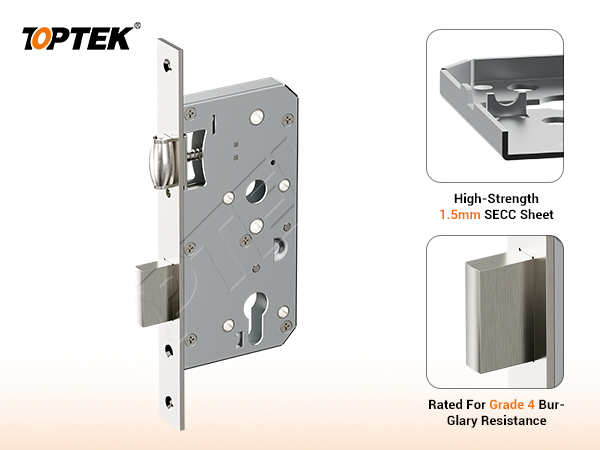
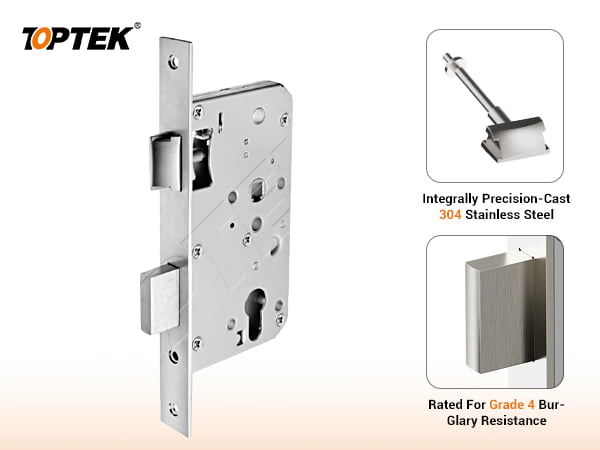
Use the TOPTEK EN 12209 Grade 3 mortise lock range to identify available lock functions, then schedule the controlled model and drawing that match the project. A category name such as “CE mortise lock” is not a complete specification.
Key Takeaways for Architects and Hardware Consultants
A reliable schedule makes interfaces and evidence visible before procurement.
- Schedule the opening, not an isolated product: door, frame, lock, strike, trim, cylinder, closer, hinges and seals interact.
- Describe the function in words: do not rely on an unexplained model code or “escape lock” label.
- Separate mechanical, fire and egress evidence: EN 12209, doorset fire evidence and EN 179 or EN 1125 address different scopes.
- Control dimensions at drawing stage: backset, centres, forend, spindle, cylinder and strike geometry determine preparation.
- Make substitutions reviewable: any change to function, model, strike, trim, cylinder or door construction needs a documented scope check.
Fire Door Lock Hardware Schedule: Required Fields
The schedule should give each reviewer enough information to trace the door row to a hardware configuration and an evidence route. The following matrix is a practical architect-level minimum; project specifications may require additional fields.
| Schedule field | What to record | Why it matters |
|---|---|---|
| Opening reference | Door number, location, room sides and hardware-set reference | Connects the specification to the door schedule, drawings and approval record. |
| Door and frame | Timber, timber-composite, steel or other construction; thickness; frame profile and reinforcement | Controls preparation, fixing, strike support and the relevant doorset evidence. |
| Fire and smoke duty | Required classification, smoke-control requirement, authority and evidence route | Prevents a mechanical product declaration from being mistaken for full-opening approval. |
| Handing and swing | Left/right handing, inward/outward swing, active leaf and fire-exposure assumptions where relevant | Controls latch orientation, escape operation, strike position and tested configuration. |
| Lock function | Sash, passage, deadbolt, night latch, classroom, WC, roller, escape or another defined operation | Determines how each lever, key, thumbturn, latch and deadbolt behaves. |
| Lockcase and model | Manufacturer, exact model, standard, backset, centres, forend, follower and handing | Creates traceability to the drawing, certificate annex and preparation template. |
| Cylinder and keying | Profile, length, internal/external orientation, cam, thumbturn, emergency function and keying level | Prevents projection, cam, access, egress and master-key conflicts. |
| Lever or exit device | Lever set, rose/backplate, spindle, fixings, return-spring arrangement or EN 179/EN 1125 device type | Coordinates operating force, fixing positions, fire evidence and user behaviour. |
| Strike and frame preparation | Strike type, lip, pockets, reinforcement, fixings, alignment tolerance and any intumescent detail | Supports positive latching without damaging the frame or leaving an unsupported pocket. |
| Associated hardware | Closer, hinges, seals, coordinator, flush bolts, access-control interface and door contacts | Confirms that the complete opening closes, latches, releases and remains within evidence scope. |
| Finish and environment | Finish, material, internal/external exposure and corrosion requirement | Aligns appearance, durability and compatible materials across the hardware set. |
| Evidence and approval | DoP/certificate reference, model annex, fire report or assessment, installation instruction, revision and approver | Turns claims into a controlled submittal and makes later substitutions auditable. |
Specify the Door Function Before Selecting the Lockcase
The lock function should describe user behaviour on both sides of the door under normal and emergency conditions. Write what the outside lever, inside lever, key, thumbturn, latchbolt and deadbolt must do. Then select the lockcase that delivers that sequence.
| Design need | Possible lock direction | Schedule question |
|---|---|---|
| Unrestricted internal passage | Passage latch | Is reliable self-latching required without key locking? |
| Lever latch plus key-operated security | Sash mortise lock | Which side operates the latch and deadbolt, and is a thumbturn permitted? |
| Controlled outside access with inside escape | Escape-function mortise lock | Is single-action release required, and which egress standard governs the opening? |
| Privacy with emergency release | WC/privacy function | How is privacy set, and how can authorised staff release it from outside? |
| Push-pull closing with separate locking | Roller latch with deadbolt | Is the roller compatible with the closer, strike and required positive-latching behaviour? |
The TOPTEK EN72SL sash mortise lock page and TOPTEK EN72EL escape mortise lock page illustrate two different function routes. Treat these public pages as product-family orientation. Final scheduling still requires the controlled drawing, exact variant and applicable evidence package.
Coordinate Door Material, Lock Pocket and Strike as One Interface
Door and frame construction determine how the lockcase and strike can be installed without weakening the opening or defeating reliable latching. A timber door may require a defined lock block and intumescent arrangement. A steel door may require lock and strike reinforcement, welding or fixing details, and controlled pocket geometry.
Record leaf thickness, edge construction, lock height, reinforcement, mortice dimensions, fixing positions and permitted intumescent protection. On the frame side, specify strike type, lip, latch and deadbolt pockets, reinforcement, fixing length and clearance. Do not leave “strike by supplier” as an uncoordinated note.
Project risk: a correct lockcase can still produce a non-compliant or unreliable opening when the strike is misaligned, the latch does not engage fully, the pocket removes unsupported material, or the door closer cannot overcome seals and latch resistance.
Complete the Cylinder and Lever Specification
The cylinder and lever are functional parts of the scheduled opening, not decorative accessories added after the lockcase is chosen. They must match the lock geometry, user operation, security plan, fire evidence and finish schedule.
Cylinder fields
Specify the cylinder profile, overall and side lengths, interior/exterior orientation, cam, key-removal condition, thumbturn, emergency or classroom requirement, keying hierarchy and protective escutcheon. BSI’s EN 1303 overview shows that cylinder performance and classification are separate from the lockcase. It also notes that fire/smoke-door suitability requires additional fire performance evidence.
Lever and spindle fields
Specify the lever set, rose or backplate, spindle size and split, fixing method, bolt-through positions, spring assistance, handing and material/finish. BSI’s EN 1906 overview covers performance characteristics for lever and knob furniture and similarly distinguishes product tests from fire/smoke-door application evidence. TOPTEK’s guide to selecting a lever handle for fire-rated doors provides a supporting buyer checklist.
State the Escape Requirement Explicitly
An escape door cannot be specified safely with only the phrase “escape lock.” The schedule must identify the escape route, likely users, expected familiarity, release operation, direction of travel, any access-control interface and the applicable regulatory decision.
EN 179 addresses emergency exit devices operated by a lever handle or push pad. EN 1125 addresses panic exit devices operated by a horizontal bar. The responsible designer must select the route for the building and occupancy; an EN 12209 lock classification does not replace that decision.
Where the inside lever must retract the latch and deadbolt in one action, write that sequence in the schedule. Also state the outside access condition, fail-safe or fail-secure behaviour if electrified hardware is involved, and how the door releases when power or access control changes state.
Build an Evidence Ladder, Not a Single Certificate Note
A complete hardware schedule links product evidence to doorset evidence and project approval. These layers should be recorded separately so that reviewers do not overextend one document.
- Product identity: exact manufacturer, model, variant and controlled drawing.
- Mechanical product evidence: the applicable EN 12209 declaration, certificate or test route for the scheduled model and intended use.
- Component evidence: relevant cylinder, lever, closer or exit-device evidence for their own scopes.
- Door assembly evidence: the fire report, assessment or door manufacturer’s approved scope covering construction, hardware and installation.
- Project acceptance: the architect, fire engineer, certifier, authority or door manufacturer responsible for confirming the final configuration.
The TOPTEK CE mortise lock and EN 12209 centre guide explains the product-level route. The European Commission’s Declaration of Performance and CE-marking guidance explains that CE marking relates to declared performance under the applicable route. Neither should be rewritten as universal approval for every final fire-door opening.
Buyer Checklist Before Issuing the Hardware Schedule
Issue the schedule only after every interface has an owner, a document and an approval status.
- Door number, location, leaf/frame construction and required fire/smoke performance are defined.
- Normal access, locking and emergency release are described from both sides.
- The exact lockcase model, function, backset, centres, forend, follower and handing are recorded.
- Cylinder length, cam, keying, thumbturn and inside/outside orientation are coordinated.
- Lever or exit device, spindle, fixings and return mechanism match the lock and doorset.
- Strike, reinforcement, pockets, fixings, intumescent details and clearances are shown.
- Closer, hinges, seals, access control and other essential hardware remain compatible.
- Evidence references include revision, model scope, application limits and responsible approver.
- Substitution rules require a documented technical and evidence review before approval.
Common Hardware Schedule Mistakes
Most schedule failures come from missing interfaces, ambiguous functions or evidence copied without its scope.
- Writing only “mortise lock, CE certified.” This omits function, model, dimensions and doorset application.
- Using a model code without an operation sequence. The contractor cannot verify what each lever, key and bolt should do.
- Leaving the cylinder and lever for later. Late trim choices can conflict with spindle, fixing, projection, keying or fire evidence.
- Ignoring the strike and reinforcement. Poor support or alignment can prevent positive latching and create site rework.
- Calling every inside-release lock EN 179 or EN 1125 hardware. These standards apply to defined exit-device assemblies and use conditions, not to a marketing description.
- Allowing “equal approved” substitutions without evidence criteria. Equivalent dimensions do not prove equivalent function or fire-door scope.
RFQ Checklist for a Fire Door Lock Hardware Package
A useful RFQ gives the supplier enough information to review the opening, not merely quote a lockcase. Send:
- Target country, project type, door numbers and approval route.
- Door and frame drawings, material, thickness, reinforcement and swing.
- Required fire/smoke classification and escape strategy.
- Written lock operation from both sides, including key, thumbturn, latch and deadbolt.
- Known backset, centres, forend, follower, cylinder and strike dimensions.
- Lever, cylinder, closer, hinge, seal and access-control requirements.
- Finish, quantity, sample plan, packaging/OEM needs and required documents.
If the schedule is incomplete, start with a door photo, door/frame material, existing lock model, basic dimensions, target market, quantity and known fire or escape requirement. TOPTEK can identify the missing fields before quotation.
TOPTEK Evidence and Schedule-Review Support
TOPTEK can review a proposed schedule by tracing the door row to a function, controlled model, drawing and available document route. Its EN 12209 platform includes multiple 72, 78 and 85 series functions. Public product pages support early selection, while final project review should use the current controlled drawings and model-specific evidence.
TOPTEK’s in-house laboratory can support development and production-quality checks, but internal validation is identified separately from third-party product or fire evidence. The TOPTEK certification and test-evidence page provides the public starting point for project document review. Buyers should request the current model annex and relevant report route before tender or sample approval.
FAQ
These short answers address the most common specification questions behind a fire door lock hardware schedule.
Is specifying the lockcase model enough for a fire door?
No. The schedule must coordinate the door, frame, strike, cylinder, lever or exit device, closer, hinges, seals, installation and evidence route.
Should the schedule name EN 12209?
Name the applicable product standard and evidence, but also identify the exact model, function, classification or declared characteristics, intended use and project-specific doorset evidence.
What is the most important lock function note?
Describe what the inside and outside levers, key, thumbturn, latchbolt and deadbolt do in normal and emergency conditions. This is clearer than a function code alone.
Does an escape-function mortise lock automatically satisfy EN 179 or EN 1125?
No. The specified exit-device assembly, user group, operating element, application and evidence must satisfy the chosen egress route.
Can an architect approve an alternative lock with the same dimensions?
Matching dimensions are only one check. The alternative also needs equivalent function, interface compatibility, product evidence, doorset scope and approval under the project’s substitution procedure.
What can TOPTEK return after a schedule review?
TOPTEK can return a preliminary model match, missing-field list, drawing and door-preparation comments, specification clarifications, sample route, relevant document route and quotation assumptions.
Conclusion: Specify the Complete Opening
A fire door lock hardware schedule succeeds when it connects user operation, physical interfaces and evidence responsibility in one controlled record. Specify the door and frame, lock function, exact model, cylinder, lever or exit device, strike, associated hardware, dimensions and evidence route. Make every substitution subject to technical and doorset-scope review.
Project risk summary: incomplete schedules can lead to the wrong function, incompatible preparation, poor latching, unsupported substitutions, failed submittals, site rework or an opening that no longer matches its approved fire and escape strategy.
Why TOPTEK: TOPTEK supports OEM/ODM lock manufacturing, function matching, controlled drawing review, sample planning, in-house quality validation and project-specific third-party document routing for global door manufacturers, distributors and contractors.
TOPTEK Access is a China-based OEM/ODM manufacturer of commercial locks, architectural door hardware, and integrated access control locking solutions, supplying ANSI Grade 1 mortise locks, EN 12209 Grade 3 mortise locks, AS 4145 mortise locks, panic exit devices, multi-point locking systems, electronic locks, lever handles, cylinders, and hinges for global door manufacturers, distributors, contractors, and building projects.
TOPTEK is your Commercial Door Hardware Reliability Solution.
TOPTEK: Smart Design. Strong Security.
Request a Fire Door Hardware Schedule Review
Email ivan.he@toptekaccess.com with your door schedule, drawings, door/frame material, fire and escape requirements, intended function, known dimensions, hardware list, target market and quantity. TOPTEK can return a preliminary model recommendation, missing-field checklist, drawing and preparation review, specification confirmation, sample route, relevant certification-document route and quotation.
Written by Ivan He, General Manager, Zhongshan Toptek Security Technology Co., Ltd.