

Which Lever Handle Is Suitable for Fire-Rated Doors?
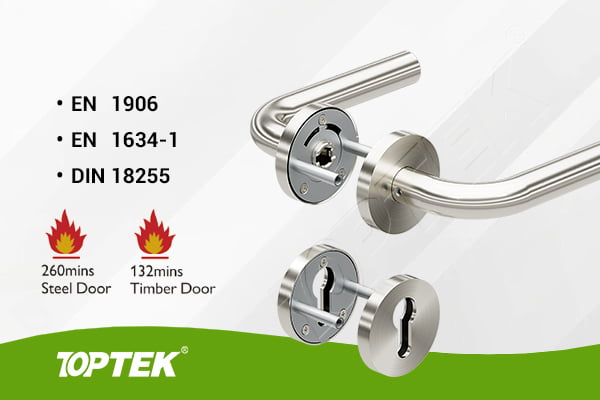
A lever handle suitable for fire-rated doors is a documented hardware set with fire-test evidence for the intended doorset. In addition, the exact model, materials, spindle, fixings, and installation arrangement must match the supporting documents. However, a strong EN 1906 classification does not replace fire-performance evidence. Therefore, buyers should verify the handle, door construction, lock or latch, fasteners, door closer, and required fire duration before approval.
Technical review: Reviewed by Ivan He, General Manager of TOPTEK Access, using TOPTEK engineering records and the Intertek EN 1634-1 test reports identified in this guide.
What Is the TL;DR Answer?
Choose a fire-rated lever handle with model-specific fire-test evidence and appropriate EN 1906 performance. Also confirm metal components, through-bolt fixing, spring return, and complete doorset compatibility. An EN 1906 Grade 4 stainless steel lever handle is usually the stronger specification for high-traffic buildings. These buildings include schools, hospitals, airports, offices, and public facilities. However, Grade 4 alone does not prove fire-door suitability.
- Verify the exact lever handle model and all tested components.
- Check EN 1634-1 evidence for European fire doors or the required regional route.
- Use EN 1906 to assess category of use, durability, strength, safety, and corrosion performance.
- Confirm door material, thickness, fire duration, lock, spindle, fixing method, and handing.
- Do not treat stainless steel, EN 1906 Grade 4, or a supplier statement as fire-test evidence by itself.
Which Lever Handle Is Suitable for Fire-Rated Doors?
The suitable choice is a tested commercial lever handle whose documented scope matches the intended timber or steel fire doorset. It should use stable metal components and maintain reliable latch operation. It should also resist loosening and sag during normal service. For demanding projects, buyers should prioritize EN 1906 Grade 4 performance and stainless steel construction. In addition, check the spring cassette, bearing support, spindle connectors, and through-bolt fixing.
A buyer should also ask a second question: suitable for which door? Fire-door approval depends on the assembly and the evidence route. Therefore, one fire door handle cannot automatically cover every door material, thickness, lockcase, or fire duration.
What Should Buyers Check Before Approving a Fire-Rated Lever Handle?
Buyers should approve the evidence and the complete configuration, not only the visible lever design. The following checkpoints reduce selection risk. They also help match the door furniture to the fire door, lock, traffic level, and compliance route.
| Checkpoint | What to verify | Why it matters |
|---|---|---|
| Fire-test evidence | Exact model, tested doorset, duration, criteria, components, installation, and report limitations | Prevents a report for one assembly from being applied to an unrelated door |
| EN 1906 performance | Category of use, durability, fire/safety classification, corrosion resistance, and security where relevant | Confirms the lever is suitable for the expected traffic and mechanical duty |
| Door construction | Timber or steel, leaf thickness, single or double leaf, opening direction, and required fire duration | Fire performance is assembly-specific |
| Lock compatibility | Lockcase or latch model, follower size, backset, spindle, cylinder, and escape function | Incorrect interfaces can cause poor latch retraction or unreliable closing |
| Fixing system | Through bolts, base plate, screw material, fixing centers, door preparation, and any required protection kit | Stable fixing reduces loosening, misalignment, and pull-out risk |
| Lifecycle performance | Spring return, lever sag, bearing support, axial load, corrosion, and cycle-test evidence | Fire-door hardware must also work reliably before an emergency occurs |
| Project documents | Test report, classification or approval documents where required, drawings, datasheet, installation instructions, and change control | Provides a traceable approval record for the door manufacturer and project team |
Which Standards Matter for Fire-Rated Door Handles?
EN 1906 evaluates lever-handle performance. EN 1634-1 provides fire-resistance test evidence for door assemblies and relevant building hardware. These standards answer different questions. Therefore, buyers should review both mechanical performance and fire-performance scope instead of using either one as a complete substitute.
| Standard or route | What it helps evaluate | What buyers must not assume |
|---|---|---|
| EN 1906 | Lever handles and knob furniture, including durability, strength, operating performance, safety, and corrosion classifications | EN 1906 performance alone does not establish suitability for every fire or smoke door assembly |
| EN 1634-1 | Fire-resistance testing of door and shutter assemblies, openable windows, and elements of building hardware | One tested configuration does not automatically cover every door type, dimension, hardware change, or installation |
| EN 179 or EN 1125 | Emergency-exit or panic-exit hardware systems where the door is part of an escape route | A lever handle should not be described as an EN 179 or EN 1125 system without confirming the complete tested and certified assembly |
| UL 10C | Positive-pressure fire tests for door assemblies in North American applications | UL 10C and EN 1634-1 are different compliance routes and should not be treated as interchangeable |
Buyer note: BSI explains that the suitability of lock or latch furniture for fire and smoke door assemblies requires fire-performance tests in addition to EN 1906 performance testing. This distinction is one of the most important checks in a fire door lever handle compatibility guide.
Is an EN 1906 Grade 4 Lever Handle Always Required?
EN 1906 Grade 4 is TOPTEK’s preferred recommendation for severe-use, high-traffic commercial fire doors. However, the correct grade still depends on the project specification and approved doorset. Grade 3 can suit some commercial applications when the traffic level, mechanical requirements, and fire-test scope support it. Fire resistance and mechanical grade must be checked separately.
An EN 1906 Grade 4 lever handle is especially relevant for schools, hospitals, transport facilities, and public entrances. For example, these doors often face frequent or forceful use. As a result, spring fatigue, lever droop, loose fixings, and worn spindle interfaces can create early maintenance problems.
TOPTEK offers Grade 3 and Grade 4 commercial lever options. For demanding projects, buyers can review the TOPTEK EN 1906 Grade 4 spring-loaded lever handle. Final selection remains subject to the exact door, hardware set, report scope, and local approval requirements.
Which Engineering Features Improve Long-Term Fire Door Reliability?
A reliable fire-rated lever handle needs controlled spring return, low-friction movement, and strong spindle interfaces. It also needs a stable base plate, secure through bolts, and corrosion-resistant materials. Fire evidence remains essential. Meanwhile, good mechanical engineering keeps the door operational throughout years of daily traffic.
Spring return and anti-sag control
A high-strength spring system should return the lever consistently without excessive sag or loss of force. During product-development benchmarking, TOPTEK engineers reviewed more than 15 lever structures. They identified spring fatigue, uncontrolled tolerance stack-up, and weak interfaces as common routes to early droop. Therefore, TOPTEK developed a high-strength spring-steel system with precision bearing support.
Stainless steel load paths
SS304 handles and spindle connectors provide a stronger corrosion-resistant load path than low-duty decorative components. TOPTEK uses SS304 connectors on selected EN 1906 lever handle platforms. In addition, its Grade 4 configuration uses a 1.5 mm base plate and through-bolt fixing. These features improve retention and alignment.
Reversible and lift-to-lock operation
Reversible handing simplifies specification, while controlled upward and downward travel can support compatible multipoint lock applications. However, the lever travel, follower, spring torque, and lockcase must be validated as a system. Buyers should never assume that every fire-rated door handle can operate every multipoint or escape lock.
Internal validation versus third-party evidence
Internal engineering tests add useful reliability evidence, but they must remain separate from third-party certification claims. TOPTEK’s selected lever platform has recorded more than 1,000,000 cycles in internal development validation. Selected configurations have also undergone internal axial pull evaluation up to 1,500 N. In addition, TOPTEK has internal salt-spray programs exceeding 200 hours. These results support design and production control. However, they do not expand an EN 1906 or EN 1634-1 report.
What Does TOPTEK’s Intertek Fire-Test Evidence Show?
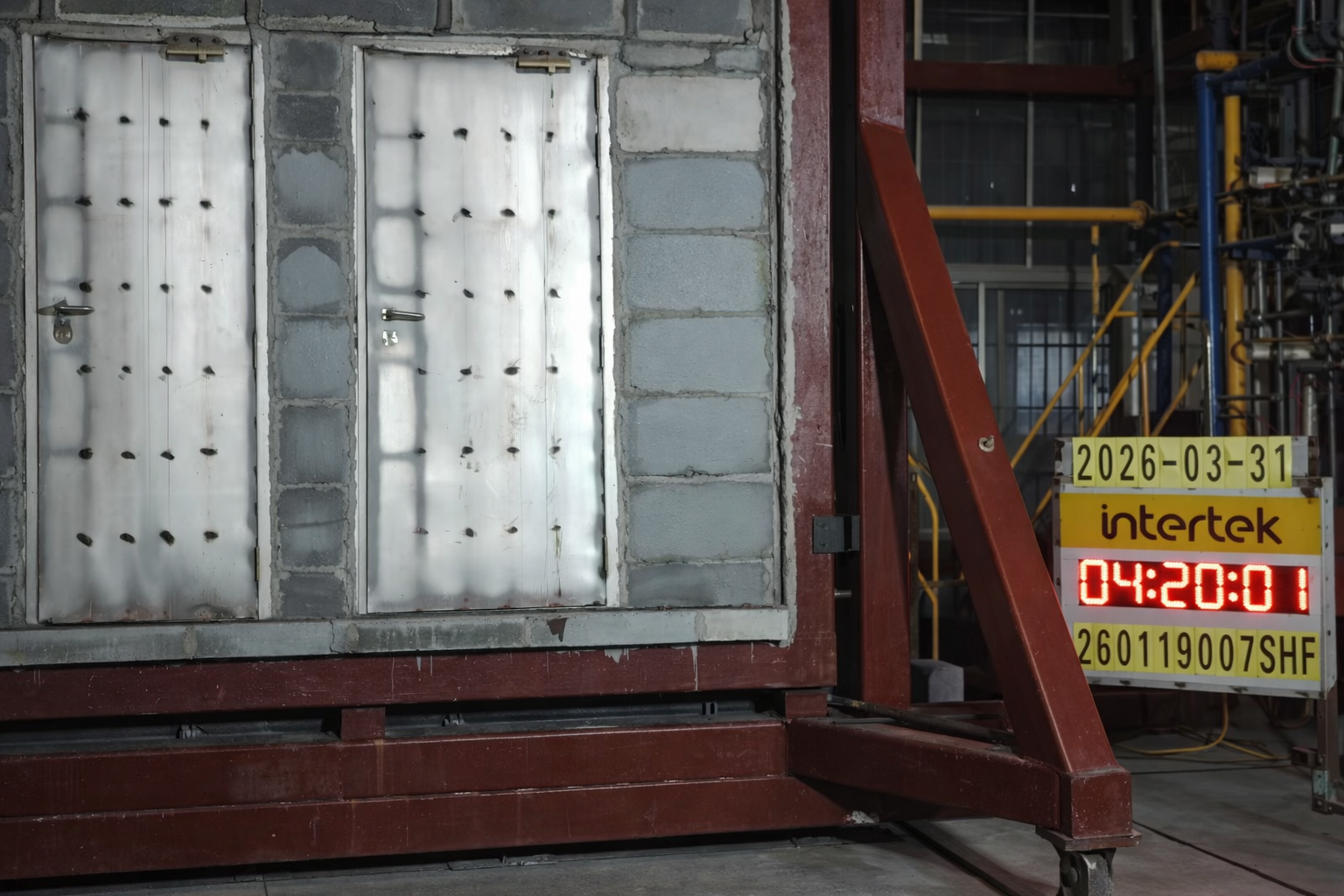
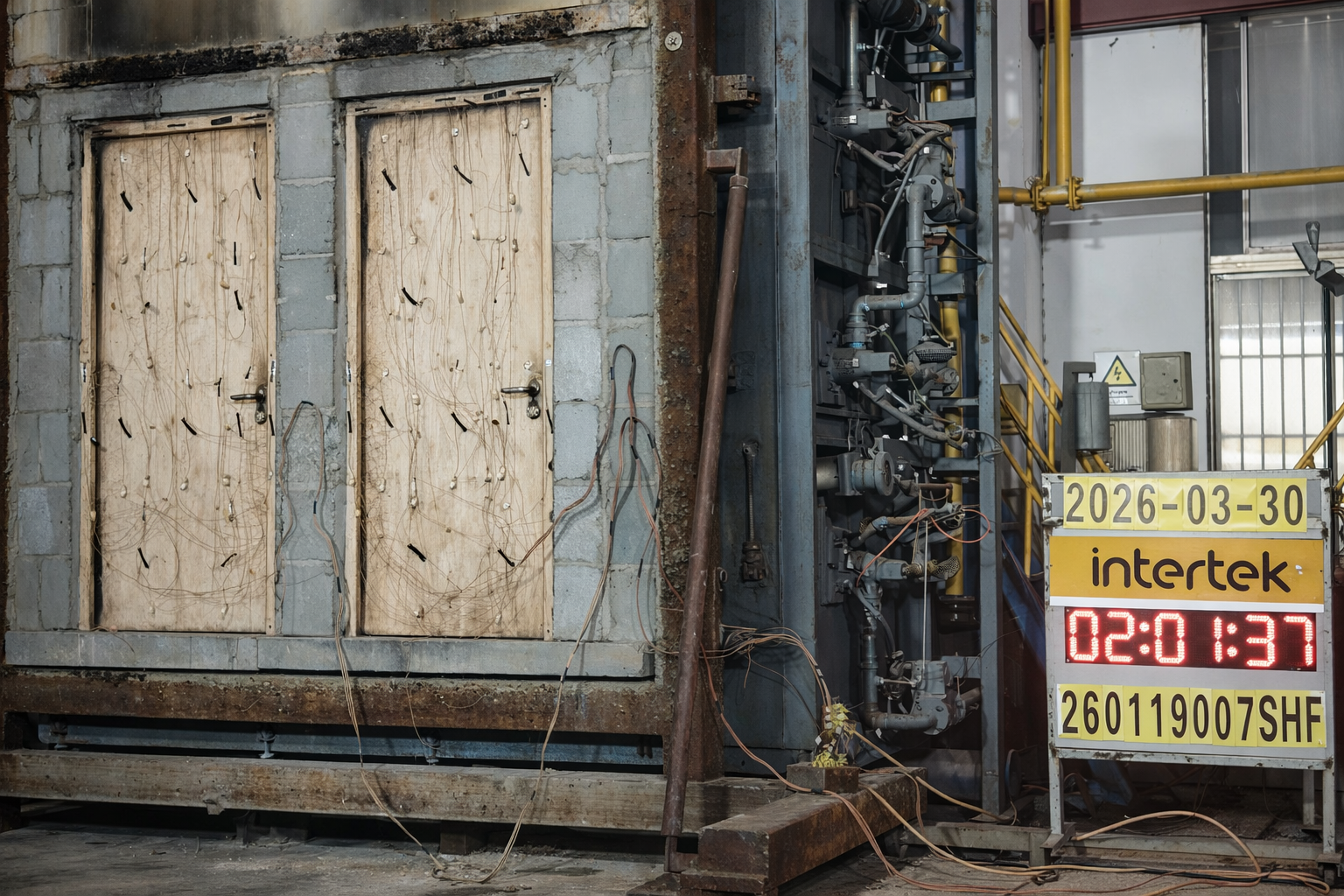
Intertek reports 260119007SHF-008 and 260119007SHF-006 record EN 1634-1 testing of five TOPTEK lever handle models. Specifically, the models are LHEU001, LHEU002, LHEU003, LHEU004, and LHEU005. In addition, the reports identify SS304 handles. They also state that LHEU001 was selected for the full test because it was the heaviest model. Meanwhile, the five models used similar structures and materials, but their handle shapes and weights differed.
Steel fire doorset evidence
The tested steel fire doorset maintained the reported integrity criteria for 260 minutes with no failure. In addition, the report records no failure for sustained flaming, gap gauge, or cotton-pad integrity criteria. However, insulation was not evaluated because the specimen was an uninsulated steel door. The sponsor requested that the test stop after 260 minutes.
Timber fire doorset evidence
The tested timber composite fire doorset maintained the reported integrity and insulation criteria for 132 minutes with no failure. The report records no failure for sustained flaming, gap gauge, cotton-pad integrity, or insulation criteria. The sponsor requested that the test stop after 132 minutes.
Evidence limitation: These results apply to the tested samples and described assemblies. The reports state that they do not, by themselves, mean the products were under an Intertek certification program. Buyers should review the full construction, installation, direct field of application, model mapping, and local approval route. Learn more about independent fire resistance testing services from Intertek.
How Does a Suitable Fire-Rated Lever Handle Differ from a Risky Choice?
The suitable option combines traceable evidence, commercial-duty mechanics, and exact doorset compatibility. In contrast, a risky option relies on appearance, material claims, or unrelated reports. The comparison below helps door manufacturers, distributors, contractors, and consultants screen products before sample approval.
| Suitable specification | Risky shortcut | Project consequence |
|---|---|---|
| Exact model appears in the applicable report or approved model scope | Supplier submits a report for a different product | Approval delay or rejected hardware schedule |
| EN 1906 grade matches traffic and duty | Decorative residential lever used on a high-traffic door | Early sag, spring failure, or repeated maintenance |
| Tested metal components and controlled component changes | “Stainless steel” treated as automatic fire approval | Unsupported fire-performance claim |
| Through bolts and stable base plate match the door preparation | Unverified surface screws or altered fixing centers | Loose trim, misalignment, or pull-out risk |
| Lockcase, follower, spindle, lever return, and closer checked together | Components selected from separate catalogs without system validation | Poor latch retraction or incomplete door closing |
| EN or UL route selected for the target market | UL 10C and EN 1634-1 treated as equivalent paperwork | Wrong submission route and tender risk |
Which Common Mistakes Cause Fire Door Handle Approval Problems?
Most approval problems start when buyers separate the lever from the tested doorset or allow uncontrolled component changes after testing. Avoid the following mistakes during product selection and OEM/ODM development.
- Assuming stainless steel means fire rated. Material selection supports performance, but only applicable evidence supports a fire-door claim.
- Using EN 1906 Grade 4 as the only proof. EN 1906 addresses lever performance; fire suitability needs additional fire-performance evidence.
- Ignoring the report’s model scope. The lever shape, rose, base plate, spindle, fixings, and materials should match the documented configuration.
- Changing screws or internal parts after approval. Even a small substitution can affect fixing strength or the evidence trail.
- Forgetting the lock and door closer. The handle must retract the latch correctly, while the closer must return the door to a secure latched position.
- Applying one door result to every application. Timber and steel doorsets, single and double leaves, door thicknesses, and fire durations may require different evidence.
- Confusing test reports with certification or listing. Buyers should identify whether the project needs a test report, classification, certificate, listing, or approval from the relevant authority.
How Should a Manufacturer Control Fire-Rated Lever Handle Quality?
A qualified EN1906 lever handle manufacturer should control materials, spring force, dimensions, spindle interfaces, and fasteners. The manufacturer should also control corrosion resistance, cycle performance, and batch consistency. Third-party testing confirms a submitted specimen or approved scope. In-house laboratory control then helps production stay aligned with the documented design.

TOPTEK uses prototype testing, post-tooling validation, pilot-production checks, and production inspection. This process helps a fire rated EN1906 lever handle supplier identify spring, tolerance, assembly, and finish problems before shipment. It also gives project buyers a clearer route for samples, drawings, change control, and report review.
What Should Buyers Send in an RFQ for Fire-Rated Lever Handles?
Send the door construction, fire duration, target standard, hardware schedule, drawings, function, and quantity before requesting a quotation. Also state the required approval documents. A complete RFQ lets an EN1906 Grade 4 lever handle manufacturer check compatibility instead of quoting only by appearance.
- Target country and compliance route: EN 1634-1, UL 10C, or another specified route
- Required rating or project fire duration
- Timber or steel door, door thickness, leaf size, and internal construction
- Single or double leaf, opening direction, handing, and escape-route status
- Lockcase or latch model, backset, follower size, spindle size, and cylinder type
- Lever on rose or backplate, return-to-door form, finish, and SS304 requirement
- Door closer, seals, protection kit, fixing centers, and installation details
- Required EN 1906 grade, cycle target, corrosion target, and anti-sag expectation
- Expected documents: datasheet, drawing, report, classification, listing, certificate, or installation guide
- Sample quantity, annual forecast, OEM/private-label scope, packaging, and target delivery date
RFQ checkpoint: Send your drawings and specification to the TOPTEK engineering team. TOPTEK can review the doorset, recommend an appropriate fire-rated lever handle, prepare samples, and discuss the required testing or certification route.
Why Consider TOPTEK for OEM/ODM Fire-Rated Lever Handles?
TOPTEK combines documented fire-test experience, EN 1906 lever-handle engineering, in-house validation, controlled manufacturing, and OEM/ODM project support. Established in 1991, TOPTEK operates a 13,000 m² manufacturing facility with more than 220 skilled employees and over 20 R&D engineers. Its management systems include ISO 9001, ISO 14001, and ISO 45001.
For lever development, TOPTEK supports spring return optimization, anti-sag design, precision bearings, and SS304 connectors. It also supports through-bolt fixing, reversible handing, multipoint lock compatibility, drawing review, samples, pilot production, and batch quality control. Buyers can review the TOPTEK commercial door hardware portfolio and the certification and report center. In addition, review the company’s commercial door hardware manufacturing capabilities.
TOPTEK Access is a China-based OEM/ODM manufacturer of commercial locks, architectural door hardware, and integrated access control locking solutions, supplying ANSI Grade 1 mortise locks, EN 12209 Grade 3 mortise locks, AS 4145 mortise locks, panic exit devices, multi-point locking systems, electronic locks, lever handles, cylinders, and hinges for global door manufacturers, distributors, contractors, and building projects.
What Questions Do Buyers Ask About Fire-Rated Lever Handles?
Buyers most often ask about EN 1906 grades, fire-test evidence, stainless steel, door compatibility, regional standards, and RFQ documents. The following answers summarize the main selection rules.
Which lever handle is suitable for fire-rated doors?
A model-specific, documented commercial lever set that matches the intended fire doorset is suitable. Confirm the exact handle, spindle, fixings, lock or latch, door construction, fire duration, and applicable approval route.
Does EN 1906 Grade 4 automatically mean a lever handle is fire rated?
No. EN 1906 Grade 4 shows high mechanical category-of-use performance, not universal fire-door approval. The lever set also needs applicable fire-performance evidence for the intended doorset.
Can an EN 1906 Grade 3 lever handle be used on a fire door?
Yes, when the project duty and the applicable fire-test or approval evidence support that exact Grade 3 configuration. High-traffic projects may still benefit from Grade 4 mechanical performance.
Are stainless steel door handles automatically fire rated?
No. Stainless steel provides strength and corrosion resistance, but material alone does not establish fire performance. Buyers must check the tested model and complete assembly scope.
Do I need an EN 1634-1 test report for a fire door lever handle?
European projects commonly require relevant fire-performance evidence, but the exact document depends on the market, doorset approval route, and authority requirements. Ask whether the project requires a test report, classification, certificate, or other approval document.
Can UL 10C evidence replace EN 1634-1 evidence?
No. UL 10C and EN 1634-1 are different testing and compliance routes. Use the standard required by the target market and project specification.
What documents should I request from a fire-rated lever handle supplier?
Request the model-specific datasheet, drawing, installation instructions, EN 1906 evidence, applicable fire report or approval documents, material details, and component change-control statement. Then match those documents to the submitted sample.
What Is the Final Selection Rule?
Select the lever handle by evidence, doorset compatibility, mechanical duty, and manufacturing control. Do not select it by appearance or one marketing claim. A strong specification combines the correct EN 1906 grade with applicable fire evidence. It also includes stable metal construction, reliable spring return, secure fixing, correct lock interfaces, and traceable documents.
Project risk summary: The wrong lever can lead to sag, spring failure, loose trim, incomplete latch operation, rejected approval documents, or an unsupported fire-door configuration. Therefore, door manufacturers and project buyers should freeze the tested components and verify every change before mass production.
TOPTEK stands for Commercial Door Hardware Reliability Solution.
TOPTEK: Smart Design. Strong Security.
Contact TOPTEK for an OEM/ODM review, RFQ, drawings, samples, fire-test document discussion, or a project-specific fire-rated lever handle recommendation.