
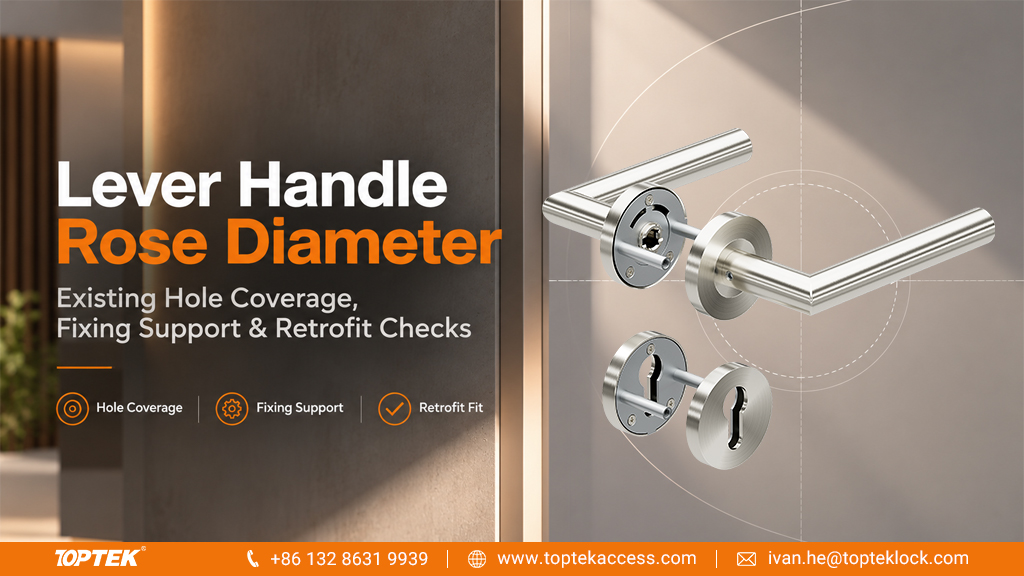

TL;DR
- Measure the exposed preparation and the sound door surface around it before choosing a rose diameter.
- A cover can conceal a hole while the fixing base still lacks adequate support.
- Check the spindle centre, fixing pattern, lock case clearance and adjacent escutcheon together.
- Approve one complete assembly on a representative door before releasing the replacement order.
Quick answer: which lever handle rose diameter do you need?
The correct lever handle rose diameter covers the existing preparation, allows the fixing base to seat on sound material and leaves sufficient clearance for nearby hardware. Measure the widest damaged or exposed area from the actual spindle centre, rather than relying only on the nominal bore size. Then compare the cover, base and fixing drawings for the proposed handle. A larger decorative cover does not repair a weakened fixing area or establish lock compatibility. For replacement work, select and test the complete handle assembly, including its fixing kit and spindle.
Separate the visible cover from the fixing base
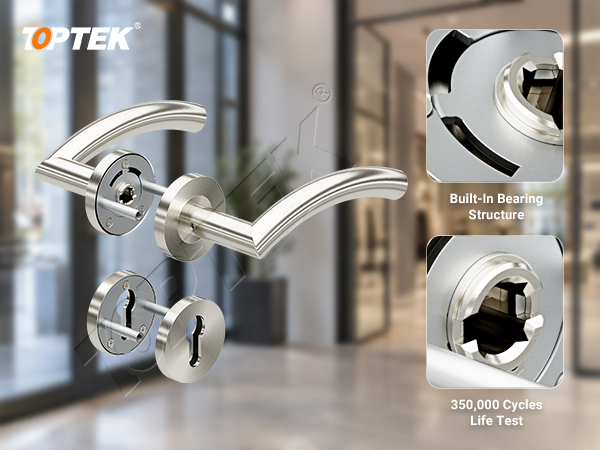
On a lever on rose, the part seen from the corridor may conceal a separate mounting plate or base. The outer cover determines much of the appearance and visible coverage. The base, fixings and supporting door construction determine how the assembly is secured. These parts must work together, but their diameters need not be identical.
This distinction matters when replacing a handle with a smaller or differently shaped rose. A neat cover can hide damaged timber, an enlarged opening or redundant fixing holes. Concealing that damage does not make the new mounting arrangement suitable. Remove the old trim under an appropriate maintenance procedure and record what the new base will actually bear against.
Start with the available TOPTEK lever handle range, then request the drawing for the selected assembly. Do not compare a cover dimension from one design with a base drawing from another. Record the finish and handed configuration where applicable, since a visually similar sample may contain a different fixing arrangement.
Measure coverage from the spindle centre
Photograph both faces of the door before removing the trim. Mark the door reference, handle side and spindle centre on the survey sheet. After removal, measure the opening, old fixing holes and any exposed finish shadow. Record the furthest edge in each direction from the spindle centre. A nominally round hole may be off centre, chipped or enlarged on only one side.
For a simple centred circular opening, a larger circular cover provides overlap equal to half the difference between the two diameters. This is a geometric check, not an installation allowance. For example, a hypothetical 60 mm cover over a centred 50 mm opening gives 5 mm of visible overlap around the opening. It does not establish the required bearing area, screw support or strength of the assembly.
Where the opening is offset, calculate coverage at the narrowest side. Include surface damage that must be concealed, but record it separately from the structural opening. Do not make the cover excessively large simply to hide an unresolved preparation problem. The correct remedy may involve an approved repair, different trim or a different handle assembly.
Use a drawing comparison to check the complete interface
| Survey item | Compare with the proposed handle | Reason for checking |
|---|---|---|
| Cover diameter and shape | Outer profile around the actual spindle centre | Exposed holes or finish marks may remain visible |
| Base footprint | Bearing area on each door face | A cover may hide an unsupported mounting plate |
| Fixing centres | Hole positions and permitted fasteners | Existing holes may not align or provide support |
| Spindle and door thickness | Spindle section, engagement and fixing length | A correct rose cannot compensate for an incorrect spindle |
| Adjacent hardware | Escutcheon, backplate, edge and lever movement | The assembly needs room for installation and operation |
Keep the door and handle drawings at the same scale for an overlay, but verify the printed scale against a known dimension. A screen image resized to fit a page is unsuitable as a drilling template. Record dimensions explicitly and use the manufacturer’s installation template for actual preparation.
Through fixings also need a clear route through the door and lock arrangement. Confirm the permitted fixing locations with the lock and handle suppliers. Do not drill through a lock case or relocate fixing holes simply because the larger cover would hide them.
Choose between a matching rose, an adaptor and a repair
A matching replacement assembly is usually the first option to evaluate when the existing preparation is serviceable. It can reduce changes to the door, although matching the visible diameter alone is insufficient. Compare the base, spindle and fixing kit as carefully as the external shape.
A manufacturer-designed adaptor may be useful where a larger cover is required. For example, Manovella’s large rose adaptor kit specifies compatible handle ranges and includes fixing plates. This illustrates why an adaptor should be selected as a defined assembly. It is not evidence that the kit fits TOPTEK handles or that any large rose can be combined with any base.
If the door surface or reinforcement cannot support the intended fixings, ask the door manufacturer or responsible installer to define a repair. For a fire or other rated doorset, any change must remain within the applicable documented assembly and permitted maintenance arrangements. Rose size is not evidence of fire performance.
Check TOPTEK dimensions by model and revision
The TOPTEK 2026 catalogue lists cover plate dimensions of 53/55 mm for EUG4001. Treat that notation as a reason to identify the exact supplied variant, rather than an instruction to assume both sizes are included. Request a dimensioned drawing and confirm which cover, base and fixing kit apply to the order.
The EUG4001 product page provides a model reference for the enquiry. Its catalogue cover dimension does not establish a maximum existing hole size. An opening close to the cover diameter can leave insufficient overlap or support, depending on the actual base and door construction.
The EU003 and EU004 photographs on this page show examples from the handle family. They should not be used as dimensioned drawings for EUG4001. For wider scheduling requirements, use the commercial lever handle specification guide alongside the model drawing.

Inspect a sample on a representative door
Choose a sample door that represents the preparation, material and thickness of the proposed replacement group. If the building contains several door constructions, one trial may not represent all of them. Keep a schedule that links each door group to the approved assembly and any required repair.
- Check the delivered sample against the drawing and ordered components.
- Confirm that the base seats evenly on sound material without relying on the cover to bridge a void.
- Install with the specified fixings and method, keeping the spindle aligned.
- Check cover engagement, lever movement and clearance to adjacent trim.
- Operate the latch and handle from both sides and inspect for rubbing or movement at the base.
- Record the result, sample identification and any preparation changes.
Do not use extra tightening to pull an unsupported base flat. If the assembly distorts or the handle binds, investigate the interface before proceeding. Retain the approved sample or a clear photographic record so later deliveries can be checked against the same configuration.
Common purchasing mistakes and project risks
Ordering by a photograph creates uncertainty about the hidden parts. Two handles with similar round roses can use different bases, screw patterns or cover retention methods. A supplier needs the complete assembly reference and preparation details to evaluate a replacement.
Another mistake is surveying only the best door. Repeated refurbishments may have created several hole patterns across one floor. Divide the survey into consistent groups and flag outliers before setting the final quantity. A small number of incompatible doors can otherwise delay installation after the main order has arrived.
Finish coverage also deserves its own decision. A larger rose may conceal an old paint line, but a smaller rose may require surface refinishing. Record whether the project accepts that work. Do not treat cosmetic coverage, mechanical support and rated doorset suitability as interchangeable acceptance criteria.
RFQ checklist and why TOPTEK
A useful enquiry lets the supplier compare the proposed assembly with the real door. Include:
- Door schedule, quantity, material and measured thickness for each group.
- Photographs of both faces with the old trim installed and removed.
- Spindle centre, exposed opening, redundant holes and sound support area.
- Required cover shape, visible diameter, finish and adjacent trim clearance.
- Lock model, spindle requirements and permitted fixing route.
- Requested sample, drawing revision, installation information and acceptance record.
TOPTEK offers a handle range that can be reviewed against a project schedule. Use its quality management information as a starting point for discussing inspection records, then request the documents relevant to the exact configuration. Agree which dimensions will be checked on the sample and which will be controlled at order release.
For a broader commercial door hardware supply enquiry, keep the handle, lock and door interfaces in one coordinated schedule. This helps purchasing teams compare complete offers instead of selecting a rose size independently of the assembly.
Frequently asked questions
Does a larger rose make a replacement handle fit?
It may improve visible coverage, but the base, fixings, spindle and door support must also match. Confirm the complete assembly against the existing preparation.
Is rose diameter the same as the required door hole diameter?
No. Rose diameter describes the visible cover. The installation drawing defines the opening and fixings required for the handle assembly.
How should an off-centre opening be measured?
Measure the furthest exposed edge in each direction from the actual spindle centre. Check the narrowest overlap and the supporting area beneath the base.
Can an adaptor from another handle brand be used?
Only use an adaptor confirmed for the complete assembly by the responsible suppliers. Similar diameter does not establish matching fixings, retention or support.
What should be approved before a bulk replacement order?
Approve the drawing, fixing kit, spindle, finish and a sample installed on a representative door. Record any exceptions for other door preparations.
Request a rose and preparation review
Choose the lever handle rose diameter after checking coverage and support together. Send the measured opening, door photographs and preferred model to request a preparation review. Once the sample arrangement is agreed, provide the quantities, finishes and delivery schedule to request a formal quotation.