

TL;DR
- Define the obstruction and required opening angle before choosing a wider hinge.
- Record finished door thickness, hinge backset and the manufacturer’s clearance reference.
- Check the complete swing path, including the handle, closer and any door power transfer.
- Confirm hinge support, fixing preparation and available model separately from clearance geometry.
- Use a representative installation to verify the final opening condition.
Quick Answer
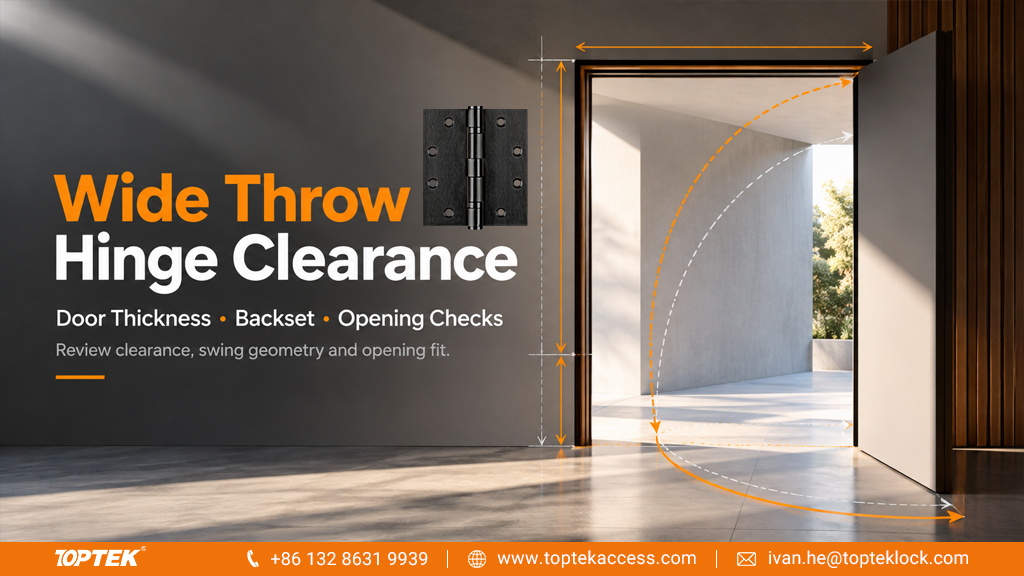
Wide throw hinge clearance depends on the door thickness, hinge location, open hinge width and the obstruction the door must pass. Start with a plan view of the finished door and frame, mark the required opening angle, and compare the selected hinge’s geometry with the casing, wall or trim. A wider hinge is not an automatic solution: its preparation, bearing arrangement, support and associated hardware must also suit the opening. Confirm the manufacturer’s dimensional convention and verify the complete swing path before ordering or modifying the door.
This guide is for commercial door buyers reviewing an opening that needs additional clearance around projecting trim. The TOPTEK hinges and door power transfer range provides product references for a dimensional enquiry. Ask for confirmation of the required geometry and available configuration before specifying a wide throw option.
Define the clearance problem precisely
Start by identifying what actually collides. The door edge, rear face, handle, closer arm and protection plate follow different paths as the door opens. Increasing hinge width may change one relationship without resolving another. A photograph of a partly open door rarely provides enough information to choose the replacement hinge.
Measure the projecting casing or other obstruction from a clearly marked frame or wall reference. Record its depth and location along the door height. State the required opening angle and why it is needed, such as furniture movement or access to adjacent equipment. Do not describe the requirement only as “open wider,” because that leaves the acceptance condition undefined.
Keep clearance around trim separate from the usable passage through the opening. A door that clears its casing may still occupy part of the required passage. If a project has an accessibility or egress requirement, have the responsible designer verify the finished opening against the applicable rules and approved door arrangement.
Read height, open width and backset from the drawing
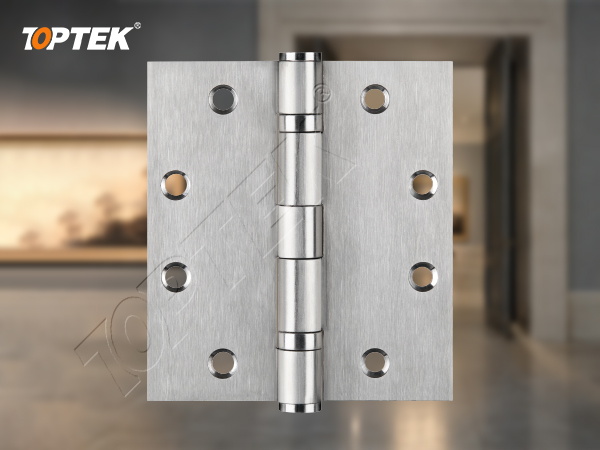
Hinge height runs along the pin axis. Open width is measured across the opened hinge according to the manufacturer’s drawing. Hinge backset locates the leaf relative to the door edge or face defined on that drawing. Do not confuse this dimension with the lock backset measured to a spindle or cylinder centre.
Request a dimensioned section showing the pin axis, door faces, frame preparation and leaf position. Where a supplier uses lettered dimensions, confirm what each letter represents rather than transferring labels from another catalogue. A familiar pair of numbers can still be misread if one party is discussing an individual leaf and another is discussing overall open width.
| Input | What to record | Why it matters |
|---|---|---|
| Door thickness | Finished thickness at the hinge edge | Sets the door geometry around the pivot axis |
| Hinge backset | Dimension and reference face on the drawing | Locates the leaf and pin relative to the door |
| Obstruction | Projection, position and finished surface | Defines what the swinging door must clear |
| Opening angle | Required and physically permitted positions | Defines the swing path to evaluate |
| Hinge dimensions | Height, open width, thickness and hole pattern | Connects clearance to a purchasable part |
Use a manufacturer’s calculation within its scope
Hager’s commercial hinge selection catalogue uses door thickness, hinge backset and required clearance to determine minimum width for the full-mortise arrangement it describes. Its method is twice the door thickness minus twice the hinge backset, plus the required clearance. The same guidance describes a full-mortise hinge with open width greater than height as a wide throw hinge.
Use the manufacturer’s drawing to understand the clearance reference and installation assumptions before applying that calculation. It is a selection method for the illustrated geometry, not a universal formula for every hinge, frame or opening angle. A calculated width also does not prove load suitability or establish that a corresponding TOPTEK model is available.
For project review, attach the marked-up section and ask the proposed supplier to confirm the required width. Retain the original units throughout the calculation or convert all dimensions consistently. Do not round down to a convenient stock size; obtain confirmation of the selected product and check its actual installed geometry.
Trace the whole swing path and adjacent hardware
A plan view should show more than the door in its fully open position. Intermediate positions may reveal contact that is hidden when only the closed and final positions are compared. Include the door thickness and projecting hardware in the outline. Check both the proposed opening angle and any movement allowed by the stop.
Review the closer mounting and arm path with the closer supplier when the hinge geometry changes. A previously approved mounting arrangement may not accommodate the new relationship between door and frame. Likewise, review a floor or wall stop’s contact point so the door is stopped by the intended component rather than by a handle striking an adjacent surface.
Where wiring crosses the opening, check the door power transfer separately. A mechanical wide throw hinge does not establish a suitable cable route. Verify the selected transfer device’s geometry and permitted movement with the responsible supplier. The hinge and door power transfer guide provides broader context for coordinating these parts.
Review preparation and support before substitution
A wider leaf may require different door or frame preparation. Compare the proposed leaf outline, thickness and fixing centres with the existing recess and reinforcement. Do not assume that the old holes can be reused or that a larger recess can be cut without affecting the door construction.
Include door weight, width, usage and attached hardware in the hinge selection request. Clearance geometry does not replace the manufacturer’s support assessment. A hinge with the desired width may belong to a different bearing or thickness configuration, and the intended door and frame must be able to support its fixings.
For a rated or otherwise controlled doorset, obtain the relevant manufacturer’s approval before changing hinge type or machining the preparation. Keep the exact assembly and applicable evidence together. A generic product image or a standard mentioned in a catalogue is not sufficient evidence that the proposed alteration is permitted.
TOPTEK product scope and dimensional evidence
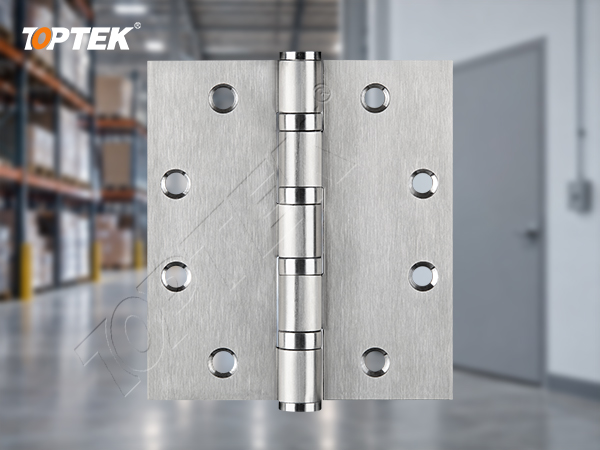
TOPTEK’s catalogue includes mechanical full-mortise hinges in 2BB and 4BB configurations, alongside separate electrical hinge products. These references help buyers identify the family to discuss. The photographs here show the mechanical range; they should not be read as confirmation that a wide throw variant has been selected for the project.
The full mortise 4BB product reference is a starting point for requesting a drawing. Ask for the exact height, open width, thickness, hole pattern and bearing configuration. If the opening requires a dimension outside the documented range, obtain an explicit availability and suitability response before adding it to the order.
Common mistakes and the sample acceptance check
One common mistake is selecting by hinge height while overlooking open width. Another is measuring unfinished trim and discovering that the final casing projects farther. A third is approving the door leaf’s clearance without including the handle or closer. These errors are easier to catch on a coordinated drawing than after a batch of doors has been machined.
- Confirm the final frame, casing, wall finish and door construction.
- Compare the installed hinge with the approved part and drawing.
- Observe movement through the whole required opening range.
- Check the door, handle, closer and stop for unintended contact.
- Verify closing and latching after the final installation adjustments.
- Record the accepted angle, measured clearance and any project exceptions.
Use a representative sample with the actual surrounding trim. Where the project has several frame depths or wall conditions, identify which sample covers each condition. A successful trial at one opening cannot automatically approve all the others.
RFQ checklist and Why TOPTEK
Send a plan section, door elevation, finished thickness, door size and weight, frame construction, obstruction measurements and required opening angle. Add the proposed hinge height and width, existing preparation, finish, quantity and required documentation. State whether the enquiry is for a new opening or a replacement on an existing door.
TOPTEK’s mechanical hinge and door power transfer range gives buyers a common place to organize related component enquiries. The value of that discussion depends on keeping each component’s requirements explicit. Use the quality management information when requesting dimensional and sample inspection records; confirm the evidence supplied for the actual configuration.
For a wider commercial door hardware package, identify the lock, handle, closer and power transfer interfaces that the hinge decision affects. Ask the quotation to distinguish a documented standard option from any configuration that still requires a separate availability decision. This prevents a clearance requirement from becoming an unsupported product assumption.
Frequently asked questions
What is a wide throw hinge?
For the full-mortise convention described in Hager’s selection guide, it is a hinge whose open width exceeds its height. Confirm the selected manufacturer’s dimensions and terminology.
Does a wider hinge guarantee the required opening angle?
No. The door, frame, casing, handle, closer and stop can all limit movement. Evaluate the complete swing path and confirm it on the intended installation.
Is hinge backset the same as lock backset?
No. Hinge backset locates the hinge leaf relative to a defined door reference. Lock backset normally locates the lock’s operating centre relative to the door edge.
Can I replace a standard hinge with a wide throw hinge using the same preparation?
Only if the selected drawings and the door and frame requirements confirm compatibility. Check leaf dimensions, thickness, fixing pattern, reinforcement and any restrictions on alteration.
Do the TOPTEK images confirm a wide throw option?
No. They identify mechanical hinge families for enquiry. Obtain the exact model drawing and confirmation of the required configuration before specifying or ordering it.
Confirm the opening geometry before ordering
Start with the obstruction and the required movement, then select a hinge whose geometry and support requirements suit the complete opening. Keep the drawing, availability response and sample result together so purchasing and installation work from the same accepted condition.
Request a hinge geometry review: email the marked-up opening section to ivan.he@toptekaccess.com. For a formal quotation, include confirmed dimensions, quantities, finish, sample criteria and delivery destination.