
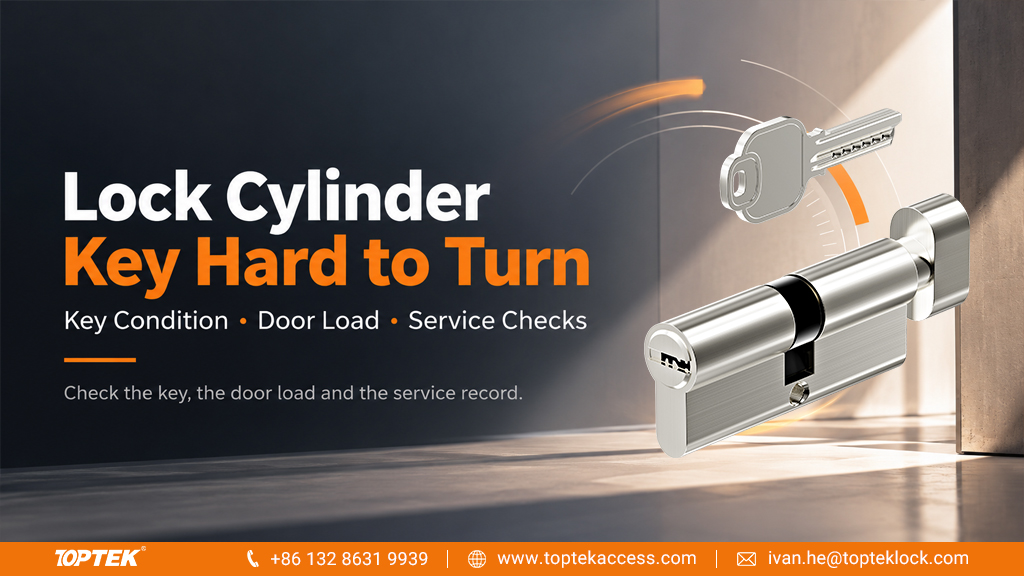

TL;DR
- Record whether the problem occurs during key insertion, initial rotation or lock movement.
- Compare an authorized service key with the affected key before condemning the cylinder.
- Have a qualified technician distinguish cylinder resistance from door and lock loading.
- Follow the exact cylinder manufacturer’s maintenance instructions; lubricant advice is not universal.
- Keep keying authority and mechanical replacement dimensions in separate, controlled records.
Quick Answer
When a lock cylinder key is hard to turn, stop applying extra force and identify where the resistance occurs. Check that the key is authorized for that cylinder and inspect it for visible damage. Record whether another authorized key behaves differently and whether the problem changes with the door position. These observations help a qualified locksmith distinguish a key or cylinder issue from resistance in the lock, strike or door assembly. Use only the maintenance product and procedure specified for the exact cylinder; persistent stiffness requires service rather than repeated force.
For building managers and commercial door buyers, the useful outcome is a service record that supports the right repair or replacement order. Start with identification through the TOPTEK construction cylinder range. A description such as “stiff lock” is too broad to establish the cylinder format, the failure point or the parts needed.
Describe the symptom before ordering a replacement
Ask the user to explain the sequence. Does the key enter fully? Is the first movement difficult? Does resistance appear only as the bolt moves? Can the key return to its normal withdrawal position? These are different observations and should remain separate on the service request. Avoid diagnosing an internal component from one brief video.
Record the door number, cylinder and lock model where known, the side used, and when the issue first appeared. Note recent painting, door adjustment, replacement keys, hardware installation or exposure to building dust. Describe these as possible context, not proven causes. A problem that started after a change deserves a review of that change, but timing alone does not establish responsibility.
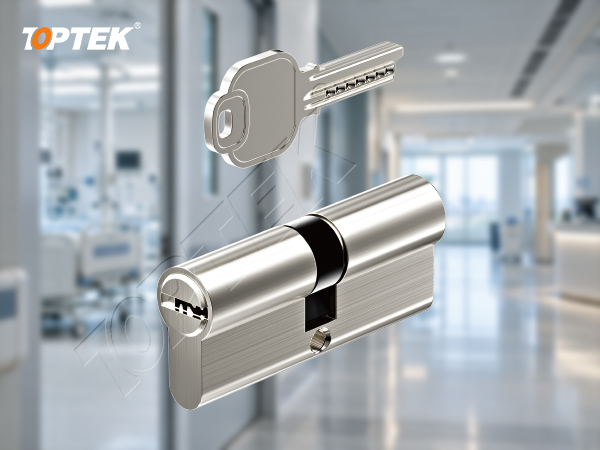
Check key identity and visible condition first
Confirm that the key belongs to the intended opening and that the user’s access authorization remains valid. A key entering a keyway does not prove that it should operate the cylinder. Keep the building’s key schedule under the control of its authorized custodian, particularly where similar keys serve different areas.
Look for a visibly bent blade, cracking, a damaged tip or debris on the key. Do not straighten, file or modify it as a trial repair. If the site has an authorized reference or spare key, a qualified service person can compare normal operation without forcing either key. One key working while another does not is useful evidence for a key review; it is not a complete assessment of cylinder condition.
Do not circulate close photographs of key cuts or key codes in an unrestricted supplier enquiry. Share model labels and non-sensitive opening information first, then use the owner’s approved channel for protected keying details. This keeps the maintenance process compatible with the building’s access-control policy.
Separate cylinder resistance from door and lock loading
The key operates a cylinder that, in turn, drives a lock mechanism. Resistance can therefore originate beyond the cylinder. A bolt meeting the edge of a strike opening, movement of the door relative to the frame, or an unsuitable cylinder-to-lock interface may change what the user feels at the key.
Where the opening can safely be taken out of service, a qualified technician should compare operation under the lock manufacturer’s permitted open-door and closed-door conditions. Do not close the door onto a projected bolt or defeat an exit function to perform this comparison. Observe the result rather than forcing the key while pushing or pulling the door.
| Observation | Useful next check | What it does not prove |
|---|---|---|
| One key is worse than another | Authorized key condition and origin | That the cylinder has no wear |
| Resistance changes with door position | Door alignment, strike and lock loading | That the cylinder must be replaced |
| Problem began after cylinder replacement | Exact cylinder, cam and installation details | That a longer cylinder will solve it |
| All authorized keys remain difficult | Cylinder and lock service assessment | Which internal part has failed |
Include the technician’s findings in the work order. A symptom that disappears during one trial can still require follow-up if the door condition, temperature or operating pattern changes. Record the conditions so a later inspection is comparable.
Use maintenance instructions for the exact cylinder
There is no universal lubricant instruction for every cylinder design. ASSA’s official lock spray guidance specifies its maintenance product and warns against several other lubricant types for the cylinders covered by that guidance. ABLOY separately publishes an official lock oil product. These manufacturer-specific references illustrate why a general recommendation to use any oil, graphite or spray is unsuitable.
For a TOPTEK cylinder, request the maintenance instruction for the exact model and environment. Confirm the product, application point and service interval before applying anything. Do not combine substances because an earlier application did not resolve the stiffness. Record what has already been used so the service provider can assess the next step.
Keep cleaning of the visible key and external surfaces separate from treatment inside the mechanism. Building dust, coating residue or moisture exposure should be reported to the technician. Do not probe the keyway, flood it with solvent or use heat as an improvised service method.
Review recent installation and replacement work
If stiffness began after a cylinder change, compare the supplied part with the approved order. Cylinder format, length, cam or tailpiece, retention method and lock interface all matter. A cylinder can appear correctly positioned at the door face while the drive component is unsuitable for the lock behind it.
Have the installer check the relevant fastening and installation instructions. Do not ask an occupant to loosen retaining parts while the door remains in normal use. The objective is to restore the specified assembly, not to find a temporary screw position that makes a symptom less noticeable.
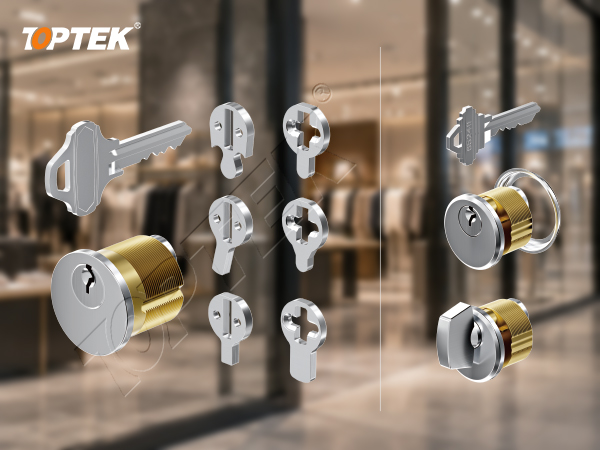
A mortise cylinder, Euro profile cylinder and interchangeable-core assembly require different identification details. Do not treat the illustrations as a compatibility chart. Include photographs of the installed furniture and product labels, then obtain the relevant assembly drawing through the authorized service process.
Decide between a key issue, service and replacement
A visibly damaged key needs an authorized replacement process. A maintenance issue needs the correct service procedure. A damaged or unsuitable cylinder may need replacement. These outcomes have different costs and lead times, so the service request should ask for an explanation supported by the observations, not simply a quantity of new cylinders.
If a key is trapped, bent during use or beginning to crack, stop repeated attempts and arrange qualified assistance. If the opening cannot provide its intended access or exit function, follow the site’s procedure for securing or taking it out of service. Keep the responsible building manager informed rather than leaving a partly functioning repair for the next shift.
Replacement must preserve the authorized keying plan or implement an expressly approved change. The project cylinders and master key systems guide helps structure that purchasing decision. Mechanical fit and access permissions should both appear in the acceptance record.
Build a service record that purchasing can use
A useful record separates reported symptoms, checks performed, confirmed findings and proposed action. For example, “door 214: reference key turns freely with the door open but resistance appears during bolt movement when closed” is more useful than “bad cylinder.” It describes an observation without assigning a cause before inspection.
- Identify the opening, lock and cylinder; attach non-sensitive photographs.
- Record which authorized keys were compared and how they behaved.
- State the door condition and the point in movement where resistance occurred.
- List recent work and maintenance substances already applied.
- Describe the confirmed repair or replacement requirement.
- Record the final operating checks and the person responsible for handover.
For multiple affected doors, keep individual records long enough to identify a shared pattern. Similar symptoms do not automatically mean the same fault. Grouping by cylinder model, installation batch or recent maintenance can help the service team plan its investigation without assuming a product-wide defect.
TOPTEK product scope and RFQ checklist
The EPCHK7P product reference provides a starting point for a Euro profile cylinder enquiry. TOPTEK’s catalogue also includes conventional mortise and interchangeable-core configurations. Select the format from the installed lock requirements and identify the exact variant before asking for replacement pricing.
Send the confirmed cylinder format, dimensions, drive component, quantity, destination and required sample checks. Add the authorized keying contact and state whether the order concerns a complete assembly or a component. Keep confidential key information outside the general commercial description.
Why TOPTEK? The product range allows buyers to structure enquiries across several cylinder formats while retaining a specific part and project record. Use the quality management information when requesting inspection documentation, and connect a wider replacement programme to the commercial door hardware supply discussion. Confirm the service instructions and acceptance evidence for the particular cylinder rather than assuming that a general capability statement resolves a field fault.
Frequently asked questions
Does a hard-to-turn key mean the cylinder is faulty?
Not necessarily. Key condition, cylinder condition, the lock interface and door loading can produce different forms of resistance. Record the symptom and obtain a qualified assessment.
Can I use any lock lubricant?
No. Use the product and procedure specified for the exact cylinder. Manufacturer instructions differ, and mixing maintenance substances is not a reliable troubleshooting method.
Why is the key easier to turn with the door open?
The change suggests that door position or lock loading should be investigated. It does not by itself identify a failed part or establish that the cylinder is sound.
Should I force a stiff key to finish locking?
No. Stop if normal operation requires extra force, especially when the key is bent or damaged. Arrange qualified service and follow the site’s procedure for the affected opening.
What information belongs in a cylinder replacement enquiry?
Include the cylinder and lock identity, mechanical dimensions, drive component, confirmed service finding, quantity and authorized keying contact. Share protected key details only through the approved channel.
Resolve the cause before purchasing the remedy
A clear service record helps prevent unnecessary cylinder replacement and repeated visits to the same door. Identify the key and mechanism, compare permitted operating conditions, and match any repair to the confirmed finding.
Request a replacement specification review: send the non-sensitive service record and product identification to ivan.he@toptekaccess.com. For a formal quotation, include the confirmed replacement configuration, quantity, sample requirement and delivery destination.