

TL;DR
- Order spindle cross-section, overall length and end details as separate dimensions.
- Measure the finished door and the selected furniture assembly on both faces.
- Confirm engagement in both lever hubs and the lock follower against the component drawings.
- Approve the shortest and thickest door conditions before releasing a common spindle pack.
Quick Answer
Choose lever handle spindle length from the complete installed assembly: finished door thickness, mounting bases, any approved spacers, hub positions and the engagement required by the handle and lock manufacturers. Door thickness alone does not determine the answer. A spindle must transmit movement through the lock follower and engage the intended handle connections without bottoming out or loading the furniture. Specify the square section, overall length, retention features and operating function together, then verify the selected part on a representative door before ordering a project quantity.
This guide helps door manufacturers, hardware distributors and project buyers turn a dimension query into a clear spindle order. Start with the TOPTEK lever handle range and identify the exact furniture and lock combination. Keep that combination attached to the measurement record so that a change of rose or lock cannot silently change the required spindle.
Separate spindle length from spindle size and function
Spindle size commonly describes the square cross-section. Spindle length describes the distance from one end to the other. Neither dimension identifies every functional feature. Two shafts with the same square section and overall length may use different slots, grooves, split arrangements or retention methods. Those details can determine whether the handles attach correctly and whether each side operates the intended lock function.
Record the lock manufacturer and model, follower specification, handle model and fixing method before choosing a replacement. If the lock uses an independent or split spindle arrangement, obtain the specified assembly drawing. A continuous square bar is not a substitute simply because it enters the follower. The purchasing description should identify the component reference and revision as well as its dimensions.
Measure the installed stack from defined reference faces
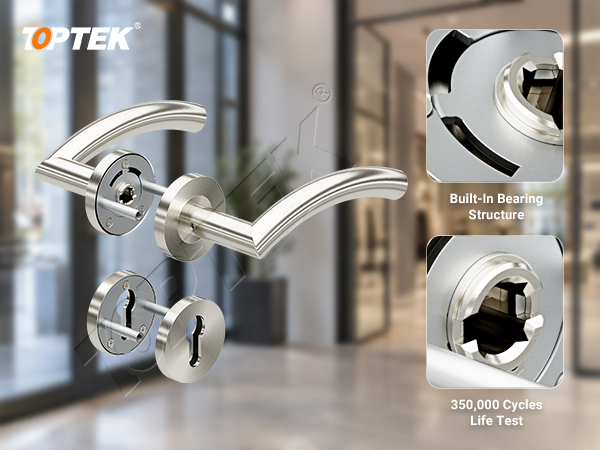
Measure the actual finished door at the handle position. Include permanent facings that form part of the finished door, and record them separately when future replacement is possible. Do not substitute the nominal timber core thickness or the door description on an early schedule. A laminate, protection plate or changed trim arrangement can make the installed condition different from the original order.
Next identify where the spindle enters each handle hub. The useful reference is the installed hub entrance, not automatically the outer face of the decorative rose. Use a section drawing to locate the mounting bases, collars and any approved spacer. Avoid adding the visible rose thickness again when the drawing already includes it in the hub position.
| Record | Measurement or document needed | Decision supported |
|---|---|---|
| Finished door | Thickness at the actual handle opening | Distance through the door construction |
| Each handle hub | Installed entrance position and usable depth | Available spindle engagement |
| Lock follower | Section, position and operating arrangement | Drive compatibility |
| Spindle | Overall length, ends and retention features | Exact part to purchase |
| Assembly range | Permitted door and trim configurations | Whether one pack serves several openings |
For replacement work, photograph the existing arrangement before removing components under the site’s maintenance procedure. Mark inside and outside on the record. An apparently symmetrical handle set may sit on different plates on the two faces, so equal projection should be confirmed rather than assumed.
Check engagement without using a universal allowance
Engagement is the length of spindle working inside the receiving component. The acceptable value depends on that component’s design. Ask the supplier for the permitted engagement and end clearance for both hubs, together with the lock’s spindle arrangement. There is no single extra length that can safely be added to every commercial door thickness.
A useful drawing check is to mark the distance between the two installed hub entrances and add the intended insertion into each hub. This creates a geometry check for a continuous spindle; it does not establish the manufacturer’s minimum engagement or authorize a different spindle construction. Locate the lock follower on the same section and check the specified drive path.
As an illustrative measurement exercise, if the distance between hub entrances increases by 3 mm while every other requirement stays fixed, the assembly must accommodate that extra 3 mm. Whether the existing spindle can do so depends on its remaining permitted engagement range. Do not assume that unused space exists simply because the handles can be pushed together.
Compare fixed and adjustable assemblies correctly
Some handle assemblies have a stated door-thickness range and a connection designed to accommodate variation. Others use a specific spindle length or a controlled cutting procedure. Identify which system the selected handle actually uses. A range on another product’s page does not establish the adjustment available in your chosen furniture.
For example, HOPPE’s Los Angeles product configuration lists spindle size and door thickness as separate fields. This is a useful example of the information buyers should request together; its connection details and dimensional range apply to that HOPPE configuration. They should not be transferred to a TOPTEK handle.
If cutting is permitted, obtain the supplier’s instructions for length, end finish and retention features. Do not shorten a component where doing so would remove a required feature or leave a rough end that interferes with assembly. Label approved cut parts by the door condition they serve, and keep unmodified stock distinguishable from finished installation parts.
What the TOPTEK EUG4001 reference establishes
The TOPTEK catalogue’s EUG4001 table lists a door-thickness range of 38–50 mm and spindle sections of 7 × 7, 8 × 8 and 9 × 9 mm. These are configuration details to resolve in the enquiry. They do not mean that every spindle section is supplied in one kit, or that one unspecified shaft works with every lock inside that door range.
Use the EUG4001 product reference to identify the handle, then request the exact spindle length and connection drawing for the selected option. Match the quoted section to the follower. Request an identified sample rather than approving only the visible lever shape.

Recognize length problems before changing the lock
A handle that will not seat can indicate excessive spindle length, but it can also result from an incorrect base, obstruction or misalignment. A lever that moves without reliably retracting the latch can involve insufficient engagement or a different connection fault. Treat these observations as reasons to inspect the assembly, not as proof that the shaft needs cutting.
Do not draw the handles together with the fixing screws to overcome resistance. Stop and have the installer compare the assembled stack with the approved drawing. Likewise, do not use an improvised sleeve to compensate for the wrong square section. A length correction cannot repair a cross-section mismatch or an unsuitable operating arrangement.
For the wider selection process, the commercial lever handle specification guide covers coordination with the lock case and fixing route. Keep the length review focused on measured hub locations, engagement and the exact spindle part.
Approve a sample across the project’s actual variations
Select representative doors by finished thickness and furniture arrangement. Include the smallest and largest approved stack where a common pack is proposed. Assemble with the intended lock, bases, spindle and fasteners. A demonstration on a thin display board cannot establish fit on a thicker project door.
- Confirm the component labels and compare the spindle with its drawing.
- Check seating without forcing the handle bases together.
- Verify engagement and retention by the manufacturer’s specified method.
- Operate both sides through the intended function and check latch return.
- Repeat after final tightening and after any permitted adjustment.
- Record the door condition, component revisions and acceptance result.
Set acceptance criteria before the trial. Include stable retention, full intended operation and the absence of binding or interference. Where a result changes after tightening, investigate alignment and the complete assembly rather than compensating by loosening the final fixings.
RFQ checklist and Why TOPTEK
Send the handle model, lock model, follower section, finished door thickness, inside and outside trim drawings, spindle reference and quantity split by door condition. Include any special operating function and the documents required for the project. Ask the quotation to identify the supplied spindle and fixing pack explicitly.
TOPTEK offers a handle product range that can be reviewed alongside the associated door hardware. Use the quality management information to frame requests for dimensional inspection and sample records. Confirm what evidence will be supplied for the selected configuration, rather than treating a general company page as a measurement report.
For a commercial door hardware enquiry, group doors that genuinely share the same assembly. Keep exceptional thicknesses separate. This makes the quotation easier to compare and helps prevent an installation team from receiving one unlabelled spindle length for several incompatible conditions.
Frequently asked questions
Can I choose spindle length from door thickness alone?
No. Include the installed hub positions, trim arrangement and required engagement. Door thickness is one measurement within the complete assembly.
Is an 8 mm spindle necessarily the correct length?
No. The 8 mm dimension describes its square section. Overall length, end features and operating arrangement must also match the selected components.
Can I reuse the old spindle with new handles?
Only after checking section, length, condition, retention features and permitted engagement against the new handle and lock requirements.
Should a long spindle be cut on site?
Only where the component manufacturer permits cutting and provides the required method. Obtain the correct part when cutting would alter a functional feature.
What should a project sample prove?
It should confirm seating, specified engagement, retention and intended operation with the actual lock and door construction, including the relevant thickness variations.
Confirm the spindle before releasing the order
A reliable spindle order connects a measured door condition to a specific handle and lock assembly. Resolve the square section and operating function first, establish the installed stack, and verify the resulting length on the agreed sample.
Request a dimensional review: send your assembly section and door-thickness schedule to ivan.he@toptekaccess.com. For a formal quotation, add quantities by configuration, finish, sample requirements and delivery destination.