

TL;DR
- Specify the strike reference and its lip dimension together; a lock model alone does not identify both.
- Use the strike maker’s drawing datum, then show the frame section and latch approach on the same review sheet.
- Check paired doors and overlapping astragals separately from single doors.
- Approve the complete lock, strike and frame sample before repeating the preparation across a door batch.
Quick Answer: how should strike lip length be selected?
Select a lip that gives the latch an appropriate approach surface for the actual frame and door arrangement. Establish the manufacturer’s lip measurement datum first. Then compare the proposed strike with the finished frame projection, door position, latch path and nearby trim or astragal. Confirm the strike openings, fixing positions and box clearance separately. There is no reliable universal choice based only on door thickness or the words ANSI mortise lock. Record the selected part number, drawing revision and dimension on the order.
Understand the lip, the opening and the frame projection
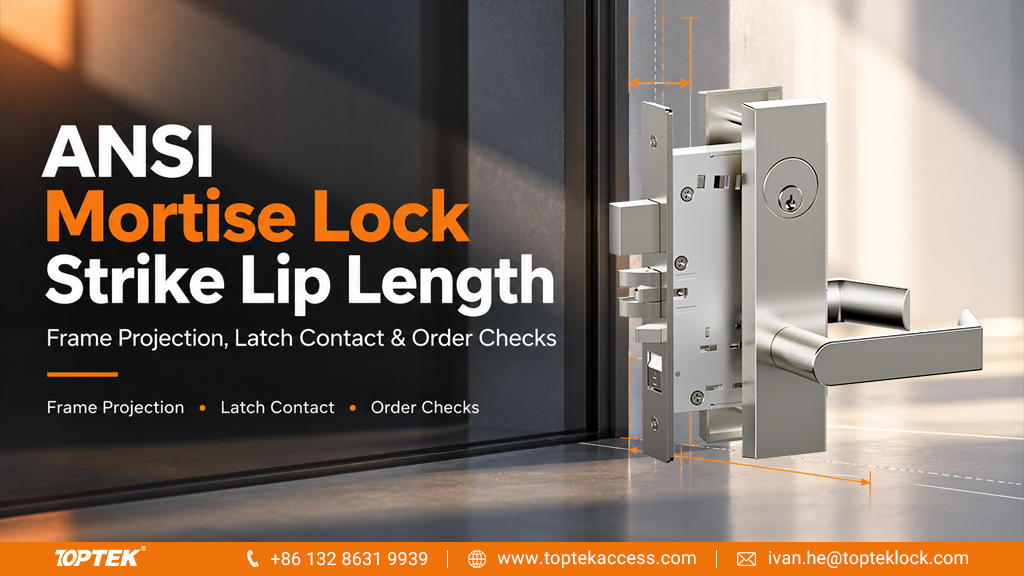
The strike lip is the approach portion of the strike that the latch encounters as the door closes. The strike opening receives the latch or bolt. These features work together, but changing one does not automatically correct the other. A latch that misses the opening vertically has a different problem from a latch that first scrapes the frame.
Frame projection describes the surrounding geometry the latch must pass. Applied trim, a deep frame return or an overlapping member can change that path. Door thickness affects the assembly, but it does not describe every frame detail. Do not select a longer lip simply because a door leaf looks substantial.
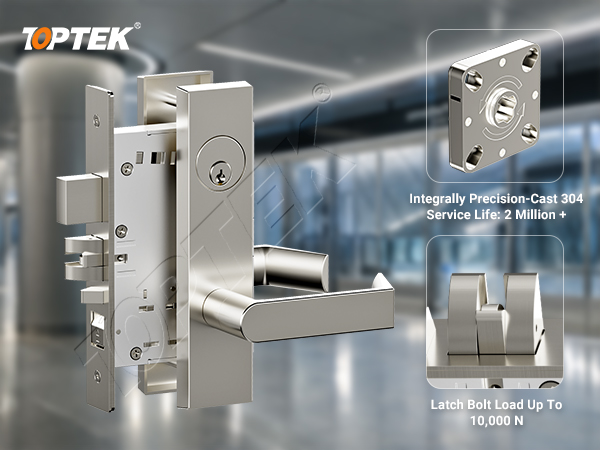
Start with the relevant TOPTEK ANSI mortise lock family, then request the matching strike drawing. Keep the lock function, trim and strike references together. The family name helps identify the system; the dimensional drawing determines the proposed fit.
Build a measurement sheet with a defined datum
A number without a reference line can create a wrong order. One person may measure from a fixing centreline while another measures the complete plate width. Ask the supplier to mark the lip dimension on the drawing. Return the marked drawing with your frame section instead of sending an isolated dimension in a message.
Use the following worksheet for each distinct frame arrangement. Enter measurements from the finished assembly or the agreed production drawing. If a detail remains unknown, identify who will supply it before releasing the strike order. Do not fill the gap with a dimension copied from a different door.
| Record | What to attach or enter | Decision supported |
|---|---|---|
| Opening identity | Door number, single or pair, opening direction | Keeps the selection tied to one arrangement |
| Strike datum | Supplier drawing with the lip dimension highlighted | Prevents two different measurement conventions |
| Frame section | Finished profile, trim projection and strike mounting surface | Shows what the latch must pass |
| Door position | Leaf thickness, stop position and specified closed-door gap | Locates the moving leaf relative to the strike |
| Latch and bolt | Exact lock reference and matching strike openings | Checks receiving geometry independently of lip reach |
| Adjacent components | Astragal, seal carrier or applied trim section | Identifies possible contact during the closing path |
| Mounting and box | Fixing centres, plate recess and available box space | Checks installation without distorting the assembly |
| Order decision | Strike part, lip value, finish, drawing revision and sample reference | Creates a repeatable purchasing instruction |
When taking photographs, include one view square to the strike and another showing the frame section. A ruler in a photograph can support identification, but perspective can distort measurements. Use a dimensioned section for the final decision. Preserve the original units and identify any conversion explicitly.
Distinguish standard, extended and flat strike options
The word standard describes a supplier’s normal option for a particular product. It does not establish a universal lip length. For example, Allegion’s L9000 strike guidance lists different lip options and distinguishes special orders. Those options belong to that product system; they are not TOPTEK dimensions or evidence of interchangeability.
For a deeper frame projection, ask whether an extended option is available for the selected lock and strike. Check the complete drawing, including the transition into the opening. For a flat or reduced-projection option, confirm that the latch still has the intended contact surface. Treat appearance, reach and opening alignment as separate acceptance points.
Changing the lip by bending or grinding a supplied strike can alter its geometry and finish. Obtain an appropriate part or an agreed manufacturer solution instead of making a field alteration the default. For a labelled assembly, the proposed change also needs to remain within the applicable assembly requirements.
Review paired doors and overlapping astragals separately
TOPTEK’s ANSI catalogue identifies strikes 900, 910 and 920. Its strike section advises against curved-lip strikes for double doors with overlapping astragals and points to strike 900 for that arrangement. This is a useful selection distinction: the presence of an astragal can change the strike choice even when the lock family stays the same.
Use that catalogue note to start a drawing review. It does not confirm every paired-door installation. Show the active and inactive leaves, the overlap profile, the strike mounting position and the closing sequence. Check the proposed assembly against the door supplier’s requirements before accepting the part.
A paired-door photograph with both leaves open often hides the overlap that matters when they close. Include a section through the meeting edges and a closed-door photograph. Identify whether the astragal belongs to the active or inactive leaf. These details make the supplier’s response more useful than a request for a generic double-door strike.
For an initial fit discussion, send the frame section and strike photograph to TOPTEK. Ask for a proposed strike reference and a marked drawing showing the measurement to confirm.
Check the contact path on a representative sample
Use a sample that includes the actual frame profile, lock, strike, trim and relevant seals. A loose lock and strike on a workbench cannot show the closing path. Record the sample configuration before checking operation so the result can be traced to the production order.
- Confirm that the door and frame preparation match the selected drawings and that the mounting surfaces are sound.
- With the door controlled, observe where the latch first meets the approach surface. Look for contact with the frame or adjacent trim.
- Check that the latch reaches its intended seated position and that any deadbolt enters its receiving opening without forced operation.
- Compare operation with the final seals and other specified hardware installed. Record any change that appears after these parts are fitted.
- Photograph the accepted strike, retain the part reference, and transfer the same configuration to the purchasing schedule.
Do not use increased closer force to conceal a contact problem. If operation is inconsistent, identify whether the cause is the strike lip, opening alignment, door position or another component. Use the broader ANSI door preparation checklist when the problem extends beyond the strike.
Common ordering mistakes and their project consequences
Ordering by plate height alone: two strikes can look similar in elevation while presenting different approach geometry. Include the section and lip dimension. Otherwise, the frame shop may prepare a recess that accepts the plate but does not provide the required latch path.
Approving only a loose sample: a visually acceptable strike can interfere after mounting. Ask for a representative frame trial before repeating the arrangement. Retain the result with the sample reference rather than treating a product photograph as installation approval.
Changing trim after the strike is selected: an applied frame component can enter the latch path. Route frame and trim revisions back to the hardware reviewer. This is especially important when different subcontractors supply the door, frame and decorative finish.
Assuming all receiving parts are equivalent: the strike opening, box and fixing arrangement still need to match the lock. A successful lip measurement alone does not verify bolt engagement, assembly performance or certification. Keep those checks visible on the order.
TOPTEK product scope, evidence and RFQ checklist
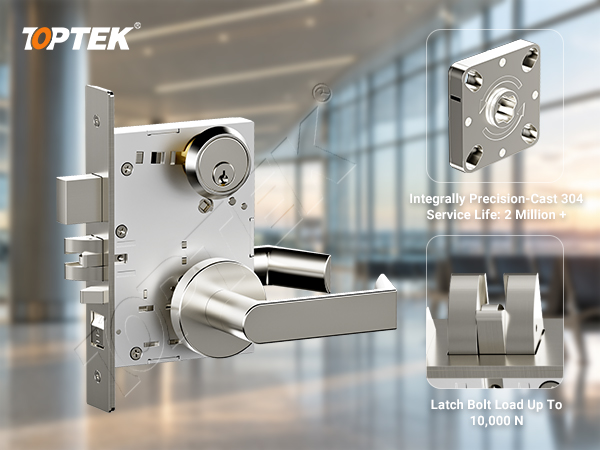
TOPTEK’s range includes the TKAMRR9200 round-rose assembly and the escutcheon presentation shown above. The ANSI catalogue’s separate strike section gives buyers a reason to request accessory identification alongside the lock model. Confirm the exact supplied combination instead of assuming the trim photograph defines every accessory.
Why TOPTEK for this enquiry? Buyers can discuss the lock and its accessories within one product family and request a configuration-specific response. Review the quality management information, then ask which dimensional records and inspection documents can accompany the proposed supply. A general company page does not replace a model-specific report.
- Door schedule and quantities grouped by frame arrangement.
- Lock model, function, trim reference and opening direction.
- Marked frame section, finished door position and strike datum.
- Selected strike drawing, lip dimension, finish and fixing details.
- Astragal, seals, box clearance and any assembly-specific restrictions.
- Sample acceptance record, document requirements and delivery grouping.
Frequently asked questions
Is ANSI mortise lock strike lip length the same as strike width?
Not necessarily. Use the manufacturer’s drawing to identify the lip measurement datum. Overall plate width and lip projection can describe different dimensions.
Can door thickness alone determine the correct lip?
No. The frame section, closed-door position, latch approach and adjacent components also affect the selection. Submit those details with the lock reference.
Does a longer strike lip solve every latching problem?
No. Vertical alignment, receiving openings, door movement and mounting conditions can cause separate problems. Diagnose the contact path before changing the lip.
Which TOPTEK strike should be reviewed for overlapping astragals?
The ANSI catalogue points to strike 900 and advises against curved-lip strikes for double doors with overlapping astragals. Confirm the proposed part against the actual paired-door section.
What should a strike enquiry include if no drawing is available?
Start with the lock reference, door number and clear photographs of the strike and frame section. Ask which dimensions are needed before the supplier selects a part.
Request a strike selection and quotation
A useful strike order connects the lip dimension to its datum, the frame section and an accepted sample. Keep that record with the lock schedule so later frame changes trigger a review. For a commercial door hardware enquiry, send the worksheet information and quantities to ivan.he@toptekaccess.com. Request the proposed part reference, drawing, sample arrangement and quotation scope.