

TL;DR
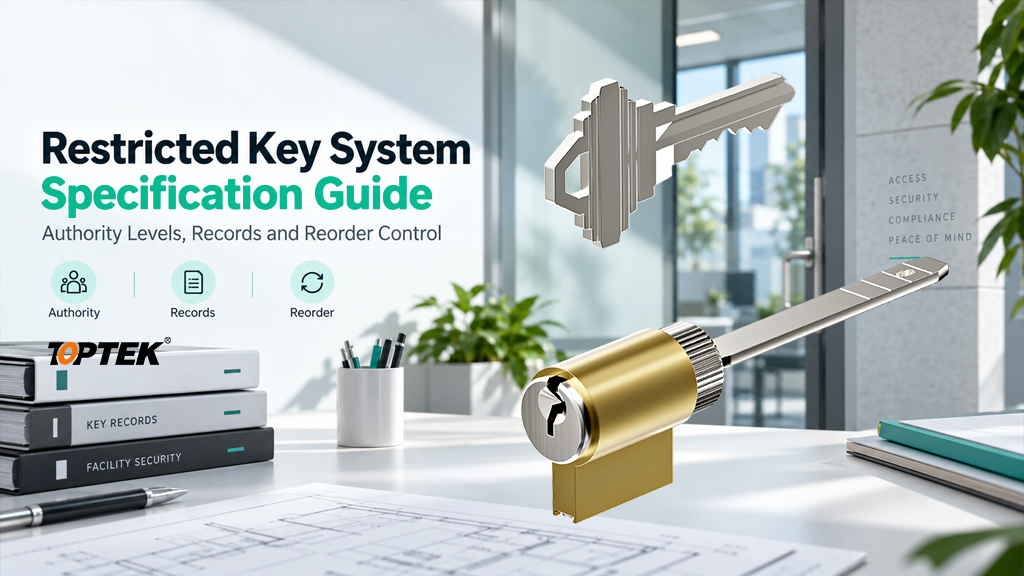
A restricted key system specification should define who can request, approve, produce and receive additional keys, alongside the exact cylinder and key platform. Separate the right to open a door from the right to order a key. Record the supplier’s distribution controls and any claimed protection for the selected system; the word restricted alone does not describe every commercial or technical condition.
Quick Answer
Specify the system identity, authorised owner, approved ordering channel, key-blank controls, request-verification method, delivery rules and transaction records. Match those controls to compatible cylinder formats and a documented access schedule. Require the supplier to explain the actual restriction mechanism for the quoted platform. A master key hierarchy describes access relationships; it does not by itself establish control over duplicate-key supply.
Use the TOPTEK construction cylinder range to identify relevant formats. If the project brief is incomplete, send a non-sensitive opening list and the required ordering roles to ivan.he@toptekaccess.com. TOPTEK can identify the information needed for a cylinder and key-control discussion.
Key takeaways for owners and procurement teams
- Door access and authority to request replacement keys are separate permissions.
- The restriction method must be described for the exact offered platform.
- A purchase order needs a verified system reference and an authorised requester.
- Approval, production, delivery and receipt should leave a traceable transaction.
- A lost key requires an access-risk decision as well as a replenishment decision.
Distinguish restricted supply from master keying
A master keyed arrangement determines which keys operate which cylinders. Restriction concerns how keys or blanks are supplied and who can authorise additional copies. Both can be part of one project, but they solve different problems. A facility can have a carefully planned access hierarchy and still lose control if additional keys can be ordered without adequate verification.
Terminology varies between platforms and markets. Ask the supplier to describe the mechanism rather than relying on the category name. The ASSA ABLOY key-control glossary distinguishes restricted keys and authorised key cutters. Use that distinction to frame questions, then obtain the actual terms for the selected TOPTEK configuration.
Start with the system owner: the organisation responsible for the key-control policy. Then identify the person or role allowed to request additional keys. Define who approves each type of request and which supplier or service partner may fulfil it. Finally, identify the authorised delivery recipient. In smaller projects one person may hold several roles, but the responsibilities should still be written separately.
Specify authority by transaction type. An administrator permitted to order replacement user keys should not automatically gain permission to order higher-level keys, release technical keying information or change the system owner. Give temporary permissions an end date and define how the supplier learns that an authorised signatory has changed. An old name in a supplier record can otherwise outlive the person’s role.
| Transaction | Authority to define | Record to retain |
|---|---|---|
| Routine user-key reorder | Named request and approval roles | System reference, quantity and approval |
| Higher-level key request | Owner-designated elevated approval | Reason, access scope and recipient |
| Cylinder replenishment | Approved hardware and keying instruction | Format, function and schedule revision |
| New service partner | Owner authority for the transfer | Partner scope and effective date |
| Signatory replacement | Identity verification and revocation route | Old authority withdrawn, new authority active |
| Keying-information release | Explicit permission for that information | Recipient, purpose and controlled transfer |
Write a reorder process that can be followed
A request should identify the customer account, system reference, key reference, quantity, business reason and delivery destination. The supplier should compare it with the current authority record before releasing the order. Establish how unfamiliar requests, changed addresses and urgent exceptions are verified. A familiar email signature or an old purchase order should not automatically override the agreed control.
Specify a separate acknowledgement that repeats the approved quantity and recipient without unnecessarily exposing sensitive keying information. At dispatch, record the package identity and the delivery method agreed with the owner. At receipt, reconcile the contents with the order and place the keys in the owner’s controlled issue process. The transaction remains incomplete if the intended recipient cannot account for the delivered quantity.
Keep approvals specific
An approval for five user keys is not an approval for a new master key or unrestricted future orders. State the transaction boundary in ordinary language. The Yale cylinders and keys catalogue illustrates authorisation tied to an identified system and a defined release. The practical lesson is to make each permission explicit, rather than treating a general commercial relationship as blanket authority.
Ask what the supplier actually controls
Request a written explanation of blank distribution, authorised cutting channels, customer identification and records. Ask whether the controls apply to all supplied formats and replacement components. A proprietary profile, restricted distribution and a claimed legal protection are different statements. If protection is claimed, request the relevant platform, territory and current supporting documents; do not assume one label answers all three questions.
Discuss service continuity before choosing a system. Identify how the owner can obtain authorised support if a local distributor closes or a signatory leaves. Ask how a supplier change is handled, what evidence of ownership is required and which information can be transferred. The aim is a controlled service route that remains usable during the building’s operating life, not an ordering process that depends on one person’s memory.
Confirm cylinder compatibility without exposing the keying file
Record the cylinder format, lock interface, function, length, retention method and any cam or tailpiece requirement. Keep these hardware details in the procurement schedule. Maintain sensitive combination and keying information in a separate controlled record, accessible only to the parties who need it. A public drawing package rarely needs to carry the data used to create individual keys.
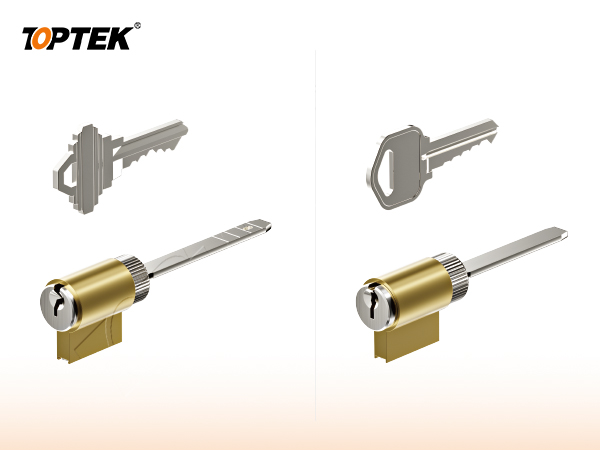
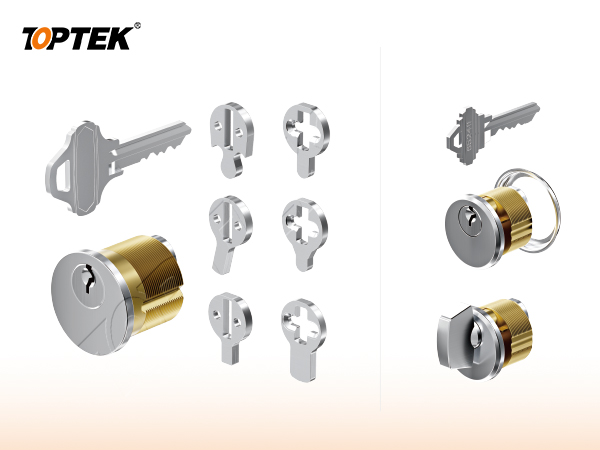
The EPCHK7P Euro profile cylinder is a current TOPTEK product reference. Its format does not establish that every restriction option is available for every quotation. Ask which exact platform and components are proposed, and confirm compatibility with the intended lock before approving a sample. Apply the same discipline to mortise, bored, SFIC and oval cylinder requirements.
Test the service process as well as the sample
Before committing to a larger programme, review a sample reorder form with the supplier. Check whether it captures system identity, key type, quantity, requester, approver and recipient. Walk through a valid request and an incomplete request using fictional references. Do not create real keys or circulate working key codes simply to demonstrate an administrative process.
For the physical sample, verify the agreed access relationships and the intended cylinder operation using an approved test schedule. Include the expected non-operating combinations without publishing their technical coding. Record only the information necessary to show that the accepted sample matches the access plan. The broader construction master key cylinder supplier guide supports initial system sourcing; this specification adds the ongoing duplicate-order controls.
Plan for losses, changes and expansion
When a key is missing, distinguish replacing the physical item from addressing its remaining ability to open doors. Ordering another key does not cancel a lost mechanical key. The owner should assess the access scope and decide whether affected cylinders or keying arrangements need to change. Record the incident and the resulting action so replenishment does not silently become the only response.
For expansion, send the proposed access requirement to the system designer before promising compatibility. Reserve capacity, common areas and new management levels can affect the design. Avoid assuming that an existing key can be extended to every future opening. For staff changes, update both the key-issue record and the supplier’s ordering-authority record; recovering a key does not automatically remove commercial ordering permission.
Common mistakes and buyer checklist
Frequent mistakes include equating restricted with patented, accepting a cylinder-format name as proof of a controlled platform, allowing a general purchase order to authorise elevated keys, sending sensitive keying data with ordinary quotations, and shipping to an address that has not been approved. Another avoidable gap is keeping the technical hierarchy current while leaving the authorised-signatory list unchanged.
- Identify the owner, system reference and current authorisation contacts.
- Separate user-key orders, elevated keys, cylinders and information releases.
- Obtain the exact restriction mechanism and service-channel terms.
- Match cylinder interfaces and access requirements to the quoted configuration.
- Agree delivery, receipt, issue records and exception handling.
- Define loss response, signatory changes and future expansion review.
TOPTEK evidence, product scope and RFQ requirements
TOPTEK’s company material identifies cylinder customisation, keyway profiles, master key hierarchies and restricted or proprietary key-control systems as project discussion areas. The range includes Euro profile, SFIC, American mortise and bored, and oval formats. Availability and terms should be confirmed for the chosen configuration rather than inferred from the breadth of that range.
The commercial lock manufacturing page provides the broader supplier context. Review the quality-management process for production and traceability questions. These capabilities support a procurement discussion; they do not substitute for a written key-control agreement.
For an RFQ, send the market, cylinder formats, lock references, door quantities, access roles, intended owner and service requirements. Describe who may order which items and how deliveries must be controlled. Request a response identifying the proposed platform, supported configurations, samples, evidence and ordering procedure. Avoid including live key codes in the initial enquiry.
Frequently asked questions
Is a restricted key system the same as a master key system?
No. Master keying defines access relationships. Restricted supply defines how additional keys or blanks are authorised and supplied. A project may require both.
Does restricted always mean patent protected?
No. Ask for the exact restriction mechanism and supporting documents for any protection claimed for the selected platform and market.
The system owner should designate the appropriate authority for each transaction type, including ordinary keys, higher-level keys and keying-information releases.
Does ordering a replacement cancel a lost mechanical key?
No. Replenishment does not change the lost key’s access. The owner must separately assess whether affected cylinders or keying arrangements need to change.
What should a restricted-key reorder record contain?
Record the system and key references, quantity, request and approval identities, delivery recipient, dispatch details and receipt confirmation.
Conclusion and project risk summary
Specify a restricted key system as a product configuration plus an accountable supply process. Unclear authority creates risk even when the cylinder operates correctly. A clear ordering chain, controlled information and a usable service route give the owner a practical basis for managing additional keys throughout the project lifecycle.
Why TOPTEK and the next step
TOPTEK brings multiple cylinder formats and project customisation into the same commercial door lock discussion. Send a non-sensitive requirements summary to ivan.he@toptekaccess.com and request a configuration-specific proposal covering interfaces, key-control options and the reorder workflow. TOPTEK is your Commercial Door Hardware Reliability Solution. TOPTEK: Smart Design. Strong Security.