
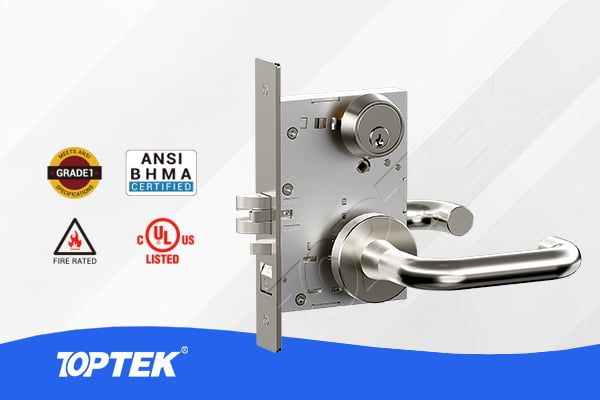

Office vs Apartment Entrance Mortise Lock Functions: F04 or F09?
TL;DR
Use F04 when the project requires an office/entry function with an outside lever that can be locked by the inside thumbturn or outside key, while the inside lever remains available for egress. Use F09 when an apartment or dormitory entrance requires outside keyed access and inside free egress. Confirm the exact operating sequence, trim and keying rather than selecting from the room name.
Start with the ANSI Grade 1 Mortise Lock product hub, then use this narrower guide to define the required function and approval evidence.
Quick Answer
Write the required outside and inside behaviour first. For the TOPTEK descriptions used here, F04 provides office/entry control at the outside trim, while F09 is intended for apartment, dormitory and multifamily corridor entrances with controlled outside entry and inside exit. Approve the configured sample and schedule together.
Why F04 and F09 are easy to confuse
Both functions can appear on doors that separate a public corridor from a controlled room. Both can provide inside egress and outside access control. A buyer who writes only “entry lock” leaves the supplier to interpret the intended state, user group and key operation.
The door schedule should state whether the outside lever can operate normally, how it becomes locked, who controls that state and how authorised users enter. Add the inside operation and auxiliary deadlatch expectation. This plain-language sequence makes the function code auditable.
How F04 office/entry works
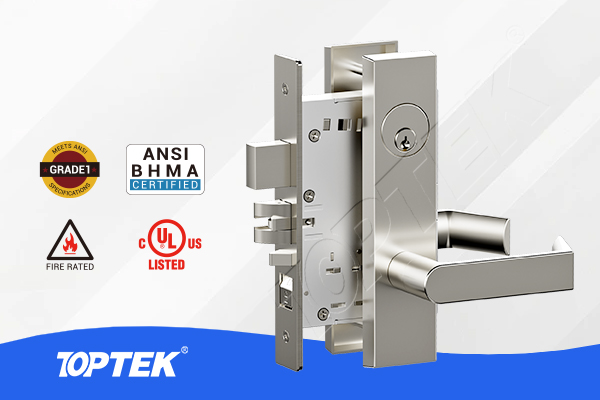
TOPTEK’s supplied function description states that the latchbolt operates by lever from either side unless the outside trim is locked by the inside thumbturn or outside key. When locked, the outside lever becomes inoperative, while the inside lever retracts the latch for egress.
This arrangement supports commercial offices and controlled entry doors where an occupant or authorised key holder may change the corridor-side access state. The schedule should say when the outside lever is expected to remain active, who may lock it and how the opening is returned to normal operation.
How F09 apartment entrance works
TOPTEK’s supplied description positions F09 for apartment entrances, dormitory units, residential corridor doors and multifamily housing. Outside access is typically key-operated, while the inside lever allows immediate exit.
The practical enquiry therefore includes resident keying, corridor-side entry, inside operation and handover. “Typically” is not a final configuration: the quotation, drawing and sample must identify the supplied cylinder, trim and exact operation for the ordered model.
F04 expressly describes inside thumbturn or outside key control of the outside trim. F09 focuses on secured outside entry and free inside exit for residential corridor applications. Ask whether the occupant is expected to place the outside lever into a different state or simply use a key for entry.
Do not choose solely from occupancy labels. A staff apartment, serviced residence office or dormitory support room may have a different access policy. The consultant and owner must confirm the intended behaviour and applicable safety requirements for each opening.
| Decision | F04 office/entry | F09 apartment entrance |
|---|---|---|
| Primary application | Office and controlled entry | Apartment, dormitory, multifamily corridor |
| Outside control | Inside thumbturn or outside key can lock trim | Typically secured/key-operated entry |
| Inside operation | Lever retracts latch for egress | Lever allows immediate exit |
| RFQ emphasis | Who changes outside state | Resident access and key handover |
| Approval | Full operation sequence | Full operation and keying sequence |
Coordinate cylinder, trim and keying
A correct function still needs the intended cylinder, keyway, trim and spindle interfaces. The ANSI mortise door-preparation checklist covers geometry; this guide covers operation. Use both during submittal review.
For residential projects, add master-key hierarchy, resident key issue, lost-key procedure and turnover responsibilities. For offices, define which users may change the outside state. A lock function does not create a key-control policy by itself.
Buyer checklist before choosing F04 or F09
- State the normal outside-lever condition.
- Identify how the outside trim is locked or released.
- Confirm inside lever operation and egress responsibility.
- List cylinder, keyway, trim and spindle references.
- Map each opening number to one function and revision.
- Approve the complete operating sample, not a photograph.
Common mistakes and project risks
One mistake is assuming every apartment entrance uses one function. Local rules, building management, accessibility, fire and egress requirements can change the correct set. Another is treating an office thumbturn control as equivalent to a resident keyed-entry arrangement.
If the wrong function is discovered after doors and keys are issued, the correction may involve lockcases, trim, cylinders, schedules and occupant communication. Preserve an approval trail so the project can identify exactly which decision changed.
TOPTEK evidence and product scope
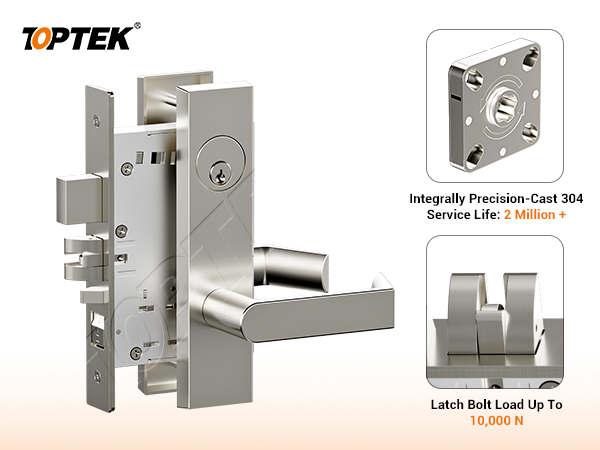
TOPTEK’s ANSI function document identifies F04 office/entry and F09 apartment entrance functions and describes their operating intent. It also identifies inside free egress within these descriptions. Final application requires an exact ordered configuration.
Request drawings and evidence from TOPTEK resources. Internal development statements, image badges and general family claims must not be converted into third-party certification claims without applicable original documents.
Product presentation and sample review
An escutcheon or round-rose presentation does not prove the internal function. The TKAMRR9200 round-rose reference supports a trim discussion, while the sample label must still show F04 or F09, cylinder, keying and revision.
Demonstrate normal outside operation, the locked condition, authorised outside entry and inside operation. If a thumbturn changes the state, include it in the sequence. Record the test without claiming that sample operation replaces project approval or certification.
RFQ checklist
- Opening schedule and room/application description
- Plain-language inside and outside operating sequence
- F04 or F09 function reference
- Cylinder format, keyway and hierarchy
- Trim, spindle, door thickness and hand
- Required listing and documentation scope
- Identified sample and approval owner
- Production labels and handover records
Why TOPTEK: make the sequence traceable
TOPTEK can review a marked-up schedule and restate the required function before quotation. The team can identify when a room label conflicts with the described behaviour or when keying information is missing.
The same sequence should follow the quotation, drawing, sample and order acknowledgement. This helps distributors and door manufacturers avoid silent function changes between approval and repeat delivery.
Two-level CTA
For an initial review, send the opening schedule and mark which doors are offices, apartments, dormitories or shared entrances. Add the expected outside and inside behaviour.
For a formal RFQ, send the approved schedule, door preparation, trim, cylinder/key plan, evidence requirements and sample process through the TOPTEK contact page. Request a function-specific quotation rather than a generic entry-lock price.
Conclusion
F04 and F09 serve related but distinct access intentions. F04 describes office/entry control of the outside trim; F09 focuses on apartment or dormitory entrance access with inside exit.
Choose from the operating sequence, not the room label. Match the trim, cylinder and keying, approve an identified sample and preserve the revision so the delivered opening behaves as specified. For multi-opening projects, add the final function and keying reference to the inspection schedule and packaging label. That last control helps installers distinguish similar-looking cases and gives the owner a usable record when rooms change use, cylinders are rekeyed or a later phase repeats the original order.
Frequently asked questions
What is the main difference between F04 and F09?
F04 describes office/entry control of the outside trim, while F09 is intended for apartment or dormitory entrance access with secured outside entry and inside exit.
Does the room name decide the function?
No. Select from the required operating sequence, access policy, egress responsibility and applicable project requirements.
Can the same trim prove either function?
No. External appearance does not prove the lockcase logic, cylinder, keying or inside operation.
What should the sample demonstrate?
Demonstrate normal outside operation, locked state, authorised entry, inside operation and any thumbturn control on the identified configuration.
What belongs in the RFQ?
Include opening numbers, operation, trim, cylinder and keying, door preparation, evidence scope and sample approval controls.