
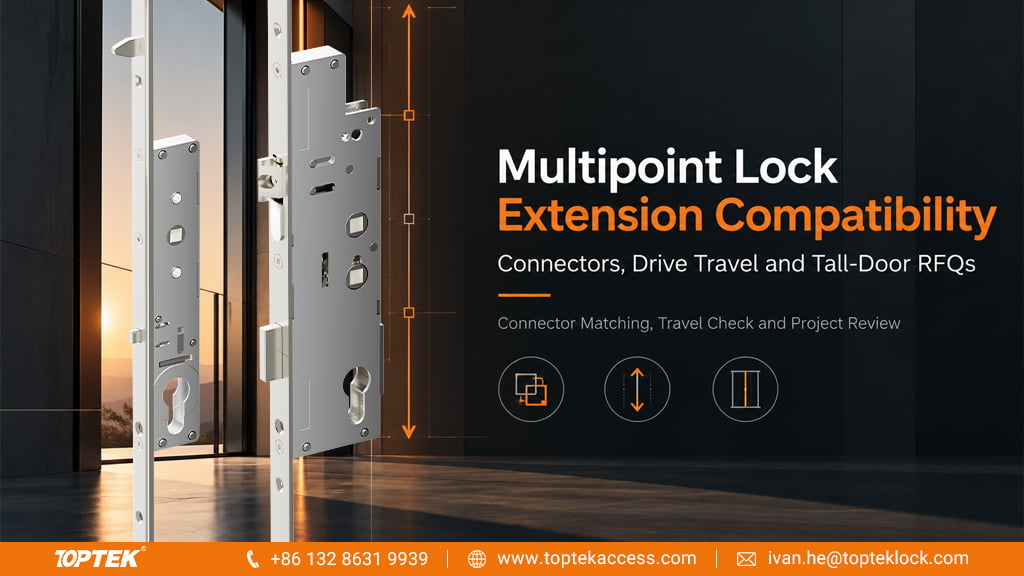

A taller door does not automatically need a longer version of the same multipoint lock. It may require a different complete assembly, an approved extension system or a revised locking-point layout. The purchasing question is whether the proposed components form a compatible operating mechanism. TOPTEK’s multi-point locking systems range is a starting point for that discussion with the door manufacturer.
TL;DR
- Distinguish a factory-length assembly, a functional extension and a plain faceplate filler.
- Match the connection geometry and transmitted movement, not just the visible strip width.
- Keep the handle position, remote locking points and frame keeps on one coordinated drawing.
- Use only the cutting, connecting and fixing instructions for the selected system.
- Approve and order the complete configuration with an itemised parts list and revision.
Quick Answer
Multipoint lock extension compatibility depends on the exact base lock, connector, drive movement, auxiliary locking unit and installation arrangement. A matching faceplate width or an apparently similar joint is insufficient. Ask whether the supplier offers a factory-length lock or a documented modular assembly for the required door. For a modular option, obtain the permitted component combination, connection details, cutting limits and operating sequence. Then verify every locking point and keep in a representative finished door. Do not assume that an extension from another platform will work or preserve the original evidence scope.
Identify what the proposed extension actually does
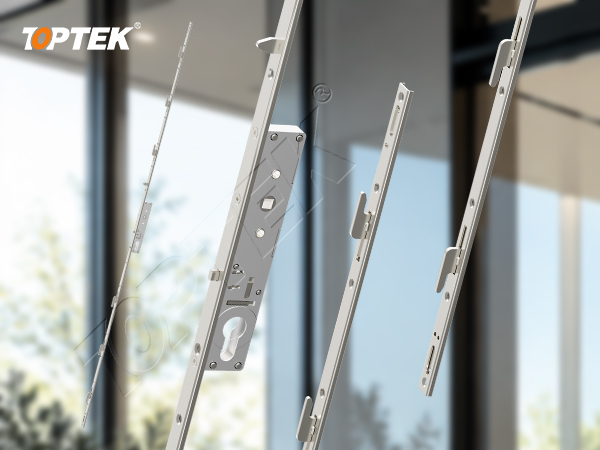
The word extension can describe several different parts. A strip can continue the appearance of the faceplate without moving a locking element. A connector can transmit motion between two sections. Another component can carry a hook, bolt or roller that adds a locking or compression point. These items have different functions and cannot be evaluated from overall length alone.
Ask the supplier to mark fixed and moving parts on the drawing. Identify the path from the handle, cylinder or automatic mechanism to each remote point. If the proposal only adds a stationary strip, it does not by itself create another locking point. If it adds a moving unit, that unit needs a compatible drive connection and a matching frame receiver.
A factory-length assembly is a separate option. Its joints, point positions and preparation may be established during manufacture instead of through site assembly. Confirm which option is being quoted, who performs any length adjustment and which drawing defines the delivered condition. This prevents a supplier quotation for a finished assembly being compared directly with an incomplete kit.
Use a compatibility matrix before comparing prices
| Interface | Required information | Reason for checking |
|---|---|---|
| Base lock | Model, revision and operating form | Defines the source of movement and intended function |
| Drive connection | Joint geometry, engagement, orientation and retention | Confirms the two moving sections can connect as intended |
| Movement | Direction, travel and released/locked reference positions | Checks that remote points complete their required movement |
| Extension body | Part number, envelope, support and fixing positions | Checks the door has space and support for the assembly |
| Frame receivers | Matched keeps and coordinates | Connects the modified leaf configuration to the frame |
| Length adjustment | Permitted cutting zones and finished-end instructions | Prevents an assumed cut through a functional component |
| Evidence scope | Approved combination and applicable documentation | Checks whether the proposed variant is covered |
A useful industry example is FUHR’s compact range, which describes dedicated drive-rail connections, extension components and marked shortening positions. Those features belong to that system. They demonstrate the importance of a documented interface, not interchangeability with TOPTEK or permission to cut another lock.
Keep the completed matrix beside the quotation. A low unit price does not resolve a missing connector, an undefined keep or a joint that requires unsupported machining. Ask suppliers to identify exclusions so the door manufacturer can compare complete assemblies and understand which work remains in its own factory.
Check drive travel and the operating sequence
A joint that physically fits can still transmit the wrong movement. The required travel and direction must suit the remote locking mechanism. A connection assembled in the wrong reference position can leave insufficient movement at one end of the cycle even if the handle turns during a quick bench check.
First identify the operating form. An automatic arrangement, a lift-lever arrangement and a cylinder-driven arrangement create different review questions. With an automatic system, the triggers and remote points must follow the specified closing sequence. With a lever-operated system, the handle movement and any separate deadlocking step must be understood. With a cylinder-driven system, the input and final point positions must match the selected mechanism.
Ask for an explanation of the released, locking and fully locked positions for the proposed assembly. Identify what prevents the connector separating or shifting during repeated operation. Obtain the specified fasteners and retention method; do not substitute an improvised screw or modify a moving rail to make an unfamiliar joint fit.
During an authorised sample trial, observe each remote point rather than judging the system only by handle feel. Smooth central movement does not establish full engagement at a distant keep. If a point stops early, document the condition and return to the component and alignment review before applying more force or changing the connection.
Coordinate tall-door geometry without moving the problem
Increasing the overall assembly length does not determine where the handle or auxiliary locks should sit. Establish the required handle position and door datums first. Then show the central case, each additional case and each keep from those references. Include the finished threshold and head conditions so the fabricator and frame supplier use the same geometry.
The extension joint also needs space. Place its full envelope on the door section, including the rear mechanism and fixing paths. A joint can conflict with internal reinforcement even where the visible faceplate fits. Confirm that the door construction supports the intended fixing method and that the mechanism can move without being pulled into alignment by the mounting screws.
Longer parts need suitable handling and packaging. Support the assembly during storage and preparation, and keep identification attached to the configuration it describes. Do not treat a bent strip as an installation tolerance to be removed by tightening screws. TOPTEK’s first-party multipoint guidance identifies long-part distortion as an issue worth checking during receiving and assembly.
Approve the complete variant in a representative door
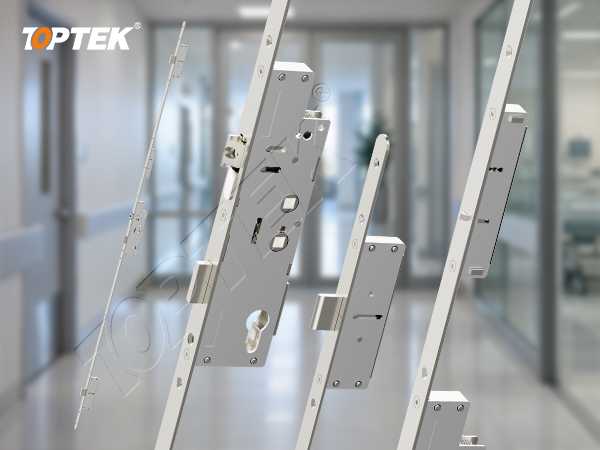
Define the sample as a complete variant: base lock, extension parts, connectors, fasteners, keeps, cylinder, handle and relevant door construction. Record its drawing revision and supplied part numbers. A sample of the base lock alone cannot settle the performance of a longer configuration that uses additional connections.
Plan the checks with the supplier and project team. They should cover intended locking and release, the relationship between door closing and point operation, alignment with the frame, and the specified user inputs. Include any project-specific escape or fire requirements through the appropriate qualified review and supporting evidence. A workshop demonstration does not create a certification.
Repeat the relevant fit and function assessment when a material change affects the joint, point location, drive path or door preparation. For the broader record structure, use TOPTEK’s multipoint lock sample approval guide. The extension-specific question is whether this exact connected assembly has been evaluated, with each component traceable to the accepted configuration.
Common purchasing mistakes and change risks
Ordering by door height alone. Two doors with the same height can have different handle positions, profiles and remote-point requirements. Send the opening drawing and function description alongside the height.
Treating a supplier’s maximum length as field-cutting permission. A length option can refer to factory manufacture. Ask for the delivered condition and the authorised adjustment process before planning site work.
Mixing product generations. A connector’s appearance can remain similar while its geometry, fastening or operating relationship changes. Retain revision information and have substitutions evaluated against the complete assembly.
Adding a locking point without updating the frame. An extra unit needs a coordinated receiver and supporting construction. It also changes the sample, parts list and service information. Describe the additional point as a proposed configuration change, not an automatic security improvement.
Ignoring the ordering unit. Clarify whether a price covers one base lock, a pair of extensions or a complete door set. List left/right or upper/lower distinctions where the actual system requires them. This small commercial check can prevent incomplete sets reaching the assembly line.
Why involve TOPTEK in the configuration review
TOPTEK’s current multipoint range includes PD1000, Auto Lock and MUSG4592. Start with the appropriate model and ask whether the door requirement is addressed by a complete factory assembly or a documented component combination. The Auto Lock product page provides a range reference; extension availability and interchangeability must be confirmed for the selected version.
TOPTEK’s quality management resources support a discussion about part identification, sample checks and change records. For a broader commercial door hardware package, include the handle, cylinder and frame interfaces in the same enquiry. This gives the buyer a defined assembly to compare and a clearer basis for future replacement orders.
Do not infer an extension kit from a long product photograph. Request the actual item numbers, drawings and supplied condition. Any performance, fire or escape claim must identify the relevant assembly and its evidence; a general reference to a standard is insufficient.
RFQ checklist for an extension-compatible assembly
- Door height, material, profile sections, finished datums and intended handle position.
- Base lock model and revision, required operation and existing component identification.
- Proposed extension function, connection location and remote locking-point positions.
- Requested factory assembly or modular supply, with responsibility for any cutting.
- Matched keeps, fixing support, cylinder and handle details.
- Target market, project evidence requirements and sample acceptance plan.
- Itemised set contents, quantities, packaging, spare-parts identification and schedule.
Send the tall-door drawing and proposed component list for a configuration discussion before purchasing extension parts.
Frequently asked questions
Are multipoint lock extensions universal?
No. The base lock, connection, movement, remote locking unit and supporting instructions must match the selected system.
Does a longer faceplate add another locking point?
Not necessarily. A stationary filler and a functional extension are different parts. Check the component function and matching frame receiver.
Can I cut an extension to any required length?
Only use the cutting positions and method permitted for the exact component. Some length options are supplied as factory assemblies.
Can I keep the same frame keeps after extending a lock?
Only if their type, positions and supported engagement remain correct for the revised assembly. Confirm them on the coordinated door and frame drawing.
What proves a TOPTEK extension combination is suitable?
Request the identified component combination, controlled drawings, applicable instructions and evidence for the intended door and function, followed by the agreed sample checks.
Order a defined assembly
The useful outcome is a complete, traceable configuration whose joints, movement and receivers work together. Once the technical scope and supplied condition are agreed, request a formal quotation for the complete multipoint door set, including its spare-parts references.