

TL;DR
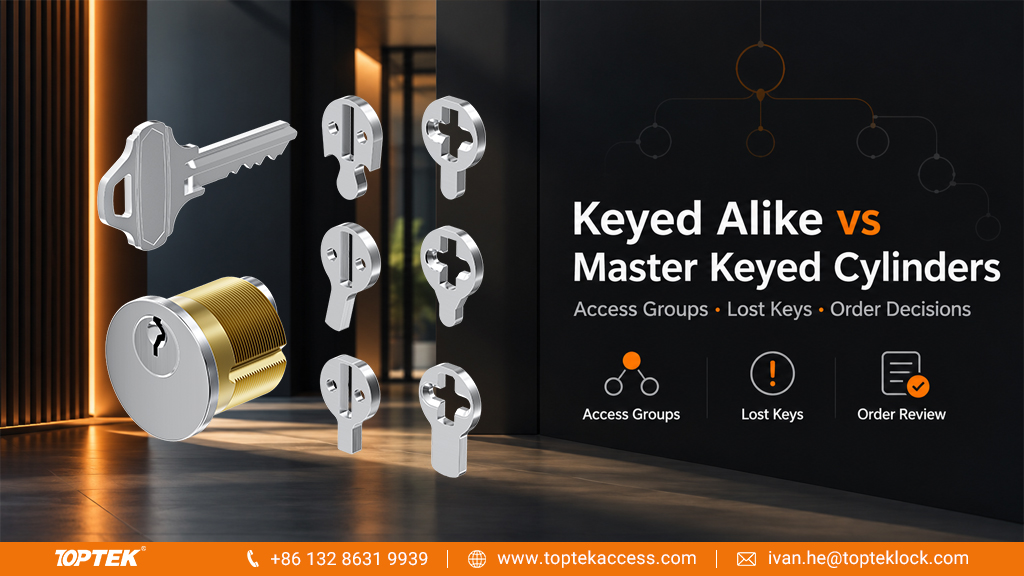
- Keyed-alike cylinders share a key within a defined group; that shared key is not automatically a master key.
- Master keying provides different access levels while retaining specified individual or group keys.
- Choose the access relationship before ordering the cylinder configuration.
- Check both permitted and prohibited key operation during acceptance.
Quick Answer
The difference between keyed alike and master keyed cylinders is the access relationship. A keyed-alike group uses the same key to operate its assigned cylinders. A master-keyed arrangement adds a higher-level key that operates an approved group while lower-level keys retain their specified access. Keyed-different cylinders use different keys unless a designed higher-level relationship also applies. Select the arrangement by who should enter which rooms, how a lost key will be handled and how the building may change. The cylinder body, cam, housing and lock compatibility still require separate approval.
For project buyers, a request for “one key” is incomplete. It might mean one key for every user, a manager’s key across otherwise separate rooms, or a limited group of service doors. The TOPTEK construction cylinder range is the product starting point; the access plan determines how selected cylinders should be keyed.
Describe access before choosing the terminology
Begin with roles and doors. List who needs access to each opening, who must not have access and who is authorised to change the plan. Use role names rather than personal details in an initial purchasing discussion. A storekeeper, cleaner and building manager may each need a different set of openings, even when all three work at the same address.
Keyed alike, often abbreviated KA, describes a common key relationship within a specified group. Keyed different, or KD, describes different key combinations. Master keying, or MK, adds an approved hierarchy. ABLOY’s keying terminology makes these distinctions and also separates central locking, where different keys operate a common lock. These terms describe arrangements; they do not establish compatibility between brands or cylinder platforms.
Do not use “master key” as a casual label for any key that opens several doors. That wording can result in every cylinder being supplied alike when the intention was to preserve room separation. Write the intended access in plain language, then let the responsible system designer translate it into the approved keying arrangement.
Compare the arrangements against the building’s needs
| Arrangement | Access relationship | Buyer question |
|---|---|---|
| Keyed different | Separate keys for separate cylinders | Must each room remain independently accessible? |
| Keyed alike | A shared key operates the specified group | Should every holder access every door in that group? |
| Master keyed | Approved higher-level access above individual or group keys | Who needs broader access without giving it to everyone? |
| KA group within an MK plan | Selected doors share a lower-level key within a designed hierarchy | Can the chosen platform support the required relationships? |
A small group of cupboards used by the same authorised team may suit keyed alike. Separate tenant rooms with manager access may call for a master-keyed arrangement. These are illustrative access decisions, not a recommendation to use one system in every building. Security requirements, tenancy responsibilities and the owner’s operating procedures should determine the actual plan.
Physical key count is only one consideration. Ask who can request additional keys, who records their issue and what happens when a role changes. A convenient arrangement with unclear authorisation can become difficult to manage. Keep access scope, duplicate-key control and cylinder performance as separate parts of the specification.
Test the choice with a simple access example
Consider an illustrative facility with two private offices and a shared store. Office users need their own room; a facilities manager needs both offices. If all three doors are simply keyed alike, every holder of that common key can operate every cylinder in the group. That arrangement does not preserve the separation between offices.
A designed master-key plan could give each office its own lower-level key and provide broader manager access. The shared store still needs a separate decision: should both office keys operate it, should only the manager enter, or should it have a dedicated group key? Do not assume that the store’s relationship follows automatically from the office hierarchy.
Write a small access matrix with roles as rows and doors as columns. Mark each intersection allowed or not allowed, and resolve blanks before design approval. The matrix is a statement of intended access, not a set of key-cutting instructions. Keep detailed security codes in the authorised system record.
For the next stage, the project cylinders and master key systems guide gives broader procurement context. Preserve the chosen relationship when converting it into door numbers, hardware references and quantities.
Evaluate a lost key before approving a large group
A lost mechanical key may continue operating the cylinders for which it was made until the affected access is changed. With a keyed-alike group, identify every cylinder operated by that key. With a master key, identify the full scope of the relevant level. The response depends on the actual system and security assessment; it is not necessarily confined to the door where the key was last used.
Before ordering, ask who owns the incident decision, who can authorise rekeying or replacement and how affected openings will be identified. Avoid assigning broad access simply because it reduces the number of keys on a ring. A narrower group may better match the work people actually perform.
A master-keyed arrangement is not inherently a claim of higher resistance to physical attack. Likewise, “restricted key” is not another name for “master keyed.” Confirm the cylinder’s security evidence and the key duplication rules separately. Do not infer a patent, restricted blank supply or certification from the keying description alone.
Keep mechanical fit independent of key relationships
Two cylinders can participate in an approved key plan while using different physical formats. Conversely, two cylinders that fit the same lock may not belong to the same compatible key system. Record the profile, keyway or platform, actuator, dimensions, retention method and receiving lock for every cylinder type. Cross-format proposals need specific compatibility confirmation.
TOPTEK’s catalogue presents project master-key systems and distinguishes factory assembly from component supply for local locksmith assembly. The appropriate route depends on the agreed system and responsibilities. A multi-format diagram is a discussion aid, not permission to combine arbitrary third-party cylinders or existing keys.
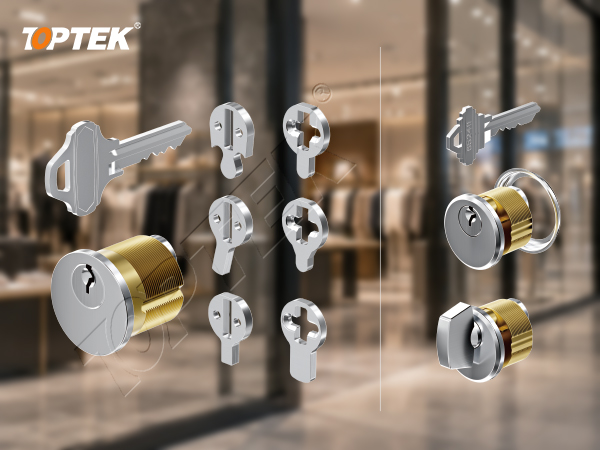
On an interchangeable-core system, distinguish the key used for ordinary operation from any key used to remove or install the core. A control function is not the same as a master-access level. Name the required operation in the order and have the applicable core and housing arrangement confirmed by the supplier.
Accept the intended access and reject unintended access
A sample that opens with the manager’s key proves only part of the requirement. Acceptance should also check that each lower-level key operates its assigned cylinders and does not operate cylinders outside its authority. Ask the system designer to define the test scope and record the approved matrix revision used for the check.
Use controlled identifiers on samples, keys and packaging. Reconcile those identifiers with the order before testing. Keep a result for each required relationship, including unexpected operation and failure to operate. Avoid broad labels such as “all keys checked” when the actual test covered only one representative cylinder.
After installation, repeat the required operating checks on the completed openings under the site’s authorised procedure. A cylinder that worked on a bench can behave differently if its actuator or retention is installed incorrectly. Separate a keying mismatch from a mechanical installation fault so the corrective action addresses the cause.
TOPTEK scope, common mistakes and evidence requests
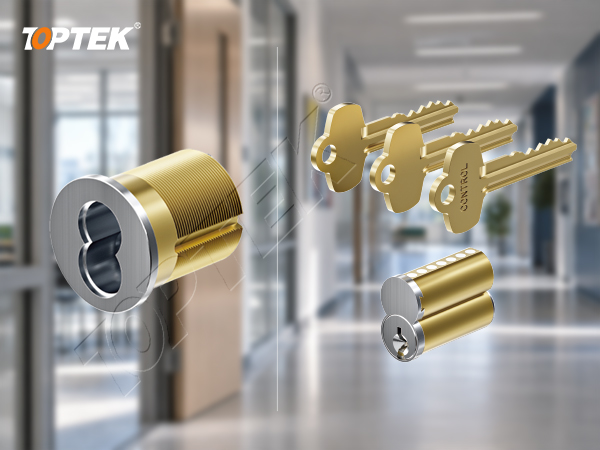
The TOPTEK SFIC mortise cylinder page lists keyed-alike, keyed-different and master-keyed options. Confirm the selected core, housing and keying arrangement in the quotation. This product-specific availability does not establish unlimited hierarchy capacity or compatibility with an existing third-party system.
Common purchasing errors include using KA without naming the group, calling a shared key a master key, assigning a manager key without defining its scope and requesting an extra cylinder without its system reference. Another risk is approving only successful openings and omitting prohibited combinations. These errors can create unintended access or expensive replacement work.
Why TOPTEK? Buyers can discuss cylinder formats and project key-management requirements within the same product review. Ask for configuration-specific documents and acceptance records through the quality management enquiry route. Keep the agreed responsibilities clear when a local locksmith completes assembly or keying.
Buyer checklist and RFQ information
For an initial discussion, send a simplified, non-sensitive access matrix and the required cylinder formats. Ask whether the proposed relationships can be supported before supplying protected system data. A commercial door hardware RFQ should then include:
- Door references, cylinder formats and receiving lock or housing details.
- Keyed-alike group boundaries and any master-key relationships.
- Allowed and prohibited access, approved by the system owner.
- Existing system references, supplied through an authorised channel.
- Cylinder and key quantities, spare requirements and future additions.
- Factory or local assembly responsibility and acceptance procedure.
- Key issue, replacement authority and lost-key response responsibilities.
Request a written response identifying exclusions and unresolved interfaces. Future expansion should be assessed with the system designer rather than assumed from the current number of doors. Preserve the final plan revision with the order so later additions do not silently change the original access boundaries.
Frequently asked questions
What is the difference between keyed alike and master keyed cylinders?
Keyed-alike cylinders share a key within a defined group. Master-keyed cylinders support an approved higher-level key while retaining specified individual or group access.
Is a key that opens several doors always a master key?
No. It may simply be the common key for a keyed-alike group with no separate access hierarchy.
Can a keyed-alike group be part of a master-key system?
It can be included when the selected platform and system design support the required relationships. Confirm the exact arrangement before ordering.
Does master keying prove a cylinder has higher security certification?
No. The access hierarchy, resistance to attack and key duplication controls are separate specification questions.
What should be checked during acceptance?
Check authorised operation, prohibited operation, physical fit, identifiers and quantities against the approved access matrix and cylinder schedule.
Choose the access relationship before placing the order
Keyed alike simplifies access within a defined group. Master keying adds differentiated authority when the project needs it. Choose using the people, doors and incident responsibilities involved, then confirm the physical cylinder configuration and test the agreed relationships.
For a formal quotation, contact ivan.he@toptekaccess.com with a non-sensitive door list, access groups, cylinder formats and quantities. Request an assessment of the proposed arrangement and an authorised route for any protected system information. TOPTEK is your Commercial Door Hardware Reliability Solution.