

TL;DR
- Identify the complete lock code and door construction before selecting the evidence.
- Read product classification, fire-test results and installation details as separate parts of the decision.
- Keep timber and steel doorset results separate, including the recorded performance criteria.
- Document any difference between the proposed construction and the permitted scope.
Quick Answer: How should buyers check EN fire door mortise lock evidence?
Compare the exact lock model, door construction, hardware arrangement and installation details with the applicable report and supporting documents. Check the report number, revision, test method, specimen description, results and permitted application. An EN 12209 product certificate does not by itself approve every doorset using that lock. A fire door lock manufacturer should help connect the proposed configuration to its evidence, while the doorset supplier and project reviewer resolve whether it is suitable for the intended opening. Keep missing matches and accepted differences in a written register.
Build a document chain around the proposed lock
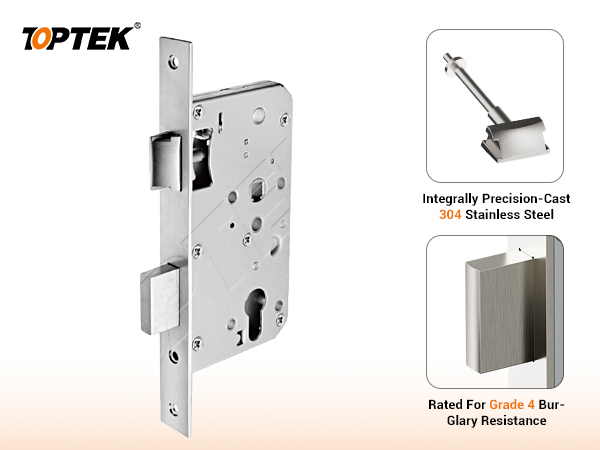
The model mapping is the starting point because a short catalogue name may represent several configurations. TOPTEK’s EN 12209 mortise lock range includes different functions and dimensional arrangements. Record the full code from the quotation, then compare it with the product documentation and the model references in the relevant evidence.
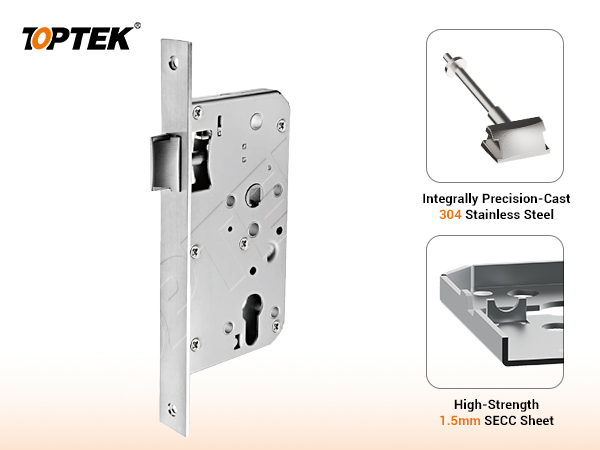
For example, the EN72SL sash mortise lock page identifies a product family. The project record should go further by identifying the ordered variant, function, backset, centres, forend, cylinder and strike. A family illustration is useful for communication, but it does not establish a match to every code appearing in a report.
Give the proposed configuration a revision and attach its drawing. Then collect the relevant product certificate or declaration, fire-test report, classification or assessment where applicable, and installation instructions. Keep each document’s purpose visible in the index. This prevents a mechanical durability result from being used to answer a fire-resistance question it does not resolve.
Use an evidence matrix with explicit limits
An evidence matrix should connect each project requirement to a named document and a specific comparison. Keep the status of the project decision separate from the existence of the document.
| Evidence layer | Compare with the proposal | Limit to preserve |
|---|---|---|
| Product identity | Model, function and drawing revision | A similar family name is not a full match |
| Product classification | Applicable characteristics and model scope | Lock performance is not whole-door approval |
| Fire-test report | Specimen, method and recorded results | Results concern the described construction |
| Application or assessment | Permitted changes and conditions | Do not invent an extension from resemblance |
| Installation details | Pocket, fixings, protection and strike | Fit alone does not establish suitability |
| Project decision | Opening, reviewer and accepted revision | Acceptance is specific to the project scope |
The BSI EN 1634 series information identifies fire-resistance and smoke-control test subjects for assemblies and hardware. Record the actual edition stated in the evidence and the edition required by the project. Do not silently change a report’s test-method reference because a newer publication exists.
When asking a supplier for additional evidence, specify the unresolved comparison. “Please confirm that this full model code and installation are included” is more useful than “Please send another certificate.” A focused request helps the supplier return the relevant document or explain which technical question needs assessment.
Read the doorset before reading the headline result
The specimen description establishes the construction to which the result belongs. Check leaf and frame construction, leaf arrangement, dimensions, opening direction, supporting construction, lock location and the surrounding hardware. Compare these with the proposed door, not simply with the lock’s appearance.
Timber composite and steel doors can use different preparation, reinforcement, fixing and protective details. A larger test duration in one construction does not authorize transfer to another. Likewise, changing from one leaf arrangement to another can introduce a new question about meeting edges, coordination and hardware positions.
Record the actual evidence for each opening group. A project using both timber and steel doors should have separate comparison rows even when the lock supplier and commercial family name are the same. This makes exceptions visible and prevents one accepted configuration from becoming an undocumented default for the whole building.
Use the related guide on reading an EN 1634-1 mortise lock test report when reviewing individual report sections. The final procurement record should retain the full applicable documents, including construction details and limitations, rather than isolated result pages.
TOPTEK evidence example: keep criteria and constructions separate
TOPTEK’s EN evidence includes separate Intertek reports for defined timber composite and steel doorset configurations. Reports 260119007SHF-002 and 260119007SHF-003, issued on 22 May 2026, identify EN 1634-1:2014+A1:2018 as the test method and list the relevant lock models within their scope.
Report 260119007SHF-002 records a timber composite doorset test with integrity and insulation results of 132 minutes without failure at the point the test was discontinued. Report 260119007SHF-003 records the steel doorset’s integrity criteria at 260 minutes without failure, while insulation is recorded as N/A. These statements describe the respective reports; they are not a universal rating for every TOPTEK lock or every door.
The useful buying lesson is to preserve the result’s criteria as well as its duration. Do not rewrite the steel result as 260 minutes of insulation performance. Do not apply the timber result to an unreviewed leaf, frame, preparation or hardware combination. Request the complete report and confirm the proposed model and allowed application before specification.
The TOPTEK fire door lock supplier resource provides the starting point for that document review. Keep a product certificate and a doorset test report distinguishable: they serve different roles, and neither should be reduced to an unrestricted badge.
Match installation details and resolve deviations
The installation comparison should show how the selected lock sits in the proposed door and how the adjacent components are fixed. Identify the pocket, forend, strike, fixings, cylinder opening and any specified protective materials. Copy relevant requirements from the applicable instructions and evidence into the controlled drawing references.
Ask the doorset supplier to address changes in machining, reinforcement or protective details before cutting a production leaf. A lock that fits a pocket can still differ from the documented construction. Conversely, a proposed difference may have an accepted application route, but that route needs a document rather than a guess.
If you need an initial comparison, email the full lock code, door construction and one preparation drawing to ivan.he@toptekaccess.com. TOPTEK can identify the relevant product information and the evidence questions that need to be addressed. An existing lock photo can start identification when drawings are unavailable.
Common evidence mistakes and practical corrections
Evidence mistakes usually arise when a useful statement is expanded beyond its original scope. Correct them by restoring the link between the proposed product, documented construction and required decision.
- Using only a certificate cover: retain the model schedule and conditions so the ordered variant can be checked.
- Comparing duration alone: record integrity, insulation and other stated criteria separately.
- Transferring steel evidence to timber: request the applicable construction-specific document.
- Assuming any latch function is acceptable: confirm the required door operation and evidence for the selected function.
- Substituting accessories after sampling: review changed cylinders, strikes, fixings and protective details before release.
- Treating a development test as certification: identify the issuer and purpose of each record accurately.
Keep a simple issue log with the opening number, discrepancy, evidence requested, responsible reviewer and outcome. An unresolved construction difference should remain visible until a documented decision closes it. This prevents purchasing and production teams from interpreting an incomplete comparison as permission to proceed.
RFQ checklist and buyer release controls
The RFQ should define both the physical lock and the evidence needed for the project. This helps suppliers distinguish an identification request from a request to quote an accepted configuration.
- Destination market, specification references and project approval route.
- Opening identifiers, required performance and doorset manufacturer.
- Timber, steel or other construction, leaf arrangement and preparation drawings.
- Full lock code, function, dimensions, trim, cylinder and strike.
- Requested reports, declarations, certificates or assessments and their required scope.
- Sample quantity, expected batch volume, finish and delivery programme.
Before production release, check the model mapping, drawing revision, installation details, evidence references and disposition of differences. Retain the approved sample identity with the purchase order. If a component or construction changes, reopen the affected comparison rather than relying on the earlier acceptance.
Why TOPTEK for coordinated product and evidence review?
TOPTEK combines a defined European mortise lock range with product drawings and model-specific test documentation for procurement discussion. This gives buyers a practical basis for comparing the lock function, physical interfaces and available evidence in the same review.
The company’s quality-management information adds context for production controls. Ask how the quoted configuration, sample and production records are linked. Manufacturing controls support consistency; the suitability of a particular fire-door application remains dependent on the applicable documents and accepted construction.
Frequently asked questions
Does EN 12209 evidence approve a complete fire doorset?
No. Product evidence for the lock must be considered alongside the applicable doorset evidence, installation details and project requirements.
Can a steel-door result be transferred to a timber door?
Do not assume that transfer. Obtain evidence or an accepted application route covering the proposed timber construction and hardware arrangement.
What does insulation marked N/A mean for procurement?
It does not establish an insulation result. Preserve that limitation and obtain the evidence required for the project’s insulation requirement.
Is a short catalogue model name enough?
No. Map the complete ordered variant and its configuration to the exact model references and conditions in the applicable documents.
What should happen when a fixing or protective detail changes?
Compare the change with the permitted application and obtain the necessary documented disposition before production preparation or installation.
Request a doorset evidence comparison
Effective EN fire door mortise lock evidence keeps product identity, construction, results and installation connected. Start with your proposed lock and doorset, then resolve differences before buying. For a formal TOPTEK quotation, send the evidence requirement, controlled drawings, function, finish and quantities to ivan.he@toptekaccess.com.
TOPTEK supplies commercial locks, lever handles, cylinders, hinges and related door hardware for project procurement. TOPTEK is your Commercial Door Hardware Reliability Solution. TOPTEK: Smart Design. Strong Security.