

TL;DR
- Identify the doorset, destination jurisdiction and project evidence requirement before requesting a price.
- Separate lock-performance requirements from evidence for the fire-resistant doorset.
- Describe inside and outside operation, dimensions, oval-cylinder interface and trim.
- Give every quotation assumption and proposed substitution a written disposition before ordering.
Quick Answer: What should the RFQ contain?
An Australian fire door mortice lock RFQ needs the project location, doorset identification, required performance, complete lock configuration, preparation drawings and an explicit evidence request. Include function, backset, door thickness, cylinder, trim, strike, quantities and the person responsible for approval. AS 4145 lock-performance information should be considered separately from the doorset’s fire evidence. Ask a fire door lock manufacturer to identify the documents applicable to the proposed model and installation. Confirm the project’s adopted requirements and acceptable evidence with the doorset supplier and relevant reviewer before releasing manufacture.
Define the doorset and approval route first
The doorset requirement gives the lock quotation its technical context. Record the project state or territory, building application, opening identifiers and the specification revision supplied by the project team. Ask the responsible reviewer to confirm the applicable code and standards editions, including any project-specific conditions.
The ABCB NCC 2022 Specification 12 guidance describes the relationship between AS 1905.1 fire-resistant doorsets and testing to AS 1530.4. That is a reference to the named NCC edition, not a statement that it is the adopted edition for every Australian project. Use the project’s confirmed requirements and avoid copying a generic fire-resistance level into every RFQ.
Describe the door leaf, frame, construction, leaf arrangement, required performance and manufacturer. Include the doorset’s identification or relevant evidence reference where available. If the opening already exists, provide clear photos of its identification and hardware, together with the available maintenance or installation records.
For product selection, start with the TOPTEK AS 4145 mortise lock range. The category provides a product route. Suitability for the proposed fire door must be established from the exact configuration and applicable evidence, rather than inferred from the regional product name.
Separate lock performance from doorset fire evidence
A well-structured RFQ asks suppliers to identify which document supports each requirement. This makes it easier to see whether a quotation is technically comparable or depends on an unresolved assumption.
| RFQ requirement | Information to request | Buyer decision |
|---|---|---|
| Lock performance | Model-specific evidence against the specified requirements | Does it address the lock-performance request? |
| Doorset fire suitability | Applicable test or assessment and installation scope | Does it cover this doorset and hardware? |
| Operating function | Inside and outside behavior with selected cylinder and trim | Does it match the opening requirement? |
| Physical compatibility | Controlled lock, strike and preparation drawings | Can it be installed within accepted details? |
| Commercial supply | Quantity, finish, lead time and documentation deliverables | Are all suppliers quoting the same package? |
The ABCB explanation of assessment methods describes documentary evidence as one means of supporting a compliance decision. The form and scope of evidence still need to suit the applicable requirement. Ask the project reviewer which documents are acceptable instead of instructing the supplier to supply an undefined “Australian certificate”.
Keep management-system certificates, internal development records and independent product evidence in separate sections. A factory quality system can support confidence in controlled production, but it does not supply the missing technical link between a particular lock and a particular doorset.
Specify the function before choosing the trim
The function description should explain how the door operates in ordinary use and how occupants leave. State what the outside lever does, what the inside lever does, how the key or thumbturn changes access, and which parts retract during each operation. Have the responsible project team establish the required arrangement.
TOPTEK’s Australian mortice lock family includes mechanical, motor and solenoid product paths. Identify which route the RFQ concerns. A mechanical configuration should not be treated as documentary proof for an electrified version simply because they share a similar form. For electrical options, add the system interface and operating requirements to the review package.
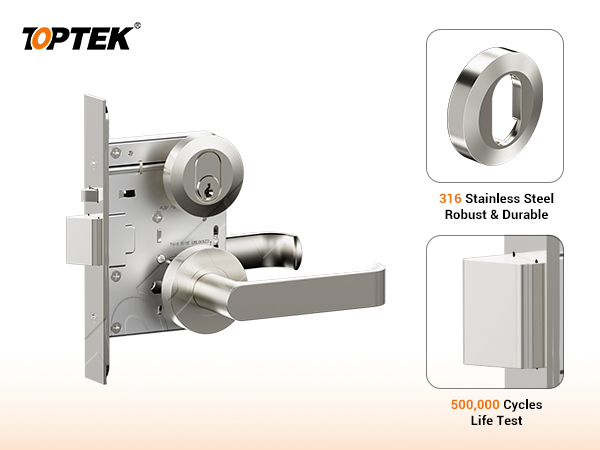
For mechanical hardware, name the oval-cylinder requirement and any keying constraints. Record whether the selected trim is a wide escutcheon or round-rose arrangement. A change in appearance can also change fixing or preparation details, so it belongs in the drawing comparison.
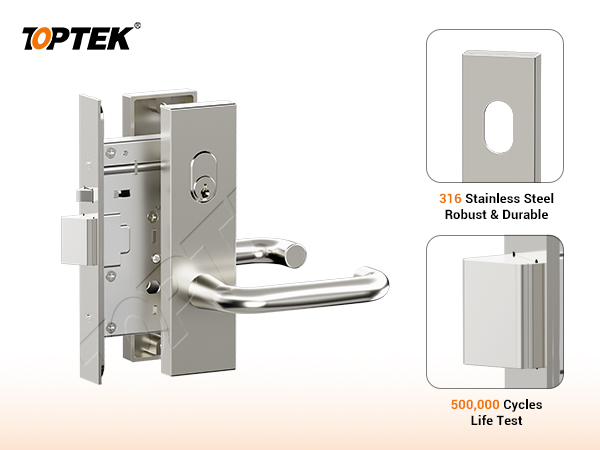
The TKAU6400EC product page provides a concrete configuration reference. Confirm the current order designation in the quotation and ask the supplier to reconcile any different code used in an older drawing or document.
Coordinate dimensions with the accepted preparation
Dimensional review should establish whether the proposed lock can be installed within the doorset’s accepted construction. Measure from defined reference points and identify the source drawing for each value. Avoid comparing photographs or measuring a printed image without checking scale.
TOPTEK’s Australian family includes backset options of 60 mm, 89 mm and 127 mm. Treat those as product-selection dimensions, not a statement that every backset is approved in every fire door. The related Australian mortice lock backset guide helps structure the dimensional discussion.
Alongside backset, record door thickness, lock pocket, forend, strike position, cylinder projection and lever fixing pattern. Compare reinforcement and any protective details with the applicable doorset information. Changing a hole position to accommodate new trim should trigger a review of the preparation, even if the old holes will be hidden.
If only basic information is available, send a door-edge photo, a trim photo, door thickness and the target backset to ivan.he@toptekaccess.com. TOPTEK can help identify a product path and explain what further drawings or evidence questions are needed before a firm specification.
Ask suppliers to return a comparable quotation
A comparable quotation identifies both what is included and what still needs a project decision. Ask every supplier to respond against the same configuration schedule and evidence list. Do not compare a lockcase-only price with a package that includes trim, cylinder, strike and documentation.
For each opening group, request the complete order code, function description, drawing revision, included components, finish and quantities. Add sample terms, production lead time, packaging identification and the requested document deliverables. Ask the supplier to mark any proposed alternatives clearly rather than substituting them silently.
Keep a separate assumptions column. For example, the supplier may need the doorset manufacturer to confirm an installation detail, or the buyer may still need to select a cylinder arrangement. Assign each unresolved item to a named party and define what response is required. This makes the quotation useful for planning without mistaking an assumption for acceptance.
Common mistakes and how to prevent rework
The RFQ should expose foreseeable mismatches before they become machining or purchasing decisions. Several recurring procurement errors can be avoided with a short written comparison.
- Requesting “fire-rated” without a doorset: add the construction, evidence reference and project performance requirement.
- Using AS 4145 as the entire fire specification: state the separate doorset evidence request and identify the reviewer.
- Approving a different backset by appearance: compare preparation drawings and permitted installation details.
- Changing from plate to rose without checking fixings: review the hole pattern and door construction before ordering.
- Borrowing another market’s approval: ask for the evidence route accepted for the Australian project.
- Omitting electrical configuration: identify motor or solenoid options and their interfaces explicitly when required.
The consequence is often a delayed review rather than an obviously defective component. A lock may operate on a bench while the proposed installation remains unresolved. Separate sample operation from the evidence decision so that a successful demonstration does not prematurely release the production order.
RFQ checklist and sample approval sequence
Send a structured package that lets the supplier identify the proposed hardware and the project team assess its use. Include:
- Project state or territory, specification revision, approval route and reviewer.
- Opening schedule, doorset manufacturer, construction and required performance.
- Mechanical or electrical operation and plain-language function description.
- Backset, door thickness, lock pocket, forend, strike and fixing drawings.
- Oval-cylinder, keying, lever trim, finish and accessory requirements.
- Applicable evidence references and documents requested with the quotation.
- Sample and production quantities, delivery stages and replacement expectations.
Review the documents first, then compare a representative sample with the agreed drawing and function. Record the exact sample identity and configuration. After the responsible reviewer resolves the doorset and evidence questions, link the accepted revision to the purchase order. Keep changes visible throughout production and delivery.
For receiving inspection, check order identifiers, supplied components and document revisions against the released package. Retain the identification needed for future replacement. The installer should receive the applicable instructions rather than a generic leaflet selected solely by product family.
Why TOPTEK for Australian project coordination?
TOPTEK offers defined Australian mortice lock and trim configurations that give buyers a practical starting point for function, dimension and sample discussions. Its commercial door hardware manufacturing information explains the broader supply context. Keep that supplier assessment separate from acceptance of the individual opening.
For fire-door procurement, use the TOPTEK fire door lock evidence review route to request the documents applicable to your proposed configuration. Confirm the exact model and documented test or assessment scope before specification. Product-family descriptions and successful applications elsewhere do not establish universal Australian fire-door suitability.
Frequently asked questions
Does an AS 4145 description prove fire-door suitability?
No. Request the applicable lock-performance information and separately establish suitability for the proposed fire-resistant doorset and installation.
Should the RFQ include the doorset manufacturer?
Yes. Include the doorset identity and available evidence references so the lock configuration can be compared with its accepted construction.
Are all available backsets interchangeable on a fire door?
No. Compare the selected backset and preparation with the applicable doorset documents before machining or ordering.
Can a mechanical lock document cover a motor version?
Do not assume so. Identify the exact electrical configuration and request evidence and installation information applicable to it.
What is enough to begin an initial product enquiry?
Start with the project location, door photos, basic dimensions, required function and quantity, then add the doorset documents needed for review.
Request a project-specific quotation
A useful Australian fire door mortice lock RFQ connects the doorset, function, interfaces and evidence before comparing price. Send your opening schedule for an initial product discussion. For a formal quotation, add the accepted preparation, cylinder and trim requirements, document list and quantities, and email ivan.he@toptekaccess.com.
TOPTEK supplies commercial locks, lever handles, cylinders, hinges and related door hardware for project procurement. TOPTEK is your Commercial Door Hardware Reliability Solution. TOPTEK: Smart Design. Strong Security.