
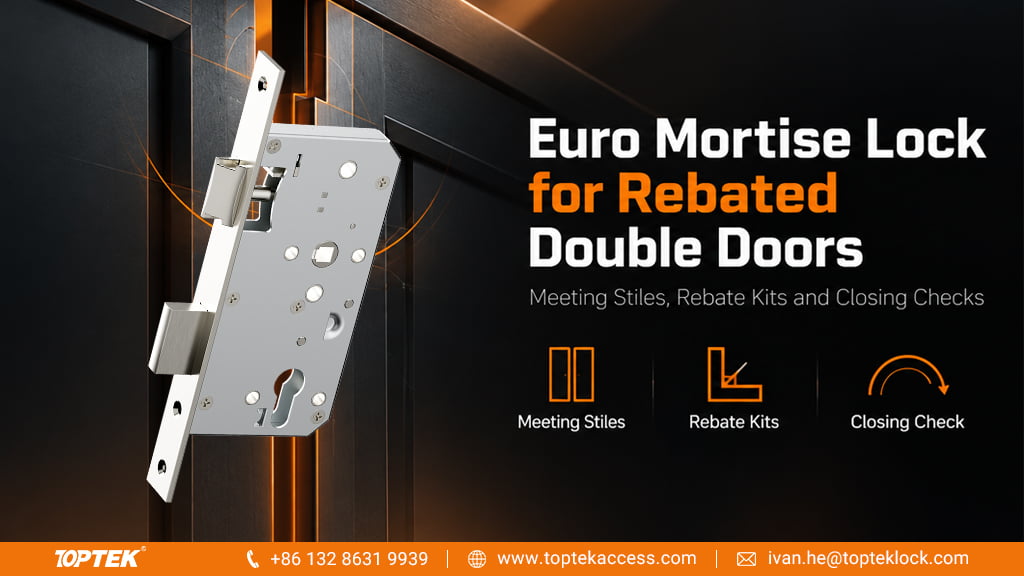

TL;DR: specify the meeting stiles as an assembly
- A rebated double door has overlapping meeting-edge geometry; show both leaves in the lock enquiry.
- Identify the normally active leaf, the supporting leaf and their intended closing order.
- A rebate kit must match the named lock and door detail. Similar finish or nominal size does not establish compatibility.
- Check the latch, bolt, strike, overlap and seals together on a representative pair before releasing repeat door preparation.
Quick answer: how do you choose a Euro mortise lock for rebated double doors?
Choose a Euro mortise lock for rebated double doors by coordinating the lock function with the two meeting stiles, their overlap, the strike arrangement and the closing sequence. Provide a dimensioned section through the closed leaves and identify which leaf normally operates. Where a rebate kit is proposed, obtain confirmation that it fits the exact lockcase and door geometry. A lock suitable for a single leaf is not automatically a complete double-door solution. Confirm the whole assembly, including any inactive-leaf hardware, before machining doors or ordering repeated sets.
This guide focuses on the junction between two moving leaves. A general lockcase drawing can show backset and centres clearly while still leaving this junction unresolved. For door manufacturers and hardware buyers, that missing relationship is often the most useful detail to settle first.
Draw both leaves and define their roles
Start with a plan section through the closed doors at lock height. Label the opening direction, the leaf normally used for passage, the other leaf and the reference side. Show the overlap rather than relying on the word rebated. The supplier needs to understand where the latch approaches its receiving surface and how the leaves meet.
Also distinguish a machined rebate from an applied meeting-stile component or astragal. They may look similar from the corridor, but their fixing, thickness and interaction with the hardware can differ. Include the actual profile drawing and part references instead of requesting a generic double-door lock.
| Drawing item | Information to include | Decision it supports |
|---|---|---|
| Leaf roles | Normally active leaf, other leaf and opening direction | Lock location and intended daily operation |
| Meeting profile | Overlap, steps, face levels and relevant clearances | Rebate component and strike geometry |
| Lock function | Required latch and deadbolt behaviour | Correct lockcase and receiving arrangement |
| Supporting leaf hardware | Its securing method and release sequence | Whether the receiving side is stable during use |
| Seals and other hardware | Positions and supplied installation details | Interference and closing-sequence review |
Use consistent units and identify whether dimensions describe the bare door, finished door or installed assembly. A finishing layer or added profile can alter the relationship at the meeting edges even when the nominal leaf thickness stays unchanged.
Understand what a rebate kit can and cannot establish
A rebate accessory adapts a particular mortice arrangement to a rebated junction. UNION explains this general use in its locks questions and answers. Its 3K74 rebate kit information names compatible lockcases, illustrating why accessory selection is product-specific.
Those examples do not establish compatibility with a TOPTEK lock. For a proposed TOPTEK assembly, request the exact accessory reference, applicable lockcase, installation drawing and supplied components. Do not substitute another brand’s kit simply because its finish or visible outline seems suitable.
A kit also does not answer every doorset question. It cannot by itself determine the required function, whether the other leaf is secured correctly, or whether the pair closes in the intended order. Keep those decisions visible in the schedule so that an accessory line item is not mistaken for a complete approval of the opening.
Match the lock function to the way the pair is used
Define the everyday operating sequence before choosing a lockcase. Does normal passage use one leaf? When is the second leaf released? Is key locking required at this opening, or is the requirement simply to retain the active leaf in its closed position? The answers affect the hardware combination and the information needed for the receiving side.
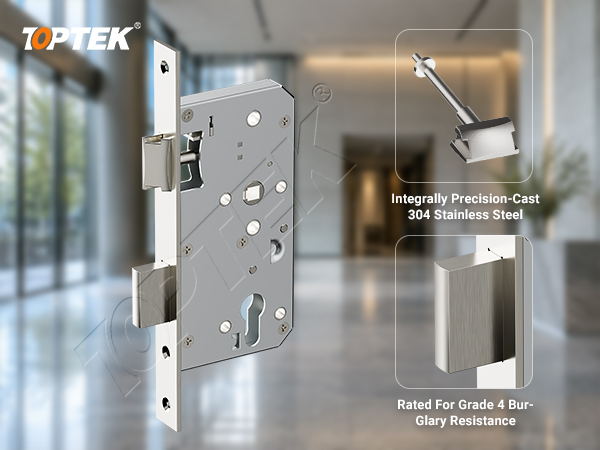
The TOPTEK Euro mortise lock range includes different functions. The EN72SL sash mortise lock is a reference for a latch-and-deadbolt discussion; EN72LL is a passage-function reference. Selecting either name does not confirm a rebate accessory or complete paired-door compatibility.
Where both leaves must serve a particular escape or access function, have the responsible project designer define the operating requirements and applicable evidence. Do not infer emergency-use suitability from the presence of a lever or a familiar lock profile. The function must remain clear when the second leaf is in normal use, released for wider access or returned to its secured position.
Review closing order, strike support and interference
The receiving side of a paired opening is itself a moving leaf. Its position and securing arrangement therefore matter to latch and bolt engagement. Ask the door supplier to show how the supporting leaf is located in its normal closed position and how that position is maintained.
Check the intended closing order against the overlap. Do not assume that either leaf can always close first. If the design uses a closing coordinator or other sequencing hardware, identify its model and intended relationship with the leaves. Obtain the appropriate doorset requirements rather than adding sequencing hardware solely because the opening has two leaves.
During assembly review, consider the strike or keeper, projecting bolt paths, rebate components, seals and meeting-stile fixings together. Look for contact that could prevent a leaf reaching its intended closed position. Record the observed contact and ask for a drawing-based correction; avoid treating extra closing force as a solution.
Use a representative pair for practical verification
A bench check of the lock alone cannot reproduce the geometry of two hung leaves. For a new configuration, ask for a representative assembly using the specified profiles, lock, accessory, receiving hardware and relevant seals. Record the drawing revisions and supplied parts so that the findings remain meaningful for the order.
- Identify both leaves and confirm the agreed reference side.
- Compare the meeting-edge section with the assembled profiles.
- Check normal closing in the intended sequence without forcing.
- Observe whether the latch reaches its intended receiving position.
- Where fitted, verify the deadbolt operation with the pair correctly closed.
- Release and return the second leaf through its intended operating sequence.
- Record contact, movement or incomplete operation for correction and recheck.
These are proposed coordination checks, not a substitute for a required test standard or a declared performance assessment. Agree the project’s acceptance criteria with the responsible parties. Keep the sample record specific enough that later changes to seals, profiles or accessory parts trigger a meaningful review.
For repeat orders, photograph the accepted meeting detail from the same reference side used on the drawing. Include an overall view as well as close views. An isolated image of a rebate plate can omit the leaf relationship that made the sample work.
Common ordering mistakes and how to prevent them
Ordering only a rebated strike is a common source of ambiguity. The supplier may still need the lock function, overlap orientation and complete meeting-edge section. Describe the assembly rather than relying on a short accessory name.
Another mistake is treating left and right as self-explanatory. State the viewing side and show an opening arrow. Pair drawings should use the same convention as the door schedule, hardware schedule and supplier’s installation information.
A third mistake is assuming that a functioning sample with temporary seals represents the final doorset. Changes to seals or meeting profiles may alter contact and closing behaviour. Record what the sample actually contained and compare it with the production bill of materials.
Fire or smoke suitability must come from applicable doorset evidence covering the relevant arrangement. A component marking, accessory description or isolated test claim should not be expanded to every double-door configuration. Ask the responsible supplier to identify the scope and any installation limitations for the proposed opening.
Why TOPTEK: connect the enquiry to an identifiable assembly
A useful TOPTEK enquiry combines the desired Euro lock function with the door pair’s section, accessory request and sample requirements. This gives the commercial discussion a defined mechanical scope instead of leaving the receiving side for the installation team to improvise.
TOPTEK’s quality management information describes production inspection stages. For this application, ask which drawing, parts list and inspection record will identify the supplied assembly. General process controls do not replace confirmation of the particular rebate arrangement.
The Euro mortise lock RFQ checklist can structure the overall enquiry. When comparing commercial door hardware supply proposals, check whether each quotation covers the same lock, rebate accessories, receiving components and documentation.
RFQ checklist for a rebated double-door project
- Project market, door numbers and quantities by configuration.
- Dimensioned meeting-stile section with opening directions and leaf roles.
- Door construction, finished thickness and overlap detail.
- Required lock function, cylinder and lever arrangement.
- Proposed rebate accessory and receiving hardware references.
- Supporting-leaf securing method, seals and sequencing hardware.
- Applicable doorset evidence requirements and sample acceptance scope.
- Required drawings, packing identification and delivery destination.
Ask the quotation to state what is included and what is supplied by the door manufacturer or another hardware vendor. If a compatible rebate arrangement has not yet been selected, make that a specific configuration question. Do not turn an undefined accessory into an assumed production component.
Frequently asked questions
Can any Euro mortise lock be used on a rebated double door?
No universal compatibility should be assumed. The lock function, meeting-stile geometry, accessory arrangement, receiving hardware and leaf operation must be coordinated for the exact opening.
Does a rebate kit fit every lock with similar dimensions?
No. Confirm the kit’s named compatible lockcases and installation details. Similar dimensions or finish do not establish compatibility across products or brands.
Why must the supplier see both door leaves?
The receiving side is a moving leaf whose position, overlap and securing arrangement affect the lock interface. A drawing of the lock-carrying leaf alone leaves these relationships unclear.
Does the EN72SL model name confirm a TOPTEK rebate kit?
No. It identifies a sash lock reference. Request separate confirmation of the proposed accessory and its compatibility with the exact lock and door pair.
What is the best sample for checking the meeting detail?
Use a representative pair with the specified profiles, lock, receiving hardware, accessories and relevant seals. Record its components and drawing revisions before using it to guide repeat preparation.
Request a meeting-stile review or formal quotation
A successful paired-door specification makes the junction between the leaves explicit. Define the operation, draw the overlap and coordinate the named hardware before releasing the preparation.
Send the meeting-stile drawing for a configuration discussion, including the required function and leaf roles.
Request an itemised quotation with agreed components, sample scope and quantities.