

TL;DR: identify the moving part before ordering a repair
- Separate normal key-plug rotation from movement of the cylinder body, surrounding ring or lever trim.
- Match the retention arrangement to the exact lockcase and cylinder assembly; a visible screw is not automatically the cylinder retainer.
- Record whether the symptom appeared after a cylinder change, trim replacement or door repair.
- Ask a qualified service provider to confirm the cause, then order named parts with the applicable installation document.
Quick answer: why is an ANSI mortise lock cylinder loose?
An ANSI mortise lock cylinder loose in the door may involve its retention, the supporting trim arrangement or an incompatible replacement assembly. First establish what actually moves: the key plug is intended to turn, while movement of the cylinder body or surrounding furniture needs a different assessment. Do not choose a repair from the exterior appearance alone. Identify the lock model, cylinder format, trim and recent changes, and ask the manufacturer or a qualified locksmith to review the assembly. The correct repair depends on those components and their installation instructions.
For a facilities buyer, the useful outcome is a precise service request: which part moves, under what normal action, and which documented assembly is installed. That description helps avoid replacing a functioning cylinder when the problem belongs to another component.
Distinguish cylinder, plug, ring and trim movement
The word cylinder is often used for several visible parts. In a service report, identify the central key plug separately from the outer cylinder body. Also describe the ring or collar around it and the larger rose or escutcheon. A short, clear observation is more useful than calling the entire lock loose.
| Observed movement | What to record | Question for the service provider |
|---|---|---|
| The central plug turns with the correct key | Whether the intended lock function completes normally | Is this normal operation for the specified function? |
| The cylinder body moves relative to the door | Location and direction of movement during ordinary use | Is the specified cylinder retention arrangement correctly engaged and undamaged? |
| A surrounding ring moves independently | Ring identity and whether the cylinder body also moves | Is this ring intended to move, or is its supporting assembly incorrect? |
| The whole escutcheon shifts | Whether the lever and cylinder surrounds move together | Does the furniture mounting require attention? |
| Key operation changes only with the door closed | Open-door and closed-door observations without forcing | Is door or strike loading contributing to the symptom? |
These observations organise an inspection; they do not establish a diagnosis by themselves. Avoid applying deliberate twisting force to prove that something is loose. Keep the opening under the site’s normal access controls while an authorised technician assesses it, especially if reliable securing or release is affected.
Confirm the retention method from the correct document
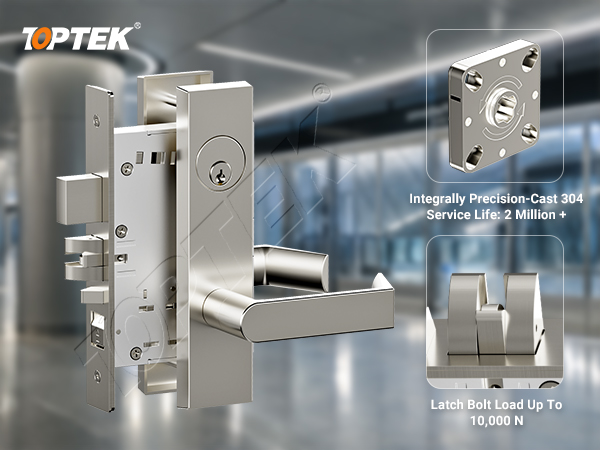
A commercial mortise assembly can contain several fasteners with different jobs. Lockcase mounting, cylinder retention and furniture fastening should not be treated as interchangeable. The drawing must identify the relevant parts and show the relationship between the cylinder, lockcase and trim.
For an example of this distinction, the Schlage L9000 indicator-trim instructions, revision 11/18-e, page 7 separately identify cylinder mounting and chassis mounting screws. That document applies to its named Schlage assembly. Use the current instructions supplied for the actual TOPTEK configuration when specifying parts or service work.
Do not infer the retainer type from a similar exterior photograph. Ask for the installation document reference, revision and applicable function. If a replacement cylinder was fitted, include its manufacturer and part number rather than describing it only as a mortise cylinder. Matching the keyway or visible finish alone does not settle mechanical compatibility.
Check the assembly history and supporting geometry
The timing of the complaint can narrow the enquiry. A symptom appearing immediately after replacement points the service provider toward the changed components and their assembly. A symptom developing during use calls for a broader inspection of retention, wear, mounting and door condition. Neither timing pattern proves a particular cause.
After a cylinder or trim change
Compare the previous and replacement part references, including any cylinder ring, spacer or trim component supplied with them. Ask whether the installed combination corresponds to a complete manufacturer-supported arrangement. Do not compensate for uncertain compatibility with improvised packing, adhesive or an arbitrary increase in tightening force.
After door refinishing or repair
Record changes to door thickness, face coverings and mounting surfaces. A retained lock can still interact differently with replacement furniture or a repaired door face. The ANSI mortise lock door preparation checklist helps organise the opening details when the door itself has changed.
For repeated complaints across several doors, compare one affected opening with an unaffected opening of the same documented configuration. Use authorised inspection records, not assumptions based on their similar appearance. Different cylinder suppliers or trim revisions can be hidden within what looks like a single hardware schedule.
Build a service record that leads to the right decision
Create one record per opening. Include a clear photograph of the whole door, a close view of the cylinder and trim, and the visible model markings. Avoid including readable key cuts or confidential key-system information in general email circulation. The supplier needs the mechanical configuration, not unrestricted access to security records.
- Give the door number, location and installed function.
- Name the moving component and the normal action that reveals the movement.
- List lockcase, cylinder and trim references, including known substitutions.
- Note installation date, recent work and previous service attempts.
- State whether normal key, lever and securing functions are affected.
- Request a documented diagnosis, compatible parts list and completion checks.
Ask the technician to record both the cause found and the work performed. A note saying tightened lock does not distinguish cylinder retention from trim mounting. A useful close-out record identifies the corrected component and confirms operation of the installed function after the work.
Where the lock belongs to a master-key system, keep mechanical replacement and key-authority decisions coordinated. A mechanically suitable replacement still needs the correct keying arrangement and authorised distribution. Have the responsible key-system contact confirm that part of the order separately.
Common mistakes and project risks
The first mistake is treating every loose-looking ring as evidence that the lockcase has failed. Some trim components have functions that are not apparent from a photograph. Confirm the part’s intended behaviour before changing it.
The second mistake is ordering a cylinder by visible length alone. The complete interface includes the cylinder format, operating connection, supporting trim and retention arrangement. A dimensional match at the door face is only one part of compatibility.
The third mistake is allowing a successful key turn to close the service request. The assembly also needs secure mounting and correct operation in its installed condition. Conversely, repeated adjustments without identifying the moving part can obscure the original complaint and increase replacement costs.
For a fire, smoke or escape-related opening, route any proposed component change through the responsible doorset and project requirements. A repair should not silently change the specified function or introduce an unsupported component. Obtain the applicable configuration evidence rather than relying on a general product-family description.
TOPTEK product references and purchasing support
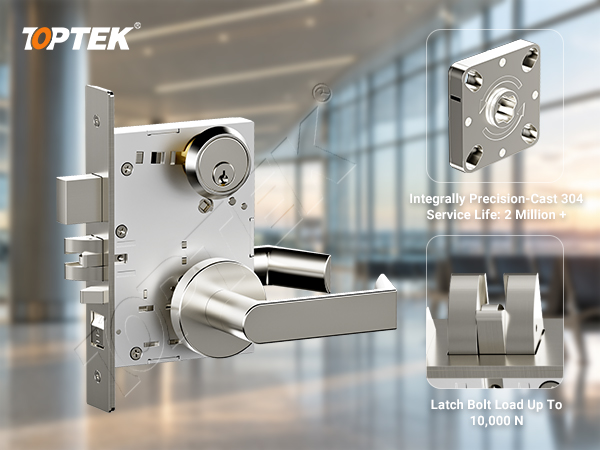
The TOPTEK ANSI mortise lock range provides the starting point for identifying the relevant assembly. The TKAMRR9200 round rose configuration and the TKAMEC9200 escutcheon configuration illustrate different furniture layouts. Neither exterior layout alone establishes the correct cylinder retainer or replacement part.
Why TOPTEK? A useful purchasing discussion connects the assembly reference with drawings, the proposed parts list and inspection requirements. TOPTEK describes first-piece, in-process and sampling controls in its quality management information. Ask which records apply to the supplied configuration; general process information is not a diagnosis of an installed door.
For a wider replacement programme, coordinate the request through the commercial door hardware manufacturing enquiry. Group orders by exact assembly and revision so that visually similar openings do not receive an unsuitable common spare.
RFQ checklist for a cylinder retention or trim enquiry
- Door schedule reference, lock function and affected quantity.
- Lockcase, cylinder, ring and trim part numbers or clear identification photographs.
- Door thickness and relevant preparation drawing, with units.
- Observed movement, operating effect and service history.
- Current installation document and requested replacement scope.
- Key-system requirements through the authorised contact.
- Sample requirement, delivery location and requested completion records.
Separate a diagnostic enquiry from a confirmed parts order. If the cause is still unknown, ask for the information needed to identify it. Once the supplier has identified the configuration, request an itemised quotation that distinguishes the cylinder, trim components and other service parts. This keeps the commercial comparison tied to a defined repair scope.
Frequently asked questions
Does a loose cylinder mean the complete mortise lock must be replaced?
Not necessarily. The issue may concern cylinder retention, supporting trim or another component. Identify the moving part and obtain a qualified assessment before choosing the replacement scope.
Is movement of the key plug the same as cylinder body movement?
No. The plug normally rotates with the correct key to operate the mechanism. Movement of the outer body or surrounding furniture is a separate observation that should be described clearly.
Can I use the same retainer on every ANSI mortise lock?
Do not assume so. Confirm the retention arrangement and compatible parts from the installation document for the exact lockcase, cylinder and trim combination.
Should a replacement cylinder be selected only by its visible length?
No. Confirm the cylinder format, operating interface, trim arrangement, retention and keying requirements as well as the relevant dimensions.
What should a supplier receive first?
Send the door reference, model information, photographs, the precise movement observed and any recent component changes. Keep confidential key-system details within the authorised communication route.
Request a configuration review or quotation
A useful loose-cylinder enquiry starts with a component-level observation and ends with a documented service decision. Identify the assembly before selecting a part, and retain the completed service record with the opening’s hardware information.
Send the assembly details for a cylinder retention review. Include the observations and photographs listed above.
Request a formal parts quotation once the required configuration and quantities are defined.