

CE Mortise Lock RFQ Checklist: Drawings, Samples, Documents and Approval Controls
Focus: CE mortise lock RFQ checklist
Author: Ivan He, TOPTEK | Technical review status: final engineering sign-off required before publication.
TL;DR
- A usable RFQ defines the door, function, interfaces, evidence route and commercial scope before price is compared.
- Approve controlled drawings before the sample; approve a production-intent assembly before mass production.
- Request model-specific certificates, DoP, reports and datasheets. A document title alone does not prove scope.
- Link the golden sample to drawing revision, BOM, finish, packaging and inspection criteria.
- No material, geometry, function, supplier, finish or evidence-affecting change should enter production without documented review.
Quick Answer
A CE mortise lock RFQ should contain five control packs: project and door requirements; the exact function and dimensional interface schedule; controlled product, strike and door-preparation drawings; a production-intent sample and approval test plan; and a document/change-control matrix covering certificates, DoP, reports, BOM, golden sample, first article, inspection and deviations. If any pack is incomplete, the quotation must list assumptions and open points rather than silently fixing the configuration.
The Five-Pack RFQ Control Map
| Control pack | Buyer sends | Supplier returns | Release gate |
|---|---|---|---|
| 1. Project | Market, application, door schedule, quantity, delivery | Scope review and open-point list | Quotation basis agreed |
| 2. Technical | Function, dimensions, trim, cylinder, strike, finish | Proposed configuration and compliance matrix | No unresolved critical interface |
| 3. Drawings | Door/frame and hardware schedule revisions | Model-specific lock, strike and preparation drawings | Signed drawing register |
| 4. Samples | Approval criteria and intended door construction | Production-intent sample, report and deviations | Signed sample record |
| 5. Documents | Required certificate, DoP and submittal list | Applicable documents, BOM and inspection plan | Technical file complete |
1. Define the Project Before Asking for Price
State the buyer, target market, building type, door locations, door and frame material, door thickness range, single or paired openings, fire/smoke/escape status, handing, swing, environment, quantity, sample quantity, annual demand, packaging, branding and required delivery. Separate mandatory tender requirements from preferences.
Price comparisons fail when suppliers quote different assumptions. One may include a sash lock, strike, screws and dust box; another may quote only a lock case. The RFQ should state package contents, Incoterm, currency, tooling, sample charges, spare-parts expectation and what is excluded.
2. Freeze Function and Interfaces
Function matrix
Describe what the outside lever, inside lever, cylinder, key, thumbturn, latch and deadbolt do in every locked and unlocked state. Include escape or access-control logic where applicable. Do not approve from a name such as “sash,” “classroom” or “night latch” without the operating sequence.
Dimension and interface schedule
- Backset and lever-to-cylinder/keyhole centre distance
- Case height, depth and thickness
- Forend length, width, thickness, end shape and screw centres
- Latch/deadbolt location, projection and strike relationship
- Follower square, spindle length, lever springing and trim holes
- Cylinder profile, A/B length, cam, keyway and keying requirements
- Door thickness, bevel, reinforcement, seals and frame condition
TOPTEK’s published EN72SL page lists 72 mm centres, backsets from 40 to 100 mm, 20/22/23/24 mm forend widths, and 8 mm or 9 mm follower options. These values show why a family name is not a purchasable specification: the RFQ must select the actual combination.
3. Drawing Approval Checklist
Use one drawing register with document number, title, revision, date, owner, status and approval signature. Each drawing should carry units, scale where relevant, datums, critical dimensions, tolerances, material, finish and model reference.
| Drawing | Critical review | Approval risk prevented |
|---|---|---|
| Lock case and forend | Envelope, axes, bolts, follower, cylinder, screws | Pocket and trim mismatch |
| Strike/keep | Lip, box depth, apertures, fixing, centre lines | Closing and locking failure |
| Door/frame preparation | Pocket, recess, holes, reinforcement, gaps | Site rework or weak fixing |
| Trim/cylinder | Spindle, A/B length, cam, through-bolts, projection | Interface conflict |
| Function diagram | Every user action and state | Wrong access or egress behavior |
“Approved” must refer to a revision. Email comments without a final consolidated drawing are not a production release.
4. Sample Approval Must Represent Production
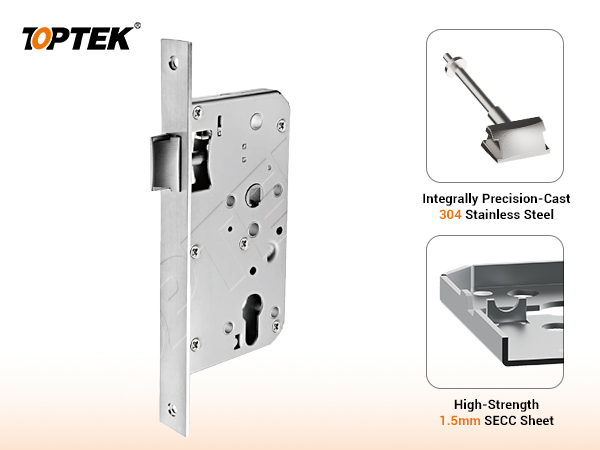
The sample should use production-intent materials, processes, finish, components, packaging labels and interfaces. If a prototype part or temporary process is used, the deviation must be written and closed with a later confirmation sample.
- Verify model, drawing revision, BOM and visible marking.
- Measure critical dimensions against the inspection plan.
- Install with the specified trim, cylinder, spindle, strike and fixings.
- Test both handings and every function state on the intended door construction.
- Check lever return, latch engagement, deadbolt throw, key withdrawal, clearances and finish.
- Record photos, results, failures, concessions and corrective actions.
- Sign the approved sample ID and retain a golden sample under controlled storage.
A golden sample is a comparison reference, not permission to ignore drawings. It must remain traceable to the approved document set.
5. Document Request and Evidence Matrix
| Document | What to verify | When required |
|---|---|---|
| Certificate | Holder, standard, model annex, classification, dates and conditions | Before technical approval |
| Declaration of Performance | Product type, intended use, declared performance and traceability | Submittal/release route |
| Test report or assessment | Exact specimen, construction, variations, limitations and issuing body | When project evidence depends on it |
| Datasheet/drawing | Model, dimensions, materials, revision and options | Quotation and sample |
| Inspection/test plan | Characteristics, method, frequency, acceptance and records | Before pilot/mass production |
| Installation instructions | Preparation, fixings, handing, adjustment and limits | Before door manufacture/site release |
TOPTEK’s Intertek certificate 2649-CPR-26002201 covers listed mechanically operated mortice locks and latches under EN 12209:2003/AC:2005 within its stated scope. It was first issued 4 June 2026 and shows expiry 31 December 2026 subject to validity conditions. The RFQ must connect the quoted model to the applicable annex and current document, not just request “a CE certificate.”
6. Production Release and Change Control
Release mass production only when the drawing register, approved BOM, golden sample, finish reference, packaging artwork, inspection plan and document matrix agree. First-article inspection should confirm the first output against these controls before the batch continues.
A change request should identify the reason, affected part/model, old and new drawing or BOM, material/process/finish impact, functional and evidence impact, stock disposition, validation required and approval owner. Supplier substitutions and “equivalent” materials are changes when they affect the agreed configuration.
7. Common RFQ and Approval Mistakes
- Sending only a photo and target price.
- Using “CE mortise lock” without exact function, model scope or project evidence expectation.
- Approving a catalogue page instead of controlled drawings.
- Testing a loose lock case rather than a complete door-set hardware combination.
- Accepting a prototype sample without recording production deviations.
- Keeping a golden sample with no revision, BOM or custody record.
- Allowing material, finish or component changes through informal messages.
8. Project Risks and Controls
| Risk | Preventive control | Release evidence |
|---|---|---|
| Wrong function | Signed state-by-state matrix | Witnessed fitted sample test |
| Door preparation mismatch | Coordinated drawing overlay | Approved door/frame revision |
| Unsupported compliance claim | Model-to-document matrix | Applicable current evidence pack |
| Sample-to-production drift | BOM, golden sample, first article | Inspection report and traceability |
| Unapproved change | Formal ECN and validation route | Buyer-approved change record |
9. TOPTEK Evidence and Product Range
Use TOPTEK’s EN 12209 mortise lock hub to identify the function family, then review the EN72SL sash lock or other exact model page. The EN 12209 buyer guide provides standard context, while the certification resource page, DoP resource page and laboratory capability page support the document route.
TOPTEK’s internal laboratory supports R&D samples, tooling samples, pilot runs and production checks. These internal controls strengthen consistency but are not described as third-party certification.
10. CE Mortise Lock RFQ Checklist
- Buyer/project, target market, application and quantity
- Door/frame material, thickness, handing, swing and fire/smoke/escape status
- Exact function matrix and lock model or approved-equivalent route
- Backset, centres, case, forend, strike, follower, cylinder and trim interfaces
- Material, finish, corrosion expectation and visible sample standard
- Controlled lock, strike, trim and door-preparation drawings
- Certificate, DoP, report, datasheet and installation-document expectations
- Sample type, quantity, production-intent deviations and approval tests
- Approved BOM, golden sample, first article and inspection plan
- Branding, labels, packaging, spare parts and shipping terms
- Change-control, non-conformance and re-approval rules
- Quotation assumptions, exclusions, open points and validity
Why TOPTEK
TOPTEK can connect RFQ review, model selection, controlled drawings, sample construction, internal verification, evidence routing, pilot approval and batch checks as one project workflow. The deliverable is not a generic promise of compatibility; it is a traceable configuration with clear buyer inputs, supplier outputs and release gates.
Frequently Asked Questions
What information belongs in a CE mortise lock RFQ?
Include the target market, door application, applicable standard and evidence expectation, exact function, dimensions, door and frame details, trim and cylinder interfaces, material and finish, quantity, packaging, drawings, sample plan, inspection criteria and required delivery schedule.
Which drawings should be approved before a sample is ordered?
Approve the lock-case and forend drawing, strike drawing, door and frame preparation, trim and cylinder interfaces, function description, dimensional tolerances and the controlled revision list.
Is a certificate enough to approve a CE mortise lock supplier?
No. Confirm the certificate holder, standard, model scope, classification, validity conditions and connection to the quoted model. Also review drawings, function, application evidence, sample performance and production controls.
What should a mortise lock sample approval test include?
Test the production-intent lock, trim, cylinder, spindle, strike and fixings in the intended door construction. Check every operating state, handing, closing, latching, locking, lever return, key operation, fit, finish and documented deviations.
What is a golden sample for mortise lock production?
A golden sample is the signed reference assembly linked to approved drawings, BOM, finish standard, labels and test criteria. It supports first-article and batch comparison but does not replace drawings or inspection records.
How should changes after approval be controlled?
Use a written change request or engineering change notice that identifies the affected model, drawing, BOM, material, finish, process, evidence and sample. Obtain buyer approval before production when the change affects the agreed configuration.
Conclusion
A professional RFQ does more than obtain a price. It creates the control chain from door requirement to configuration, drawing, sample, evidence, production and change approval. When every release gate is documented, buyers can compare suppliers on the same basis and reduce late changes, unsupported claims, installation rework and repeat-order drift.