

Commercial Door Lock Cylinder Types Guide: Matching Euro, SFIC, Mortise and Oval Formats
Focus: commercial door lock cylinder types
Author: Ivan He, TOPTEK | Technical review status: final engineering sign-off required before publication.
TL;DR
- Select the cylinder format from the lock interface, regional hardware convention, door construction and service plan—not from a product photo.
- Euro profile, SFIC, American mortise, American bored, Australian oval and Scandinavian oval cylinders are distinct platforms.
- Freeze the housing/profile, retention, cam or tailpiece, effective length, operating function and keyway before ordering a sample.
- A master key system controls authorization; it does not make incompatible cylinder bodies physically interchangeable.
- Approve a fitted, production-intent sample with the actual lock, trim and door preparation before bulk release.
Quick Answer
Which commercial door lock cylinder type should a buyer choose? Choose the format that the specified lock and trim are designed to accept. Euro profile cylinders fit Euro-profile lock preparations; SFIC requires a compatible interchangeable-core housing; American mortise cylinders use a threaded body and selected cam; bored lock cylinders fit the intended bored or key-in-lever/knob interface; Australian and Scandinavian oval cylinders must match their regional lock-case and fixing geometry. Then confirm length, operating function, keyway, master-key plan and sample evidence.
Why Cylinder Format Is a System Decision
“Cylinder” is not a complete purchasing description. A cylinder must physically fit the lock or housing, operate the correct mechanism, project correctly through the finished trim and support the required key-control process. Two cylinders can look similar yet differ in retention, profile, plug diameter, cam, tailpiece, fixing position or service method.
The buyer should therefore begin with the approved lock platform and door opening. Identify the market, door type, lock model, trim, fire or smoke requirement where applicable, access function and maintenance strategy. Only then should the cylinder format and keying plan be selected.
This guide has a deliberately narrow search intent: it helps buyers distinguish six physical cylinder formats. It does not repeat TOPTEK’s existing guides on measuring Euro profile cylinders, evaluating a cylinder supplier, designing a complete project hierarchy or comparing general security features.
Commercial Door Lock Cylinder Types: Selection Matrix
| Format | Typical lock/interface question | Buyer must freeze | Do not assume |
|---|---|---|---|
| Euro profile | Does the lock case accept the Euro profile and selected cam? | A/B length, double/knob/half function, cam, orientation | One total length fits both sides |
| SFIC | Are the core and housing compatible with the lock? | 6/7-pin platform, housing, keyway, control key, cam/tailpiece | Any IC core fits any housing |
| American mortise | Does the threaded body and cam operate the mortise hardware? | Threaded interface, length, cam, collar/trim, keying | Any cam produces the required function |
| American bored | Does the cylinder fit the intended bored lock chassis or trim? | Housing shape, tailpiece, lock brand/interface, door/trim stack | A mortise cylinder is a direct replacement |
| Australian oval | Does the profile and actuation match the Australian lock case? | Profile, fixing, turn/tailpiece, lock model, side orientation | All “oval” cylinders share one geometry |
| Scandinavian oval | Does the cylinder match the Scandinavian modular lock interface? | External/internal component, fixing, profile, lock case, keyway | Australian oval is automatically interchangeable |
1. Euro Profile Cylinders
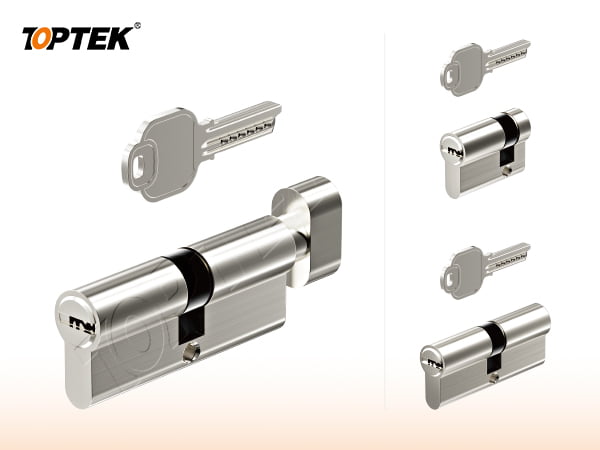
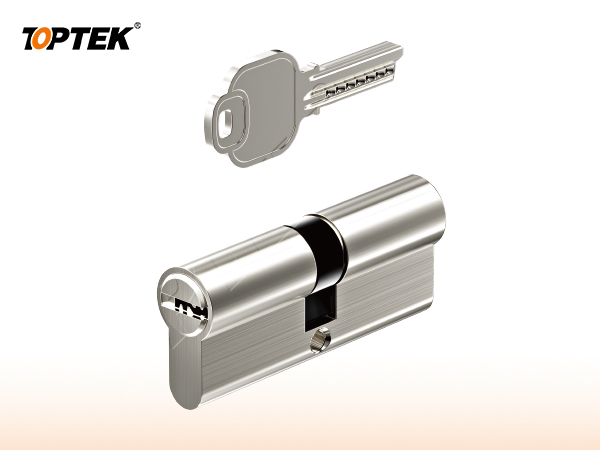
A Euro profile cylinder is selected around a recognisable profile opening, but the profile alone does not complete the specification. Buyers must record the dimension from the fixing-screw/cam centre to each finished side of the door as separate A/B values. A symmetrical and an offset cylinder can have the same total length but sit differently in the trim.
The operating format must also be defined: double cylinder, key-and-knob cylinder or half cylinder. Cam geometry, cam home position and operating rotation must suit the lock case. The internal/external orientation and escutcheon thickness affect projection and usability.
TOPTEK’s EPCHK7P Euro profile cylinder page lists double and knob versions from 60–95 mm and half-cylinder versions from 40–55 mm, with the final length expressed as A+B. Those are range references; the approved project drawing must select the exact combination.
2. SFIC: Core, Housing and Control Key
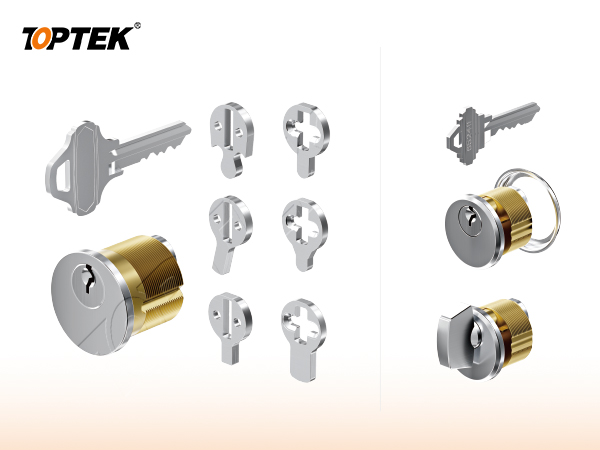
Small Format Interchangeable Core separates the removable keyed core from the compatible housing. A specialized control key is used to remove or install the core without dismantling the complete lock. This can support faster controlled changeover during construction, tenant turnover or maintenance—but only when the core, housing, keyway and lock interface are coordinated.
TOPTEK’s SFIC Mortise Cylinder page describes 6- or 7-pin core options, control and operating keys, and housings for mortise, KIK, rim and related applications. The page also lists different housing lengths and cam options. Buyers should not quote “SFIC” alone: state whether the request is for cores, housings or complete assembled cylinders, and identify the control-key and operating-key quantities.
SFIC approval questions
- Which keyway and pin platform are required?
- Is the housing part of the supplier scope?
- Which cam or tailpiece connects the housing to the lock?
- Who controls core removal during construction and handover?
- Are temporary and permanent cores separately scheduled?
3. American Mortise and Bored Lock Cylinders
American mortise cylinder
A conventional American mortise cylinder commonly uses a threaded body with a selected cam to operate compatible mortise or auxiliary hardware. The thread engagement, cylinder length, collar or trim relationship and cam are all functional interfaces. TOPTEK’s AMMC01 product page lists different cams and a series of cylinder lengths; the final choice must follow the actual lock and trim drawing.
American bored lock cylinder
A bored lock cylinder belongs to the specified bored lock chassis, lever, knob or trim interface. Its body retention and tailpiece logic differ from a threaded mortise cylinder. Buyers replacing an existing cylinder should identify the complete lockset, manufacturer/interface reference, door thickness, trim and tailpiece rather than order by keyway alone.
The important distinction is not “which cylinder is better.” It is which physical interface the lock was engineered to accept. A project may use both formats on different openings while still coordinating key authorization at system level, subject to keyway and engineering confirmation.
“Oval cylinder” is a family description, not proof of interchangeability. Australian and Scandinavian door-hardware systems can use different profile geometry, mounting, internal/external arrangements and lock-case actuation. A buyer should submit the lock-case model and a dimensioned cylinder-interface drawing for either format.
For Australian oval applications, confirm the intended AS-style mortice lock, the cylinder orientation, fixing method and operating interface. For Scandinavian oval applications, confirm the modular lock case, outside/inside cylinder components, fixing and key profile. TOPTEK’s SOC01 page identifies it as a Scandinavian Ovallock Cylinder; that label must not be transferred to a different oval preparation without review.
A comparison sample should be fitted into the actual lock and trim. A visual overlay or product photo cannot reveal every tolerance, fixing or rotational requirement.
5. Five-Step Format-to-Lock Matching Process
- Identify the opening: Assign door number, building zone, market, lock function, door/frame and service requirement.
- Freeze the lock interface: Record the exact lock model, preparation, trim and cylinder opening.
- Select the cylinder platform: Choose Euro, SFIC, American mortise, bored, Australian oval or Scandinavian oval from the interface—not preference alone.
- Complete the operating specification: Define dimensions, retention, cam/tailpiece, key/knob function, keyway, hierarchy and finish.
- Prove the assembled sample: Install production-intent parts, test every operating state and sign the drawing/sample record before volume release.
6. Physical Compatibility vs Key-System Compatibility
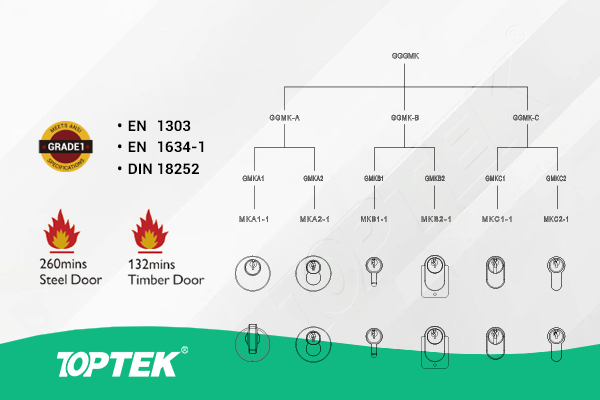
Physical compatibility answers: “Will this cylinder fit and operate this lock?” Key-system compatibility answers: “Can the approved keys operate the intended door groups?” They should be designed together but never confused.
TOPTEK’s internal Construction Cylinder insight describes project concepts that coordinate American IC, Euro and Nordic formats under a managed key plan while retaining the required cylinder standards and dimensions. This is a project-engineering capability, not an automatic promise for every keyway, cylinder or hierarchy. The RFQ must list every format, door quantity, access group and future expansion requirement for feasibility review.
Review the complete TOPTEK Construction Cylinder range before building the schedule. Where documentation is required, use the TOPTEK resource centre and request the exact model-specific evidence rather than assuming one report covers all formats.
7. Common Buyer Mistakes
- Ordering from a cylinder photo without naming the lock model.
- Using one total Euro length instead of separate A/B dimensions.
- Specifying SFIC without defining core, housing and control-key scope.
- Assuming a mortise-cylinder cam is universal.
- Calling every American cylinder “bored” or every oval cylinder interchangeable.
- Designing the master-key chart before confirming physical cylinder platforms.
- Approving a loose cylinder instead of a fitted lock/trim sample.
8. Project Risks and Approval Controls
| Risk | Likely result | Control |
|---|---|---|
| Wrong format | Cylinder cannot be retained or installed | Lock-interface drawing and model confirmation |
| Wrong cam/tailpiece | Incomplete locking or wrong rotation | Function test with production-intent lock |
| Wrong effective length | Excess projection or inaccessible operation | Finished door/trim stack and side dimensions |
| Uncontrolled SFIC core | Handover and access-security failure | Core, control-key and custody schedule |
| Key-system assumption | Unauthorized access or unusable hierarchy | Approved door-by-key matrix and sample keys |
9. TOPTEK Evidence and Product Range
The TOPTEK range includes Euro profile, SFIC, American mortise, American bored lock, Australian oval and Scandinavian oval cylinders. Model pages provide starting specifications, while project drawings and samples control the ordered configuration.
TOPTEK’s internal laboratory includes cylinder crushing-resistance, drill-resistance and life-cycle test equipment. Internal testing can support development, sample verification and production control, but it is not described as third-party certification. Any standard, certificate or fire-door claim must be checked against the applicable model, document scope, assembly and current status before publication or project approval.
10. Commercial Cylinder RFQ Checklist
- Project, market, building type and door schedule
- Exact lock model, function, trim and cylinder preparation
- Cylinder format for every opening
- Body/profile dimensions and effective length
- Retention, fixing, cam or tailpiece drawing
- Double, key/knob, half or other operating function
- Interior/exterior orientation and finished trim stack
- Keyway, keyed different/keyed alike and master-key hierarchy
- SFIC core, housing, control keys and turnover plan where applicable
- Material, finish, environment and required evidence
- Sample quantity, fitted test method and approval record
- Packaging, marking, spare cores/keys and future expansion
Why TOPTEK
TOPTEK can review several regional cylinder formats together with the corresponding lock platforms, drawings, key plan, sample build and internal verification. The value is not a generic claim that every cylinder interchanges. It is an engineering process that preserves the required physical format while coordinating project key management where technically feasible.
Frequently Asked Questions
What are the main commercial door lock cylinder types?
Common project formats include Euro profile cylinders, SFIC, American mortise cylinders, American bored lock cylinders, Australian oval cylinders and Scandinavian oval lock cylinders. The correct format is determined by the lock interface, door and trim—not by appearance alone.
Can a Euro profile cylinder replace an SFIC cylinder?
No, not as a direct substitution. Their housings, retention methods, operating interfaces and service procedures differ. A project can coordinate them within a wider key-management plan only when the cylinder platforms and keying design are engineered for that purpose.
What is the difference between SFIC and a conventional mortise cylinder?
SFIC uses a removable core operated by a control key inside a compatible housing. A conventional mortise cylinder is normally threaded into the lock or trim and uses a selected cam. Confirm the housing, cam, keyway and lock preparation before ordering either format.
Do not assume so. Both are described as oval formats, but the profile, fixing arrangement, tailpiece or cam, lock case and regional hardware conventions must be checked against drawings and a fitted sample.
Can different cylinder formats use one master key system?
Cross-format key management may be possible with an engineered platform, compatible keyways and a controlled hierarchy. It is not automatic. Provide every cylinder format, quantity, door group and access level for technical confirmation before approval.
What should a commercial cylinder RFQ include?
Include the cylinder format, exact lock model, door and trim details, dimensions, cam or tailpiece, operating function, keyway, keyed-different or keyed-alike requirement, master-key hierarchy, quantities, finish, evidence expectations, drawings, sample plan and handover controls.
Conclusion
Commercial cylinder selection becomes reliable when format, lock interface and key control are approved as one schedule. Start with the lock, choose the correct physical platform, freeze each operating interface and prove the complete door sample. This prevents wrong-fit orders, unreliable operation and expensive rekeying after handover.