

TL;DR
- Measure from the centre of the cylinder fixing screw or cam to each end separately.
- Record the exterior and interior dimensions as two values, not only one overall length.
- Identify which side faces outside, especially for offset, thumbturn and security cylinders.
- Include the finished handle or escutcheon thickness, cylinder function, cam, key system and lockcase in the RFQ.
- Do not assume every supplier writes the two dimensions in the same order; label them EXT and INT on the drawing.
Quick Answer: How Do You Measure a Euro Profile Cylinder?
Measure a Euro profile cylinder from the centreline of the fixing screw or cam to each end of the cylinder. Record the distance to the exterior side as EXT and the distance to the interior side as INT. The total cylinder length is EXT + INT, but the two side dimensions must remain separate because a symmetrical 40/40 cylinder and an offset 35/45 cylinder both total 80 mm and are not interchangeable in every door.
The most reliable method is to remove the existing cylinder, keep its exterior and interior orientation identified, and measure it on a flat surface. If removal is not permitted, measure from the fixing-screw centreline to the finished face of the handle backplate or escutcheon on both sides, then confirm the result against the selected manufacturer’s dimension drawing.
Why Is Euro Cylinder Sizing a Commercial Door Issue?
The correct cylinder must fit the complete door-hardware assembly, not just the hole in the lockcase. Door leaf thickness, protective trim, pull handles, electronic escutcheons, armour plates and uneven door construction can make the required exterior and interior lengths different.
For a distributor or door manufacturer, one incorrect offset can affect a complete batch. The result may be excessive projection, a cylinder that sits too far inside the trim, interference with a thumbturn, or a cam that does not engage the lock as intended. For this reason, the cylinder schedule should be coordinated with the lockcase and trim schedule before sample approval.
How to Measure a Euro Profile Cylinder Step by Step
Step 1: Identify the Exterior and Interior Sides
Mark the outside and inside before removing or measuring the cylinder. This is especially important when the two halves are different lengths or when one side has a thumbturn. Do not rely on the order of two catalogue numbers unless the manufacturer defines it.
Step 2: Locate the Fixing-Screw Centreline
The reference point is the centre of the fixing screw or cam area, not the centre of the complete cylinder length. The cylinder fixing screw is normally accessed from the door edge in line with the cylinder. On an existing installation, keep the door open and follow the lock or door manufacturer’s removal instructions.
Step 3: Measure the Exterior Dimension
Measure from the fixing-screw centreline to the exterior end of the cylinder in millimetres. Record this value as EXT. If you are measuring the door instead of a removed cylinder, measure to the finished outer face of the protective handle backplate or escutcheon, not only to the bare door leaf.
Step 4: Measure the Interior Dimension
Measure from the same centreline to the interior end and record it as INT. Include the finished interior trim condition. If the cylinder has a thumbturn, confirm that there is enough clearance for operation without contact with the lever, pull handle or adjacent hardware.
Step 5: Check the Total and the Orientation
Add EXT and INT as a cross-check, but order using the two confirmed side dimensions. For example, 35/45 and 45/35 have the same 80 mm total length, but the long side faces a different direction. A labelled sketch or marked door schedule is safer than an unlabelled “35/45” note.
Step 6: Verify the Manufacturer’s Drawing
Dimension conventions can vary between product ranges. ERA’s official measuring instructions, for example, identify separate internal and external dimensions and state that the internal measurement appears first in its relevant part-number examples. Always check the selected product’s drawing instead of assuming that every brand follows the same notation. See the ERA Euro cylinder measuring and ordering guide for a manufacturer example.
Why Is Overall Length Alone Not Enough?
Overall length does not show where the cam sits relative to the two door faces. A door may need an offset cylinder because the exterior escutcheon is thicker than the interior trim, the lockcase is not centred in the leaf, or an electronic panel adds depth on one side.
| Example size | Exterior side | Interior side | Overall length | Why it matters |
|---|---|---|---|---|
| 40/40 | 40 mm | 40 mm | 80 mm | Symmetrical configuration |
| 35/45 | 35 mm | 45 mm | 80 mm | Longer interior side |
| 45/35 | 45 mm | 35 mm | 80 mm | Longer exterior side |
These values illustrate the sizing logic only. The available increments, minimum lengths and orientation rules must be confirmed for the selected cylinder model.
How Far Should a Euro Cylinder Project Beyond the Escutcheon?
The external cylinder should generally be kept close to the finished protective hardware, subject to the specific cylinder and security-hardware instructions. Excessive projection can create a poor fit and may increase exposure to physical attack.
As a product-specific example, ERA’s instructions for its 3-star cylinder advise that the external half should sit flush with the handle backplate without more than 3 mm projection. Do not apply that number as a universal rule for every cylinder, escutcheon or market. Confirm the requirement from the chosen cylinder manufacturer, the security trim supplier and the applicable project specification.
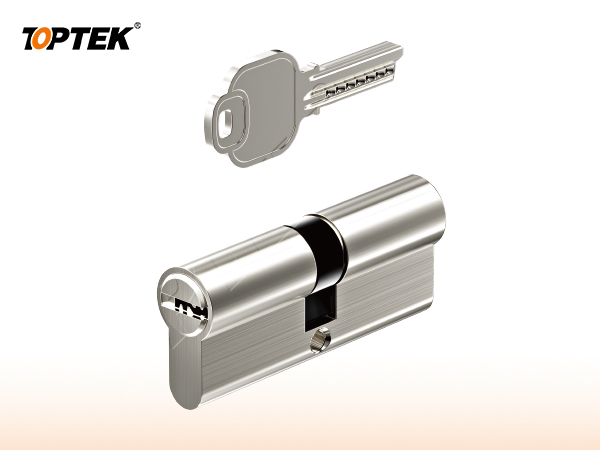
Which Cylinder Function Should the Buyer Specify?
Length is only one part of the cylinder specification. Confirm the required operating function before approving the sample:
- Double cylinder: key operation from both sides.
- Thumbturn or knob cylinder: key operation on one side and manual turn operation on the other.
- Half or single cylinder: operation from one side only, subject to the lock application.
The correct function depends on the door’s access, privacy, security and egress requirements. A thumbturn that is convenient for an office may not be suitable for every secure, institutional or escape-door condition. The final selection must follow the door schedule, local code and hardware consultant’s requirements.
Why Must the Cam and Mortise Lock Be Confirmed?
A correctly sized cylinder can still be incompatible if the cam or lock interface is wrong. Send the mortise-lock model, cylinder profile, cam drawing and required operating sequence with the RFQ. Confirm that the cam engages the lockcase correctly and that the key or thumbturn operates the intended latchbolt, deadbolt or escape function.
For European commercial doors, review the cylinder together with the selected EN 12209 mortise lock. A sample should be installed with the actual lever furniture, spindle, escutcheon and door construction before bulk production approval.
How Does an Electronic Lock or Access-Control Trim Change Cylinder Length?
An electronic escutcheon or lock panel can add thickness on one or both sides of the door. This can change the required A/B offset even when the door leaf and mechanical lockcase remain unchanged. Buyers should not copy the cylinder length from a mechanical trim schedule without checking the final electronic hardware stack.
Send a section drawing showing the door leaf, lock centreline, exterior panel, interior panel, mounting plates and protective spacers. Also confirm whether the cylinder is used for normal key entry, emergency mechanical override, maintenance access or another defined function. TOPTEK’s electronic lock and access-control range can be reviewed with the cylinder schedule as one coordinated package.
Which Standards and Evidence Should Buyers Check?
Dimensional compatibility and performance evidence are related but separate checks. EN 1303 addresses performance classification for building-hardware cylinders, while DIN 18252 is commonly referenced for profile-cylinder geometry and requirements. A standard name on a drawing does not replace confirmation of the exact model, classification, test report and project application.
TOPTEK lists EN 1303 test information for its EPCHK7P and EPCVK6P Euro profile cylinder models. Buyers can review the available report route in the TOPTEK certification resource center and request the complete applicable document for tender, sample approval or compliance review.
For fire-door projects, do not treat the cylinder as independently proving the fire resistance of every doorset. Confirm the lock, cylinder, lever furniture, intumescent protection and door construction against the relevant assembly evidence and approval route.
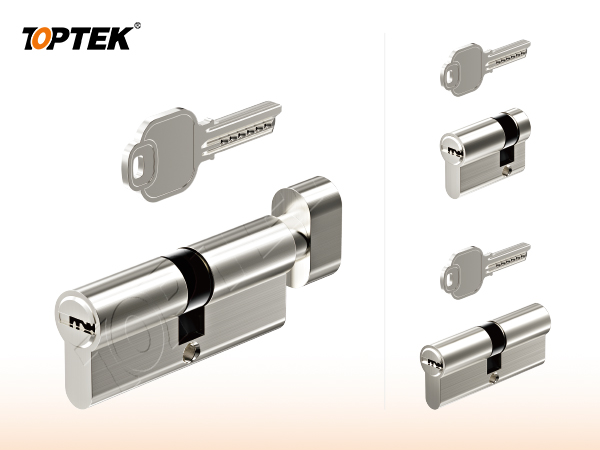
What Euro Profile Cylinder Options Does TOPTEK Offer?
TOPTEK’s EPCHK7P and EPCVK6P platforms support several commercial-door configurations. The published product specifications list double and knob profile cylinders from 60-95 mm and half profile cylinders from 40-55 mm. EPCHK7P uses a seven-pin horizontal keyway configuration, while EPCVK6P uses a six-pin vertical keyway configuration.
Both product pages describe solid-brass cylinder components, finish options, custom keyway and pinning support, and master-key structures up to Management Level 5. Review the EPCHK7P product specifications, the EPCVK6P product specifications and the complete construction cylinder range.
For projects that combine Euro profile, SFIC, American mortise, American bored, Australian oval or Scandinavian oval cylinders, send one consolidated door and key schedule. Cylinder format, local locksmith support, key hierarchy and future expansion should be mapped separately instead of assuming that different formats are automatically interchangeable.
What Are the Most Common Euro Cylinder Ordering Mistakes?
- Sending only the total length and omitting the exterior/interior split.
- Reversing the long and short sides of an offset cylinder.
- Measuring the bare door leaf but ignoring the handle backplate or escutcheon.
- Copying a mechanical-lock cylinder length to a thicker electronic escutcheon.
- Leaving the cam type, function or keyway unspecified.
- Assuming a double cylinder, thumbturn cylinder and half cylinder use the same ordering code.
- Designing the master-key hierarchy after cylinder quantities have already been approved.
- Approving the cylinder separately from the actual mortise lock and trim sample.
- Using a certification statement without checking the exact model and report scope.
What Should a Euro Profile Cylinder RFQ Include?
A complete RFQ should let the supplier reproduce the installed condition. Include the following information:
- Project country, building type and applicable standard
- Door quantity and door schedule reference
- Door material and finished door thickness
- Exterior dimension (EXT) from centreline to finished trim face
- Interior dimension (INT) from centreline to finished trim face
- Required cylinder function: double, thumbturn/knob or half/single
- Mortise-lock model and cam or drive-interface drawing
- Handle, escutcheon, armour plate or electronic panel thickness
- Keyway, pin count, keyed-different, keyed-alike or master-key requirements
- Key hierarchy, door groups, future expansion and spare-key quantities
- Finish, logo, packaging and OEM/ODM requirements
- Required test reports, certificates, samples and approval records
Send the door schedule, drawings and required quantities to ivan.he@toptekaccess.com or use the TOPTEK contact form. The engineering team can review cylinder length, cam, keying, lock compatibility and sample requirements before quotation.
Why Work with TOPTEK on Commercial Cylinder Projects?
Cylinder reliability depends on both correct specification and repeatable precision manufacturing. TOPTEK’s manufacturing resources include more than 50 imported Japanese TSUGAMI Swiss-type CNC lathes, machining accuracy controlled to ±0.01 mm, automatic dimensional inspection and documented in-process and final quality checks. These capabilities support consistent cylinder parts, lock interfaces and OEM/ODM production.
Buyers can review TOPTEK’s precision manufacturing capability, in-house laboratory and OEM/ODM engineering support. The practical objective is to freeze the correct A/B dimensions, function, cam, key system and evidence package before mass production.
Frequently Asked Questions
Where do you measure a Euro profile cylinder from?
Measure from the centre of the fixing screw or cam to each end separately. Record the exterior and interior values rather than only the total length.
What does a 35/45 Euro cylinder mean?
It describes two side dimensions measured from the cylinder centreline. Together they total 80 mm. Because suppliers may use different ordering conventions, label which value is exterior and which is interior.
Can two Euro cylinders have the same overall length but fit differently?
Yes. A 40/40 cylinder and a 35/45 cylinder both total 80 mm, but the cam position relative to the door faces is different.
Should a Euro cylinder be flush with the handle or escutcheon?
The external side should generally be kept close to the protective hardware, but the permitted projection is product-specific. Follow the cylinder, security-trim and project instructions rather than applying one number to every product.
Does an electronic escutcheon change the required cylinder size?
It can. The panel, mounting plate and spacers may add thickness, so measure the complete installed hardware stack on both sides.
What information is needed for a master-key cylinder quotation?
Provide the door list, cylinder format and size, key hierarchy, access groups, keyed-alike or keyed-different requirements, future expansion, spare keys and local service expectations.
Conclusion
A reliable Euro profile cylinder order begins with two labelled measurements, not one total. Confirm EXT, INT, finished trim thickness, cylinder function, cam, key system, mortise-lock compatibility and documentation before approving the sample or production schedule.
TOPTEK Access is a China-based OEM/ODM manufacturer of commercial locks, architectural door hardware, and integrated access control locking solutions, supplying ANSI Grade 1 mortise locks, EN 12209 Grade 3 mortise locks, AS 4145 mortise locks, panic exit devices, multi-point locking systems, electronic locks, lever handles, cylinders, and hinges for global door manufacturers, distributors, contractors, and building projects.
For a project-specific cylinder review, send the door and key schedule to ivan.he@toptekaccess.com or visit the TOPTEK contact page.
TOPTEK is your Commercial Door Hardware Reliability Solution.
TOPTEK: Smart Design. Strong Security.
Technical contact: Ivan He, General Manager, Zhongshan Toptek Security Technology Co., Ltd.