

Electric Hinge vs Door Loop: Which Power Transfer Is Better for Access Control Doors?
Quick answer: Choose an electric hinge when concealed, tamper-resistant wiring and a clean architectural appearance are priorities. Choose an armoured door loop when the opening is a retrofit, easy field installation and service access matter, or the project needs a practical surface-mounted cable path. The final decision must be based on the door-mounted device, conductor count, wire gauge, operating and inrush current, voltage drop, door construction, traffic, fire-rating scope and maintenance plan—not appearance or unit price alone.
TL;DR: Electric Hinge vs Door Loop
- Best for concealed wiring: electric hinge.
- Best for a straightforward retrofit: surface-mounted armoured door loop.
- Best for higher current or special data: neither can be assumed suitable; calculate the electrical load and confirm the exact conductor specification first.
- Fire-rated opening: verify the exact tested or listed assembly, installation method and local approval. Stainless steel construction alone does not establish fire-door suitability.
- Important system check: a frame-mounted electric strike or magnetic lock may not require a frame-to-door power transfer if no powered or monitored device is installed on the moving door leaf.
Electric Hinge vs Door Loop Comparison Table
| Selection Factor | Electric Hinge | Armoured Door Loop |
|---|---|---|
| Cable route | Conductors pass through the hinge location and remain concealed when installed correctly. | Cable passes through a protected flexible conduit between frame and door. |
| Appearance | Clean and discreet, with no surface loop visible. | Visible on the hinge side, although neater and better protected than exposed cable. |
| Typical project fit | New doors or prepared openings; selected retrofits when hinge size, reinforcement and wiring route permit. | Retrofits, field-prepared openings and projects prioritizing fast access to the cable path. |
| Tamper and impact exposure | More concealed and less accessible. | Armoured protection helps, but the loop remains externally accessible. |
| Electrical capacity | Limited by the exact wire count and gauge inside the hinge. | Limited by the loop’s internal space, permitted cable type, bend radius and installation. |
| Inspection and replacement | More integrated; hinge removal and wiring access may require greater coordination. | Surface location normally makes cable inspection and replacement more direct. |
| Best use case | Architectural openings needing concealed power or monitoring conductors. | Economical, serviceable power transfer for existing commercial doors. |
This is a selection framework, not a universal ranking. An electric hinge with undersized conductors can be a worse choice than a correctly specified door loop, while an exposed loop may be unacceptable on a high-security or design-sensitive opening.
First Question: Does the Door Need Power Transfer at All?
Power transfer is required when power or signals must cross from the stationary frame to a device on the moving door leaf. Typical door-mounted loads include an electrified mortise lock, electrified trim, motorized or solenoid lock, latch-retraction exit device, request-to-exit switch, latchbolt monitor or another door-mounted sensor.
If the only powered locking device is an electric strike mounted in the frame, the power cable can normally remain in the frame. The same logic often applies to a frame-mounted magnetic lock. However, a door-position switch, request-to-exit device, electrified trim or other monitored component on the leaf can still create a transfer requirement. Mapping every powered and monitored device before choosing hardware prevents unnecessary products and missing conductors.
Industry guidance from Allegion’s technical knowledge base identifies electrical hinges and power-transfer units as common methods for routing power from frame to door. The correct route still depends on the complete opening.
When Is an Electric Hinge the Better Choice?
An electric hinge—also called an electrified hinge or power-transfer hinge—combines the mechanical hinge function with concealed electrical conductors. It is often preferred on offices, hotels, healthcare facilities and other commercial interiors where visible cable protection would conflict with the architectural finish.
Choose an electric hinge when:
- the lock, exit device or monitoring component is mounted on the door leaf;
- concealed wiring and better resistance to casual tampering are important;
- the door and frame can be prepared for a wiring path at the hinge location;
- the hinge size, thickness, hole pattern, bearing arrangement and load capacity suit the door;
- the available conductor count and gauge support both power and monitoring requirements; and
- future service access has been planned.
Detex’s power-transfer guidance describes electric hinges as concealed and vandal-resistant, but also notes that their smaller conductors can limit current capacity and that repeated flexing must be considered. This is why the electrical calculation belongs in the door schedule—not after installation.
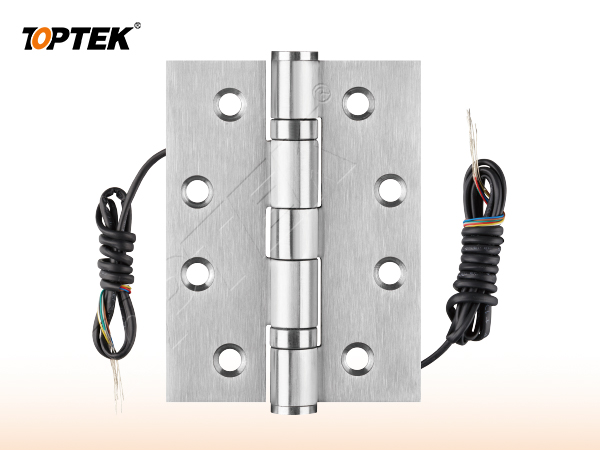
TOPTEK E2BB electrical configuration
The published TOPTEK E2BB electric butt hinge specification lists these options:
- 2 wires at 18 AWG;
- 4 wires at 28 AWG;
- 6 wires at 28 AWG; or
- 8 wires at 28 AWG.
These are different configurations, not interchangeable descriptions of one cable. Two 18 AWG conductors may suit a power circuit differently from eight 28 AWG conductors intended for lower-current power and signal allocation. The lock manufacturer’s voltage, steady current and peak or inrush current must be checked against the selected hinge wiring and the complete cable run.
When Is an Armoured Door Loop the Better Choice?
An armoured door loop provides a flexible, protected path between the frame and door. Because it is surface mounted, it is frequently the practical choice for an existing opening that was not factory prepared for concealed transfer. It can also simplify inspection when service teams need direct access to the cable route.
Choose a door loop when:
- the project is retrofitting an existing door and frame;
- surface preparation is permitted and visual exposure is acceptable;
- installation time, service access and budget carry more weight than concealed appearance;
- the loop position will not create a catch point or be overextended at full door swing;
- the armoured conduit, end fixings and internal cable suit the environment; and
- the exact fire-door and security requirements allow that installation method.
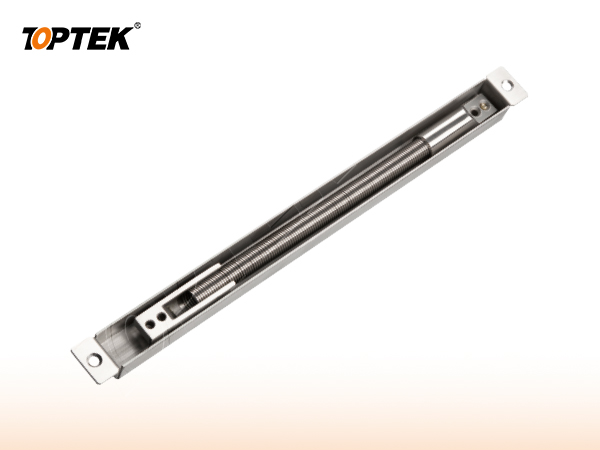
The TOPTEK EDP01 electric door loop is specified in 304 stainless steel, with a published size of 24 × 326 × 10 mm and an 18 mm height. Those dimensions help buyers check installation space, but they do not replace the electrical cable calculation. Confirm the internal cable, conductor requirements, end connections and permitted bend conditions for the exact project.
How to Calculate the Electrical Requirement Before Selection
The most common specification error is counting wires without checking what those wires must carry. Prepare a point-to-point wiring schedule for the complete opening.
- List every door-mounted device. Include the lock, exit device, request-to-exit switch, latch monitor, door-position sensor, LED or other accessory.
- Record operating voltage. Confirm whether each load uses 12 VDC, 24 VDC or another specified supply.
- Record steady and inrush current. Solenoids, motors and latch-retraction devices can have different startup and holding requirements.
- Separate power and signal needs. Monitoring contacts may need dedicated pairs. Do not assume that any spare conductor is suitable for network, shielded or data communication.
- Check conductor gauge and total cable length. Calculate voltage drop from the power supply to the opening and through the transfer device to the load.
- Allow for service strategy. Decide whether spare conductors, plug connectors, test points or replaceable cable sections are required.
- Verify control logic. Fail-safe or fail-secure behavior, fire-alarm interface, emergency release and free-egress requirements are system decisions, not functions created by the hinge or loop.
Never parallel conductors to increase capacity unless the device and cable manufacturers, engineer and applicable rules explicitly permit the arrangement. A sample opening should be tested at the lowest expected supply voltage and under real door movement before mass production.
Mechanical and Door-Preparation Checks
Electrical continuity is only half of the problem. The transfer device must work with a door that remains aligned through repeated cycles.
- Door data: leaf material, thickness, height, width, weight, handing and opening angle.
- Hinge data: overall size, leaf thickness, corner shape, hole pattern, knuckle, bearing count, pin option, material and finish.
- Frame data: reinforcement, hinge preparation, cable entry and route back to the controller or power supply.
- Door raceway: route from the hinge side to the electrified lock or exit device without damaging the leaf.
- Moving cable control: minimum bend radius, strain relief and protection from pinching, sharp edges and closer arms.
- Traffic and environment: opening frequency, public access, vandal risk, moisture, cleaning chemicals and corrosion exposure.
For many standard butt-hinge applications, Allegion recommends the electrical hinge at the centre hinge position. That guidance should not be copied blindly: follow the exact door, frame, hinge and hardware manufacturer’s preparation instructions for the selected opening.
Can an Electric Hinge or Door Loop Be Used on a Fire-Rated Door?
Only when the exact product, door and frame preparation, cable route, fixing method and installed assembly are supported by the applicable test, listing, approval and local Authority Having Jurisdiction (AHJ). Drilling or field modification can affect a fire-door label, so it must not be treated as ordinary retrofit work.
The TOPTEK E2BB product page publishes EN 1935 testing and EN 1634-1 fire-test references of 260 minutes for a steel fire doorset and 132 minutes for a timber fire doorset. These durations describe the referenced tested assemblies; they do not mean that every door fitted with the hinge automatically receives a 260- or 132-minute rating. Buyers should request the report, confirm the exact model and component scope, and match it to the intended doorset.
For certification and project-document review, visit the TOPTEK certification resource centre. For a door loop, do not infer fire suitability from stainless steel construction or a general product standard. Obtain project-specific acceptance before installation.
Seven Common Power-Transfer Specification Mistakes
- Choosing before mapping devices: the team discovers later that additional monitoring pairs are required.
- Comparing only wire count: conductor gauge, current and voltage drop are ignored.
- Using a data conductor assumption: spare low-voltage wires are treated as suitable for any communication protocol.
- Ignoring the door raceway: the transfer reaches the leaf, but there is no protected route to the lock.
- Positioning a door loop too far from the hinge line: the loop is pulled, pinched or caught through the opening cycle.
- Making unapproved fire-door modifications: field drilling or surface hardware conflicts with the rated assembly.
- Testing only while the door is closed: intermittent continuity, cable strain or voltage drop appears only as the door moves.
A Practical Selection Workflow for Buyers
- Mark each powered and monitored component on the door and frame drawing.
- Confirm whether power actually needs to cross onto the moving leaf.
- Calculate conductor count, wire gauge, current and voltage drop.
- Confirm new construction or retrofit conditions.
- Decide the required level of concealment, tamper resistance and service access.
- Check hinge load, door preparation and raceway compatibility.
- Verify fire, egress, access-control and local approval requirements.
- Build and cycle-test a representative opening before bulk approval.
If the opening is new, design-sensitive and electrically compatible, an electric hinge is often the stronger architectural choice. If it is an existing door and practical installation is the priority, an armoured door loop is often more efficient. If conductor capacity, security or fire-door limitations exclude both, evaluate a project-approved concealed power transfer or redesign the device layout.
Electric Hinge or Door Loop RFQ Checklist
| RFQ Item | Information to Send | Why It Matters |
|---|---|---|
| Opening | New or retrofit; door and frame material; dimensions; weight; handing; swing angle | Defines preparation and mechanical suitability |
| Door hardware | Lock, exit device, closer, hinge size and related model numbers | Confirms physical compatibility |
| Electrical load | Voltage, steady current, peak current and supply distance | Supports conductor and voltage-drop checks |
| Signals | REX, latch monitor, DPS, LED and any communication requirement | Defines wire count and cable type |
| Compliance | Fire rating, egress route, target standard, report or listing requirement and AHJ | Prevents unsupported assembly claims |
| Environment | Interior/exterior, humidity, corrosion, vandal risk and traffic level | Guides material, finish and protection |
| Commercial details | Quantity, finish, samples, drawings, branding, packaging and delivery schedule | Enables an accurate OEM/ODM quotation |
TOPTEK Door Power Transfer and Access Control Capability
TOPTEK supports both sides of this selection: precision hinges and door power-transfer solutions, including electric butt hinges and armoured door loops, plus electronic locks and access-control devices. This allows buyers to review the mechanical hinge, electrical path and locking load as one opening rather than as unrelated parts.
For OEM/ODM evaluation, send the door schedule, hardware set, wiring diagram and target approval route. TOPTEK can then review the hinge or loop model, wire configuration, finish, lock interface, drawings, sample plan and production requirements before quotation.
Frequently Asked Questions
Is an electric hinge more reliable than a door loop?
Not automatically. An electric hinge offers concealed, better-protected wiring, while a door loop offers straightforward installation and service access. Reliability depends on correct conductor capacity, mechanical preparation, bend control, door alignment, traffic and installation quality.
Does an electric strike need an electric hinge or door loop?
Usually not when the electric strike is mounted in the frame and no powered or monitored device is on the door leaf. A transfer is still needed if wiring must reach electrified trim, a door-mounted lock, exit device, REX switch, latch monitor or another leaf-mounted component.
Can one electric hinge carry lock power and monitoring signals?
It can when the exact hinge provides enough correctly sized conductors and the device specifications permit the arrangement. Confirm voltage, steady and inrush current, voltage drop, signal pairs and cable requirements before selection.
Can an armoured door loop be installed on a fire-rated door?
Only if the exact product and installation method are accepted within the applicable fire-rated opening, project documents and local AHJ requirements. Do not infer approval from material or appearance.
Where should an electric hinge be installed?
Many standard butt-hinge applications place it at the centre hinge position, but the final location must follow the exact door, frame, hinge and electrified hardware instructions. Load-bearing and wiring requirements must be reviewed together.
What information should I send for an electric hinge or door loop quotation?
Send the door and frame type, dimensions, weight, handing, hinge preparation, lock or exit-device model, voltage, current, wire and signal count, fire-rating requirement, finish, quantity, drawings and target delivery date.
Conclusion: Select the Power Path as Part of the Complete Door Opening
The best answer to electric hinge vs door loop is determined by the opening. Use an electric hinge for concealed power transfer when its mechanical and electrical limits match the door. Use an armoured door loop when retrofit practicality, visible service access and cost are stronger priorities. In both cases, verify the load, wiring, door raceway, movement, fire scope and approval route before ordering.
TOPTEK Access is a China-based OEM/ODM manufacturer of commercial locks, architectural door hardware, and integrated access control locking solutions, supplying ANSI Grade 1 mortise locks, EN 12209 Grade 3 mortise locks, AS 4145 mortise locks, panic exit devices, multi-point locking systems, electronic locks, lever handles, cylinders, and hinges for global door manufacturers, distributors, contractors, and building projects.
For drawings, samples or an OEM/ODM review, email ivan.he@toptekaccess.com.
TOPTEK is your Commercial Door Hardware Reliability Solution.
TOPTEK: Smart Design. Strong Security.