

TL;DR
- Determine DIN left or DIN right from the hinge-side view of the hinged door.
- Record the viewing side, swing and controlled-access side on the same drawing.
- A reversible latch does not prove that every lever, escape function or strike is reversible.
- Approve handing using the exact lock, trim and door preparation, then label each opening accordingly.
Quick Answer: How do you identify DIN mortise lock handing?
For DIN mortise lock handing, view the door from the side where its hinges are visible: hinges on the left indicate DIN left, and hinges on the right indicate DIN right. Record that view on the door drawing. Then confirm the selected lock’s latch orientation, lever-control sides and any conversion instructions. A commercial door lock order needs more than “left” or “right” because the door’s DIN direction, the access side and the lock’s operating function describe different things. Verify all three on the intended assembly.
The TOPTEK EN 12209 mortise lock range includes several functions and layouts. Choose the function and dimensions for the opening, then check its handing requirements. A family photograph or the presence of a bevelled latch does not establish how a particular configuration may be converted.
Fix the reference view before writing left or right
Use a plan view and a photograph taken from a clearly labelled side. Mark the hinges, lock edge, door number and swing arc. This prevents a buyer looking from the corridor and a factory looking from the room from using the same word for opposite views.
The manufacturer Griffwerk explains the hinge-side method for DIN direction. Use that convention consistently when the project calls for DIN left or DIN right. Do not silently translate an external supplier’s LH, RH, LHR or RHR code into a DIN designation; first obtain that supplier’s reference diagram.
Door swing and access side need their own fields. “Opens into the room” describes movement relative to a room. “Outside” may mean the corridor or access-controlled side, even when both sides are inside the building. A DIN designation alone does not tell the locksmith which lever is to be controlled.
For concealed hinges, unfamiliar drawings or a double-door assembly, use the approved plan and the hardware manufacturer’s diagram to establish the reference. Identify each leaf independently. Do not infer the active leaf’s lock handing from the other leaf’s appearance.
Separate door handing from lock configuration
| Question | What it identifies | Evidence to retain |
|---|---|---|
| DIN left or DIN right? | Door direction under the stated hinge-side convention | Labelled plan and reference-side photograph. |
| Which way faces the latch bevel? | How the latch meets the strike during closing | Selected lock drawing and conversion instructions. |
| Which lever is controlled? | Access side and occupied-side operation | Function description and installed sample check. |
| Is the trim handed? | Lever shape, mounting or operating differences | Trim part numbers and side-specific layout. |
| Is the strike suitable? | Frame-side interaction with latch and other bolts | Strike drawing, frame profile and alignment check. |
These questions may all be answered by one coordinated drawing, but they should not disappear into one abbreviated field. If the lockcase has a reversible latch, the supplier still needs to know how the opening should operate after installation. A reversible component can reduce stock complexity while leaving other configuration requirements unchanged.
Similarly, a handed lever or escutcheon can remain unsuitable even when the lock’s latch is correctly oriented. Check the full hardware set. This is especially important when purchasing lockcases and trim from separate suppliers whose left/right terminology may differ.
Check the exact reversible-latch instructions
Ask whether the chosen model supports latch reversal, which components are involved and whether conversion is permitted before or after installation. Use the supplier’s instructions for that exact lock revision. Do not assume that pulling, rotating, opening the cover or removing a screw is the correct method merely because another mortise lock uses it.
TOPTEK’s EN product materials identify sash, passage, deadbolt, bathroom, night-latch, classroom, roller and escape-related functions. Those descriptions are a selection map. They are not a universal conversion procedure. For example, changing the bevel on a latch-bearing lock does not explain the operation of a roller latch or a deadbolt-only case.
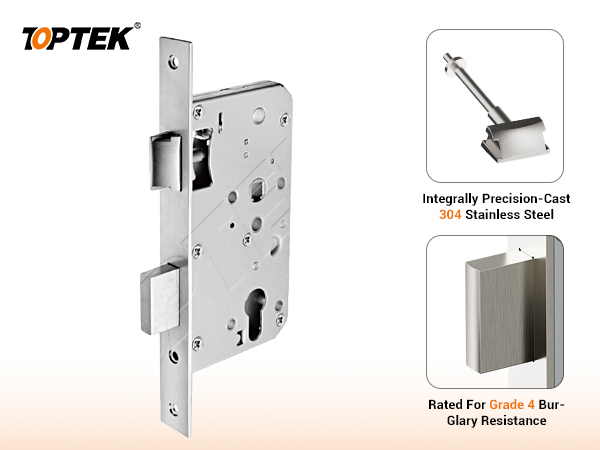
The EN72SL sash mortise lock is a useful product reference when reviewing a latch-and-deadbolt arrangement. Request the configured model drawing rather than deriving preparation dimensions or conversion steps from its photograph.
After an authorised conversion, check smooth latch movement, full return and correct interaction with the intended strike. Repeat the function checks with the final trim installed. If operation changes after tightening the hardware, investigate the interface before accepting the sample.
Preserve the correct side of controlled-entry functions
A passage latch has a different operating question from a night-latch or classroom lock. For passage, both intended lever sides need to operate the latch. For controlled-entry functions, identify which side is restricted and which side provides the required release.
TOPTEK describes its classroom function as key control of the outside lever while the inside lever remains available for exit. Its night-latch description uses key entry from outside and lever release inside. The schedule should state those sides explicitly. Turning a latch does not by itself demonstrate that the controlled lever has been assigned to the correct side.
For an escape-related function, request the exact release sequence and the relevant assembly evidence. Do not infer compliance with a project escape requirement from an “escape” product name or from latch reversibility. Operating elements, door arrangement, installation and the project’s applicable requirements must be considered together.
An economical early check is to send TOPTEK a labelled door sketch showing the hinges, swing and controlled side. Add the proposed lock function. Request a configuration check before finalising quantities or machining the door preparation.
Coordinate the strike, forend and door preparation
Correct handing does not cure an incompatible strike or preparation. Confirm the forend shape, fixing positions, case depth, backset, centres and follower interface from the chosen drawing. Treat handed parts and dimensions as related checks, not interchangeable answers.
The forend and strike plate guide explains the frame-side coordination in more detail. For handing approval, concentrate on the direction of closing contact, latch entry into the strike and the clearance available for full bolt travel.
Do not force a door shut to compensate for the wrong latch presentation. Inspect hinge adjustment, frame alignment, seals and closer action separately. Excessive effort can hide an alignment problem and makes a comparison between left- and right-hand samples unreliable.
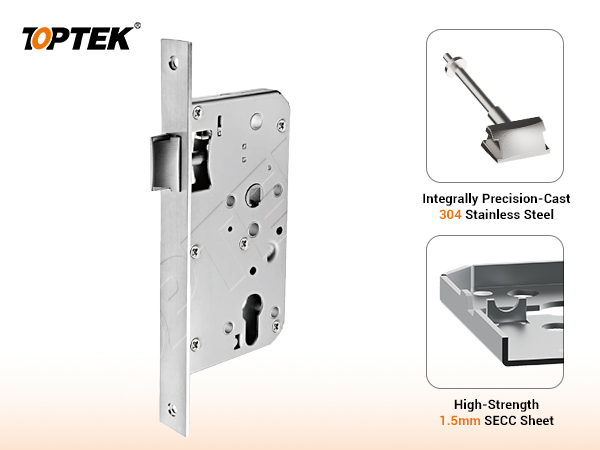
TOPTEK’s EN platform materials describe a one-piece stainless-steel latch construction and a dust-cover feature. These are relevant construction details when discussing latch integrity and installation debris. They do not replace the need to protect the mechanism during preparation or to inspect the specific sample supplied.
Create a handing record for every opening
| Schedule field | Buyer entry |
|---|---|
| Opening identity | Door number, room-to-room relationship and active leaf where applicable. |
| Reference convention | DIN designation with hinge-side plan or photograph. |
| Operation | Access side, inside release side, key and lever behaviour. |
| Product configuration | Lock model, function, trim, cylinder and strike references. |
| Conversion control | Factory configuration or permitted site conversion, with instruction revision. |
| Acceptance | Sample reference, installer check and matching packing label. |
Group identical configurations only after these fields agree. Two doors with opposite DIN directions may share a reversible lockcase, yet still require different packing or installation instructions. Conversely, two doors with the same DIN direction may require different controlled-entry functions.
Keep quantities traceable to opening numbers. When a drawing changes, revise the affected door rows and packing information together. A verbal instruction to “reverse the next batch” is too ambiguous when several trim and function combinations are being supplied.
Common errors, project risks and TOPTEK evidence
- Writing “left hand” without a convention or viewing side can produce a mirrored order.
- Equating reversible latch with reversible function can put access control on the wrong side.
- Approving the bare case can miss trim, spindle or strike interference.
- Changing handed parts without updating labels can move the correct assembly to the wrong opening.
The resulting risks include machining rework, incorrect entry behaviour, difficult closing and replacement parts that do not match the installation. Use an opening-based sample check to find these issues before delivery. Do not solve a discrepancy by changing door hardware outside the permitted project evidence or installation scope.
Why TOPTEK: its EN mortise range provides several function routes across the documented product families, supported by product drawings and configuration discussions. The TOPTEK quality management page is a starting point for reviewing inspection controls. Request records that identify the ordered model and revision rather than treating a general quality statement as model approval.
A commercial lock manufacturer should be able to connect handing, function, trim and production identification. Ask TOPTEK to quote against that complete configuration. Its wider range also includes ANSI and AS mortise locks, exit devices, multipoint systems, electronic locks, handles, cylinders, hinges and power-transfer products; their handing conventions and interfaces require separate review.
Frequently asked questions
Which side should I use for DIN left or DIN right?
Use the hinge-side view. Hinges on the left indicate DIN left; hinges on the right indicate DIN right. Label the reference view on the drawing.
Does a reversible latch mean the complete lock is non-handed?
No. Confirm the lever-control sides, trim, strike and any escape-function configuration separately for the selected model.
Can I use an outside-view LH code as DIN left?
Not without checking the supplier’s diagram. Outside-view conventions and DIN hinge-side descriptions may identify the opening differently.
Should a deadbolt-only case use the same reversal check?
No. It has no bevelled latch to reverse. Check its cylinder operation, installation orientation, strike and exact model instructions.
What proves the handing configuration is correct?
A labelled opening drawing, matching component references and an installed sample that performs the specified entry and release sequence provide a practical acceptance record.
Request a DIN handing and configuration review
Reliable handing control begins with a shared view of the opening and ends with a labelled, functioning assembly. Keep DIN direction, latch presentation and controlled-entry sides explicit at each step.
For a formal quotation, send the opening list, hinge-side plans, swing directions, functions, proposed models, door dimensions and trim details to ivan.he@toptekaccess.com. Request the matching configuration, permitted conversion instructions, drawing references and sample-check scope.
TOPTEK is your Commercial Door Hardware Reliability Solution. TOPTEK: Smart Design. Strong Security.