

TL;DR
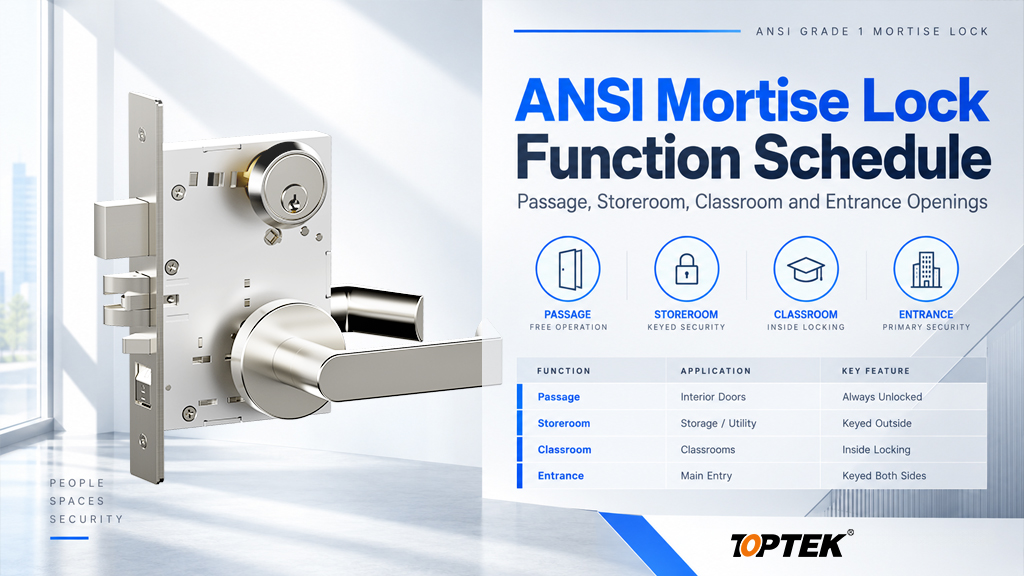
- Build the ANSI mortise lock function schedule around each opening’s entry and exit behaviour.
- Separate passage, continuously restricted entry, key-controlled classroom access and entrance control.
- Record the function description alongside the selected manufacturer’s ordering code.
- Approve the complete lock, cylinder, trim and strike combination before releasing door quantities.
Quick Answer: What belongs in an ANSI mortise lock function schedule?
An ANSI mortise lock function schedule connects each door number to a defined operating sequence, exact lock configuration and matching hardware. Record whether the outside lever is normally active or locked, how authorised users enter, how occupants leave, and what happens after the key is removed or the door closes. Add the cylinder, trim, handing, strike and drawing revision. For a commercial door lock project, this gives the buyer and supplier a shared acceptance test instead of relying on a room name or a short function label.
Start with the TOPTEK ANSI Grade 1 mortise lock range, then assign a function to each opening. The product platform is a selection starting point. A performance grade alone does not identify the operating function, cylinder arrangement or suitability for an individual opening.
Describe the opening before choosing a function
A room label can conceal several different requirements. A storeroom used only by maintenance staff differs from a shared supply room that must remain accessible during working hours. A classroom may need a particular security procedure that a conventional classroom function does not provide. Write down the desired behaviour before selecting an ordering code.
Give each door a permanent opening number. Define the access side and occupied side on the drawing, including interior rooms where “outside” does not mean outdoors. Record who can change the locking state, whether that state should persist, and whether the opening has an adopted fire, accessibility or means-of-egress requirement.
Use an operating sentence that a sample inspector can follow. For example: “Outside lever remains locked; authorised key retracts the latch; inside lever releases the latch; outside lever remains locked after the key is removed.” This is an illustrative requirement, not a substitute for the selected product’s function sheet. If another party expects the key to leave the outside lever unlocked, the discrepancy becomes visible immediately.
Keep mechanical function separate from access-control sequencing. If the opening needs an electric release, monitoring or a defined power-loss response, add those requirements and obtain a specific electromechanical configuration. Do not assume that a mechanical function name describes an electrical variant.
Compare the four function routes
| Function route | Entry behaviour to define | Schedule checkpoint |
|---|---|---|
| Passage | Both levers operate the latch without a locking selection | Confirm that unrestricted entry is intended and identify the exact passage configuration. |
| Storeroom | Outside lever stays locked; key provides authorised entry | Check the outside lever again after key removal and door closure. |
| Classroom | Outside key selects locked or unlocked outside-lever operation | Define who controls the state and whether it remains after key removal. |
| Office or entrance | Entry is controlled using the selected key and inside control arrangement | Identify the exact inside control and any deadbolt behaviour; “entrance” is insufficient. |
TOPTEK’s function descriptions identify F05 as classroom and F07 as storeroom. F04 covers an office or entry arrangement. Keep these descriptions attached to the selected order configuration. Do not extrapolate a function code to another lock type or another manufacturer’s catalogue without checking its published definition.
The BHMA A156.13 mortise lock overview explains the role of function numbers in specification, alongside performance testing. It provides standards context; it does not establish that a particular TOPTEK order is certified or that its function is suitable for a given building.
For the closer comparison between the two restricted-entry routes, use the classroom versus storeroom function guide. In the project schedule, the purpose is to assign and verify a function across openings, including the exceptions that do not fit a repeated hardware set.
Make entrance functions explicit
“Entrance lock” can refer to different combinations of latch control, inside thumbturn and deadbolt operation. The label should trigger a request for an operation diagram. State which control locks the outside lever, whether the key can change that state, and what the inside lever releases.
TOPTEK’s F04 description uses inside thumbturn or outside key control of the outside trim. Other room-entry functions have different arrangements. Do not substitute apartment, dormitory or privacy functions merely because the external trim looks similar. A shared lever design does not establish an identical internal mechanism.
Where a deadbolt is included, add a separate test condition with the deadbolt projected. Confirm the required inside release sequence against the exact function sheet and project requirements. Record whether an auxiliary deadlatch is included and its correct interaction with the strike. These checks concern different components and should not be collapsed into a single “lock works” box.
A conventional classroom function also should not be treated as a complete school security specification. Ask the project designer to define any inside lockdown requirement, key control and release arrangement. The schedule should reproduce that approved requirement accurately and identify the matching product.
Build a schedule row that purchasing can use
| Field group | Required information | Reason |
|---|---|---|
| Opening | Door number, location, access side, leaf and frame reference | Connects the function to one physical opening. |
| Operation | Outside lever, inside lever, key, inside control and bolt sequence | Defines the sample acceptance test. |
| Order identity | Lock platform, function code, trim code, cylinder and finish | Prevents a function description becoming an incomplete order. |
| Interfaces | Handing, door thickness, preparation, spindle and strike drawing | Coordinates the parts installed together. |
| Control | Drawing revision, quantity, evidence reference and substitution rule | Maintains consistency from sample to shipment. |
Separate door quantities from spare hardware. A spare lock intended for several openings must retain the relevant function and conversion limitations. Avoid a spare-parts line that says only “ANSI lock body”; it may conceal different cylinder, trim or operating requirements.
For repeated doors, use a common hardware-set reference plus an opening-by-opening exception column. This lets purchasing aggregate identical assemblies while preserving differences. If a room changes use, review the operating sentence before copying the old hardware-set number.
For an initial check, send TOPTEK one proposed schedule row with a plan sketch and required entry behaviour. Request a function match and a list of missing interface information before completing the full order schedule.
Coordinate trim, cylinder and strike with the function
The TKAMEC9200 escutcheon lever trim and TKAMRR9200 round rose trim illustrate different trim routes within TOPTEK’s ANSI offering. Select the function first, then confirm how the required cylinder and inside control fit the chosen trim. A matching appearance alone is not an interchangeability statement.
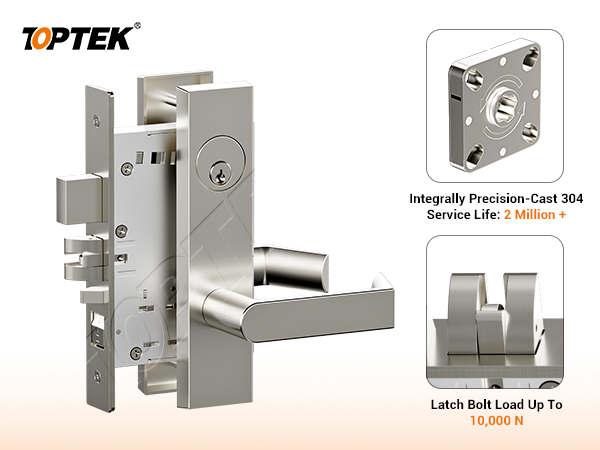
Confirm the cylinder format and operating interface for the selected function. The keying plan determines who can operate the cylinder, while the lock function determines what that operation does. Both belong in the project records, but one cannot replace the other. Retain the cylinder supplier’s interface drawing with the hardware set.
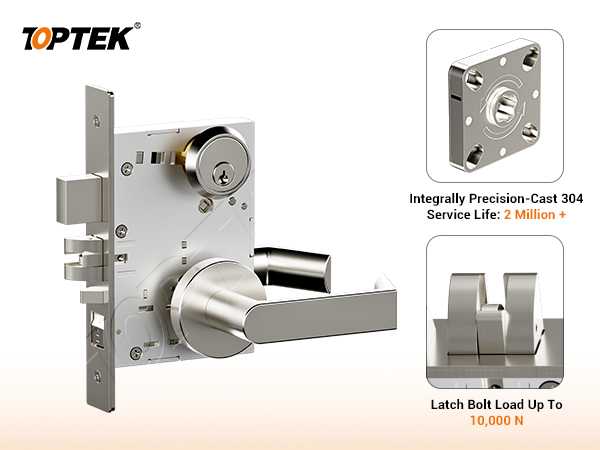
The strike must accept the required bolt travel and support the auxiliary deadlatch correctly where fitted. Inspect on the intended door and frame preparation with the specified trim tightened normally. A successful loose-bench demonstration does not establish installed alignment.
Test state changes and preserve the approved configuration
- Start with the door open and identify every operating control on both sides.
- Demonstrate the unlocked and locked states described in the schedule.
- Remove the key and repeat outside-lever operation to check whether the selected state persists.
- Close the door on the intended strike, then repeat entry and inside release.
- For a deadbolt function, repeat the documented release sequence with the deadbolt projected.
- Record the function code, drawing revision, cylinder and trim used in the accepted sample.
Common mistakes include copying a function from an adjacent room, confusing key entry with a permanently unlocked outside lever, and approving a lockcase without its final trim. Each can produce an assembly that fits the door but behaves differently from the owner’s requirements.
Project risks include unintended access, delayed room entry, unsuitable release behaviour and replacement hardware that no longer matches the original schedule. Resolve discrepancies before batch release. If a function changes after sampling, update the affected door rows and repeat the relevant operating checks.
TOPTEK evidence and RFQ checklist
Why TOPTEK: the ANSI platform offers escutcheon and round rose trim routes, with documented function descriptions for project selection. TOPTEK’s quality management information provides a route for reviewing inspection and production control. Ask for the records relevant to the exact model and configuration. Internal validation and third-party certification serve different purposes.
For purchasing discussions with a commercial lock manufacturer, attach the following items:
- Opening list and hardware-set quantities, including separately identified spares.
- Operating sentences for passage, storeroom, classroom and entrance exceptions.
- Selected trim, cylinder, keying responsibility, handing and door preparation.
- Strike details and any door-assembly evidence required by the project.
- Sample quantities, acceptance checks, drawing revision and packaging identification.
TOPTEK’s product scope includes ANSI, EN and AS mortise locks, panic exit devices, multipoint locking systems, electronic locks and access control, lever handles, cylinders, hinges and door power transfer. This schedule concerns the ANSI mortise platform; other product families require their own interface and evidence checks.
Frequently asked questions
Is ANSI Grade 1 a lock function?
No. A performance grade does not identify passage, storeroom, classroom or entrance operation. Specify the grade requirement and the exact function separately.
What separates classroom and storeroom functions?
In the described TOPTEK configurations, classroom operation lets an outside key select the outside-lever state. Storeroom operation keeps the outside lever locked and uses a key for entry.
Can I specify only “entrance lock”?
No. Define the outside lever, key, inside control, latch and any deadbolt sequence, then identify the matching function and trim.
Does reversing the latch change the function?
Do not assume it does. Latch orientation and control of the inside or outside lever are separate configuration questions. Follow the exact model instructions.
What should accompany a replacement order?
Provide the opening number, current function description, lock and trim identification, cylinder interface, strike details and the applicable drawing revision.
Request a function schedule review
A useful function schedule describes behaviour precisely enough to order, inspect and maintain the same assembly. Keep the operating sentence, component references and accepted sample connected throughout procurement.
Send your opening list, required entry and exit behaviour, trim preference and available drawings to ivan.he@toptekaccess.com. Request a formal quotation against the agreed function matrix, including the proposed model configuration, sample scope and relevant documentation.
TOPTEK is your Commercial Door Hardware Reliability Solution. TOPTEK: Smart Design. Strong Security.