

ANSI Classroom vs Storeroom Mortise Lock Functions: F05 or F07?
TL;DR
Choose F05 when authorised staff must be able to lock or unlock the outside lever by key. Choose F07 when the outside lever should remain locked and every outside entry requires the key. In both functions described by TOPTEK, the inside lever remains available for free egress.
Start with the ANSI Grade 1 Mortise Lock product hub, then use this narrower guide to define the required function and approval evidence.
Quick Answer
The decisive question is not the room label; it is the required outside-lever state. F05 provides key-controlled locked or unlocked states. F07 keeps the outside lever locked, with keyed entry from outside. Confirm the exact function on the door schedule, drawing and approved sample.
Why room names are not enough
A classroom, training room and storage room may sit in the same building, yet their daily access patterns differ. A schedule that says only “mortise lock” transfers the most important decision to the installer or distributor. The buyer should define who may enter from the corridor, whether the outside lever may remain unlocked, and how occupants leave from inside.
The function code is a shorthand for operating logic, not a substitute for that logic. Write the expected state in plain language next to the code. This makes submittal review easier for consultants, purchasing teams and site staff who may not use the same naming convention.
How the F05 classroom function operates
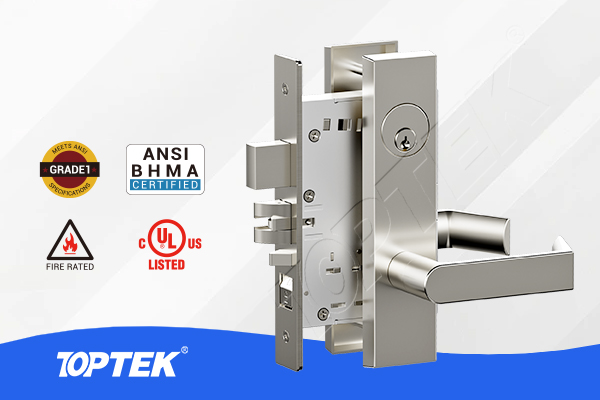
TOPTEK’s supplied function description states that the F05 outside lever can be locked or unlocked by the outside key. When locked, that lever does not retract the latch. The inside lever remains free to retract the latch for egress. This allows authorised staff to change the corridor-side access state without entering the room.
A key-controlled change of state is useful only when the operating procedure and key authority are defined. The hardware schedule should say who can place the outside lever in the unlocked state, when it must return to locked, and whether a project policy requires additional controls. Do not infer those policies from the function name.
How the F07 storeroom function operates
TOPTEK’s supplied description states that the F07 outside lever remains locked. Entry from outside requires the key, while the inside lever retracts the latch for free egress. This fits service, equipment and restricted-access rooms where an unlocked outside lever is not an intended state.
The permanent outside locked state is the practical difference from F05. It reduces the risk that staff leave a restricted room in an unlocked operating mode, but it also means authorised users need the correct key for every outside entry. Key control and handover planning therefore belong in the same approval discussion.
Compare the access states before choosing
Both functions control entry from outside and preserve inside exit in the descriptions supplied by TOPTEK. The difference appears when the buyer asks whether the outside lever may be left operable without a key. F05 can provide that unlocked state; F07 does not.
Do not change the decision merely because a room is called a classroom or storeroom. Some education projects use restricted laboratories, IT rooms or shared teaching spaces whose access policy differs from the label. The responsible project team must match the function to the actual access and life-safety requirements.
| Decision | F05 classroom | F07 storeroom |
|---|---|---|
| Outside lever state | Key can lock or unlock | Remains locked |
| Outside entry when locked | Key required | Key required for every entry |
| Inside operation | Lever retracts latch for egress | Lever retracts latch for egress |
| Best approval evidence | Show both outside states | Show always-locked outside state |
| RFQ emphasis | Access-state authority | Key access and handover |
Check the complete opening, not the lockcase alone
A mortise function interacts with trim, cylinder, keying, door preparation and the surrounding opening. The ANSI mortise lock door-preparation checklist helps teams record geometry, while this guide addresses function. One page should not silently replace the other.
Confirm the cylinder and key system that can operate the required function. Confirm the inside and outside trim references, handing or field configuration instructions, and any auxiliary deadlatch relationship. A function sample should be evaluated as a matched assembly rather than a bare case on a desk.
Buyer checklist before approving F05 or F07
- Describe the required outside-lever state during normal hours.
- Identify who may change that state and by what key authority.
- Confirm that the specified inside operation meets the project’s egress requirements.
- List lockcase, trim, cylinder, keyway and door references together.
- Match each opening number to one function and drawing revision.
- Approve an identified sample before releasing repeat production.
Common mistakes and project risks
A common mistake is treating F05 and F07 as interchangeable because both restrict outside access. The error may not appear until occupancy: a classroom cannot be placed in the expected unlocked state, or a restricted room can be left unlocked. Replacing lockcases after doors are installed adds coordination, keying and programme risk.
Another mistake is approving a photograph. A photograph does not prove the outside lever state, cylinder interface or inside operation. Record a short operation sequence for the sample and link it to the submittal reference. Do not modify an egress function or disable a deadlatching feature to make an incorrect selection appear workable.
TOPTEK evidence and product scope
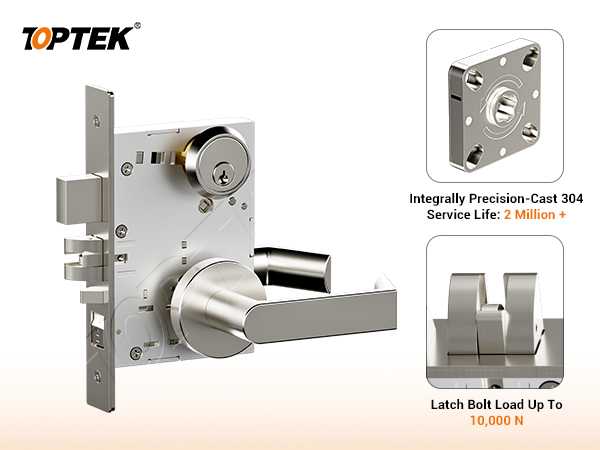
TOPTEK’s internal product material identifies F05 classroom and F07 storeroom among its ANSI mortise lock functions. The material describes key control at the F05 outside lever, an always-locked outside lever for F07, inside free egress and an auxiliary deadlatch in these configurations. These are model-family descriptions; final supply still requires an exact configuration.
Use the TOPTEK resource page to request current drawings and evidence. Internal development-test statements must remain separate from third-party listings or certificates. This article intentionally makes no new certification, fire-rating, cycle, load or material claim.
Product range and sample approval
The ANSI range can be discussed with escutcheon or sectional trim presentations, but trim appearance does not identify F05 or F07 logic. The TKAMRR9200 round-rose reference is useful for a trim conversation, while the function must remain explicit in the quotation and sample label.
Ask the sample label to show opening number, function, hand or field-setting status, cylinder reference and keying note. During review, demonstrate outside locked, outside unlocked where applicable, keyed entry and inside operation. Sign off the sequence rather than relying on a general “sample approved” email.
RFQ checklist for an education or service-room project
- Door schedule with opening numbers and room use
- Required F05 or F07 operating sequence in plain language
- Cylinder format, keyway and key hierarchy
- Inside and outside trim references
- Door thickness, preparation and handing details
- Applicable listing, certification and documentation requirements
- Sample quantity, approval owner and revision control
- Packaging labels linking production to the approved function
Why TOPTEK: convert a room label into an approval record
A useful supplier response should repeat the operating requirement, not only a product name. TOPTEK can review a marked-up schedule, map the stated function to the proposed configuration and identify information that remains unconfirmed. This reduces the chance that purchasing shorthand becomes a site interpretation.
The process is most reliable when quotation, drawing, sample and production label use the same function reference. If the customer changes the access policy, the team can then see whether a new function, cylinder or keying review is required.
Two-level CTA
For a quick first review, send the opening schedule and highlight every door that may need classroom or storeroom logic. TOPTEK can return a question list covering outside state, inside operation, trim and keying.
For a formal RFQ, send the approved schedule, door details, cylinder/key plan, evidence requirements and sample protocol through the TOPTEK contact page. Request a configuration-specific quotation rather than a generic ANSI mortise lock price.
Conclusion
F05 and F07 answer different access questions. F05 lets authorised staff change the outside lever between locked and unlocked by key; F07 keeps that lever locked and requires keyed entry. Both descriptions retain inside free egress, but the complete project assembly and applicable requirements still need review.
Put the intended behaviour in writing, demonstrate it on an identified sample and preserve the approval reference through production. That is the practical way to prevent a small function-code error from becoming a building-wide replacement problem.
Frequently asked questions
What is the main difference between F05 and F07 mortise lock functions?
F05 allows the outside lever to be locked or unlocked by key. F07 keeps the outside lever locked, so outside entry requires the key.
Does the inside lever remain free on both functions?
In the TOPTEK function descriptions used for this guide, the inside lever retracts the latch for free egress on both F05 and F07. Confirm the exact configured assembly and project requirements.
Should every classroom automatically use F05?
No. Select the function from the required access policy, egress requirements and approved door schedule rather than the room name alone.
Can a product photograph prove the function?
No. Approve an identified operating sample, configuration drawing, trim and cylinder references.
What should an RFQ include?
Include opening numbers, operating sequence, trim, cylinder and keying, door preparation, evidence requirements and the sample approval process.