

CE Bathroom Mortise Lock Guide: Thumbturn, Privacy Bolt and Emergency Release
TL;DR
A bathroom mortise lock normally combines lever-operated latching with inside privacy control and an outside emergency-release interface. Buyers must confirm the exact turn/release furniture, spindle or follower relationships, door preparation and intended operating sequence before approving a set.
Start with the EN 12209 / CE Mortise Lock product hub, then use this narrower guide to define the required function and approval evidence.
Quick Answer
Specify the whole WC set: lockcase function, lever furniture, inside thumbturn, outside release, spindle or follower details, door dimensions and emergency-access method. Do not assume that visually similar turns and releases fit or operate every European bathroom lock.
Start with the operating sequence
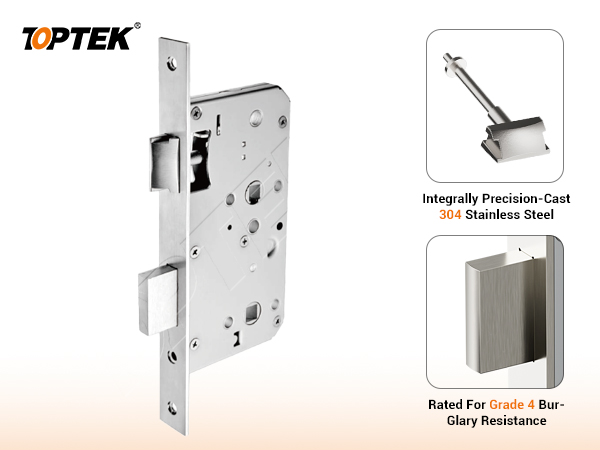
TOPTEK’s supplied European function description says the latchbolt is operated by the lever for normal access, while an internal thumbturn controls the privacy bolt. An outside emergency release can unlock the privacy function in an emergency. The buyer should reproduce this sequence in the door schedule rather than writing only “bathroom lock”.
The sequence needs named actors and states: how an occupant enters, how privacy is engaged, what the outside indicator shows if present, how authorised staff release the door, and how the inside operation behaves. The responsible project team must also confirm applicable accessibility, egress and building requirements.
Separate latching from privacy locking
The spring latch keeps the door closed during normal use and retracts through the lever. The privacy bolt creates the occupied state through the internal turn. Confusing those operations leads to incomplete specifications, such as selecting lever furniture without the required turn/release set or choosing a latch-only case for a privacy opening.
Ask the drawing to identify each operating centre and interface. Confirm the centre distance, backset, forend, follower and turn-hub details for the exact model. The European commercial-door hardware guide provides broader set coordination; this article stays focused on WC function.
Define the inside thumbturn
An inside thumbturn should be selected as part of the matched function. Confirm the turn spindle, projection, fixing, rose or plate and its relationship to the privacy hub. A turn that looks suitable in a catalogue may have the wrong spindle, engagement length or operating direction.
Also check usability for the intended occupants and door environment. A project may have accessibility, anti-ligature, cleaning or vandal-resistance requirements beyond the lockcase. Those requirements need the relevant specialist and applicable documents; they cannot be inferred from CE wording or this buyer guide.
Define the outside emergency release
The outside release is not a normal key override. Its purpose and tool depend on the approved WC furniture and project design. Specify whether the release uses a coin, tool or other intended interface, how staff access it, and how the operation is labelled.
Do not improvise a release by drilling or adapting trim. An unauthorised modification may alter alignment, privacy performance or the approved doorset. Review the release on a complete sample and keep the tool or operating instruction within the building-management plan.
| Item | Buyer must define | Approval evidence |
|---|---|---|
| Lever latch | Normal entry and retraction | Operation on complete sample |
| Privacy bolt | Inside engagement method | Thumbturn and hub match |
| Outside release | Intended tool and operation | Demonstrated emergency release |
| Door preparation | Centres, backset and fixings | Current marked-up drawing |
| Evidence scope | Applicable product/doorset documents | Model-specific document list |
Coordinate door preparation and furniture
The lockcase, lever set and WC turn/release occupy the same door faces and edge preparation. Confirm all centre lines from one controlled drawing. A correct lockcase can still fail the approval if the plate holes, through-fixings or turn spindle conflict with the prepared door.
For lockcase geometry, use the model drawing rather than a generic template. For related product references, the EN mortise lock hub shows the family scope. Do not transfer dimensions or evidence from one function to another without explicit confirmation.
Buyer checklist for a WC opening
- Identify latch and privacy-bolt operations separately.
- Specify inside thumbturn and outside emergency-release references.
- Confirm all spindle, follower and centre-distance interfaces.
- Show lever furniture, plates or roses on the same drawing.
- Record door thickness, material, hand and edge preparation.
- Confirm applicable accessibility, egress and doorset requirements.
- Approve the exact release method on an identified sample.
Common mistakes and project risks
The first mistake is buying a “bathroom lock” without its compatible turn/release. The second is accepting an attractive trim set before checking operating centres. The third is assuming that emergency release means a cylinder. Each can create re-machining, mismatched finishes or unusable privacy control at installation.
Another risk is treating a successful bench operation as complete doorset approval. Door thickness, fixings and preparation can change spindle engagement and alignment. Test the intended sample in a representative preparation and record what was included. Do not disable privacy or egress behaviour to compensate for a mismatch.
TOPTEK evidence and product scope
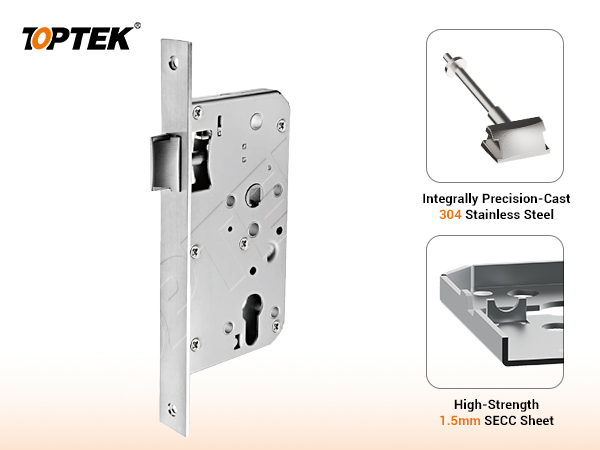
TOPTEK’s European mortise lock material identifies a bathroom function among a wider range including sash, passage, deadbolt, night-latch, escape, classroom and roller-latch options. The current function description supports lever latching, inside thumbturn privacy control and outside emergency release.
The EN78WCL image is used as the bathroom/WC product reference in this draft. Before publication or order release, confirm the exact model suffix, supplied components, current drawing and evidence scope through TOPTEK technical resources. This guide makes no independent certification-classification or fire-rating claim.
Product sample and approval controls
Label the sample with model, function, door thickness, furniture, turn/release, finish and drawing revision. The review should demonstrate lever opening, privacy engagement, outside restricted state, authorised release and return to normal operation. Record any tool needed.
If the customer changes the trim design, repeat the interface review. Similar spindle holes do not prove matching length or engagement. Preserve photographs of both door faces and the edge, plus a short operation record, so production and inspection teams can compare the delivered set with the approved basis.
RFQ checklist for bathroom mortise locks
- Opening schedule and room application
- Exact lockcase function and model reference
- Backset, centre distance, forend and case envelope
- Lever furniture and spindle data
- Inside thumbturn and outside release references
- Door construction, thickness, hand and finish
- Required evidence and approval documents
- Sample test sequence and revision owner
Why TOPTEK: coordinate the interfaces
TOPTEK can review the lockcase, lever furniture and WC turn/release as one enquiry instead of three unconnected catalogue lines. A useful response highlights missing dimensions and unconfirmed evidence rather than guessing.
The quotation should repeat the required function and identify included components. Drawings and sample labels then preserve that definition. This approach supports distributors and door manufacturers who need repeatable sets across multiple openings and deliveries.
Two-level CTA
For a first check, send a photograph of both door faces, the edge preparation and the proposed turn/release, together with door thickness and operating requirements. TOPTEK can identify the documents still needed for a proper comparison.
For a formal RFQ, submit the schedule, marked-up drawing, component list, evidence requirements and sample-approval method through the TOPTEK contact page. Ask for a matched WC set rather than an isolated lockcase price.
Conclusion
A CE bathroom mortise lock is a coordinated privacy function, not a generic label. The latch, privacy bolt, lever, inside turn and outside emergency release must share the correct geometry and operating logic.
Define the sequence, verify every interface, approve the release on a complete sample and retain the revision record. That work gives the buyer a reliable basis for quotation and repeat production without overstating what CE wording proves.
Frequently asked questions
What does a bathroom mortise lock do?
It provides normal lever-operated latching plus an inside privacy control and an outside emergency-release arrangement in the configured set.
Is the outside emergency release the same as a key cylinder?
Not necessarily. It may use a coin, tool or another intended WC-release interface. Confirm the exact furniture and project requirement.
Can any thumbturn operate the privacy bolt?
No. Confirm the spindle, engagement, fixing, operating direction and hub compatibility for the exact lockcase and door thickness.
Does CE wording prove that all WC furniture is compatible?
No. Compatibility depends on the exact lockcase, furniture, interfaces and preparation.
What should be tested on the sample?
Test lever latching, privacy engagement, outside restriction, authorised emergency release and return to normal operation on the identified configuration.