

TL;DR
- Give every Australian commercial opening a complete mortice lock schedule row.
- Connect function, backset, oval cylinder and trim through one controlled drawing set.
- Separate the mechanical configuration from motorised or solenoid variants.
- Approve evidence and samples for the actual assembly, then keep the same references on repeat orders.
Quick Answer: What belongs in an AS 4145 mortice lock door schedule?
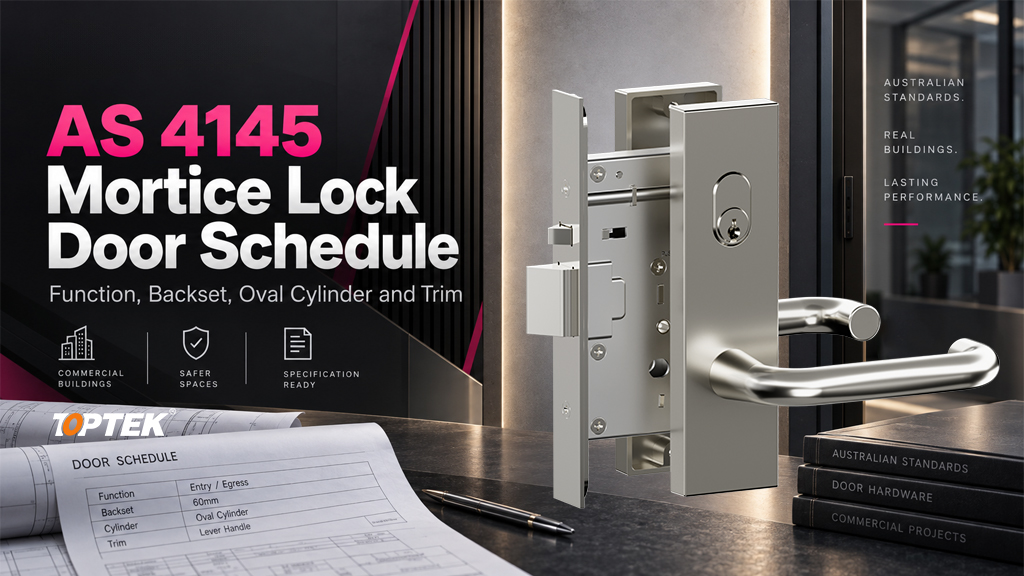
An AS 4145 mortice lock door schedule should identify the opening, required function, selected model, backset, cylinder interface, trim and strike. Add the door thickness, preparation drawing, handing convention, finish, quantities and relevant evidence. For Australian commercial door hardware, “AS 4145 lock” does not describe a complete assembly. The schedule must connect how the door operates with the parts that create that operation, and distinguish performance requirements from the documents demonstrating that the selected configuration meets them.
Use the TOPTEK AS 4145 mortise lock range to identify the product route, then complete the opening-specific details. A useful schedule serves purchasing, door machining, installation and maintenance. It should not require each party to reconstruct the intended assembly from separate emails.
Start with opening identity and the operating requirement
Assign a unique door number and describe the spaces it connects. Record the door and frame construction, leaf thickness, opening direction and which side provides controlled entry. Include the hardware-set reference, but retain exceptions at the individual opening level.
Write the function in plain language before selecting a model. State whether both levers operate freely, which control changes the locked state, how authorised entry occurs and what the inside lever does. If a thumbturn or key acts on more than one part of the mechanism, record that sequence rather than assuming all “commercial” functions behave alike.
For a shared office, for example, the owner may want the outside lever to stay unlocked during business hours. A restricted store may require key entry each time. These are illustrative operating needs, not model assignments. Ask the supplier to identify the exact configuration that performs the approved sequence.
Keep the locking-side selection distinct from latch orientation. TOPTEK’s TKAU6400 product materials describe configuration control of the lever sides. Confirm the permitted setup and instructions for the ordered version. A site adjustment should reproduce the approved function, with the door number and resulting configuration recorded.
Use backset to coordinate the lock and the door profile
Backset locates the lock’s operating axis relative to the reference face of the forend. It affects the position of trim, cylinder and preparation within the door profile. Measure using the selected drawing’s datum; do not use the visible edge of decorative trim as a substitute.
TOPTEK’s TKAU6400 materials list 60 mm, 89 mm and 127 mm backset options. These are product selection options, not a statement that every variant, function or trim combination is available in every configuration. Identify the required option on each schedule row and obtain the matching drawing.
The Australian mortice lock backset guide explains the dimension choice in more detail. In the door schedule, the task is to connect the approved dimension to the correct model and opening. Do not repeat one preparation drawing across different backsets without checking the lockcase and fixing geometry.
Review the stile, glazing beads, reinforcement and any existing holes. On a replacement door, measure the present installation rather than inferring dimensions from a familiar handle. A larger trim plate may cover a visible hole while leaving an incompatible lock pocket or fixing arrangement underneath.
Match the oval cylinder and its operating interface
“Oval cylinder” identifies a format, not a complete compatibility specification. Australian and other oval systems must not be treated as interchangeable based on shape alone. Confirm the profile, retention method, operating cam or tailpiece, projection and relationship with the selected mortice lock function.
Record the cylinder supplier, model reference and operating interface drawing. Then identify the keying requirement: individual keying, keyed alike or an agreed master-key relationship. Keying controls permission; the lock and cylinder interface determine how key rotation operates the mechanism.
Check the cylinder with the actual trim and door thickness. A cylinder that engages a bare lockcase may still project incorrectly or bind after the escutcheon is installed. Include any protective trim and retaining parts in the sample assembly.
Separate construction access from final handover keying when the project requires it. The lock schedule can reference the controlled keying schedule without reproducing sensitive key information. Give one authorised party responsibility for changes, and ensure the supplier knows which cylinder configuration is required at shipment.
Choose wide plate or round rose trim as a coordinated assembly
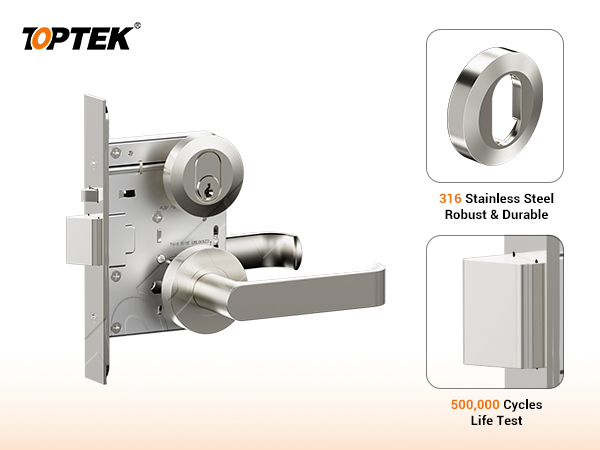
The TKAU6400EC escutcheon lever trim provides a wide-plate route, while TKAU6400RR provides a round rose arrangement. Select based on the required controls, door preparation, fixing pattern and appearance. A trim change should trigger an interface review even when the underlying lock family remains the same.
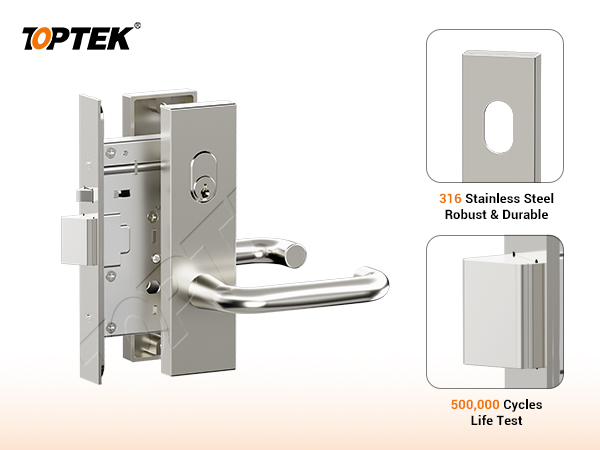
For wide plates, confirm the centre relationships, plate outline, fixing positions and clearance around the door edge. For separate roses, check each fixing pattern and the relationship between lever and cylinder furniture. Do not infer a machining template from the external size of the trim.
Confirm spindle engagement and follower fit with the supplied parts. Tighten the trim to its specified installation condition, then operate both sides. Binding that appears after tightening needs investigation before acceptance; loosening the assembly indefinitely is not a satisfactory configuration fix.
If the opening details are incomplete, send TOPTEK a door photo and one schedule row. Include the intended function, measured thickness and preferred trim. Request a list of the drawings and dimensions needed for a configuration proposal.
Keep evidence requirements separate from product descriptions
The DIN Media entry for AS 4145.2:2008 identifies the mechanical lockset standard and its listed amendments. Specify the edition and amendments required by the project. A standard reference in a product description does not identify the tested sample, result, test scope or installed door assembly.
Ask for documentation tied to the exact model and configuration. Record the document reference, issue date, tested components and any limits relevant to the opening. Do not assign another manufacturer’s classification, test result or installation allowance to a TOPTEK product.
Where a fire-resisting opening is involved, obtain the applicable doorset evidence and installation requirements separately. A mechanical lock performance statement is not a substitute for evidence covering the door, frame, hardware and installation arrangement. The project’s responsible designer should identify the required approval route.
For finishes and materials, describe the parts covered by each specification. A stainless-steel lever statement should not become an assumption about every internal component. If corrosion testing is required, ask for the method, duration, result and sample identification applicable to the proposed supply.
Build an orderable door schedule
| Field | Information to enter | Cross-check |
|---|---|---|
| Door identity | Opening number, location, leaf/frame type and thickness | Matches the architectural schedule. |
| Function | Outside and inside lever, key and thumbturn sequence | Matches the selected configuration. |
| Lock geometry | Backset, centres, case and forend drawing references | Matches the door preparation. |
| Cylinder | Australian oval interface, retention, projection and keying reference | Works with the lock and trim. |
| Trim and strike | EC or RR route, spindle, fixings, strike and finish | Installed sample operates correctly. |
| Version | Mechanical, motorised or solenoid configuration | Additional electrical scope is separately defined. |
| Procurement control | Quantity, spare quantity, revision, evidence and sample reference | Quotation and packing agree. |
Electrical versions require additional information such as power, control and monitoring interfaces. Keep those requirements attached to a distinct configuration row. Do not assume that a shared external trim means the mechanical and electrical versions have identical operating or installation requirements.
Review the schedule as an assembly, not as independent columns. If the backset changes, revisit the preparation. If the cylinder changes, revisit the operating interface and projection. If the trim changes, revisit fixings and spindle engagement. This review catches combinations that individual component selections may miss.
Control sample approval, errors and repeat orders
- Match each sample to an identified schedule row and drawing revision.
- Inspect the lock, trim, spindle, cylinder and strike as a complete supplied set.
- Install on the intended preparation or a representative approved sample.
- Check normal closing, key operation, lever return and each required locking state.
- Record the accepted configuration and mark any permitted alternatives explicitly.
- Carry the same references into the purchase order, labels and replacement-parts list.
Common errors include mixing an EC trim reference with an RR preparation, treating all oval cylinders as equivalent, and copying one backset across doors with different profiles. Another risk is accepting an alternative because the outside appearance matches while the lock function or evidence scope changes.
The consequences can include site machining, cylinder replacement, incorrect access behaviour and delayed handover. Keep substitutions subject to a component and evidence review. An approved sample should be reproducible from its record without relying on the memory of the person who first assembled it.
Why TOPTEK and what to include in the RFQ
TOPTEK’s TKAU6400 family provides identified wide-plate and round rose routes, backset options and mechanical or electromechanical project discussions. Its quality management information helps buyers identify the inspection and traceability questions to raise for an order. Request exact model evidence rather than extending a family description to every configuration.
For a commercial door hardware manufacturing enquiry, attach the door list, function sentences, backset selection, oval-cylinder interface, trim references, preparation drawings and finish requirements. Add quantities, sample needs, project evidence requirements and the person authorised to approve substitutions.
TOPTEK also supplies ANSI and EN mortise locks, exit devices, multipoint systems, electronic locks and access control, lever handles, cylinders, hinges and door power transfer. Keep these associated products linked to their own drawings and requirements when they form part of the same opening.
Frequently asked questions
Is “AS 4145 mortice lock” enough for an order?
No. Add the exact model, function, dimensions, cylinder interface, trim, strike and relevant evidence for each opening.
Which backsets are listed for the TKAU6400 family?
TOPTEK materials list 60 mm, 89 mm and 127 mm options. Confirm availability and the matching drawing for the required function and version.
Does an oval cylinder automatically fit?
No. Confirm its Australian oval format, retention, operating interface, projection and compatibility with the selected lock and trim.
Do not assume they can. Compare the complete lock and trim drawings, including fixing positions and spindle or cylinder clearances.
Does a mechanical test result establish fire-door suitability?
No. The relevant doorset evidence and installation scope must also cover the proposed assembly and project application.
Request a coordinated mortice lock quotation
A complete door schedule connects the user’s operating need to an assembly that can be ordered and checked consistently. Treat every change to function, geometry, cylinder or trim as a change to that assembly.
Email the schedule and available drawings to ivan.he@toptekaccess.com. Request a quotation identifying the proposed model configuration, backset, cylinder and trim coordination, sample scope and supporting document references.
TOPTEK is your Commercial Door Hardware Reliability Solution. TOPTEK: Smart Design. Strong Security.