
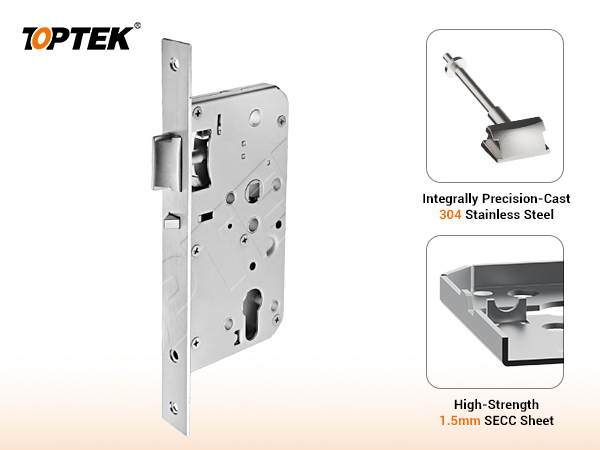

CE Mortise Lock Forend and Strike Plate Guide: Dimensions, Alignment and Door Preparation
A drawing-led guide for door manufacturers, frame suppliers, distributors and project buyers who need the lock edge and frame preparation to work as one controlled interface.
TL;DR
- A CE mortise lock forend and strike plate must be specified as a paired door-and-frame interface. A lock body that fits inside the door can still bind, rattle or fail to latch when the forend and strike are not coordinated.
- Confirm forend length, width, thickness, end shape, fixing holes and bolt openings on the model-specific drawing. Confirm strike length, width, thickness, lip/rebate geometry, openings, fixing support and frame datum separately.
- Set the strike from the hung door and actual latch/deadbolt centre lines, with the specified door gap and seals in place. Do not position it from a catalogue photograph or an assumed centre line.
- TOPTEK’s CE certificate identifies covered lock and locking-plate scope; it is not a machining drawing and does not approve an arbitrary strike substitution.
- Freeze the drawing revision, fit a production-representative first article, test closing and locking from both sides, and record the approved door/lock/strike combination before batch preparation.
Quick Answer: How Should a Forend and Strike Plate Be Matched?
Match the forend to the door edge, then locate the strike from the actual hung-door relationship—not from nominal dimensions alone. The forend must seat correctly without distorting the lockcase. The strike must receive the latch and deadbolt at their real centre lines while allowing the specified door gap, rebate, seals and operating clearance.
Use the current lock drawing, door-edge detail and frame-section drawing with one agreed datum. Approve the exact lock, strike, cylinder, furniture and door construction as a sample set before releasing CNC, routing, punching or welding data.
Forend, Faceplate, Strike Plate or Keep: What Do These Terms Mean?
The forend is the plate fixed to the lockcase at the door edge. Some markets or teams call it the lock faceplate, although “faceplate” can also be confused with visible trim on the door face. In an RFQ, use a drawing or photograph to remove that ambiguity.
The strike plate is the frame-side component that receives the latchbolt and, where applicable, the deadbolt. “Keep” is a common alternative term. A box, dust box or reinforcement behind the strike may be a separate component. Buyers should state whether these parts are included, required or supplied by the frame manufacturer.
| Component | Primary interface | Dimensions to control | Typical failure if unclear |
|---|---|---|---|
| Forend / lock faceplate | Door edge and lockcase | Length, width, thickness, end shape, hole pattern, latch/deadbolt openings | Rocking plate, visible gap, weak fixing or distorted lockcase |
| Strike plate / keep | Frame, rebate and bolts | Length, width, thickness, lip, opening positions, fixing holes and support | Binding, excessive play, incomplete bolt entry or damaged frame finish |
| Door gap and seals | Closed-door relationship | Gap, seal compression, rebate depth and final stop position | Strike is correct on paper but wrong after the door is hung |
| Lock and trim axes | Door face, edge and frame | Backset, centres, follower, cylinder, latch and deadbolt centre lines | Misaligned holes or inconsistent operation from either side |
How to Specify the Mortise Lock Forend
The forend selection must start from the actual door-edge construction and the exact lock version. The TOPTEK EN 12209 Grade 3 mortise lock hub shows multiple functions and platforms. Similar product images do not prove that their forend geometry or fixing coordinates are interchangeable.
1. Confirm length and bolt-opening positions
The overall length must fit the prepared recess and leave appropriate material around the fixing points. The latch and deadbolt openings must correspond with the selected function. A passage latch, sash lock, deadbolt-only lock or escape-related function can require a different opening arrangement even when another headline dimension looks familiar.
2. Confirm width and edge support
Forend width affects the routed or punched recess and the remaining door-edge support. A wider recess should never be assumed acceptable simply because the plate covers it. Timber edge strength, steel-door reinforcement and profile machining zones require separate review.
3. Confirm thickness and seating condition
Forend thickness affects whether the plate sits flush, proud or recessed relative to the finished edge. The preparation must support the plate as specified without pulling the lockcase sideways when the screws are tightened. If lever return, latch travel or key operation changes after tightening, stop and inspect the pocket, alignment and fasteners.
4. Choose round or square ends intentionally
Round-ended and square-ended forends can require different tooling and corner preparation. The choice should follow the door manufacturer’s process, visual requirement and approved drawing. Do not substitute one end shape after door machining without checking dimensions, fixing positions and the controlled bill of materials.
5. Freeze fixing holes and finish
Hole position, countersink, fastener type, substrate and finish belong in the approval pack. Re-drilling a thin frame or door reinforcement on site may reduce fixing quality and create finish damage. A finish description alone also does not establish material grade; record material and finish as separate fields.
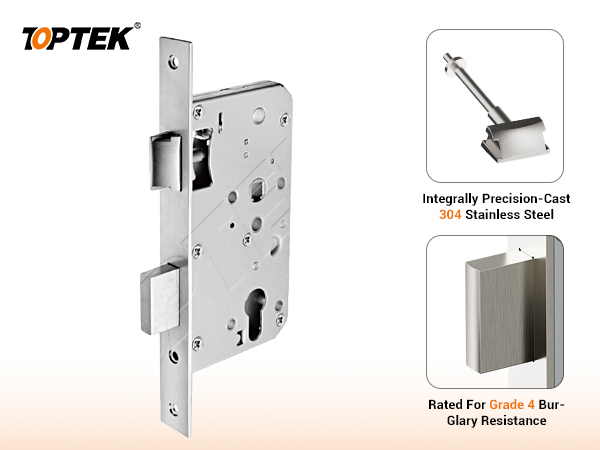
TOPTEK EN72SL Forend and Strike Data: A Controlled Example
The live TOPTEK EN72SL product page currently lists a 235 mm-high forend, 20/22/23/24 mm width options, round or square ends and 3 mm thickness; it lists a 1.5 mm strike plate thickness. These values are useful for early screening, but they are not permission to mix any width, end shape, backset or strike arrangement.
Before ordering or machining, confirm the full model code, function, backset, centres, handing, material/finish option, forend variant, strike geometry and drawing revision. A model-family page can contain multiple available options; the purchase specification must identify the exact approved combination.
| EN72SL page field | Current public value | Approval action |
|---|---|---|
| Forend height | 235 mm | Match the exact recess length and bolt openings to the current drawing |
| Forend width options | 20, 22, 23 or 24 mm | Select one option and freeze it in the model/BOM/drawing |
| Forend end shape | Round or square | Match door tooling and approved corner preparation |
| Forend thickness | 3 mm | Check flush seating and edge support on the representative door |
| Strike plate thickness | 1.5 mm | Confirm the supplied strike drawing, lip, openings and frame support |
How to Align the Strike Plate With the Hung Door
The strike should be located from the actual latch and deadbolt paths after the door, hinges, seals and closing condition are established. Nominal drawing dimensions remain essential, but final alignment depends on the physical door-to-frame relationship.
- Establish datums. Mark the finished floor or door reference, hinge side, closing face and lock centre lines on the approved door and frame drawings.
- Set the intended gap and seal condition. Install the relevant seals and confirm the door closes to the defined stop without unusual force.
- Transfer latch and deadbolt centre lines. Use a non-damaging method on a representative assembly; do not rely on the forend outline alone.
- Check the strike opening and lip. The latch must enter and retain as designed. Where a deadbolt is present, it must extend into the correct opening without scraping or stopping short.
- Confirm frame support and fixings. The strike needs suitable substrate or reinforcement. Screw heads and plate edges should not obstruct the door or seals.
- Operate the complete set. Test lever, key or cylinder operations from both sides, repeated closing, deadlocking where applicable and acceptable movement at the closed door.
Do not “solve” a binding latch by enlarging the strike opening until the cause is known. Hinge position, door sag, excessive seal pressure, a twisted frame, distorted lockcase or incorrect latch orientation can produce the same symptom.
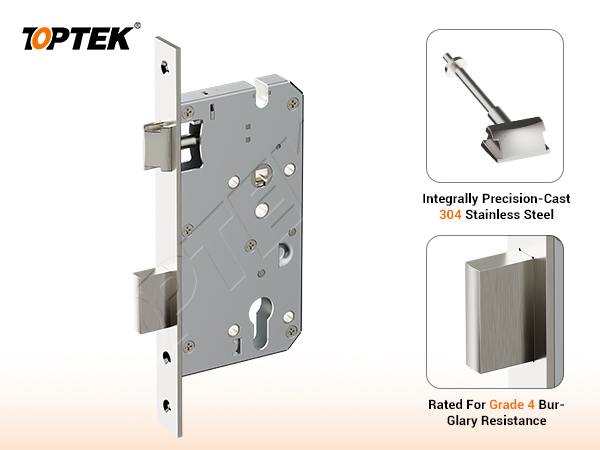
Door and Frame Preparation Checklist
| Stage | Door-side control | Frame-side control | Release evidence |
|---|---|---|---|
| Drawing review | Lock pocket, forend recess, axes, holes, reinforcement | Strike position, rebate, lip, openings, backing | Signed model-specific door/lock/frame drawing set |
| First preparation | Clean pocket, supported forend seat, correct fasteners | Supported strike seat, correct gap and seal relationship | Dimensional inspection record and photographs |
| Functional test | Lever/cylinder movement, latch and deadbolt travel | Positive engagement without scraping or forced closing | First-article operation checklist |
| Production release | Tooling/program tied to drawing revision | Frame preparation tied to matching strike revision | Approved sample, BOM and change-control record |
What CE and EN 12209 Evidence Can Confirm
The reviewed Intertek Certificate of Constancy of Performance No. 2649-CPR-26002201 covers mechanically operated locks, latches and locking plates within the listed model scope. Its notes state that the lock and plate shall be installed in accordance with the product installation instructions. The certificate’s model tables are valuable for scope verification, but they are not forend, strike or door-frame machining drawings.
Use the TOPTEK certification resource centre to identify available evidence, and read the EN 12209 classification-code guide for the performance-code context. Then verify the full supplied model against the current certificate/Declaration of Performance package and the intended project route.
A different strike, lock function, forend, door construction or installation condition may require a documented engineering and evidence review. Internal dimensional or functional inspection supports production control; it must not be presented as third-party certification.
Common Forend and Strike Plate Mistakes
Approving by overall length only
Matching length does not prove that width, thickness, end shape, holes, latch/deadbolt openings or the rear lockcase position are correct.
Using a product photograph as a template
Photographs can be cropped, scaled or show one option within a family. They are suitable for identification, not CNC or punch-tool coordinates.
Preparing the strike before the final door relationship is known
A nominal centre line may shift relative to the frame because of the actual hinge, gap, rebate, seal and assembly condition. Final verification belongs on the representative hung door.
Enlarging the strike opening to hide another problem
An oversized opening may reduce retention or mask sag, frame twist, seal pressure, lockcase distortion or an incorrect latch orientation. Diagnose the system before changing the plate.
Substituting the strike without an evidence check
The strike is part of the lock-and-frame interface. A physically similar plate is not automatically within the approved product, fire-door or project scope.
Project Risks and Controls
| Risk | Consequence | Control |
|---|---|---|
| Forend recess mismatch | Visible gap, proud plate, weak edge or lockcase distortion | Freeze all dimensions and inspect the first prepared door |
| Strike centre-line error | Poor latching, scraping, incomplete deadbolt entry | Locate and test on the representative hung assembly |
| Insufficient frame support | Loose fixings, damaged frame or unstable engagement | Define reinforcement, fasteners and substrate in the frame drawing |
| Door/lock revision mismatch | Batch rework despite an approved earlier sample | Link CNC/program, BOM, lock and strike to controlled revisions |
| Evidence boundary ignored | Tender rejection or unsupported performance claim | Review model, plate, installation and project evidence together |
Buyer Approval Checklist
- Exact lock function, model code, backset, centres and handing are recorded.
- Forend length, width, thickness, end shape, material/finish, holes and openings are dimensioned.
- Strike length, width, thickness, lip/rebate geometry, openings, holes and backing are dimensioned.
- Door material, finished thickness, edge construction, reinforcement and machining limits are known.
- Frame material, profile, rebate, stop, reinforcement and fasteners are known.
- Door gap, seals, hinges, closer and finished closing condition are coordinated.
- Lever, spindle, cylinder and trim fixings do not conflict with the lock or door.
- Certificate, DoP, model schedule and any door-set evidence are checked for the required scope.
- A production-representative door/lock/strike sample has passed dimensional and operational review.
- The approved drawings, sample, BOM and change-control owner are retained.
TOPTEK Product Range and Selection Boundary
TOPTEK’s EN 12209 platform includes sash, passage, deadlocking, night-latch, bathroom, roller and access/escape-related functions across listed 72, 78 and 85 mm centre arrangements. Buyers can use the EN 12209 buyer guide to understand the wider platform, then move to the exact model and controlled drawing.
No single forend or strike configuration should be assumed across all functions, backsets or door types. Final selection must identify the exact model, plate variant, finish, frame interface and required evidence.
RFQ Checklist for Forend, Strike and Door Preparation
Send the following information to reduce clarification cycles and avoid a false match:
- Door and frame material, profile sections, finished thickness and intended application
- Required lock function and inside/outside operating sequence
- Backset, centre distance, follower/spindle and cylinder interface
- Forend dimensions, end shape, finish, fixing and bolt-opening requirements
- Strike dimensions, lip/rebate, opening, fixing and backing requirements
- Door gap, seals, hinges, closer, opening direction and handing
- Existing lock/strike samples, model labels and photographs with a scale
- Target market, required certificate/DoP/door-set evidence and tender wording
- Quantity, finish, branding/packaging, spare requirements and project schedule
- Drawing format, revision owner, sample quantity and approval signatories
Why Work With TOPTEK?
TOPTEK can review the lock, forend, strike, door and frame as one approval package. The team can identify missing dimensions, match the requested function to the product family, compare supplied sections and drawings, and prepare a first-article checklist before the order is frozen.
This process is useful when an RFQ starts with only a lock photo, a partial forend measurement or a door-frame drawing. It creates reviewable decisions and helps prevent one unverified sample from becoming a batch-wide preparation error.
Frequently Asked Questions
What dimensions should be shown for a CE mortise lock forend?
Show the forend length, width, thickness, end shape, fixing-hole positions, countersink or screw details, latch and deadbolt openings, material/finish and their datums to the lockcase axes.
Is a mortise lock forend the same as a faceplate?
For mortise lockcases, many buyers use forend and lock faceplate for the visible plate on the door edge. Because faceplate can also mean door-face trim, identify the component with a drawing or photograph in the RFQ.
How should a strike plate be aligned?
Align it to the actual latch and deadbolt paths on a representative hung door with the specified gap, rebate and seals in place. Confirm positive engagement and operation from both sides before production release.
Can a round-ended forend replace a square-ended forend?
Only after the door preparation, overall dimensions, fixing positions, lock variant and bill of materials are reviewed and approved. The end shape changes the edge machining and may not be a drop-in substitution.
Does a CE certificate provide the strike plate machining dimensions?
No. A certificate can identify covered lock and locking-plate scope, but the current model-specific product drawing and installation instructions must control the strike and frame preparation.
What should buyers approve before mass door preparation?
Approve the full lock and strike model, controlled drawings, door and frame sections, function, cylinder and furniture interfaces, evidence package, and a production-representative fitted sample with recorded operational checks.
Conclusion
A reliable CE mortise lock installation depends on a controlled forend-to-strike relationship, not merely a lock body that fits the pocket. Specify both plates completely, establish shared datums, check the real door gap and frame condition, separate certificates from machining drawings, and approve the complete opening before batch preparation.
Request a Forend, Strike and Door-Preparation Review
Primary CTA: Send TOPTEK your lock model or sample, door-edge section, frame detail, required function, forend/strike dimensions and evidence requirements. We can return a preliminary product direction, missing-data list, drawing-review points and first-article approval route.
Low-friction route: If you have only a photograph or partial drawing, send that first with one known dimension. TOPTEK can identify which measurements are still needed before quotation.
TOPTEK is your Commercial Door Hardware Reliability Solution.
TOPTEK: Smart Design. Strong Security.