
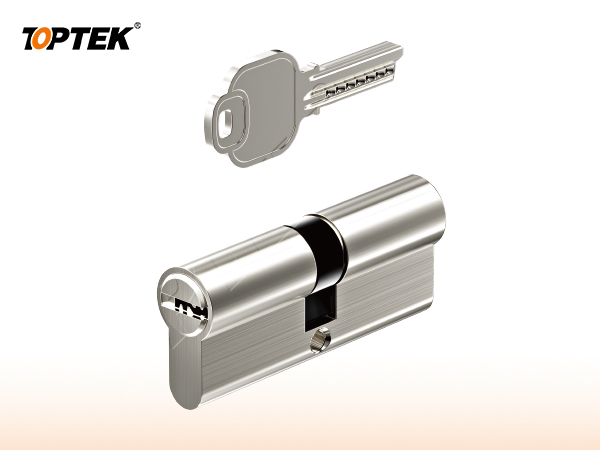

CE Mortise Lock Cylinder and Spindle Compatibility Guide for Door Hardware Buyers
Focus: CE mortise lock cylinder compatibility
Author: Ivan He, TOPTEK | Technical review status: final engineering sign-off required before publication.
TL;DR
- A Euro profile opening does not prove that every Euro cylinder will work with a lock case.
- Confirm the cylinder profile, cam geometry and orientation, fixing-screw location, A/B cylinder length, trim build-up and function.
- Confirm the lever interface separately: follower square, spindle square, spindle length, lever springing and any split-spindle requirement.
- TOPTEK’s published EN72SL data lists 72 mm centres and 8 x 8 mm or 9 x 9 mm follower options. Treat those as configurable project options, not an invitation to mix unmatched components.
- For fire or smoke doors, verify the complete tested or assessed door-set configuration. CE documentation for the lock case does not automatically validate every cylinder, trim or door combination.
Quick Answer
CE mortise lock cylinder compatibility is a five-interface decision: the cylinder must match the lock case profile, cam, fixing point and operating function; its A/B length must suit the finished door and trim; and the lever spindle must match the follower square and installed thickness. Approve the combination from drawings and a working door sample before mass production.
The Compatibility Decision in One Table
| Interface | Buyer must confirm | Risk if assumed |
|---|---|---|
| Cylinder profile | Euro profile or another specified form | The cylinder will not enter or seat correctly. |
| Cam and function | Cam drawing, rotation, throw and which bolt it operates | Key turns without completing the intended action, or the mechanism binds. |
| Cylinder length | A/B dimensions from fixing-screw centre to each finished trim face | Excessive projection, recessed key access or clash with escutcheons. |
| Centres | Lever-follower centre to cylinder centre, such as 72 mm where specified | Escutcheon or door preparation holes do not align. |
| Spindle interface | Follower square, spindle square, length, springing and split-spindle logic | Loose lever, incomplete latch retraction or incorrect access function. |
| Door-set evidence | Applicable certificate, test or assessment and installation limits | A valid component is used outside the supported assembly. |
1. Match the Cylinder to the Lock Case
Profile is only the first gate
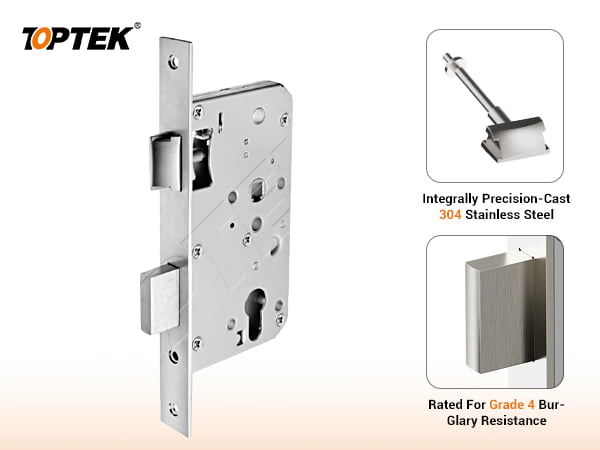
A buyer may see a Euro profile cut-out and conclude that the cylinder question is finished. It is not. The profile confirms the external form; it does not confirm the operating cam, length, keying function, fixing location, or interaction with the lock mechanism.
Start with the exact lock function. In TOPTEK’s current CE listing, the sash-lock family is described with the handle operating the latch and the cylinder operating the latch and deadbolt. Other listed functions behave differently: a deadlocking-bolt model is cylinder-operated without a lever follower, while a passage latch is handle-operated without cylinder locking. The same-looking door preparation can therefore require a different operating package.
Cam geometry must be drawing-controlled
The cam is the mechanical translator between the key or knob and the lock case. Ask for a dimensioned cam drawing, not only a profile name. Confirm cam width, projection, angular home position, permitted rotation and the lock’s required sequence. A sample should prove key insertion, rotation, bolt projection and retraction, key withdrawal and operation from both sides where applicable.
Measure cylinder length from the fixing-screw centre
Specify a Euro cylinder as two dimensions, A/B, measured from the centre of the fixing screw to the finished face on each side. Include the door leaf, reinforcement, decorative plate, rose, escutcheon and cylinder protector. Door thickness alone is not enough. The two sides may be unequal, and the orientation matters for a knob cylinder or controlled key side.
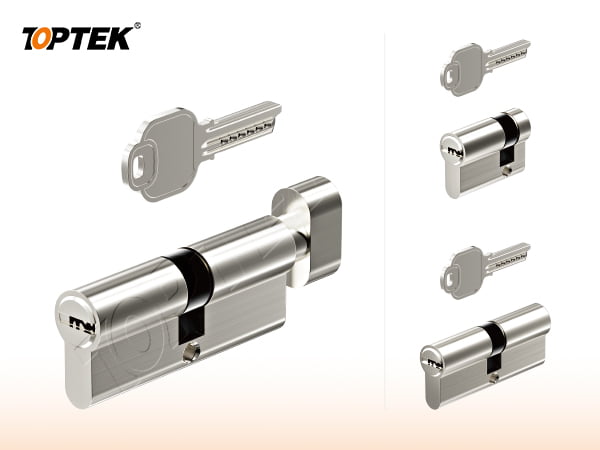
TOPTEK’s published EPCVK6P page lists double and knob profile cylinders from 60 to 95 mm and half cylinders from 40 to 55 mm, with length defined as L=A+B. These are product-range statements; the RFQ must still identify the exact A/B combination required.
2. Match the Spindle to the Follower and Trim
Follower size and spindle size are one controlled interface
The follower is the square opening in the lock case that receives the lever spindle. TOPTEK’s verified EN72SL product page lists 8 x 8 mm and 9 x 9 mm follower options. A buyer should state the required option on the drawing, purchase order and sample label. Do not treat an 8 mm spindle in a 9 mm follower as acceptable merely because it can be assembled. Clearance can create rotational play, incomplete latch movement, noise and accelerated wear.
Spindle length follows the finished assembly
Calculate spindle length from the actual door and trim stack, not a nominal door thickness. The spindle must engage both lever hubs and the lock follower adequately without bottoming out or forcing the roses apart. Include escutcheon depth, mounting plates, washers and any door-face tolerances. If the spindle is cut on site, define the allowable cut range and deburring method.
Check springing and functional architecture
A mechanically compatible square can still produce a poor door set if the lever spring and lock return force are not coordinated. Verify whether the lever set is sprung or unsprung, whether the lock function needs a solid or split spindle, and whether inside and outside levers must behave differently. Escape, classroom and access-control functions require a function test; a dimension-only review is insufficient.
3. Do Not Confuse Centres, Backset and Spindle Size
Three measurements are regularly mixed in RFQs:
- Centre distance/PZ: lever follower centre to cylinder centre.
- Backset: forend reference line to the follower or cylinder axis as defined by the drawing.
- Spindle square: cross-section of the lever spindle and follower.
The EN72SL page identifies 72 mm centres, multiple backsets from 40 to 100 mm, and 8 mm or 9 mm follower options. These values describe independent choices. A 72 mm lock does not tell the buyer whether the spindle is 8 mm or 9 mm, and an 8 mm spindle says nothing about backset. Use a coordinated lock-case, trim and door-preparation drawing.
4. Sample Approval Workflow for Buyers
- Freeze the door condition. Record leaf material, thickness range, reinforcement, handing, swing, frame and fire/smoke requirement.
- Freeze the lock function. State what the outside lever, inside lever, cylinder, knob or thumbturn must do in locked and unlocked states.
- Overlay drawings. Compare lock case, cylinder, trim and door-preparation centres. Mark the cylinder fixing screw and spindle axis.
- Build the real stack. Use production-intent roses, escutcheons, fasteners, spindle and cylinder, not loose bench parts.
- Run an operation matrix. Test lever return, latch retraction, deadbolt throw, key withdrawal, knob operation, handing and emergency egress where applicable.
- Record approval evidence. Sign the drawing revision, sample ID, component list, photos and deviations before releasing the bill of materials.
5. Common Compatibility Mistakes
- Ordering only by “Euro profile” without a cam drawing.
- Using total cylinder length without identifying A/B orientation.
- Measuring the bare door but ignoring escutcheon and protector thickness.
- Assuming 72 mm centres specify an 8 mm spindle.
- Mixing the 8 mm and 9 mm options between sample and mass-production BOMs.
- Checking key operation on a bench but not in the fitted door set.
- Using a CE or fire-test statement as blanket approval for an unassessed hardware combination.
6. Project Risks and Controls
| Project risk | Control before order | Release evidence |
|---|---|---|
| Cylinder projects too far from trim | Confirm A/B from fixing centre to finished faces | Section drawing and assembled sample photo |
| Cam does not complete bolt travel | Approve cam and rotation drawing | Functional video and signed sample |
| Lever play or partial latch withdrawal | Match spindle and follower square; verify engagement | Interface drawing and cycle check |
| Wrong access or egress behavior | Approve a state-by-state function matrix | Witnessed door-set test |
| Fire-door documentation gap | Map every component to the applicable evidence | Approved hardware schedule and technical file |
7. TOPTEK Evidence and Product Range
TOPTEK’s Intertek certificate 2649-CPR-26002201 covers listed mechanically operated mortice locks and latches for use on fire-resistance and/or smoke-control doors under EN 12209:2003/AC:2005. The certificate was first issued on 4 June 2026 and shows an expiry date of 31 December 2026, subject to its stated validity conditions. Buyers should request the current certificate and verify that the exact model and intended application are included at order release.
The certificate listing includes 72 mm, 78 mm and 85 mm centre-distance families across sash, roller, passage, deadlocking, night-latch, bathroom and access-mortice functions. It is model-specific; do not transfer one model’s classification or operation statement to another model without evidence.
For cylinder evidence, Intertek report 260119007SHF-007 identifies a brass P05D90 double Euro profile cylinder at 45/45 mm and lists related P05 double, single and half-cylinder sizes assessed within that report’s scope. This supports a documented product range, but project acceptance still depends on the applicable door assembly and authority requirements.
Review TOPTEK’s EN 12209 mortise lock hub, the EN72SL product page, the construction cylinder hub, and the EPCVK6P cylinder page. For context, use the existing EN 12209 buyer guide and laboratory capability page.
8. RFQ Checklist
- Door type, thickness range, handing and swing
- Fire/smoke requirement and required evidence
- Lock function and exact model or approved equivalent
- Backset and centre distance/PZ
- Cylinder profile, double/knob/half type and A/B length
- Cam dimension, orientation and operating rotation
- Follower and spindle square: 8 mm, 9 mm or other specified interface
- Spindle length and door-trim stack drawing
- Escutcheon, rose, protector and fastener details
- Finish, keyway and master-key schedule where applicable
- Sample quantity, approval tests, drawing revision and golden-sample control
Why TOPTEK
TOPTEK can coordinate the lock case, Euro profile cylinder, lever interface, drawings, sample build and internal verification as one project package. The practical advantage is not a generic “compatible” label; it is a controlled chain from RFQ inputs to approved interfaces and repeatable production. Third-party certification and test evidence should be quoted only within the exact scope shown in the applicable documents.
Frequently Asked Questions
Does a CE mortise lock automatically accept every Euro profile cylinder?
No. The profile may fit the cut-out, but buyers must still confirm the cam, cylinder length, fixing-screw position, lock function, trim thickness and tested door-set evidence.
How do I choose the correct Euro profile cylinder length?
Measure from the centre of the cylinder fixing screw to each finished face of the door trim. Specify the two sides as A/B dimensions and avoid excessive projection beyond the escutcheon or protector.
Can an 8 mm spindle be used in a 9 mm follower?
Not as a direct production assumption. A loose interface can create play and unreliable operation. Specify the follower square and spindle as a matched interface, or use an engineered adapter only when the hardware supplier approves it.
Is the 72 mm centre distance the same as the spindle size?
No. The 72 mm centre distance is the distance between the lever follower centre and the cylinder centre. The spindle size is the square cross-section that engages the follower.
What should be checked for a fire-rated door application?
Check the complete tested or assessed door assembly, including the lock case, cylinder, lever set, fixings, door construction and installation method. A component claim alone does not approve every door combination.
What should a buyer send with a compatibility RFQ?
Send the door thickness, trim build-up, lock function, backset, centre distance, cylinder type and A/B length, cam drawing, follower square, spindle length, handing, fire or smoke requirement, drawings, photos and sample approval plan.
Conclusion
Compatibility is an interface-control task, not a catalogue checkbox. Freeze the function, dimensions and evidence together; then prove the assembled door set before production. That discipline prevents the most expensive failures: misaligned trim, wrong cam operation, loose lever action, incorrect egress behavior and unsupported fire-door combinations.
[…] A cylinder can only work correctly when the mortise lock body is compatible.5 If buyers choose the cylinder first and the lock body later, the set may not operate smoothly. This can lead to poor latch movement, incorrect hole alignment, or unstable assembly. […]