
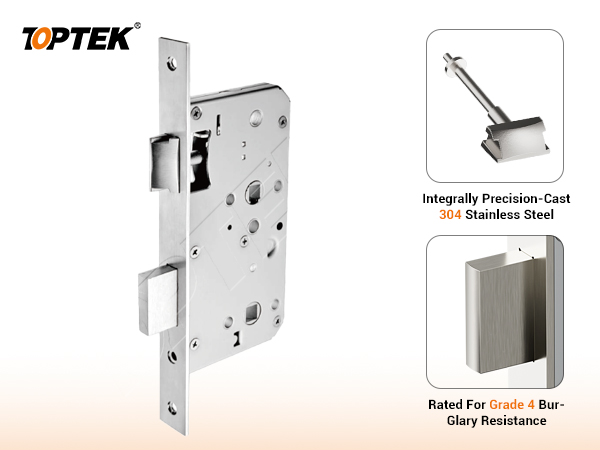

CE Mortise Lock Case Depth Guide: Matching the Lock Body to the Door Profile
A drawing-led guide for door manufacturers, distributors and project buyers who need to fit an EN 12209 lock case inside a real door construction.
TL;DR
- CE mortise lock case depth is the overall horizontal envelope of the lock body measured from the drawing datum at the door edge or forend to the rear of the case.
- Case depth is not the same as backset. Backset locates the operating axis; case depth describes the space the complete lock body occupies.
- A door profile must provide enough clear space for the full case envelope, fixings and moving parts without conflicting with glazing beads, reinforcement, welds, seals, cables or other hardware.
- The TOPTEK certificate schedule lists model function, backset and centre distance; it does not replace the current model drawing for case depth, height, forend, holes or pocket preparation.
- Approve the exact drawing and test a production-representative door sample before releasing machining data or mass production.
Quick Answer: How Do You Match Lock Case Depth to a Door Profile?
Start with a dimensioned cross-section of the door at lock height, mark the door-edge datum, then compare the lock’s complete case envelope with the clear internal space. Check backset, case depth, case height, forend, fixing points, follower and cylinder positions, latch/deadbolt projection, reinforcement, glazing and strike geometry together. A lock fits only when the complete interface fits; one matching number is not enough.
If your team has only a profile drawing or an existing lock sample, send it for an initial dimensional review. TOPTEK can identify the missing measurements before a quotation or sample is frozen.
What Does CE Mortise Lock Case Depth Mean?
Case depth is an installation-envelope dimension, not a CE performance grade. It is normally read on the manufacturer’s controlled drawing as the horizontal distance from the stated forend or door-edge reference to the rear of the lock case. The exact datum must be taken from that drawing because suppliers may dimension faceplates and case bodies differently.
EN 12209 addresses the performance and test requirements for mechanically operated locks, latches and locking plates. It does not make visually similar lock bodies dimensionally interchangeable. The BSI standard record for EN 12209 describes durability, strength, security and function requirements, while the actual preparation remains model-specific.
Case depth vs backset
Backset locates an operating axis; case depth describes the lock body’s overall horizontal envelope. A 55 mm backset, for example, does not mean the case is 55 mm deep. Space is still required behind the follower or cylinder axis for the mechanism, case wall and clearances shown on the drawing.
Case depth vs centre distance
Centre distance, often called centres or PZ, is the vertical distance between the lever follower and cylinder or key reference. A 72 mm or 85 mm centre distance does not determine the horizontal case depth. It affects trim and drilling coordination on another axis.
Case depth vs forend dimensions
The forend is the visible plate at the door edge. Its width, length, thickness, end shape and screw positions affect the edge preparation, but they do not state the rear case envelope. All these dimensions must be checked together.
Why the Door Profile Controls the Final Selection
The usable lock pocket is the clear internal volume at the actual installation height, after every obstruction is considered. The nominal door thickness alone is not enough. A timber stile can contain reinforcement or glazing; a steel door can contain channels, welds or internal plates; an aluminium or composite profile can have webs, thermal breaks, gaskets and limited machining zones.
Review the TOPTEK EN 12209 Grade 3 mortise lock platform only after the door cross-section and required function are known. The family includes different functions and 72, 78 and 85 mm centre arrangements, but the exact case envelope must still come from the selected model drawing.
| Profile check | What the buyer should measure or identify | Risk if omitted |
|---|---|---|
| Clear internal depth | Door-edge datum to the nearest rear obstruction at lock height | The case cannot enter fully or presses against an internal component |
| Clear vertical envelope | Available height around the case, fixings and moving parts | Fixings or mechanisms conflict with reinforcement or joints |
| Edge preparation | Forend width, length, thickness, end shape and screw locations | Visible gaps, weak fixing or incorrect routing |
| Operating axes | Backset, follower, cylinder/key position and centre distance | Handle, escutcheon or cylinder holes do not align |
| Door internals | Reinforcement, glazing beads, channels, seals, cables and welds | Late redesign, damaged components or restricted operation |
| Frame interface | Door gap, strike position, rebate, seal compression and fixing support | Poor latching, bolt binding or unreliable closing |
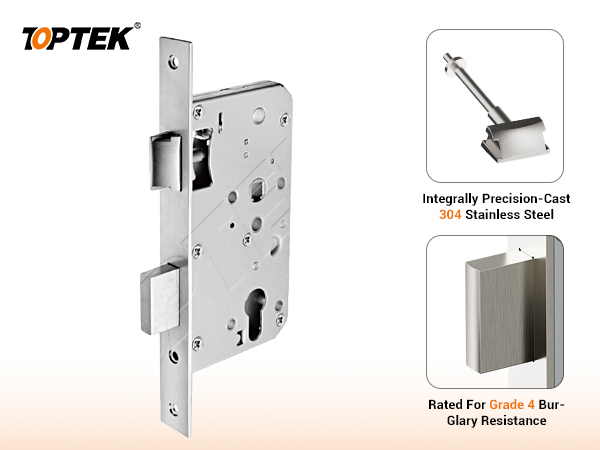
What the TOPTEK Certificate Schedule Confirms—and What It Does Not
Certificate of Constancy of Performance No. 2649-CPR-26002201 lists the product functions, full model codes, backsets and C-to-C distances in its product-description schedule. For sash locks, it lists 72 mm-centre combinations with 40, 45, 50, 55, 60, 65, 70, 80 and 100 mm backsets, plus 85 mm-centre combinations with 45, 50 and 60 mm backsets.
This is useful information gain for a buyer, but the boundary matters: the schedule does not state every case-depth, case-height, forend, fixing-hole or door-pocket dimension. Buyers must not convert a listed backset into an assumed case depth. Review the exact model in TOPTEK’s certification resource centre, then obtain the current controlled drawing.
| Certificate-listed sash-lock group | Backsets listed | Centres listed | What still requires a drawing |
|---|---|---|---|
| EN4072SL to EN10072SL schedule | 40, 45, 50, 55, 60, 65, 70, 80, 100 mm | 72 mm | Case depth/height, forend, holes, projections and preparation |
| EN4585SL, EN5085SL, EN6085SL | 45, 50, 60 mm | 85 mm | Case depth/height, forend, holes, projections and preparation |
The EU Construction Products Regulation record explains the relationship between CE marking and declared performance. Project suitability still depends on the intended use, current documents and the complete door assembly. Verify the applicable regulatory route and certificate status for the target market before tender submission.
Five-Step Door-Profile and Lock-Case Matching Workflow
- Freeze the required function. Define how the lever, cylinder, latch and deadbolt must operate from each side. Do not select the shallowest-looking case before the function is agreed.
- Obtain the real door cross-section. Use the profile at lock height and identify material, thickness, reinforcement, glazing, seals, cables, thermal breaks and permissible machining zones.
- Overlay the current lock drawing. Use one common datum to compare case depth, height, backset, centres, forend, follower, cylinder, fixing locations and bolt positions.
- Coordinate the frame and trim. Check the strike, door gap, rebate, lever furniture, spindle, cylinder length and any through-fixings. The lock case is only one part of the interface.
- Approve a production-representative sample. Machine and operate the intended door construction, record the approved drawing revision and retain the sample/inspection points for production.
For a real 72 mm-centre platform example, review the TOPTEK EN72SL sash mortise lock page. For an 85 mm-centre interface, compare the TOPTEK EN85SL standard mortise lock page. Product pages help identify the family; only the approved drawing can release machining.
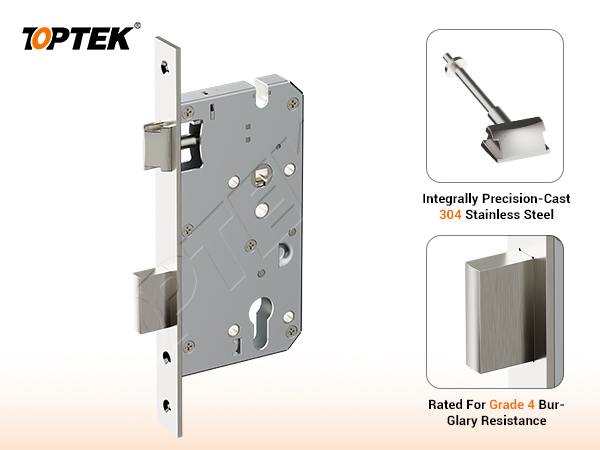
Common Case-Depth and Door-Preparation Mistakes
Using backset as case depth
Backset ends at an operating axis; the case continues behind that axis. Ordering or routing from the backset alone can create a pocket that is too shallow.
Choosing by 72 mm or 85 mm centres
Centres coordinate the vertical handle-to-cylinder relationship. Equal centres do not guarantee equal backset, case envelope, forend, fixing points or strike geometry.
Measuring a catalogue image
Product photos can be cropped or resized and are not scale drawings. They are useful for product identification, not machining approval.
Checking an empty profile instead of the final door
Reinforcement, glazing, seals, cables and production fasteners can reduce the usable cavity. Check the finished construction and the exact installation height.
Releasing all doors from one unverified sample
A sample should represent the production door, lock revision, trim, cylinder and strike. Record the approved combination before batch machining.
Project Risks Buyers Should Control
| Risk | Likely consequence | Control |
|---|---|---|
| Case/profile collision | Lock cannot seat or internal parts are loaded | Overlay current drawings using one datum |
| Incorrect operating axes | Lever, cylinder and escutcheon holes misalign | Freeze backset and centres independently |
| Weak edge preparation | Loose fixing, visible gaps or damaged door edge | Coordinate forend geometry and reinforcement |
| Strike mismatch | Latch or deadbolt binds and the door does not close reliably | Review the lock, gap, seal, frame and strike together |
| Evidence mismatch | Tender documents do not support the supplied model or intended use | Match full model code, current certificate/DoP and project scope |
| Premature batch machining | Large-scale rework or replacement cost | Approve a production-representative door sample first |
Buyer Checklist Before Door Machining
- The required lock function and operating sequence are written.
- The full model code and drawing revision are recorded.
- Case depth, case height, backset and centre distance are treated as separate dimensions.
- Forend width, length, thickness, end shape and fixing locations match the edge preparation.
- Follower, spindle, cylinder/key interface and trim fixing are coordinated.
- The finished door cross-section shows reinforcement, glazing, seals, cables and other obstructions.
- Strike position, door gap, rebate and frame support are checked.
- Certificate, Declaration of Performance and model schedule are reviewed together where applicable.
- A production-representative sample has been fitted and operated before batch release.
TOPTEK Product Range and Evidence Boundary
TOPTEK’s EN 12209 mortise lock platform includes sash, passage, deadlocking, night-latch, bathroom, roller and access/escape-related functions across listed 72, 78 and 85 mm centre arrangements. The certificate schedule and the EN 12209 classification guide help buyers understand performance scope. They do not authorize unlisted dimensional combinations or replace an approved drawing.
TOPTEK also performs in-house dimensional and functional quality checks. Those internal controls support sample review and production consistency, but they must not be described as independent certification. Third-party claims must remain tied to the named document, model and tested or assessed scope.
RFQ Checklist for CE Mortise Lock Case Depth Review
Send the following information to reduce clarification cycles:
- Door type, material, finished thickness and intended application
- Dimensioned door-profile cross-section at lock height
- Internal reinforcement, glazing, seal, cable and machining restrictions
- Required lock function and inside/outside operating sequence
- Backset and centre distance, if already fixed
- Forend and strike requirements, including edge shape and finish
- Follower/spindle, lever furniture and Euro-profile cylinder interface
- Door handing, latch orientation, door gap and frame details
- Target market, required certificate/DoP/fire-door evidence route and tender wording
- Existing lock sample, photographs with a scale, annual volume, sample quantity and schedule
Why Work With TOPTEK?
TOPTEK reviews a mortise lock as an interface between function, hardware, door preparation, evidence and repeatable production. The team can compare a buyer’s door cross-section with the available lock family, identify missing dimensions, coordinate the model and drawing, and define a sample-fit route before a production specification is frozen.
This approach is especially useful when an RFQ begins with an incomplete phrase such as “55 mm CE lock” or “72 mm lock case.” TOPTEK can turn that partial request into a controlled checklist instead of assuming that one number defines the product.
Frequently Asked Questions
What is CE mortise lock case depth?
CE mortise lock case depth is the overall horizontal lock-body envelope measured from the datum stated on the current product drawing to the rear of the case. It is an installation dimension, not a CE performance grade.
Is mortise lock case depth the same as backset?
No. Backset locates the follower, cylinder or another operating axis from the door-edge datum; case depth continues to the rear of the full lock body. Both dimensions must be checked independently.
Does a 72 mm or 85 mm centre distance determine case depth?
No. Centre distance is a vertical relationship between operating centres, while case depth is a horizontal envelope. Equal centres do not guarantee equal backset, case size, forend or door preparation.
Can the CE certificate be used as a machining drawing?
No. A certificate schedule may confirm model scope, function, backset and centres, but it does not provide every case, forend, fixing and pocket dimension. Use the current controlled model drawing for machining.
How much clearance should be left behind a mortise lock case?
Use the clearance and tolerances stated or approved by the lock and door engineering teams. Do not invent a universal allowance; door material, reinforcement, installation method and moving parts can change the requirement.
What should a buyer send for a case-depth review?
Send the door-profile cross-section, material, finished thickness, obstructions, required function, backset, centres, forend, strike, trim/cylinder interface, target market, evidence requirements and any existing sample or scaled photographs.
Conclusion
The safest way to select CE mortise lock case depth is to compare the complete lock drawing with the finished door profile—not to choose from backset, centres or a product photo alone. Freeze the function, mark one datum, check the full case/forend/trim/strike interface and approve a representative sample before mass machining. This protects the door preparation, tender file and production order at the same time.
Request a Door-Profile and Lock-Case Review
Primary CTA: Send TOPTEK your door-profile section, required function, target backset/centres and hardware interfaces. We can return a preliminary model direction, missing-dimension list, drawing-review points and sample-approval route before quotation.
Request an engineering review and RFQ or email ivan.he@toptekaccess.com.
Low-friction route: If the specification is incomplete, send one profile drawing, an existing lock model or scaled photographs first. TOPTEK can help identify the remaining RFQ questions.
TOPTEK is your Commercial Door Hardware Reliability Solution.
TOPTEK: Smart Design. Strong Security.