

CE Sash Lock Mortise Lock Guide: Function, Backset and Centre-Distance Selection
A dimensional and evidence-led guide for door manufacturers, distributors, contractors and architectural hardware buyers.
TL;DR
- A sash mortise lock combines a latchbolt and deadbolt in one lock case. In TOPTEK’s certificate scope, the handle operates the latch, while the cylinder operates the latch and deadbolt.
- Centre distance is the vertical centre-to-centre dimension between the handle spindle and cylinder. The certified sash-lock range listed in the certificate includes 72 mm and 85 mm options.
- Backset and centre distance are independent selection dimensions. A 72 mm lock is not automatically interchangeable with every other 72 mm lock.
- Confirm the exact model code, backset, centres, case envelope, forend, strike, handing, spindle, cylinder and door preparation before approving a sample.
- A lock certificate does not by itself approve a complete fire-door assembly. Door-set evidence and installation instructions remain project-specific.
Quick Answer
A CE sash lock mortise lock should be selected in this order: required function, centre distance, backset, lock-case and forend geometry, cylinder/handle interface, door preparation, and documentary scope. For the TOPTEK sash-lock models listed in Certificate No. 2649-CPR-26002201, the certified schedule includes nine 72 mm-centre combinations with 40–100 mm backsets and three 85 mm-centre combinations with 45, 50 and 60 mm backsets. Buyers should quote the full model and drawing revision, not only “72 mm sash lock” or “85 mm sash lock.”
What Is a CE Sash Lock Mortise Lock?
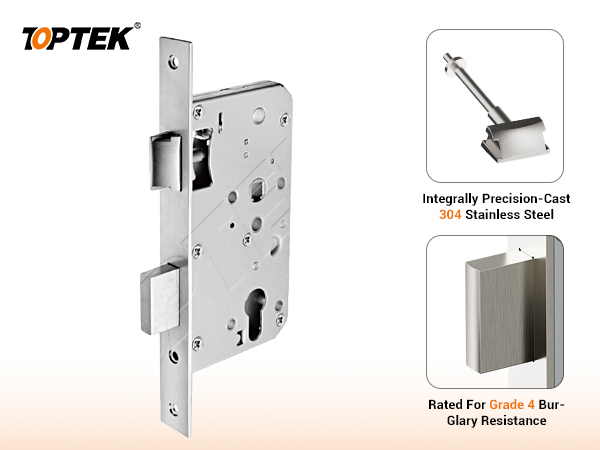
A sash lock is a mechanically operated lock case containing both a spring latch and a deadbolt. The latch holds the closed door during normal use, while the deadbolt provides the additional locked state. In the function description recorded in TOPTEK’s CE certificate annex, the handle operates the latch and the cylinder operates the latch and deadbolt. This functional definition matters because a sash lock is not the same as a passage latch, deadlock, roller lock or escape lock.
“Mortise” is the common US spelling and “mortice” is the common UK spelling. Buyers may see both in tenders, certificates and search results. The spelling does not define the geometry; the drawing, model code and declared product scope do.
EN 12209 addresses mechanically operated locks, latches and locking plates. The referenced edition and conformity route must match the actual certificate and Declaration of Performance supplied for the product. A standard title alone is not proof that a particular size or model is covered. Buyers should therefore review the certificate number, manufacturer, issuing body, model schedule, classification and document dates together. For broader background, see TOPTEK’s CE mortise lock and EN 12209 guide.
Backset and Centre Distance: Two Different Decisions
What does centre distance mean?
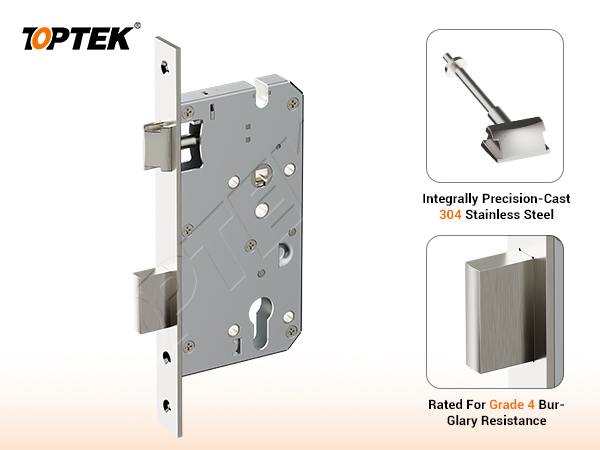
Centre distance, often called centres or PZ in the market, is the vertical distance between the centre of the handle follower and the centre of the cylinder. A 72 mm sash lock positions these two operating centres 72 mm apart; an 85 mm sash lock positions them 85 mm apart. This affects the matching handle plate, escutcheons, drilling pattern and door preparation.
What does backset mean?
Backset is the horizontal distance from the specified faceplate or door-edge reference to the operating axis shown on the product drawing. It affects how far the handle and cylinder sit from the door edge, the available space inside the door profile, the case depth and the relationship with glazing beads, reinforcements or other internal obstructions. Because manufacturers may define drawing datums differently, approve the dimension from the current technical drawing rather than measuring a catalogue photograph.
Does one determine the other?
No. Centre distance and backset describe different axes. The certificate schedule demonstrates this clearly: multiple backsets are listed under the same 72 mm centre, while the 85 mm family includes its own backset choices. A buyer must specify both.
Certified Sash-Lock Model Schedule
The following schedule is transcribed from TOPTEK Certificate of Constancy of Performance No. 2649-CPR-26002201, issued by Intertek Ibérica Spain S.L.U. on 4 June 2026. The certificate identifies the product group as mechanically operated locks, latches and locking plates and states EN 12209:2003/AC:2005. Its listed classification for these sash-lock models is 3 X 9 1 2 0 G 4 B C 2 0. Verify the latest document status before tender submission or purchase because certificates, standards and declarations can be revised.
| Certificate model | Backset | Centre distance | Selection note |
|---|---|---|---|
| EN4072SL | 40 mm | 72 mm | Compact 72 mm-centre option; confirm case envelope. |
| EN4572SL | 45 mm | 72 mm | Confirm door-profile clearance and forend. |
| EN5072SL | 50 mm | 72 mm | Match the 50 mm backset drawing. |
| EN5572SL | 55 mm | 72 mm | Do not substitute by centres alone. |
| EN6072SL | 60 mm | 72 mm | Confirm handle and cylinder positions. |
| EN6572SL | 65 mm | 72 mm | Check case depth and reinforcement. |
| EN7072SL | 70 mm | 72 mm | Approve door preparation from drawing. |
| EN8072SL | 80 mm | 72 mm | Check clearance in the intended door leaf. |
| EN10072SL | 100 mm | 72 mm | Deep-backset option; verify internal space. |
| EN4585SL | 45 mm | 85 mm | 85 mm-centre interface with 45 mm backset. |
| EN5085SL | 50 mm | 85 mm | 85 mm-centre interface with 50 mm backset. |
| EN6085SL | 60 mm | 85 mm | 85 mm-centre interface with 60 mm backset. |
The family name on a product page can be shorter than the complete certificate model. For procurement, sample approval and compliance review, use the exact model-specific code. Start with the TOPTEK EN 12209 Grade 3 mortise-lock hub and review the EN72SL sash mortise lock family, but ask for the certificate annex and approved drawing for the chosen backset.
72 mm vs 85 mm Sash Lock: Which One Fits?
Neither centre distance is automatically “better.” The correct choice is the one coordinated with the door-set design and compatible hardware. Treat 72 mm and 85 mm as interface dimensions, not as security grades.
| Decision point | 72 mm centre | 85 mm centre |
|---|---|---|
| Handle-to-cylinder spacing | 72 mm | 85 mm |
| Certificate-listed backsets in this sash range | 40, 45, 50, 55, 60, 65, 70, 80, 100 mm | 45, 50, 60 mm |
| Hardware coordination | Use 72 mm-compatible furniture/preparation | Use 85 mm-compatible furniture/preparation |
| Replacement decision | Confirm every interface dimension; equal centres do not guarantee interchangeability. | |
For a new door platform, the door manufacturer should freeze the centres, backset and case envelope before releasing machining data. For a replacement project, obtain the original drawing or measure the existing lock and door preparation systematically. A photograph is useful for function identification but is not a dimensional approval document.
Seven-Step Selection and Approval Workflow
- Confirm the function. Verify that the project requires a latch-and-deadbolt sash function, including how the handle and cylinder should operate.
- Confirm the centre distance. Record 72 mm or 85 mm from the coordinated hardware schedule or measured existing preparation.
- Confirm the backset. Use the drawing datum and state the value in millimetres.
- Check the full lock geometry. Compare case height, case depth, forend length/width/thickness, fixing centres, follower position, cylinder cut-out, latch/deadbolt position and projection, and strike geometry.
- Coordinate adjoining hardware. Confirm the euro-profile cylinder, spindle size, lever furniture, escutcheons, strike, door handing and any access-control interface outside the mechanical lock scope.
- Verify evidence by exact model. Match the selected code to the certificate annex, Declaration of Performance, drawing and labelling. Review documents in TOPTEK’s certification centre and Declaration of Performance resource area.
- Approve a physical sample. Test the lock in the intended door construction before mass door preparation and retain the approved sample/drawing revision for incoming inspection.
Buyer Checklist Before Door Preparation
- Required sash-lock operating sequence is written and approved.
- Full model code, not only family name, is stated on the RFQ and purchase order.
- Backset and centre distance are both recorded.
- Lock-case envelope and all door cut-outs are checked against the current drawing.
- Forend, strike, fixing-hole centres and edge shape are coordinated.
- Follower/spindle and cylinder profile are compatible with the selected furniture.
- Latch handing or reversibility is confirmed from the product instruction.
- Door material, thickness, reinforcement and intended use are declared.
- Certificate, Declaration of Performance and model schedule are reviewed together.
- A sample is fitted and operated before machining a production batch.
Common Specification Mistakes
Ordering by “72 mm” or “85 mm” alone
Centres describe only one relationship. The backset, case, forend, strike and fixing geometry can still be different.
Using a family photo as a scale drawing
Product photos may be cropped or resized. They cannot establish the true case dimensions or drilling coordinates.
Assuming every model on a website is in the certificate
Certification is model-specific. Review the annex and confirm that the exact model and intended use are included.
Treating the classification code as a marketing badge
The code must be read in the context of the referenced standard, certificate and product scope. Do not transfer one model’s result to another unlisted configuration.
Machining doors before sample approval
An early dimensional assumption can become a full-batch door-preparation error. The cost is usually much higher than the cost of a controlled sample-fit stage.
Project Risks Buyers Should Control
| Risk | Likely consequence | Control |
|---|---|---|
| Wrong centres | Handle plate and cylinder openings do not align | Freeze 72/85 mm during hardware coordination |
| Wrong backset | Operating hardware sits in the wrong position or case clashes internally | Approve the backset-specific drawing |
| Wrong function | Door operation differs from the access plan | Write the handle/cylinder sequence into the schedule |
| Certificate mismatch | Tender or compliance documents do not support the supplied model | Match model, classification, date and DoP |
| Uncoordinated strike/forend | Poor alignment, rework or unreliable closing | Review the complete lock-and-strike interface |
| Fire-door overclaim | Unsupported project statement | Assess the complete door-set evidence and installation scope |
What TOPTEK Evidence Supports—and What It Does Not
TOPTEK’s available Certificate of Constancy of Performance No. 2649-CPR-26002201 was issued under AVCP System 1 by Intertek Ibérica Spain S.L.U. It lists the 12 sash-lock codes shown above and records their sash function. It also identifies the intended use as locks/latches/locking plates on fire-resistance and/or smoke-control doors.
The certificate’s fire-suitability section identifies specific tested models and assesses other listed models by stated equivalence. That distinction should be preserved in project submissions: do not describe every sash model as the physical fire-test specimen. Likewise, certification of a lock does not certify the complete fire door. The door leaf, frame, hinges, closer, seals, glazing, fixings, installation and applicable assessment all affect the door-set claim.
TOPTEK also performs in-house quality-control testing. Internal checks can support production consistency, but they must not be described as third-party certification. For public compliance documents, use the recognized-body certificate and project-specific evidence set.
Buyers should also note that the certificate cites EN 12209:2003/AC:2005, while standards bodies may publish newer editions. The correct compliance path depends on market requirements, harmonisation status and project specification. Review the current regulatory route before making a tender claim. See the official BSI standard record and EU Construction Products Regulation record for authoritative context.
TOPTEK Sash-Lock Product Range
Within the certificate schedule reviewed for this guide, TOPTEK’s CE sash lock mortise lock range covers 72 mm-centre backsets from 40 to 100 mm and 85 mm-centre backsets of 45, 50 and 60 mm. This provides useful platform choices, but the schedule should not be treated as permission to create unlisted combinations. If a project asks for a different backset, centre, forend, follower, material option or function, request an engineering review and confirm whether the change remains within documented scope.
TOPTEK Access is a China-based OEM/ODM manufacturer of commercial locks, architectural door hardware and integrated access-control locking solutions. The practical value for a buyer is not simply a long option list; it is controlled translation of the door requirement into a model, drawing, sample and repeatable production specification.
RFQ Checklist for a CE Sash Lock Mortise Lock
Send the following information to reduce clarification cycles:
- Door type, material, thickness, profile section and intended application
- New platform or replacement project
- Required sash-lock operating sequence
- Centre distance: 72 mm or 85 mm
- Backset in millimetres
- Forend and strike dimensions, edge shape and finish
- Follower/spindle size and euro-profile cylinder requirement
- Door handing and latch orientation
- Required certification, DoP, fire-door evidence and target market
- Drawing, photos with a scale, existing lock sample or door-preparation file
- Sample quantity, annual volume, packaging and project schedule
Why Work With TOPTEK?
TOPTEK approaches lock selection as an engineering interface. The team can compare the buyer’s functional schedule and door preparation with the available lock family, identify dimensional conflicts before sampling, and assemble the relevant model documents for review. During production, in-house checks support consistency; third-party documents remain clearly identified as external evidence.
TOPTEK is your Commercial Door Hardware Reliability Solution. The objective is a verified specification that can move from RFQ to sample approval and mass production without losing the approved geometry.
Frequently Asked Questions
What is a CE sash lock mortise lock?
A CE sash lock mortise lock is a mechanically operated lock case combining a latchbolt and deadbolt, with documented conformity for the declared model and intended use. In TOPTEK’s certificate scope, the handle operates the latch, while the cylinder operates the latch and deadbolt.
What is the difference between a 72 mm and 85 mm sash lock?
The difference is the vertical centre-to-centre distance between the handle follower and cylinder. It changes the compatible hardware and door drilling pattern; it is not by itself a security or quality grade.
Does the backset determine the centre distance?
No. Backset is a horizontal door-edge-to-operating-axis dimension, while centre distance is the vertical spacing between handle and cylinder centres. Buyers must specify and verify both.
Can a 72 mm sash lock replace another 72 mm lock?
Not automatically. The backset, case envelope, forend, fixing centres, strike, spindle, cylinder position, bolt geometry and door preparation must also match the approved drawing.
Does the CE certificate approve the complete fire door?
No. A lock certificate supports the declared lock models and intended use; it does not by itself approve the complete door assembly. Project teams must review door-set evidence, compatible components and installation requirements.
What information should a buyer send for a sash lock RFQ?
Send the function, door construction, 72 or 85 mm centres, backset, forend and strike details, spindle/cylinder interface, handing, required documents, target market, drawings or samples, quantity and project schedule.
Conclusion
The safest way to select a CE sash lock mortise lock is to turn a general product name into a controlled interface specification. Confirm the function first, then lock the centres and backset, review the remaining geometry, verify the exact certificate model and approve a physical sample. This process protects the door preparation, the compliance file and the production order at the same time.
Request the Right Sash-Lock Configuration
Primary CTA: Send TOPTEK your door drawing, required function, centre distance and backset for a model-and-document review before quotation.
Request an engineering review and RFQ or email ivan.he@toptekaccess.com.
Secondary CTA: If your door preparation is not final, request the current lock drawing and a sample first, then freeze the machining data after fit verification.
TOPTEK: Smart Design. Strong Security.