

TL;DR
- Identify the complete Australian mortice lock assembly before requesting a replacement part.
- Record lockcase, trim, cylinder, function and dimensional references separately.
- Ask whether a service part, assembly or complete replacement is the appropriate supply option.
- Retain the accepted replacement reference and door location for future maintenance orders.
Quick Answer
To order Australian mortice lock spare parts, first identify the installed lockcase and its exact configuration. Collect model markings, door location, photographs, relevant dimensions, trim style, cylinder format and a description of the required function. Then ask the manufacturer to confirm the correct service item and whether it is supplied separately. Similar appearance, backset or a general AS 4145 description does not establish interchangeability. For electrical versions, include the variant and interface documentation before discussing a replacement assembly.
This guide is for distributors, facilities teams and project buyers preparing a service enquiry. The TOPTEK Australian mortice lock family provides product references, but a family name is only the beginning of identification.
Identify the assembly before naming the failed part
A request for a replacement handle spring may describe a symptom rather than a confirmed diagnosis. A lever that does not return could involve the furniture, connection, fitting condition or lock mechanism. Record what the user observes and ask a qualified installer or supplier to identify the cause before purchasing an internal component.
Start with the door number and the original hardware schedule if available. Add the purchase order, installation date or supplied kit label when those records exist. A reliable order reference can identify the assembly more effectively than a close photograph of one visible part.
Capture markings exactly, including suffixes and revision labels. Distinguish a lockcase marking from a trim reference and a cylinder marking. They may identify different parts of the opening. Do not combine fragments into a new model code or assume an unmarked item belongs to the same family as the adjacent furniture.
For an unidentified installation, prepare a structured enquiry rather than promising a direct replacement to the building owner. State which information is known, which components are accessible and which measurements still need a site visit. This makes the next service action easier to arrange.
Distinguish lockcase, furniture and cylinder references
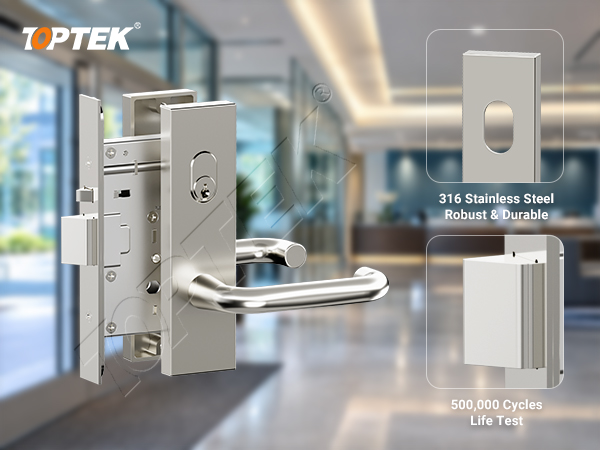
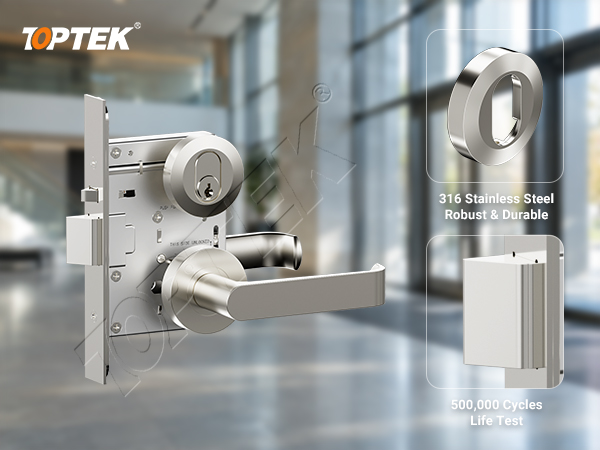
TOPTEK’s current product information identifies TKAU6400EC with escutcheon lever trim and TKAU6400RR with round rose lever trim. The visible furniture arrangement helps route the enquiry, but it does not prove that every spindle, fixing or internal service component is shared.
Use the TKAU6400EC product reference when discussing an escutcheon assembly. If the existing opening uses round roses, identify that arrangement explicitly rather than describing it as the same lock with a different cover. The supplier needs to confirm the actual component relationship.
Record the cylinder independently. Its format, operating interface and keying requirements can affect the replacement proposal even when the lockcase remains unchanged. A functioning key does not prove that a proposed replacement cylinder will interface correctly with the lock or retain the required access arrangement.
Also identify the strike and any separately supplied frame component. A lockcase enquiry should not silently become an order for a complete door kit, and a complete kit quotation should state whether the cylinder, trim and strike are included.
Create a useful identification record
Photograph the installed opening before removal, then collect additional details through an authorised service procedure. Keep inside and outside views labelled. A clear photograph of the door edge and relevant markings is often more useful than several unlabelled images of loose components.
| Record | What to capture | Why the supplier needs it |
|---|---|---|
| Door identity | Site reference, door number and intended use | Connects the service enquiry to the correct opening |
| Product identification | Complete markings, order reference and variant label | Distinguishes families and revisions |
| Geometry | Backset, forend, fixing positions and relevant interface dimensions | Supports comparison with the candidate drawing |
| Furniture | Escutcheon or rose, inside and outside arrangement, visible fixings | Identifies the trim interface |
| Function | Expected and observed behaviour of levers, key and thumbturn | Separates a symptom from a requested function change |
| Electrical variant | Product label, wiring reference, connector and controller interface | Prevents a mechanical-only compatibility decision |
| Service scope | Part, subassembly or complete lock requirement | Clarifies what must be included in the quotation |
Use measurements to support identification, not to manufacture certainty. Where a dimension is inaccessible, mark it for confirmation by the installer. Avoid estimating critical dimensions from an image with an unknown scale. Keep units consistent and include the drawing or measurement datum.
Choose between a service part and a replacement assembly
Ask whether the suspected component is intended to be serviced separately, whether the required part remains available and which instructions apply. Availability is a commercial and technical question for the supplier. A product photograph or an exploded view does not automatically mean every illustrated item can be ordered individually.
A complete replacement assembly may be appropriate when the existing model cannot be identified sufficiently, the affected component is not separately supplied, or the manufacturer recommends replacement. That decision should still include a fit and function comparison. Complete replacement does not eliminate the need to verify the door preparation and surrounding hardware.
For comparison, Lockwood publishes a Synergy mortice lock service manual with family-specific parts and accessories. It illustrates how service information can be tied to defined products. Its part numbers and dimensions apply to Lockwood products; they are not TOPTEK replacement references.
When requesting TOPTEK parts, ask for the proposed item reference, compatible assembly, included hardware and service instructions. Do not order a competitor’s component merely because its catalogue illustration resembles the removed item.
Compare the replacement with the installed opening
Prepare a comparison with separate rows for physical fit, operating function and the project documentation. Backset is one input, but the forend, fixing locations, spindle and cylinder interfaces, case envelope and strike relationship also need review. A candidate that fits one dimension may still require a different furniture or receiving arrangement.
Describe the required inside and outside operation in plain language. The building may need the same function as before, or the service request may include an authorised change. Keep those cases separate. A replacement that restores physical movement but changes access behaviour has not necessarily fulfilled the service requirement.
For mechanical, motorised and solenoid variants, identify the specific platform and supplied configuration. TOPTEK’s current business information describes these variants within its Australian lock offering. That does not establish shared electrical ratings, connectors or universal component interchangeability. Obtain the applicable wiring and function information for the proposed assembly.
If the opening has fire, security or other documented performance requirements, review the replacement within the applicable assembly evidence and project approval process. A matching appearance is not evidence that the substituted component is covered.
Control the service work and record the result
Arrange the work through the person responsible for the opening and use a competent installer. Keep any access-control isolation or temporary access arrangements within the site’s approved procedure. The purchasing enquiry should give the service team enough information to plan the work without guessing which components will arrive.
After fitting, check the required operation from both sides with the supplied trim, cylinder and receiving hardware in place. For an electrical version, include the relevant control and monitoring checks specified for that system. Record the outcome against the door number and replacement reference.
Retain the removed component until the fault investigation or supplier return requirement is resolved. Keep it labelled and separate from usable spares. If multiple doors are serviced together, use individual records so the team can trace which item came from which opening.
Update the mortice lock door schedule after an accepted replacement. A service record that only says lock changed is insufficient for the next order. Record the final configuration and any change to the original reference.
Build a spare-parts register around actual installations
For a facilities team or distributor, the most useful spare-parts register starts with the installed population. Group identical confirmed assemblies and record how many openings use each one. Keep separate entries when the function, trim, electrical version or component revision changes.
Add the supplier-confirmed service reference, pack contents, compatible assembly and any ordering restrictions. Distinguish parts physically in stock from parts that can be requested. Set stock levels using the site’s maintenance experience, lead times and operational needs rather than copying a generic percentage.
Store spare components in their identified packaging and retain the associated instructions. A mixed container of similar spindles or fixings defeats the purpose of a controlled register. Review unused stock when the installed hardware configuration changes, and prevent superseded components from being issued by habit.
For an initial identification enquiry, send TOPTEK the labelled photographs and original order details. Ask for confirmation of the assembly reference and the appropriate service supply route before setting a stock policy.
Common mistakes and the spare-parts RFQ
Typical mistakes are naming a spring before diagnosing the symptom, dropping a suffix from the model code, assuming equal backset means interchangeability, or ordering a mechanical part for an electrically configured assembly. Another is treating a general standard description as a replacement part number.
Use this RFQ checklist to make the request concrete:
- Door number, installed model and original order reference where available.
- Labelled photographs of the assembly, markings and relevant interfaces.
- Measured dimensions with units and drawing references.
- Expected function and a factual description of the observed problem.
- Requested supply scope and components that will be retained.
- Electrical variant details where relevant.
- Quantity, required timing and any project evidence requirements.
Ask the quotation to distinguish a confirmed matching service item from an alternative requiring additional review. Request the included parts list, installation information and any restrictions on the replacement proposal. This reduces the chance that a purchasing description hides a different technical scope.
Why TOPTEK for the configuration enquiry
TOPTEK offers identifiable Australian mortice lock assemblies, including the TKAU6400EC and TKAU6400RR trim arrangements. Those references provide a basis for discussing the installed configuration. Specific spare availability and compatibility still need confirmation against the actual product and service requirement.
The company’s quality management information gives context for drawing and component control. For a broader commercial door hardware supply enquiry, request a traceable parts list and retain it with the project records. The value of the enquiry is a clear, reproducible replacement decision.
Frequently asked questions
Can I identify a spare from the handle appearance alone?
No. Record the lockcase markings, trim reference, function and relevant interfaces. Similar furniture can be used with different configurations.
Does the same backset make two mortice locks interchangeable?
No. Compare the case, forend, fixings, spindle and cylinder interfaces, strike arrangement and required function as well.
Are all TOPTEK internal lock components sold separately?
Do not assume individual availability. Ask TOPTEK to confirm the appropriate service item or replacement assembly for the exact model and revision.
What information is needed for an electrical replacement?
Include the product variant, wiring reference, connector, required operating behaviour and control interface, alongside the mechanical identification record.
What should the maintenance record show after replacement?
Record the door number, removed reference, installed replacement, date, final function and check results. Retain the supplier’s compatibility confirmation and instructions.
Request an identified replacement proposal
Start with the installed assembly, confirm the service scope and keep the final reference with the door record. Send TOPTEK your identification record and quantities to request a parts availability review and quotation for the appropriate replacement proposal.