
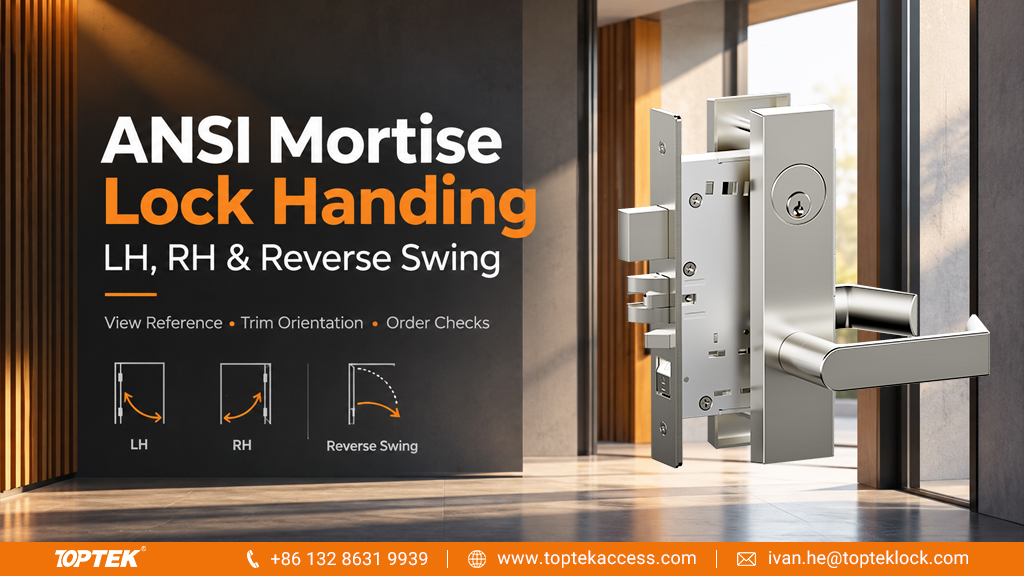

TL;DR: prevent a handed order mismatch
- Agree on the reference side before assigning LH, RH, LHR or RHR.
- Record door swing separately from the lock function and trim orientation.
- Confirm which components are handed and which exact configurations permit adjustment.
- Approve a labelled sample against the opening drawing before repeating the order.
Quick Answer: how do you specify ANSI mortise lock handing?
Specify ANSI mortise lock handing with a plan view showing the reference side, hinge edge and direction of opening. Add the intended inside and outside operation, lock model and trim configuration. Ask the supplier to confirm the corresponding order designation for that complete assembly. An LH or RH code alone does not establish the function, prove that every component is reversible, or identify the correct lever arrangement. Keep the drawing and supplier confirmation together so purchasing, production and installation work from the same instruction.
1. Establish the viewing convention before using a code
Using the outside-view convention described in Allegion’s lock handing explanation, the hinge side and opening direction distinguish the four designations below. Confirm that everyone supplying the opening uses this convention.
| Viewed from outside | Door opens | Designation |
|---|---|---|
| Hinges on the left | Away from the viewer | LH |
| Hinges on the right | Away from the viewer | RH |
| Hinges on the left | Toward the viewer | LHR |
| Hinges on the right | Toward the viewer | RHR |
In a project record, replace an unexplained word such as “outside” with a location name as well: corridor, public lobby or room. A door between two controlled areas may have no obvious everyday outside. If the drawing and schedule disagree about this reference, resolve that discrepancy before assigning the order code.
A photograph of the closed door is useful but incomplete. It may hide the hinge edge or fail to show the direction of movement. Add an annotated plan sketch with the door ID, reference position and swing arc. Photograph labels should describe where the camera stood rather than relying on the viewer to infer the secure side.
2. Separate handing, function and lever orientation
Handing answers an orientation question. Function answers an operating question. An opening can retain its swing direction while a revised access requirement changes what the outside lever, key or inside control must do. Combining these decisions in one shorthand description makes later substitutions difficult to evaluate.
Create separate schedule columns for door hand, function, outside operation and inside operation. Describe the required behaviour in ordinary language and have the supplier map it to the selected function designation. Do not assume that the words “office,” “storeroom” or “privacy” identify an identical assembly across every product range.
Trim introduces another distinction. The visible lever direction, mounting arrangement and any side-specific features must agree with the approved opening. A supplier may use one ordering method for the lock case and another for trim. Ask for an assembly-level confirmation covering the case, both sides of the trim and the intended controls.
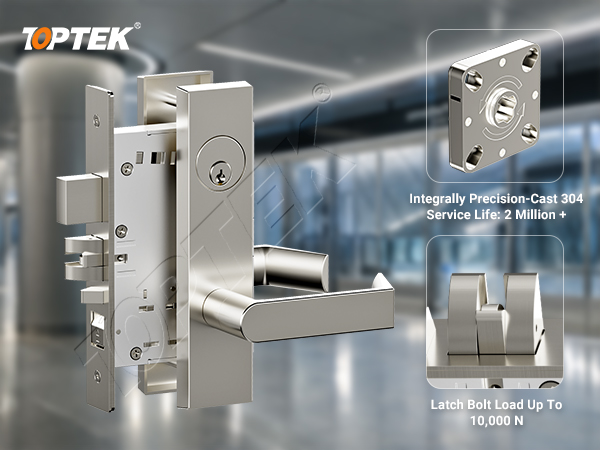
For TOPTEK selection, begin with the ANSI Grade 1 mortise lock range, then identify the particular trim and function under discussion. The product family name does not establish that all combinations share the same handing procedure.
3. Build a handing record that survives procurement
The useful deliverable is a traceable record for each opening, not a detached LH/RH total. The following matrix can be added to a hardware schedule. Its purpose is to prevent different teams from interpreting the same code differently.
| Record | What to provide | Question it resolves |
|---|---|---|
| Opening identity | Door ID, level, room names and drawing revision | Which opening does this instruction cover? |
| Reference side | Named location and arrow on the plan | From where is the hand determined? |
| Swing | Hinge edge and opening arc | Does the code match the geometry? |
| Operation | Inside and outside behaviour in each required condition | Does the selected function meet the brief? |
| Assembly | Case, trim, lever and control identifiers | What must the supplier actually configure? |
| Confirmation | Supplier order code and approved sample reference | What should purchasing and receiving compare? |
For a pair of doors, identify each leaf individually. A single description for the pair can conceal which leaf carries the lock or how the adjoining hardware affects the opening. Record the active leaf where applicable and show the relationship in the plan instead of copying one hand code into both rows.
Keep door preparation in a linked record. The ANSI mortise lock door preparation checklist addresses that separate physical interface. A handing approval should reference the preparation revision without pretending that one approval settles every dimension.
4. Ask exactly what “reversible” covers
A claim that a lock is reversible needs a scope. Does it refer only to the latch orientation, to a particular function setting, or to the complete supplied assembly? Does adjustment take place before installation, and what model-specific instructions apply? These questions are more useful than a yes-or-no request for universal reversibility.
Ask the supplier to identify the component and configuration covered by any adjustment instruction. Require the relevant instruction revision and the conditions under which the work may be performed. Do not transfer a procedure from a visually similar lock, another manufacturer’s case or a different function in the same family.
A receiving team should not treat field conversion as a substitute for an accurate order. Even when an authorised adjustment is available, the receiving record must establish what arrived and what changed. Otherwise a later service request may refer to the factory designation while the installed assembly has a different recorded orientation.
When the procedure or permitted configuration is unclear, retain the original assembly identification and ask the supplier for a confirmed solution. Avoid dismantling the case or improvising a reversal based on a general article. The commercial decision is whether to order the correct configuration, obtain an approved adjustment instruction or replace the affected assembly.
5. Use a sample opening to close the interpretation gap
For a repeated project configuration, identify a representative opening and agree on a sample review before releasing the remaining quantity. Label the sample with its case, function, trim and intended hand. The reviewer should compare it with the same drawing revision that purchasing will use.
Record observations for both sides of the opening under the selected function’s instructions. Note which control is operated and what the latch or bolt is expected to do. Keep orientation checks separate from operation checks so a correct-looking lever does not conceal a function mismatch.
The sample record should include a clear result, photographs and any agreed changes. If a change affects the function or trim, ask whether the earlier handing confirmation remains valid. Attach the revised confirmation to the order instead of leaving it in a separate email that production may never see.
At receiving, compare carton labels, assembly identification and quantities against the approved hand schedule. Quarantine an unexplained difference for clarification before mixed configurations reach multiple floors. This makes a discrepancy easier to resolve and avoids relying on installers to reconstruct the purchasing decision.
6. Common mistakes and the project risks they create
- Mixing conventions: a plan uses one reference side while the order uses another. Add a named viewpoint and supplier confirmation.
- Copying room numbers without drawings: two visually similar openings swing differently. Verify each door ID rather than extrapolating from its neighbour.
- Equating handed trim with a handed case: one component decision is treated as an assembly decision. List the relevant parts separately.
- Assuming reversibility: an installer receives no exact instruction or function limitation. Obtain model-specific guidance before adjustment.
- Changing access requirements late: the hand code stays the same but the required operation changes. Recheck the complete assembly.
These errors can create sorting work, interrupted installation and unclear service records. The prevention is modest: keep the geometry, operational brief and supplier order code linked. An unexplained spreadsheet abbreviation cannot provide the same traceability.
7. Why TOPTEK: discuss the complete configured assembly
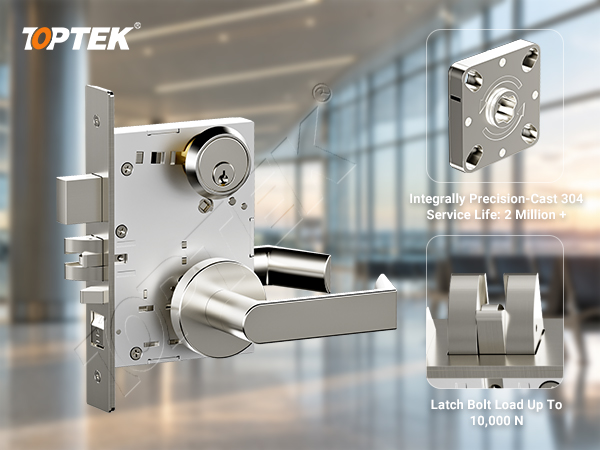
TOPTEK identifies TKAMRR9200 round rose and TKAMEC9200 escutcheon trim options in its ANSI mortise lock materials. Buyers can use the TKAMRR9200 product page to establish the model reference before discussing the required function and opening geometry.
TOPTEK’s documented quality process includes first-article and in-process checks. Use the quality management information to frame a practical question: which approved drawing, sample and configuration record will be available to the people checking this order? A general process description does not replace confirmation for the exact supplied assembly.
For a wider commercial door hardware package, send the door schedule with the other related hardware references. Ask TOPTEK to identify the proposed assembly and any unresolved interfaces before the quotation is treated as an approved production instruction.
Frequently asked questions
Is a handing code enough to order an ANSI mortise lock?
No. Include the reference-side drawing, opening direction, function and trim configuration, then obtain the supplier’s matching assembly designation.
Does the correct hand prove the lock function is correct?
No. Record inside and outside operation separately and compare it with the selected function’s documentation.
Can every ANSI mortise lock be reversed on site?
Do not assume that it can. Ask for the adjustment scope and current instructions for the exact model, function and supplied components.
How should a pair of doors be recorded?
Give each leaf its own identity and show the hinge edges, movement and relevant hardware arrangement on the drawing.
What should change after a revised sample is accepted?
Update the drawing, supplier confirmation and order record together, and retain the revised sample reference for receiving and installation.
Request a handing review or project quotation
The best handing instruction connects an opening drawing to a defined assembly. Before placing the order, check that the door ID, reference side, swing, function, trim and supplier designation all describe the same requirement.
For an initial handing review, send the annotated plan, photographs and required inside/outside operation. Identify any configuration already installed so the comparison starts with the correct reference.
For a formal quotation, add quantities by door ID and hand, model and trim preferences, finish, door preparation revision, sample requirements and delivery destination. Request written confirmation of the final assembly code and the documents that will accompany the supply.