

TL;DR: turn a vague fault into a useful record
- Identify the exact model and expected function before classifying a blocked outside control as a fault.
- If the door is already safely accessible, compare normal operation open and closed without forcing it.
- Record lever movement, latch movement and door contact as separate observations.
- Escalate an unreliable opening to a competent person and preserve the product identification for service.
Quick Answer: what should you check when the latch will not retract?
For an Australian mortice lock latch not retracting, begin with the model, function and side being operated. Establish whether the control is supposed to retract the latch in that condition. Where safe access already exists, record whether normal operation changes with the door open, whether the lever moves and whether the latch follows it. Provide these observations to the installer or supplier with photographs and the assembly identification. Do not force the door, alter the lock function or dismantle the case based on a generic troubleshooting description.
1. Check the intended operation before diagnosing failure
Commercial mortice lock functions can behave differently on the two sides of an opening. An outside control that does not operate in one condition may be behaving as specified, while the same observation on a different function could indicate a problem. Start with the approved door schedule and the instruction for the installed model.
Record which side was used, which control was operated and the state immediately before the observation. Avoid describing everything as “the handle does not work.” A service request should distinguish a control that does not move from one that moves without the expected latch response.
If the expected function is unclear, ask the supplier to identify it from the assembly record. Do not infer the function from lever shape, the presence of a key cylinder or the appearance of a similar opening elsewhere in the building. A photograph can support identification, but the order or installation record is a stronger starting point.
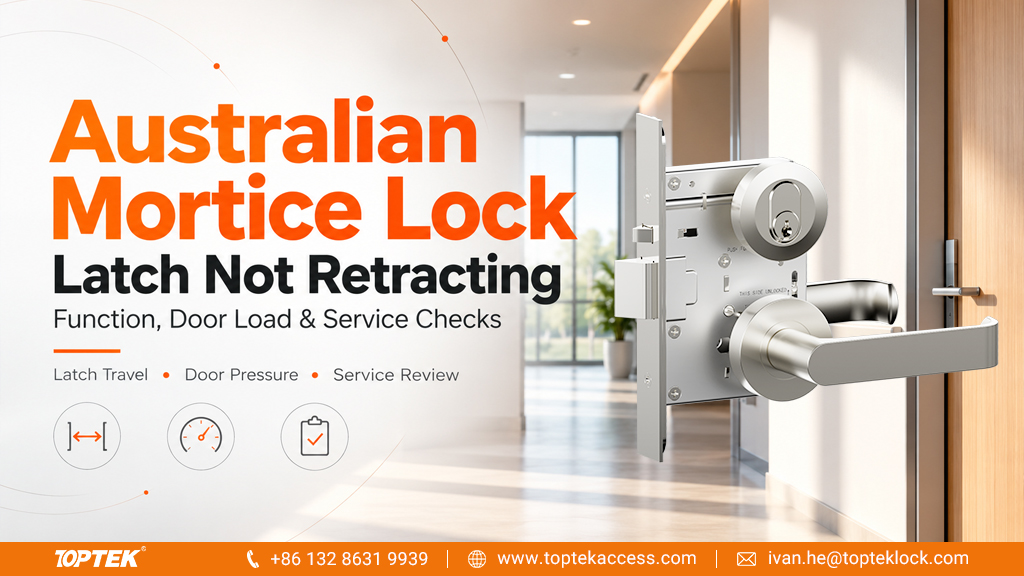
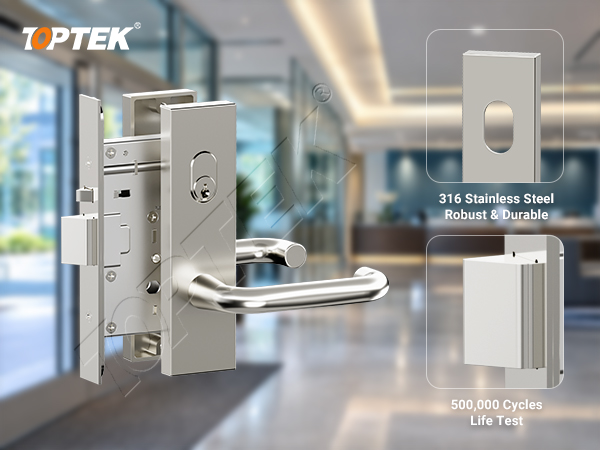
TOPTEK’s Australian mortice lock range is a product reference for the selection discussion. Match that reference to the actual installed configuration before applying any operating or service instruction.
2. Make safe observations before requesting a repair
If the door is already open and its normal use permits a check, observe the controls under the model’s instructions. Keep people clear of the moving leaf and avoid creating a situation in which the opening may close and become inaccessible. Do not close an unreliable door merely to reproduce a fault.
Where the opening is required for evacuation or another critical building function, arrange prompt assessment and appropriate temporary management by the responsible building team. Repeatedly trying the handle is not a substitute for resolving unreliable operation. The correct response depends on the opening’s role and the applicable site procedures.
Use ordinary authorised operation only. Do not insert tools through gaps, manipulate internal components or attempt to bypass the locking arrangement. If safe access is unavailable, the service route is a competent installer or authorised service provider.
Photographs should show the door ID, visible trim, edge identification and surrounding strike area where accessible. A short observation record is often more useful than several unlabelled close-ups. State whether the image shows the door open or closed and identify the side from which it was taken.
3. Compare the symptoms without assuming the cause
| Observation | What to record | Useful next question |
|---|---|---|
| Control does not move | Side, function and operating condition | Is that control intended to operate in this condition? |
| Lever moves but latch does not follow | Visible movement and assembly identity | Which model-specific input and coupling checks are required? |
| Operation differs open versus closed | Existing observations and contact marks | Should door position, strike relationship or loading be assessed? |
| Latch response is intermittent | Timing, circumstances and recent changes | What repeatable condition can the installer investigate safely? |
| Electrical indication appears but release is unclear | Indication, command and actual mechanical response | Which electrical and mechanical checks apply to this configuration? |
This table organises evidence; it does not identify a failed component. Several interfaces can produce a similar symptom, and more than one issue may be present. Keep the observation and proposed cause in separate fields so a tentative suggestion does not become an unverified repair instruction.
For example, “lever moved on the room side while the visible latch remained extended” is a useful description. “The lock case is broken” is a conclusion that requires investigation. That distinction helps the supplier request the right follow-up information.
4. Consider door contact when open and closed behaviour differs
An existing observation that the latch operates with the leaf open but behaves differently when closed is valuable. It directs attention toward the installed opening as well as the lock. A competent installer can assess alignment, contact and the relationship between the leaf, frame and strike using the applicable installation instructions.
Provide clear photographs of visible rubbing or impact marks without altering the surfaces. Note whether the door has recently been adjusted, painted, resealed or fitted with different hardware. These changes are context for investigation, not proof of a particular cause.
Avoid requesting an immediate strike alteration based on a telephone description. Enlarging or moving components can affect fit, operation and the evidence associated with an opening. The installer should first establish what is wrong and which correction is appropriate for that doorset.
The AS 4145 mortice lock door schedule guide can help locate the intended opening configuration. Compare the installation with the approved record so the investigation includes changes made after the original order.
5. Distinguish mechanical input from electrical indication
Where a lever moves without the expected latch movement, describe the visible input and response separately. The authorised installer may need to investigate the trim-to-lock interface or the assembly itself, following the exact model’s documentation. The buyer’s task is to supply the configuration and symptom record, not to prescribe an internal adjustment.
For an actuated assembly, add the control event and indication to the record. A light or access-system message describes part of the system’s behaviour; it does not by itself prove that the latch physically retracted. Record what was commanded and what the door hardware actually did.
TOPTEK’s Australian platform includes mechanical, motorised and solenoid configurations. This makes configuration identification important; it does not mean that wiring, operating behaviour or service procedures can be transferred from one configuration to another.
Route electrical investigation to a person qualified for that system and provide the current wiring and product instructions. Do not change supply settings, disconnect controls or apply a procedure from a different lock to test a theory. Keep the access-control contractor and hardware installer working from the same assembly reference.
6. Use manufacturer guidance within its stated scope
Manufacturer troubleshooting resources can show why component identity matters. For example, Lockwood’s commercial mortice lock FAQ discusses particular 3572 and 3582 issues involving cylinder cams, debris and strike alignment. Those answers concern the named Lockwood products and symptoms; they are not a TOPTEK latch-repair procedure.
For the actual installed lock, request the relevant instruction and ask the supplier which checks apply to the reported symptom. Include the document revision in the service record. If the available paperwork names a different model, resolve that mismatch before work proceeds.
Do not add an unapproved lubricant or cleaning product as a universal first step. Supply and maintenance instructions should identify what is permitted for the assembly. Record any products already used, as that information may be relevant to the investigation.
Keep removed parts and their identification available when a replacement is authorised. A service record should explain what was changed and why, rather than simply noting that the door “now works.” This supports later maintenance and makes repeated issues easier to assess.
7. Prepare a service request that can be acted on
- Door ID, location, building contact and the opening’s operational importance.
- Manufacturer, model, function, trim and available order or installation reference.
- Side and control used, expected behaviour and observed latch response.
- Whether an open-door comparison already exists and how it differs.
- Photographs of identification, trim, accessible edge and strike area.
- Recent installation work, adjustments, cleaning or changes to the access system.
- Required service outcome, access arrangements and available documentation.
For multiple affected doors, create one record per opening and then identify common configurations. Do not combine different symptoms into one general complaint. A repeated model reference can be useful, but the installer still needs to understand each opening’s actual condition.
After an authorised correction, request an operation check against the selected function and update the service record. Identify the instruction followed, components changed and result observed. Return the opening to normal service through the responsible site’s process, with unresolved behaviour clearly escalated.
8. Why TOPTEK: begin with a clear product reference
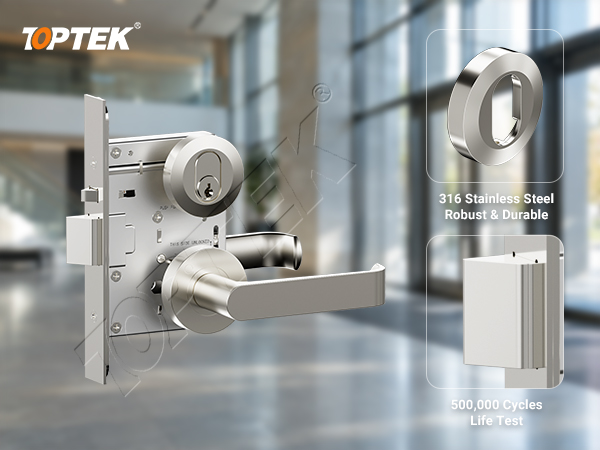
For a TOPTEK enquiry, the TKAU6400RR product page and the TKAU6400EC model reference help establish the trim family. Send the installed assembly details as well, because the visible trim does not establish the complete function or actuation configuration.
TOPTEK describes first-article and in-process checks in its company quality information. Use the quality management page to frame a request for the relevant product and order records. The practical service question is which documents and replacement configuration apply to this particular assembly.
If investigation leads to a replacement or wider commercial door hardware purchase, ask for written scope: what is supplied, what remains in place and what compatibility checks are required. Do not assume that a replacement trim, case or complete lockset are interchangeable purchasing descriptions.
Frequently asked questions
Does a stationary outside lever always mean the lock is faulty?
No. First compare that observation with the expected operation of the exact installed function and operating condition.
What does different operation with the door open suggest?
It gives the installer a reason to assess the installed opening, contact and alignment as well as the lock. It does not establish a single cause.
Does an access-system indication prove that the latch released?
No. Record the command, indication and actual mechanical response separately for the relevant configuration.
Should the lock case be opened to look for the problem?
Do not dismantle it using generic advice. Obtain the exact model’s service guidance and use a competent authorised person.
What should a replacement request include?
Include the assembly identity, observed symptom, service findings and required supply scope so the proposed replacement can be checked against what remains installed.
Request service guidance or a replacement quotation
A useful investigation begins with a precise symptom and ends with a documented result. Keep function, lever movement, latch movement and door contact distinct. That record helps the responsible specialist determine the appropriate next step without guessing from a general product name.
For service guidance, send the model identification, opening photographs and observation record. Explain whether the door is currently accessible and identify any critical operational constraint.
For a replacement quotation, add the confirmed configuration, required supply scope, quantities, compatibility documents and destination. Ask for the proposed replacement reference and the instructions required for installation and verification.