

Apartment Entrance vs Dormitory Mortise Lock: F09 or F13?
TL;DR
Choose F09 when the opening requires controlled outside entry and free inside egress primarily through the latch function. Consider F13 when a dormitory, corridor or residential room entrance also requires deadbolt security with free egress. Do not select from the room label alone: confirm the exact deadbolt operation, cylinder, trim and inside release sequence on the scheduled configuration.
Start with the ANSI Grade 1 Mortise Lock product hub, then use this narrower guide to define the required function and approval evidence.
Quick Answer
Write four states before selecting F09 or F13: normal outside entry, secured outside entry, deadbolt state and inside egress. F13 normally introduces a deadbolt that F09 does not define in the same way. Approve the operating sequence, keying and identified sample together.
Why F09 and F13 overlap in project language
Apartment, dormitory and residential corridor schedules often use broad labels such as “unit entry” or “room entrance.” Both F09 and F13 may appear plausible because each supports controlled outside access and inside egress. The decisive difference is not the occupancy label; it is the required locking sequence.
TOPTEK’s function material describes F09 as an apartment entrance function and F13 as a corridor/dormitory function that normally includes a deadbolt. The buyer should therefore state whether the opening needs latch-only access control or an additional deadbolt state, and who is authorised to operate it.
What F09 should communicate
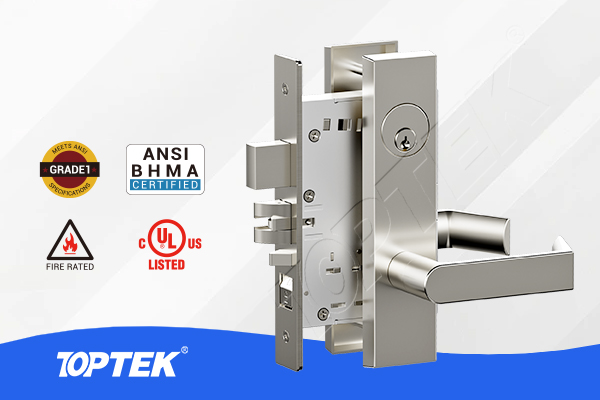
F09 is intended for apartment entrances, dormitory units, residential corridor doors and multifamily housing where secured outside entry and immediate inside exit are required. The outside trim is typically key-operated, while the inside lever provides convenient egress.
“Typically” must not become an assumption. The quotation should identify the exact cylinder, trim, keying and latch operation. The schedule should state whether any inside control changes the outside condition and how residents, management and emergency personnel obtain access.
What F13 adds to the decision
TOPTEK’s supplied description positions F13 for dormitory rooms, corridor doors and residential room entrances where deadbolt security and free egress are both required. Compared with F09, the enquiry therefore adds deadbolt projection, retraction and inside-release questions.
The function code alone does not prove how every supplied trim operates. Ask whether the inside lever retracts the latch only or also releases the deadbolt, whether a thumbturn is present, and how outside key operation interacts with both bolts. Record that sequence before selecting trim or cutting doors.
Map the four operating states
State one should describe the normal closed door. State two should describe authorised outside entry. State three should describe the secured or deadbolted condition. State four should describe immediate inside exit. This state map makes missing information visible.
If the schedule cannot describe all four states, it is not ready for final function selection. Add power-loss or access-control states only when those components are genuinely part of the opening. Do not import electronic behaviour into a mechanical F09 or F13 enquiry without a defined interface.
| Decision | F09 apartment entrance | F13 corridor/dormitory |
|---|---|---|
| Primary question | Controlled outside entry and inside exit | Deadbolt security plus inside exit |
| Deadbolt | Not the defining comparison point | Normally included |
| Keying focus | Resident/management entry | Resident/management entry plus deadbolt operation |
| Approval | Latch/access sequence | Latch, deadbolt and egress sequence |
| Change control | Recheck outside state | Recheck trim, cylinder and deadbolt state |
Coordinate cylinder and key hierarchy
Residential and dormitory projects often combine resident keys, management access, master keys, construction keying and turnover controls. The chosen function must be compatible with the intended cylinder and key hierarchy, but the function itself does not establish that hierarchy.
Provide the cylinder format, keyway or approved equivalent, key quantities, hierarchy diagram and handover responsibility. Keep sensitive bitting information out of general schedules. Link each opening number to the function and keying reference so similar-looking lockcases do not get exchanged during installation.
Confirm trim, handing and door preparation
F13 deadbolt requirements can change the required trim openings and how the occupant operates the secured state. Confirm escutcheon or sectional presentation, spindle and cylinder interfaces, door thickness, handing and edge preparation.
Use the ANSI mortise door-preparation checklist for geometry and this guide for function. A correct pocket with an incorrect operating configuration still fails the project. Approve drawings before machining production doors.
Buyer checklist before choosing F09 or F13
- Opening number and room/application description
- Plain-language outside entry sequence
- Normal and secured/deadbolted states
- Inside lever and deadbolt release sequence
- Cylinder, key hierarchy and turnover plan
- Trim, spindle, handing and door thickness
- Door preparation and strike relationship
- Evidence scope and approval owner
- Identified operating sample and revision
Common mistakes and project risks
One mistake is assigning F13 to every dormitory door because the name contains “dormitory.” Another is retaining F09 when the owner actually expects a separate deadbolt. A third is approving the visible trim without operating every state.
A late function correction can affect the lockcase, cylinder, trim, door machining, strike, key schedule, labels and resident communications. Preserve the decision trail from schedule to quotation, drawing, sample and order acknowledgement. If a room changes use, reopen the function review instead of relying on the old room name.
TOPTEK evidence and product scope
TOPTEK’s ANSI function document provides the F09 and F13 intent used in this comparison. It states that F13 normally includes a deadbolt and that both applications must maintain free egress as specified. Final suitability remains configuration- and project-dependent.
Use TOPTEK resources to request current drawings and applicable documents. Product images, web badges and internal development statements are not substitutes for original reports or complete doorset approval.
Product presentation and sample review
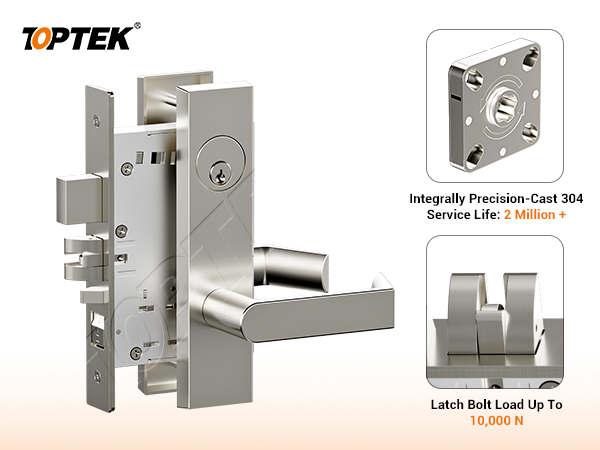
The TKAMRR9200 round-rose reference and TKAMEC9200 escutcheon reference show different presentations, not proof of F09 or F13 internal logic.
Label the sample with opening/function, trim, cylinder, hand, drawing revision and keying reference. Demonstrate outside entry, secured state, deadbolt operation where applicable and inside egress. Record exceptions and do not approve by photograph alone.
RFQ checklist
A controlled RFQ should include the opening schedule, F09 or F13 reference, four-state operating description, deadbolt requirement, cylinder and key hierarchy, trim, spindle, hand, door preparation, finish, evidence scope, sample quantity and acceptance owner.
Ask the quotation to repeat every selected field and mark unresolved items as open. A price line that says only “dormitory mortise lock” cannot control production. Require the drawing and sample label to carry the same configuration reference.
Why TOPTEK: convert room labels into operating logic
TOPTEK can review the room schedule and restate each opening as an inside/outside operating sequence. This helps expose conflicts between a room label, deadbolt expectation, cylinder plan and free-egress requirement before production.
The same matrix can support sample approval and repeat orders. When the owner changes a door from apartment entry to dormitory use, the team can see which fields require reapproval rather than assuming the previous lock remains suitable.
Two-level CTA
For an initial review, send the opening list and describe how residents or occupants enter, secure the door and leave from inside. Mark every opening that needs a separate deadbolt state.
For a formal RFQ, submit the approved schedule, door preparation, trim/cylinder data, key plan, evidence requirements and sample protocol through the TOPTEK contact page. Request a configuration-specific quotation and drawing revision.
Conclusion
F09 and F13 are related residential-corridor functions, but they should not compete for the same intent. F09 centres on controlled apartment entrance and inside exit; F13 normally adds deadbolt security for corridor or dormitory room doors.
Choose from the required operating states, not the occupancy name. Coordinate the deadbolt, cylinder, trim, key hierarchy and door preparation; then approve an identified sample. This creates a usable record for installation, handover and later room-use changes without pretending that one function code resolves every project responsibility.
Frequently asked questions
What is the main difference between F09 and F13?
F13 normally includes a deadbolt for corridor or dormitory room security, while F09 centres on controlled apartment entrance through the latch function and free inside egress.
Does every dormitory door require F13?
No. Select from the required operating sequence, deadbolt requirement and project rules rather than the room label.
What should the sample demonstrate?
Demonstrate normal outside entry, secured entry, deadbolt operation where applicable and inside egress on the identified configuration.
Can the same trim be used for both functions?
Possibly, but appearance does not prove compatibility. Confirm openings, cylinder, spindle, inside control and the exact lockcase drawing.
What belongs in the RFQ?
Include the opening schedule, function, operating states, deadbolt requirement, cylinder/key plan, trim, preparation, evidence and sample controls.