

Australian Mortice Lock Sample Approval Checklist: From Drawing to Repeat Order
TL;DR
Approve more than appearance. The sample record should identify the exact lock version, function direction, backset, trim, cylinder, door preparation, components, drawing revision and evidence scope. Demonstrate the agreed sequence, record deviations, and preserve a golden-sample reference for repeat production.
Start with the AS 4145 Mortise Lock product hub, then use this narrower guide to define the required function and approval evidence.
Quick Answer
Connect five records: RFQ, quotation, drawing, identified sample and order acknowledgement. If any model, function, backset, trim or evidence requirement changes, reopen the affected checks instead of carrying forward a generic “sample approved” statement.
Why “sample approved” is not enough
A sample can be approved for finish while its function, backset or evidence remains undecided. A short email saying “OK” does not tell production which features were accepted.
Use an approval form that identifies what was reviewed, what was not reviewed, the responsible person and the governing drawing revision. Separate visual approval, dimensional approval, operating approval and documentation approval.
Start with a controlled RFQ
The RFQ should state opening application, mechanical/motor/solenoid version where relevant, inside/outside behaviour, backset, trim, cylinder, door thickness and evidence requirements. Missing fields should be marked unconfirmed.
TOPTEK’s Australian material identifies TKAU6400 family options and 60, 89 and 127 mm backsets. Those family facts do not select a configuration. The buyer must identify the intended combination.
Approve the drawing before machining
A controlled drawing should show case envelope, forend, backset, operating centres, fixings, spindle/cylinder interfaces and strike relationship. Add Side A/Side B and door-hand reference.
Compare the drawing with the door manufacturer’s preparation before cutting a production door. A product photograph cannot replace dimensions. Record every approved deviation and update the revision rather than annotating an old print without control.
Identify the physical sample
Label the sample with model, version, backset, trim, function, hand or setting, finish and drawing revision. Identify loose components and packaging.
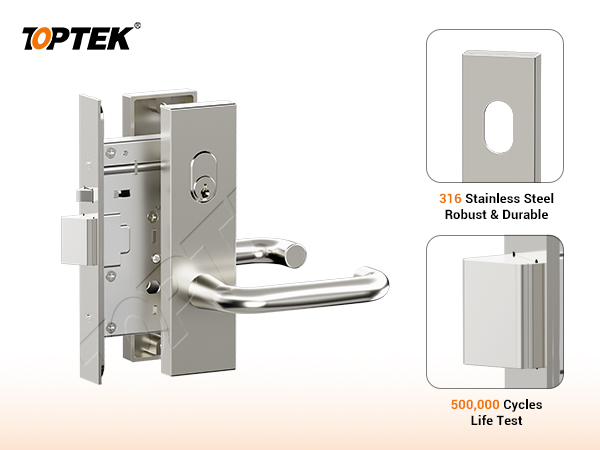
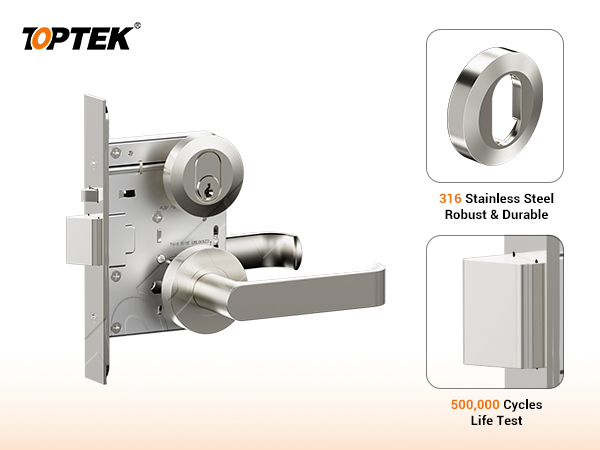
If the sample uses TKAU6400EC or TKAU6400RR presentation, name it explicitly. Do not let an escutcheon sample become approval for a round-rose order or vice versa.
| Stage | Control | Output |
|---|---|---|
| RFQ | Define configuration and open items | Configuration matrix |
| Drawing | Confirm geometry and interfaces | Approved revision |
| Sample | Identify and demonstrate function | Signed checklist |
| Evidence | Match documents to scope | Evidence register |
| Repeat order | Compare requested and approved setup | Change/reapproval decision |
Demonstrate the operating sequence
Test the agreed lever, key, turn and access-control states in order. Record Side A and Side B, normal state, locked state, released state and power-loss state where applicable.
The demonstration is an acceptance record, not permission to bypass installation instructions or life-safety review. Use a representative preparation and stop if safe operation is uncertain.
Sample approval checklist
- Exact model/version and product code
- Backset and complete drawing revision
- EC or RR trim and all supplied components
- Inside/outside function and handing reference
- Cylinder, spindle and fixing interfaces
- Door and strike preparation
- Finish and visual acceptance criteria
- Evidence documents and scope
- Signed deviations and approval owner
Check dimensions and interfaces
Use calibrated measurement methods appropriate to the project and record the reference faces. Backset alone does not define case depth, forend or fixing positions.
Confirm door thickness, stile space and trim footprint. For replacement work, compare existing holes and pocket details separately. The Australian mortice lock supplier guide provides broader sourcing context.
Control evidence and claims
List every certificate, report, drawing or internal-test statement requested by the project. Record the exact model/configuration scope.
Do not convert internal tests or image captions into third-party certification. If the report is missing or the sample differs from its scope, mark the evidence check pending and limit the publication or order claim.
Create a golden-sample reference
After approval, preserve an identified sample or an agreed equivalent record. Photograph both faces, the edge, components and labels. Store the signed checklist and current drawing together.
Define custody, retention period and what happens if the sample is damaged. A repeat order should cite the approval reference, not merely the customer name or old purchase order.
Manage changes and repeat orders
A change to backset, trim, version, finish, function or supplier component can affect other checks. Use a change matrix to decide which drawing, interface, operation and evidence items must be reopened.
Do not assume that a later sample supersedes the earlier one unless the revision record says so. The quotation and order acknowledgement should repeat the approved configuration.
TOPTEK product scope
Use the TOPTEK AS mortice lock hub for family context. The TKAU6400EC reference and TKAU6400RR reference distinguish two trim presentations.
Request current drawings and evidence through TOPTEK resources. The approval checklist must still identify the exact supplied version and scope.
Why TOPTEK: link approval to production
TOPTEK can return a configuration matrix with the quotation, identify missing inputs and label the sample against the drawing. This makes technical questions visible before production.
For repeat orders, the same reference supports comparison between approved and requested configurations. Differences can be reviewed deliberately instead of being hidden inside a familiar product family name.
Use first-article inspection before releasing the batch
The approved sample should inform a first-article inspection when production begins. Compare the visible configuration, function, backset, trim, supplied components, labels and document revision. Record the serial, batch or other production reference used by the supplier.
A first article is not automatically another customer approval sample, but it provides an internal control between the approved basis and the production process. Define who reviews deviations and what level of change requires customer reapproval. Hold the affected release when an interface or evidence item cannot be matched.
Plan packaging and site identification
Packaging should help the warehouse and installer distinguish similar variants. Use the approved product and function references, backset, trim and hand or setting information where appropriate. Avoid labels that expose sensitive instructions but still make the configuration traceable.
Include the correct installation instructions and component list. If keys, cylinders or loose trim are packaged separately, define how the opening number and set are reunited on site. A complete approval can still fail operationally if logistics separate matched components or mix two revisions.
Two-level CTA
For a quick review, send the existing sample photos, door preparation and previous drawing. TOPTEK can identify which approval fields remain open.
For a formal RFQ, submit the full schedule, configuration matrix, evidence list, sample quantity and approval owner through the TOPTEK contact page. Request that the quotation cite the same revision.
Conclusion
A useful sample approval is a controlled technical record, not a visual preference. It connects function, geometry, trim, components and evidence.
Identify the sample, demonstrate the sequence, record pending items and preserve the approved reference. This creates a repeatable basis for production without pretending that one sample proves every variant. Before closing the approval, ask the door manufacturer, distributor and project reviewer to confirm that they are using the same reference. Attach the component list and photographs to the record and state whether packaging, installation instructions or keys were included in the review. When production begins, use first-article inspection to compare the delivered configuration with the approval basis. Record the result before releasing the balance. For later orders, check the new purchase order against the approved matrix rather than relying on memory. If a customer requests an equivalent component, treat equivalence as a technical question: compare geometry, operation, finish, evidence and interfaces, then document the decision. These controls are especially useful when several TKAU variants share a similar appearance.
Frequently asked questions
What should an Australian mortice lock sample label include?
Include model, version, backset, trim, function, hand or setting, finish and drawing revision.
Is visual approval enough?
No. Separate visual, dimensional, operating and documentation approval.
What is a golden sample?
It is an identified approved physical reference, or an agreed equivalent record, retained with drawings and acceptance evidence for repeat-order comparison.
When should a sample be reapproved?
Reopen affected checks when the model, version, function, backset, trim, finish, component or evidence scope changes.
What should TOPTEK receive with the RFQ?
Send the schedule, configuration, door preparation, evidence list, sample quantity, acceptance sequence and approval owner.