

TL;DR
- Measure the finished door at the lock position, including permanent facings that affect the trim mounting surfaces.
- Show the lock position relative to both door faces; equal total thickness does not guarantee equal component lengths.
- Review the spindle, mounting posts, through-bolts, cylinder and thumbturn as a coordinated assembly.
- Approve a representative fitted sample before releasing a nonstandard thickness configuration for production.
Quick Answer
ANSI mortise lock door thickness is a configuration input for the complete lock and trim assembly. Give the supplier the finished leaf thickness, the lock position within the leaf, the selected function and the exact furniture on each face. Ask for a coordinated parts list and installation drawing covering spindle engagement, fixings, cylinder projection and thumbturn connection. A lockcase fitting inside the door does not prove that the external components will assemble correctly. The suitable thickness range must come from the selected model and configuration documentation.
This guide helps door manufacturers, hardware distributors and project buyers prepare that enquiry. Start with the TOPTEK ANSI mortise lock family, then resolve thickness through the drawings for the proposed assembly.
Measure the finished door and identify both mounting faces
A drawing may describe the core or structural leaf thickness while the installer receives a finished door with additional surface layers. Record the condition in which the hardware will actually be fitted. Distinguish a permanent facing from removable protection, and show any raised panel, plate or recess near the trim. The important surfaces are those against which the specified furniture and fixings will seat.
Take measurements at the proposed lock position. A measurement at an unrelated edge may miss a local detail. Record the units and measurement method, and attach a section rather than sending only one number in an email. If production tolerances are relevant, ask the door manufacturer for the permitted range and submit that range with the nominal thickness.
Do not assume that adding a decorative face to one side moves the lockcase to the new centre of the finished door. The case may remain positioned relative to the original construction. That changes the relationship between the lock mechanism and the two mounting faces. The supplier needs to see that relationship before selecting connecting components.
Explain where the lock sits within the door
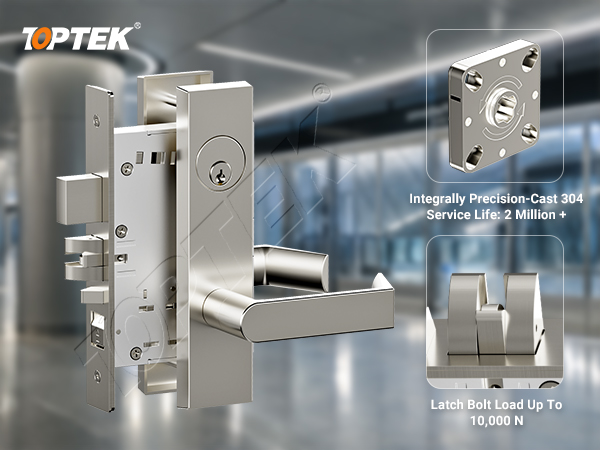
A useful section labels the inside face, outside face and the lock reference line used in the manufacturer’s drawing. Do not invent a reference line from a photograph. Ask which datum the supplier uses, then dimension both sides from it. This prevents two companies from using the same phrase, such as centred lock, with different meanings.
For a door with unequal build-up, describe which side carries the additional material. Include the handing and intended inside and outside functions. Some connections may differ between the two faces, so an overall thickness cannot always specify the complete kit. Treat asymmetric construction as a drawing question even when its total thickness resembles a previously supplied door.
Keep thickness separate from backset. Backset locates an operating axis relative to the door edge in the relevant drawing; thickness describes the distance between the faces. Changing one measurement does not solve the other. For the surrounding preparation checks, use the ANSI mortise lock door preparation checklist alongside the thickness record.
Review the parts affected by thickness
The buyer’s task is to obtain a matched configuration, rather than select isolated longer parts. A longer fastener may reach its mating component while still being unsuitable for the specified fastening arrangement. A spindle may appear to enter the follower without satisfying the required engagement or retention detail. Use the manufacturer’s dimensions and assembly instructions for both checks.
| Component | Question for the supplier | Record to retain |
|---|---|---|
| Lever spindle | Does the selected length and form suit both trim connections and the lock follower? | Spindle reference and engagement detail |
| Mounting posts and through-bolts | Can the specified fastening system clamp the finished assembly without bottoming or interference? | Fixing set and mounting section |
| Cylinder and collar | Does the combination achieve the required operating interface and external position? | Cylinder, collar and cam references |
| Thumbturn connection | Is its connecting component suitable for the selected function and inside build-up? | Thumbturn assembly detail |
| Escutcheon or rose | Will the mounting surface, supports and visible coverage match the door preparation? | Trim drawing and fixing locations |
| Strike arrangement | Does the finished door and frame relationship still match the selected receiving hardware? | Frame section and strike drawing |
Allegion’s L9000 thick-door guidance illustrates the assembly issue: its own configuration can involve changes to several connecting and trim components, with function and extension arrangement affecting selection. Those instructions apply to Schlage products. TOPTEK components require their own drawings and cannot be selected from another brand’s part numbers.
Coordinate trim and function before choosing lengths
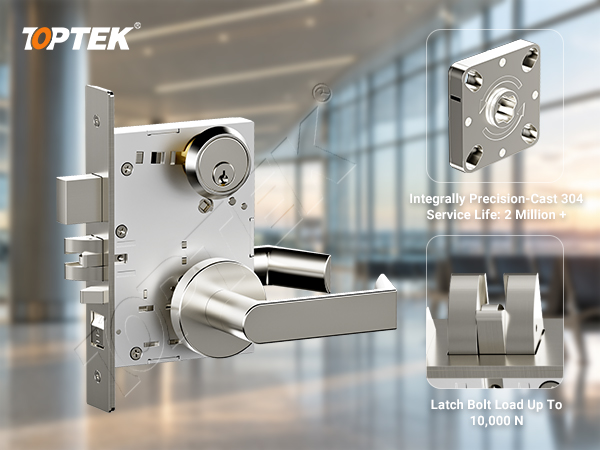
TOPTEK identifies TKAMEC9200 as an escutcheon lever trim assembly and TKAMRR9200 as a round rose lever trim assembly. These product references help define the intended furniture arrangement. They do not, by themselves, specify a universal thick-door kit or establish interchangeability between all associated components.
Review the TKAMRR9200 round rose configuration when the project calls for separate roses. Confirm the exact lock function, cylinder arrangement and inside furniture before requesting the spindle and fixing package. Changing from a blank face to a cylinder or thumbturn arrangement may change the components needed on that side.
A function label also needs a clear operating description. State what the outside lever, inside lever, key and thumbturn should do. The supplier can then review the thickness configuration against that assembly. Do not infer the required components from the appearance of a sample with a different function.
Use a thickness worksheet for the sample
Create one worksheet for each distinct combination of door construction, thickness, lock position, function and trim. Multiple door numbers can reference the same worksheet when the configuration is identical. Separate a new variant when one of those inputs changes; a new colour alone may be handled in a separate finish record.
- Identify the door type, drawing revision and finished thickness range.
- Mark inside and outside mounting faces and the supplier’s lock datum.
- List the lock function, trim, cylinder, collar, thumbturn and fixing references.
- Attach the supplier’s coordinated assembly drawing and relevant installation instructions.
- Record sample observations, exceptions and the final accepted parts list.
For an initial review, send TOPTEK the door section and selected trim. Ask which additional dimensions are needed before a sample configuration can be proposed. This gives the supplier a clear starting point without requiring the buyer to guess component lengths.
Check fit through the complete assembly sequence
Use a representative door construction with the intended finished faces. A loose lock on the bench can help identify components, but it does not reproduce the support, alignment and spacing of the installed trim. Have the installer follow the applicable instructions and document the assembly sequence.
Check whether the furniture seats correctly, the designated fixings engage as specified and the operating parts move through their intended travel. Record any difference between operation before and after the trim is secured. If resistance appears, stop and investigate the cause using model-specific guidance. Do not compensate by leaving required fasteners loose.
Include both sides of the door in the observation. A configuration may feel acceptable from one face while a connection on the other side is incomplete. Where a key or thumbturn is part of the function, include it in the sample rather than adding it after the main review. Confirm the strike relationship with the finished door and frame.
Physical fit and operational checks do not establish a fire or security approval. Where the project requires documented performance, match the exact configuration and door construction to the applicable evidence. A thickness change needs its own review within that scope.
Avoid the common ordering mistakes
The first mistake is quoting only a nominal door thickness. Correct it by attaching the finished section and identifying the lock position. The second is specifying longer screws as the entire solution. Correct it by requesting a coordinated list of affected parts, including the spindle and cylinder-side components.
A third mistake is treating an apparently similar competitor’s kit as a substitute. Matching a visible dimension does not establish thread, connection or functional compatibility. A fourth is approving a standard-thickness sample and then changing the production leaf construction without reviewing the hardware package again.
Finally, keep the accepted kit together. Mixing parts from different trial configurations can make a successful sample impossible to reproduce. Label the sample, retain its parts list and attach the drawing revision to the purchase order. This is particularly useful when a distributor buys several door-thickness variants under one project reference.
Why TOPTEK and what to include in the RFQ
TOPTEK’s ANSI range offers the escutcheon and round rose configurations described above, providing concrete starting points for a door-thickness enquiry. Its quality management information describes the production control context. Ask for the configuration-specific drawing and inspection requirements that connect your accepted sample to the order.
Your RFQ should include the finished door section, thickness range, lock location, handing, function, furniture on each side, cylinder requirements, frame arrangement, quantities by variant and required delivery sequence. Identify which components the door factory will supply separately. Ask the quotation to list included parts and any unresolved interfaces explicitly.
For a wider commercial door hardware package, keep the thickness worksheet linked to the overall hardware schedule. The practical outcome is a repeatable assembly specification, with a clear distinction between the door manufacturer’s inputs and the lock supplier’s proposed component set.
Frequently asked questions
Does a standard mortise preparation prove the lock fits my door thickness?
No. Preparation and thickness are separate checks. The case may fit the pocket while the spindle, fixings, cylinder or thumbturn connection requires a different configuration.
Should I measure the core or the finished door?
Provide the finished thickness at the lock position and a section showing permanent layers and trim mounting faces. Identify the core separately if it helps explain the construction.
Can I solve a thick-door installation with longer screws?
Longer screws alone do not establish compatibility. Ask the manufacturer to coordinate the spindle, mounting components, cylinder and thumbturn with the selected function and trim.
Do TKAMEC9200 and TKAMRR9200 use the same thickness kit?
Do not assume a shared kit. Confirm the exact parts list for the escutcheon or round rose assembly, its function and the finished door section.
What if the lock is not centred between the finished faces?
Show its position relative to both faces using the supplier’s drawing datum. Unequal build-up can affect the components needed on each side.
Request a coordinated thickness configuration
A reliable order connects the measured door, the intended function and the complete furniture package. Retain the accepted sample record and use it when production details change. Send your thickness worksheet and quantities to TOPTEK to request a proposed component list, sample scope and quotation for the selected assembly.