

TL;DR
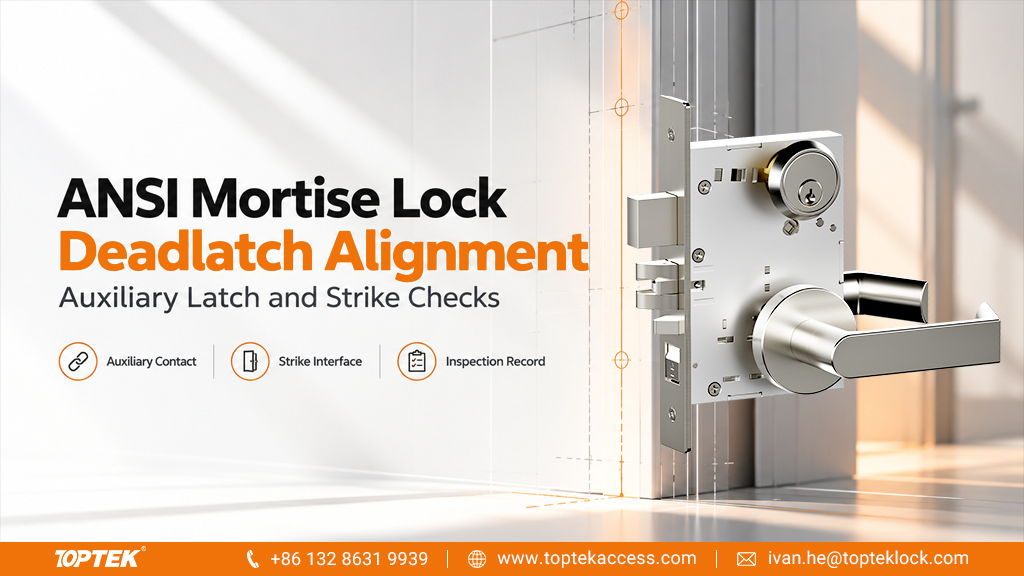
- Identify whether the specified lock includes an auxiliary deadlatch before evaluating its strike.
- Check the main latch pocket and the auxiliary contact surface as separate parts of the interface.
- Use the exact lock and strike drawings; a familiar faceplate outline does not establish compatibility.
- Record the installed result and refer unexplained operation to the responsible hardware specialist.
Quick Answer
ANSI mortise lock deadlatch alignment means matching the auxiliary latch to its intended strike contact while allowing the main latch to engage correctly. For a configuration that uses auxiliary deadlatching, the small auxiliary component has a different role from the main latchbolt. Establish the required arrangement from the exact manufacturer’s drawing and installation instructions. Check the assembled door and frame, including the closed position and specified gap. A door that appears closed has not, by that observation alone, demonstrated correct deadlatch operation. Request a configuration-specific inspection when the relationship is unclear.
Identify the components before comparing strikes
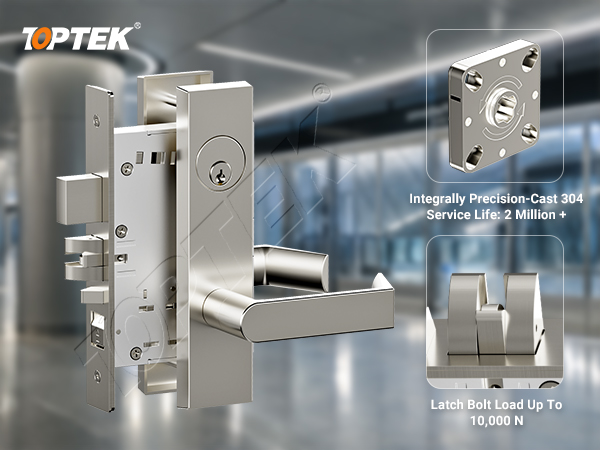
A mortise lock can contain several projecting components with different jobs. The main latchbolt normally participates in routine closing and lever operation. An auxiliary latch, where included, controls a deadlatching feature. A separate deadbolt belongs to another operating sequence. Putting all three under the label “bolt” makes drawings, photographs and service requests harder to interpret.
Start with the full assembly reference and its function description. Record which components are present, their locations on the lock front and the associated strike reference. Do not assume that every function in a product family uses the same combination. The trim appearance also cannot establish the internal function: two doors with similar handles may have different operating requirements.
For the product discussion, identify the proposed assembly within the TOPTEK ANSI mortise lock range. State whether the enquiry concerns a new opening, an existing installation or a replacement strike. Each situation needs different supporting information, although all require a clear lock-to-strike relationship.
Understand why auxiliary contact matters
In a typical auxiliary-deadlatching arrangement, the auxiliary component contacts the intended strike surface as the door closes while the main latch enters its receiving space. That relationship allows the mechanism to perform its designed deadlatching function. The exact component position and contact requirements are product-specific; use the instructions for the supplied configuration rather than a general sketch.
Allegion’s explanation of mortise deadlatching in rescue-strike applications illustrates why the auxiliary trigger’s contact changes main-latch behaviour. That guidance addresses its stated application. It does not establish TOPTEK dimensions, rescue-hardware suitability or an approved combination for a particular project.
For procurement, the useful distinction is between a correctly identified contact relationship and a general statement that the door shuts. A latch can appear to enter the frame while another part of the interface remains unresolved. Ask the competent installer to confirm the arrangement through the manufacturer’s prescribed procedure, and retain the result with the opening record.
Build a lock and strike interface record
Use one record for each distinct combination of lock function, strike and frame preparation. Repeated openings can share a configuration reference, but site differences should remain visible. A door with a different frame profile, stop or preparation should not inherit another opening’s acceptance without review.
| Record item | Information to obtain | Decision it supports |
|---|---|---|
| Lock identity | Complete assembly and function reference | Whether auxiliary deadlatching is present |
| Strike identity | Part number, drawing revision and intended hand | Whether the proposed part matches the lock |
| Receiving geometry | Main latch pocket and auxiliary contact area | Whether each component meets its intended surface |
| Opening condition | Door and frame preparation, closed position and applicable gaps | Whether installed alignment matches the documents |
| Verification | Instruction used, observation, responsible person and outcome | Whether the combination can be released for the project |
Photographs should help locate the opening and identify the parts. Include an overall view and clear views of the lock front and strike. If measurements are needed, use the drawing’s datums and units. A photograph with an angled ruler may help explain a concern, but it should not replace a controlled measurement for ordering or machining.
Keep the ANSI door preparation checklist with the interface record when door machining also needs review. Preparation and deadlatch contact are connected questions, but a complete preparation drawing still needs an installed check.
Review the assembled opening without improvising a repair
First establish that the installed parts match the scheduled references. Record any substitution in the strike, faceplate or lock assembly before interpreting the symptom. A replacement that looks similar can change the relative position of a pocket or contact surface. Ask the supplier to confirm the substitution against the exact assembly rather than approving it by appearance.
Next, have the responsible installer compare the actual closed position with the installation documents. The door leaf, hinges, frame stop and seals help determine where the lock front sits relative to the strike. Describe visible rubbing, uneven positioning or a recent change in closing behaviour without assigning a cause prematurely.
Complete the operating checks specified for the identified function. Record the state before the action, the action performed and the observed result. Keep these checks within the manufacturer’s procedure and the site’s access arrangements. If operation is abnormal, arrange qualified assessment; do not force components or remove a safety-related feature to obtain a convenient result.
An inspection report should distinguish a finding from a proposed remedy. “Strike reference differs from schedule” is a finding. “Replace it with the scheduled part after confirming compatibility” is a proposed action. This distinction helps the buyer request a precise response and prevents an informal observation from becoming an unauthorised modification.
Common mistakes that obscure the problem
The first mistake is using the largest visible opening as the only compatibility check. Main-latch travel and auxiliary contact need their own review. A general statement that there is enough space in the frame does not identify where the auxiliary component should bear.
The second mistake is treating strike lip length as the complete answer. Lip geometry concerns the relationship between the strike and projecting frame surfaces, while auxiliary deadlatching depends on the relevant contact and receiving geometry. One dimension cannot describe the whole interface.
The third mistake is enlarging an opening before confirming the cause. Filing, grinding or relocating hardware changes the installed configuration. Those changes may also affect the door or frame’s documented construction. Obtain the responsible manufacturer’s and project team’s direction before altering parts.
Finally, avoid copying an acceptance result across different functions. A successful test on one sample does not establish that another lock with a different bolt arrangement uses the same strike. Carry the complete assembly designation through the sample record, purchase order and installation schedule.
TOPTEK product scope and evidence for the enquiry
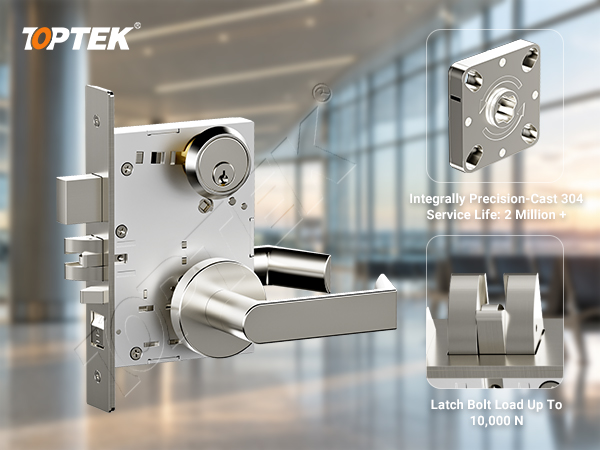
TOPTEK’s current product references include TKAMEC9200 escutcheon trim and TKAMRR9200 round rose trim. These references help identify the proposed appearance and assembly discussion. They should be accompanied by the function, lockcase and strike details before a buyer treats the enquiry as a complete specification.
TOPTEK’s company information describes first-piece, patrol and sampling checks during production. Its quality management information provides context for a discussion about inspection records. For this interface, request the drawing revision and any applicable model-specific verification record rather than relying on a general quality statement.
Why TOPTEK for this discussion? The combination of identifiable mortise product references and manufacturing quality processes gives purchasing a concrete starting point. The useful response is a documented assembly proposal with clear limits. It should say which strike and function have been considered, what opening information was used and what remains to be established on the intended door.
RFQ checklist and control of repeat orders
- Provide the project opening reference and the complete proposed lock function.
- Include lock-front and strike drawings with revisions and units.
- Describe the door, frame, swing and existing preparation.
- Identify the main latch, auxiliary component and any separate deadbolt.
- State whether the enquiry is for a complete assembly or a replacement part.
- Request the applicable installation and inspection information.
- Define quantities, sample requirements and who may accept substitutions.
A distributor ordering repeat stock should keep the confirmed combination under a stable order reference. If the strike supplier changes, compare the new part’s drawing and intended application before adding it to the same stock item. Separate cartons and labels are useful only if they point to an unambiguous configuration.
For broader purchasing requirements, use TOPTEK’s commercial door hardware manufacturing information alongside the product-specific enquiry. Keep manufacturer capability evidence and the alignment decision connected through the named product, instead of allowing a broad capability statement to stand in for interface confirmation.
Frequently asked questions
Is the auxiliary deadlatch the same as the deadbolt?
No. An auxiliary deadlatch controls a deadlatching feature in the applicable lock arrangement. A separate deadbolt has a different operating role. Identify both from the exact function and drawing.
Does every ANSI mortise lock have an auxiliary deadlatch?
Do not assume that it does. Check the complete model and function documentation to establish which components are present and which strike arrangement applies.
Does normal door closing prove correct deadlatch alignment?
No. Closing is one observation. The responsible installer should verify the main latch and auxiliary contact relationship using the instructions for the supplied assembly.
Can a similar-looking strike replace the original?
Only after the proposed replacement has been confirmed for the exact lock, function and opening. Compare the relevant geometry and documents rather than accepting appearance as proof.
What should be sent with an alignment enquiry?
Send the lock and strike references, function, drawing revisions, opening information and clear photographs. Include the observed behaviour and any recent component or door changes.
Request an interface review or a formal quotation
Correct deadlatch alignment starts with identifying the two interacting parts and checking their intended relationship on the assembled opening. Preserve that information through ordering and handover so later substitutions can be assessed against the same record.
Send the lock and strike references for an initial interface discussion. Include the opening photographs and the specific question that needs resolution.
Request a formal mortise lock quotation with the confirmed configuration, quantities, drawings and required documents.