

Why Is an ANSI Mortise Lock Hard to Close? 9 Causes and a Troubleshooting Checklist
Why is an ANSI mortise lock hard to close? If the lock operates smoothly while the door is open but needs a push, pull, lift, or slam before the latch enters the strike, the problem is usually at the interface between the door, frame, hinges, closer, seals, strike, trim, and lock preparation. Replacing the lock before isolating those conditions can waste time and leave the original problem in place.
TL;DR
- First test the lever, latchbolt, deadbolt, key, and trim with the door open.
- If operation is smooth when open but difficult when closed, inspect alignment and closing conditions before blaming the lockcase.
- The most common causes are strike misalignment, hinge sag, closer settings, compressed seals, door warp, distorted preparation, incorrect latch orientation, trim interference, and contamination or wear.
- Do not file the latchbolt or enlarge a fire-door strike opening without checking the approved door-assembly route.
- Record the symptom, contact marks, door gaps, closer condition, trim configuration, and test results before making an adjustment.
- Send the supplier photos, drawings, measurements, model details, function, and a short operating video if the cause remains unclear.
Quick Answer: Is the Lockcase or the Door Causing the Problem?
Open-door testing is the fastest first separation test. If the ANSI mortise lock retracts and returns smoothly with the door open, but the latch rubs, stops, or needs extra force when the door closes, investigate the door-to-frame interface. If the lever, key, latchbolt, or deadbolt remains rough with the door open and the strike is not involved, inspect trim fixing, spindle and cylinder compatibility, lockcase distortion, contamination, lubrication condition, or internal damage.
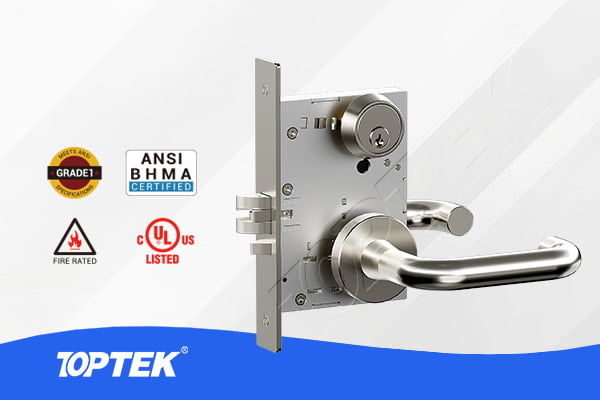
For product context, review the TOPTEK ANSI Grade 1 mortise lock platform. Model selection does not replace a complete door and strike review.
Symptom-to-Cause Diagnostic Table
The symptom pattern usually tells the inspector where to begin. Do not change several components at once; one controlled change preserves the evidence.
| Observed Symptom | Likely Area | First Controlled Check | Buyer Risk |
|---|---|---|---|
| Lock is smooth with the door open but binds at the final closing point | Strike, door gap, hinge or seal | Mark latch contact and compare the latch centreline with the strike opening | Repeated slamming, latch wear and failed positive latching |
| Door latches only when lifted by the lever or handle | Hinge sag or frame movement | Check head and jamb gaps and inspect hinge fixing | Temporary adjustment hides a structural alignment problem |
| Door latches only when pushed or pulled against pressure | Seals, closer or door warp | Observe seal compression and perform an approved closer isolation test | Excessive force, user complaints and unreliable latching |
| Lever or key feels rough even when the door is open | Trim, cylinder, spindle, preparation or lockcase | Loosen and isolate components without operating an unsecured opening | Misdiagnosis and unnecessary strike modification |
| Problem appeared after trim installation or screw tightening | Lockcase distortion or interference | Check through-bolt position, screw torque and pocket clearance | Internal drag and accelerated component wear |
| Problem changes with temperature or humidity | Door movement, seals, finish or contamination | Record site conditions and compare gaps at different times | Intermittent failure that sample-room testing may miss |
Nine Reasons an ANSI Mortise Lock Becomes Hard to Close
1. The strike is too high, low, deep, or shallow
Strike misalignment is the first condition to inspect when the latch operates freely with the door open. A latchbolt that contacts the upper, lower, front, or rear edge of the strike opening must overcome friction before it can retract and enter. Moving the strike without recording the original position can create a new problem, so mark the contact area and compare it with the released door-preparation drawing.
2. The door has dropped on the hinges
Hinge wear, loose fasteners, insufficient reinforcement, or door weight can move the latch centreline after installation. A door that latches only when someone lifts it is giving a useful diagnostic signal. Adjusting the strike alone may make the door work temporarily while leaving the hinge or reinforcement problem unresolved.
3. The door closer does not provide the correct latching action
A closer can create either too little final energy or unnecessarily aggressive closing. Low latching power may leave the latch resting against the strike. Excessive speed or force can create impact, noise, rebound, and wear. Closer adjustment must follow the closer manufacturer’s instructions, accessibility requirements, door size, seals, air pressure, and the approved fire-door configuration.
4. Gaskets, weather seals, or intumescent materials are over-compressed
Seal pressure can make a correctly machined opening feel difficult during the last few millimetres of travel. Confirm whether the door must be pushed against a smoke seal, acoustic gasket, weather seal, or other perimeter material. Do not cut, remove, or relocate fire- or smoke-control materials merely to reduce operating force.
5. Door bevel, frame squareness, gap, or warpage is incorrect
A mortise lock cannot compensate for an opening whose geometry has moved outside the project tolerance. Check hinge-side and lock-side gaps, door bevel, frame twist, leaf warp, and whether the door contacts the frame before the latch reaches the strike. Temperature, humidity, building movement, and installation sequence can change these conditions after sample approval.
6. The lock pocket, faceplate, or fixing screws distort the lockcase
A tight mortise pocket or over-tightened fixing can transfer pressure into the lock body. The faceplate should seat correctly without forcing the case against an uneven pocket wall. Through-bolts and trim fixings must pass through the intended locations and must not clamp moving components. Before changing production machining, compare the released drawing, the approved sample, and the interoperability questions in this ANSI Grade 1 mortise lock buyer guide.
7. The latch orientation or auxiliary latch position is wrong
The latch bevel must face the correct closing direction, and the auxiliary latch must meet the strike as designed. A reversible lock body reduces ordering complexity, but the installed latch still needs the correct orientation and confirmed function. If the auxiliary latch enters an opening where it should remain depressed, the latchbolt may not deadlock as intended.
8. Trim, spindle, cylinder, or cam interference prevents full return
Incorrect spindle length, cylinder projection, cam geometry, rose or escutcheon alignment, and screw position can load the mechanism. Test the actual order configuration, not a bare lockcase. The TKAMRR9200 round-rose trim and TKAMEC9200 escutcheon trim use the same platform logic but require their own released preparation and component review.
9. Debris, inappropriate lubrication, damage, or wear affects movement
Metal chips, wood dust, paint, sealant, incompatible lubricant, transport damage, and worn parts can produce rough operation even before the latch reaches the strike. Do not flood the lockcase with an unapproved lubricant. Record the product model, batch, installation date, environment, maintenance history, and open-door symptom before disassembly or replacement.
Eight-Step Troubleshooting Checklist
- Secure the opening. Follow site safety, access-control, and fire-door procedures before testing or removing hardware.
- Record the exact symptom. Note whether the door needs a push, pull, lift, slam, repeated lever operation, or key assistance.
- Test with the door open. Operate every applicable lever, key, thumbturn, latchbolt, deadbolt, toggle, and override function.
- Identify contact. Use a non-damaging marking method to locate latch, auxiliary-latch, faceplate, seal, or frame contact.
- Inspect the complete opening. Check gaps, hinge security, door sag, frame condition, closer action, seal compression, strike position, and debris.
- Isolate one interface at a time. Follow approved procedures when testing trim, cylinder, spindle, closer, or strike influence.
- Measure and document. Record door dimensions, contact position, operating and closing-force conditions, photos, video, drawing revision, and adjustment.
- Retest every function. After correction, confirm closing, positive latching, deadlocking, key operation, free egress, access control, and fire-door requirements where applicable.
Closing Force, Latch Strength, and ANSI Grade Are Different Questions
Low closing resistance, high latch strength, and ANSI Grade 1 classification describe different performance questions. They should not be merged into one marketing number.
In controlled internal engineering validation, TOPTEK targets approximately 10 N closing force for a correctly aligned TKAM9200 configuration when the auxiliary-latch and latch interface operates under the defined fixture conditions. This is an internal product-development reference, not a published ANSI/BHMA pass-or-fail threshold. Field readings can change with the door mass, closer, seals, air pressure, alignment, measuring point, speed, and test method.
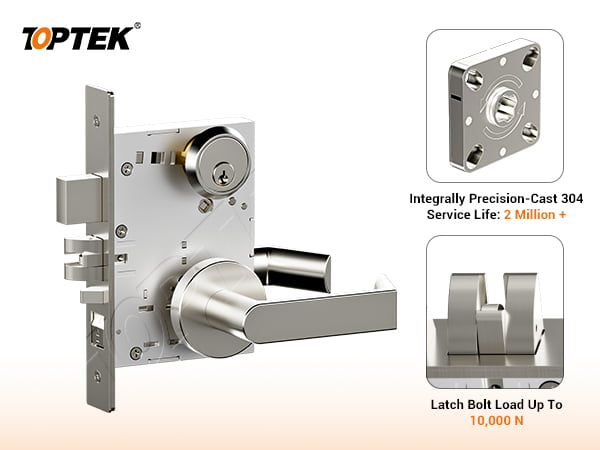
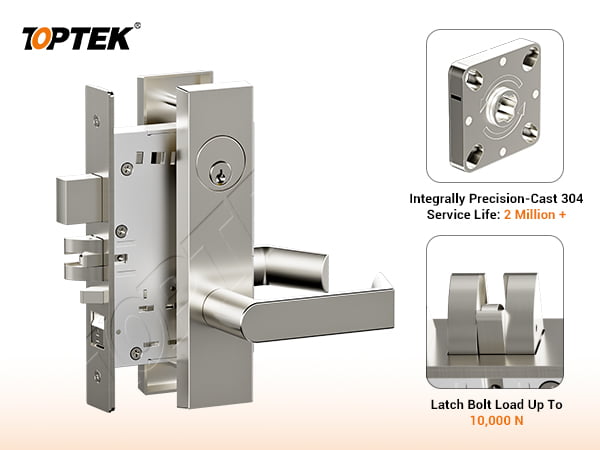
Separately, current TOPTEK product information states more than 2,000,000 mechanical cycles and latchbolt compressive-load resistance up to 10,000 N for the TKAM9200 platform. Buyers should request the controlled test conditions and verify the exact model and configuration. The public BHMA A156.13-2022 overview provides standard context; the full current standard and applicable controlled reports remain the authority for project acceptance.
When Should Troubleshooting Stop for Fire-Door Review?
Stop before making any change that may move a fire-rated opening outside its approved construction or evidence scope. Filing the latch, enlarging or relocating the strike, removing seals or intumescent material, changing fixings, machining a new opening, substituting trim, or changing closer behavior may affect positive latching or the listed assembly.
Check the approved door, frame, lock, trim, strike, closer, seal, installation instruction, listing, report, and authority requirements. ANSI Grade 1 does not by itself establish fire-door approval. Use the TOPTEK certification resource page as a document-review starting point and verify the exact project scope.
Seven Troubleshooting Mistakes That Create More Risk
- Replacing the lock before comparing open-door and closed-door operation.
- Moving the strike before recording contact marks and original dimensions.
- Filing the latchbolt instead of correcting the actual door interface.
- Changing the closer until the door slams hard enough to hide poor alignment.
- Testing a bare lockcase without the order’s trim, cylinder, spindle, and strike.
- Changing several variables at once and losing the evidence of cause and effect.
- Modifying fire-door hardware without checking listing and assembly limitations.
Why TOPTEK for Troubleshooting and Production Control
TOPTEK approaches hard-closing complaints as a system problem that must be separated into product, preparation, installation, door, and operating-condition causes. The review can include configuration checks, released drawings, open-door function testing, door-interface measurements, controlled force checks, retained samples, first-article inspection, and corrective-action retesting.
TOPTEK’s in-house testing capability supports internal engineering validation for durability, strength, function, and related product-development questions. Internal results are identified as internal evidence and are not represented as third-party certification.
The TKAM9200 series supports round-rose and escutcheon trim, multiple ANSI functions, a 2-3/4 in. (70 mm) backset, 3-5/8 in. (92 mm) lever-to-cylinder centres, and standard 1-3/4 in. (44.5 mm) door thickness according to current public product data. The released project drawing and approved configuration remain the production authority.
Buyer Checklist Before Approving an Adjustment
- Exact lock model, function, trim, cylinder, strike, finish, and drawing revision
- Door and frame material, door thickness, handing, bevel, gaps, and reinforcement
- Whether the symptom occurs with the door open, nearly closed, or fully closed
- Latch and auxiliary-latch contact marks relative to the strike opening
- Hinge condition, door sag, closer model and settings, seals, and air pressure
- Trim-fixing, spindle, cylinder, cam, faceplate, and pocket-clearance checks
- Fire-door, egress, accessibility, access-control, and local inspection constraints
- Corrective action, responsible person, retest result, approval, and change control
RFQ and Troubleshooting Information to Send
A useful supplier review needs evidence from the installed opening, not only the sentence “the lock is hard to close.” Send:
- Target market, project type, door ID, required standard, and fire-door expectation
- Lock model, function, batch or order reference, trim, cylinder, cam, spindle, strike, and finish
- Door and frame material, thickness, backset, centres, handing, bevel, closer, hinge, and seal information
- Released lock, door, frame, and strike drawings with revision numbers
- Clear photos of the door gaps, hinges, faceplate, latch, strike, trim, and contact marks
- A short video showing open-door operation and the complete closing symptom
- Measurements, site conditions, frequency, affected quantity, changes already attempted, and required delivery date
FAQ: ANSI Mortise Lock Closing Problems
Why does my mortise lock work with the door open but not when it is closed?
The pattern normally points to the door-to-frame interface. Check strike alignment, hinge sag, door gaps, closer action, seal pressure, door warp, and latch contact before replacing the lockcase.
Should I file the latchbolt or enlarge the strike opening?
Not as a first response. Identify and document the real cause before removing material. On a fire-rated opening, any modification must remain within the approved assembly, listing, installation instructions, and authority requirements.
Can a door closer make a mortise lock hard to latch?
Yes. Insufficient final latching action may leave the latch against the strike, while excessive speed or force can cause impact and rebound. Adjust the closer only through an approved procedure.
Does an ANSI Grade 1 lock prevent strike and door-alignment problems?
No. ANSI Grade 1 addresses defined product-performance requirements. The installed opening still depends on correct door preparation, hinges, frame, strike, closer, seals, trim, cylinder, and maintenance.
What does TOPTEK’s approximately 10 N closing-force reference mean?
It is an internal engineering reference for a correctly aligned TKAM9200 configuration under defined fixture conditions. It is not a public ANSI/BHMA acceptance threshold, and field results depend on the complete door system and test method.
What should I send TOPTEK for a troubleshooting review?
Send the model, function, drawing revisions, door and frame data, trim, cylinder, strike, closer, hinge and seal information, photos, measurements, contact marks, and a video of both open-door operation and the closing symptom.
Conclusion: Diagnose the Opening Before Replacing the Lock
When an ANSI mortise lock is hard to close, separate the lockcase from the installed-door conditions before deciding on the correction. A controlled open-door test, contact record, door-gap review, and one-variable-at-a-time troubleshooting process can reveal whether the cause is the strike, hinges, closer, seals, preparation, trim, cylinder, contamination, or the lock itself.
For a low-friction first review, email ivan.he@toptekaccess.com with several photos and a short video, even if the full door schedule is not ready. For a complete configuration or quotation, use the TOPTEK project inquiry form and send the RFQ information above. TOPTEK can return missing-information questions, a model and drawing review, a proposed test route, and a quotation.
Written by Ivan He, General Manager, Zhongshan Toptek Security Technology Co., Ltd.
TOPTEK is your Commercial Door Hardware Reliability Solution.