
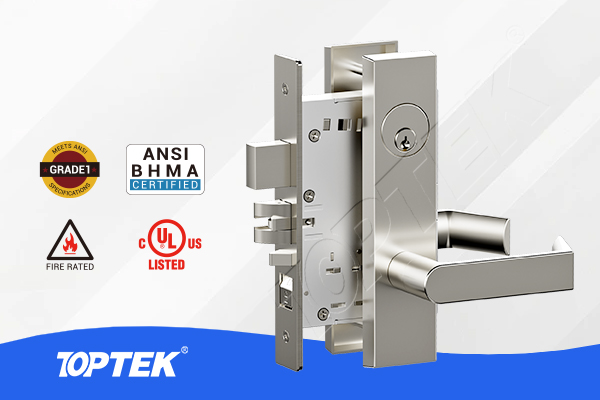

ANSI Grade 1 Mortise Lock Sample Approval Checklist: 12 Tests Before Mass Production
An ANSI Grade 1 mortise lock sample approval checklist should verify more than whether one sample can lock and unlock. Before mass production, buyers should freeze the exact function, operational behavior, dimensions, trim, cylinder, strike, finish, test conditions, compliance route, packaging, inspection plan, and change-control record. A sample that works on a bench can still fail on the real door or become inconsistent during volume production.
TL;DR
- Approve the complete configuration, not an unidentified lockcase sample.
- Test function, operating force, durability, strength, lever return, cylinder operation, door preparation, finish, fire-door scope, and packaging.
- Use ANSI/BHMA A156.13 as the performance framework, but keep internal validation separate from third-party certification.
- Record the drawing revision, sample ID, test conditions, result, approver, and permitted production changes.
- Use first-article inspection and pilot-production checks to connect the approved sample to the production batch.
- Do not release mass production until unresolved failures have a corrective action and a passed retest.
Quick Answer: What Must Be Approved Before Mass Production?
Buyers should approve four connected items: the product specification, the functional sample, the evidence package, and the production-control plan. The approval should identify the manufacturer, model, function, trim, cylinder, strike, handing logic, door thickness, backset, finish, fire-door expectation, packaging, drawing revision, and acceptance tests.
If your project file is incomplete, send TOPTEK the door schedule, application, function, trim, cylinder, target standard, door drawing, quantity, and required documents. The engineering team can identify missing approval checkpoints before a final sample plan or quotation is issued.
Why a Working Bench Sample Is Not Enough
A bench test proves only the conditions used during that test; it does not automatically prove door compatibility or repeatable production quality.
Real installations introduce door weight, closer force, door and frame tolerances, bevel, strike alignment, trim fixing, cylinder projection, environmental exposure, and user behavior. Production introduces additional variation in materials, stamping, machining, casting, plating, assembly, lubrication, packaging, and inspection.
The approval process therefore needs two questions:
- Does this exact sample meet the project requirement?
- Can the factory reproduce the approved result across the production batch?
Use ANSI/BHMA A156.13 as the Test Framework
ANSI/BHMA A156.13 gives buyers a structured framework for evaluating mortise locks and latches. BHMA’s public A156.13-2022 overview identifies operational, strength, security, cycle, finish, and dimensional criteria. It also states that Grade 1 mortise locks must complete 1,000,000 opening-and-closing cycles with a 10-pound load.
Review the official BHMA A156.13-2022 Hardware Highlights for public context, then use the full standard and applicable controlled reports for the complete requirements.
The 12-Point ANSI Grade 1 Mortise Lock Sample Approval Checklist
Each approval point should have a defined method, acceptance result, retained record, and responsible approver.
1. Freeze the model, function, and drawing revision
Record the lock model, ANSI function, trim type, lever design, cylinder, strike, door thickness, backset, finish, handing logic, and drawing revision. Label the sample with the same identifiers. A passed sample cannot control production if the factory and buyer are referring to different revisions.
2. Verify the complete functional sequence
Test the outside lever, inside lever, key, thumbturn, toggle, deadbolt, latchbolt, auxiliary latch, emergency override, and free-egress behavior applicable to the selected function. Confirm locked and unlocked states in writing rather than relying only on the function number.
3. Check operating force and smooth latch movement
Operate the lock repeatedly with the selected trim and cylinder. Check latch retraction, deadbolt movement, key torque, lever torque, closing behavior, friction, noise, and return. Excessive force can indicate interference, poor alignment, spring problems, or tolerance accumulation.
4. Define the mechanical durability test
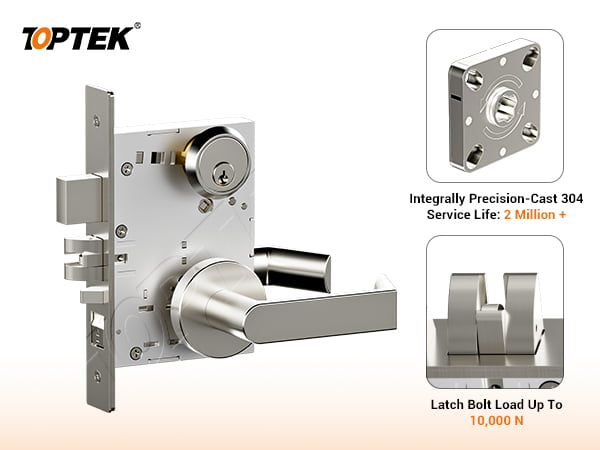
State the cycle target, applied load, test fixture, operating speed, function, lubrication condition, inspection intervals, failure criteria, and post-test checks. TOPTEK’s current TKAM9200 product data states more than 2,000,000 mechanical cycles in internal testing. Buyers should request the controlled report and conditions for the exact configuration under review.
5. Evaluate latchbolt, deadbolt, and locked-trim strength
Check the required load and security tests for the project. Inspect deformation, cracking, withdrawal, incomplete engagement, and operation after loading. TOPTEK’s current product data states latch compressive resistance up to 10,000 N; this is a product-performance statement that should be matched to the applicable test record.
6. Confirm lever return and spring stability
Check lever return before, during, and after endurance testing. Measure sag, free play, loose fixing, incomplete latch retraction, and return consistency. TOPTEK uses precision investment-casting logic for the lever-return spring structure to support long-term stability.
7. Test cylinder, keying, and override compatibility
Install the actual mortise cylinder, SFIC, keyway, cam, ring, and keying arrangement planned for the order. Check projection, rotation, key withdrawal, outside access, emergency override, master-key logic, and interference with the trim or lockcase.
8. Trial the lock on the real door preparation
Verify the door thickness, backset, lever-to-cylinder centres, pocket, faceplate, trim holes, spindle, cylinder projection, strike, bevel, frame preparation, and handing. For the TKAM9200 platform, current catalog references include a 2-3/4 in. (70 mm) backset, 3-5/8 in. (92 mm) lever-to-cylinder centres, and standard 1-3/4 in. (44.5 mm) door thickness. The released drawing remains the production authority.
9. Approve finish, corrosion route, and appearance limits
Approve a physical finish reference and define acceptable color, gloss, texture, plating, coating, scratches, stains, corrosion, and batch variation. Match corrosion testing to the target market and project environment. Coastal, humid, chemical, and high-cleaning-frequency applications may require different expectations.
10. Verify the fire-door and compliance document route
ANSI Grade 1 does not automatically mean UL 10C fire rated. Where the opening is fire rated, verify the applicable listing, duration, lock model, function, trim, strike, door and frame construction, installation conditions, and limitations. The complete assembly must remain within its approved route.
11. Test packaging and transport protection
Confirm component separation, surface protection, cylinder and key control, accessory count, label accuracy, carton strength, moisture protection, drop risk, and pallet method. Packaging approval is part of product approval because damaged trim, bent faceplates, mixed accessories, or missing strikes can stop installation.
12. Connect the approved sample to FAI and pilot production
Define first-article inspection, critical dimensions, functional checks, sample size, inspection frequency, retained master sample, batch traceability, nonconformance handling, and change approval. Run a pilot batch when risk justifies it. Any material, drawing, supplier, tooling, plating, or process change that may affect performance should trigger documented review.
Sample Approval Record: What the File Should Contain
A usable approval file allows another engineer or quality inspector to reproduce the decision.
| Record | Required Detail | Purpose |
|---|---|---|
| Configuration sheet | Model, function, trim, cylinder, strike, finish, door data | Prevents wrong-sample approval |
| Controlled drawing | Number, revision, approval date, critical dimensions | Controls machining and fit |
| Test plan | Method, fixture, conditions, sample quantity, acceptance criteria | Makes results repeatable |
| Test record | Results, photos, observations, failures, corrective actions, retest | Shows evidence and closure |
| Compliance matrix | Claim, applicable standard, document, model scope, limitation | Controls overstatement |
| Production control plan | FAI, in-process and final checks, frequency, traceability | Connects sample to batch |
| Approval signatures | Buyer, engineering, quality, supplier, and date | Defines decision ownership |
How TOPTEK Supports Sample-to-Production Control
TOPTEK supports ANSI Grade 1 mortise lock projects through configuration review, drawings, sample validation, internal testing, first-article inspection, process inspection, assembly checks, and final verification.
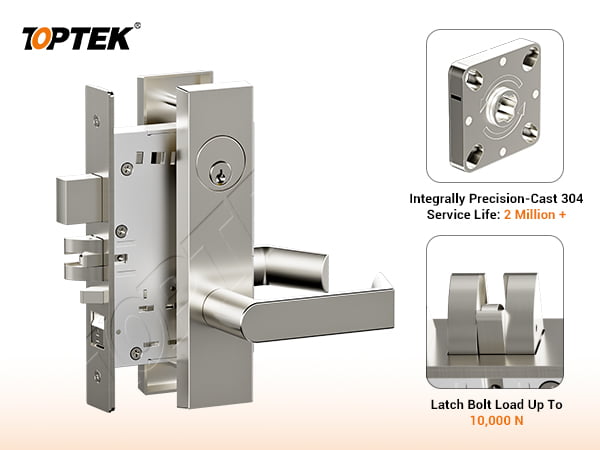
The TOPTEK ANSI Grade 1 mortise lock category includes TKAMRR9200 round-rose trim and TKAMEC9200 escutcheon trim. Buyers should select the exact function, lever, thumbturn, ring, cylinder, strike, finish, and door preparation before approving the master sample.
TOPTEK’s in-house testing capability supports engineering validation before production and third-party routes where required. The public certification resource page provides a starting point for controlled document review.
Seven Sample-Approval Mistakes to Avoid
Approval risk increases when the sample, documents, and production specification are not controlled as one package.
- Approving an unlabeled sample without a drawing revision.
- Testing only lock and unlock, without checking the complete function sequence.
- Using internal validation as if it were third-party certification.
- Testing the lockcase without the actual trim, cylinder, strike, and door.
- Ignoring finish, corrosion, packaging, and transport risk.
- Allowing production changes without written buyer approval.
- Releasing mass production before failed items have passed a documented retest.
RFQ Checklist for Sample Approval Planning
A supplier can prepare a useful sample plan only when the RFQ identifies the application and acceptance route. Send:
- Target market, standard edition, operational grade, security grade, and fire-door expectation
- Door schedule, door and frame material, thickness, handing, bevel, and closer information
- Function code plus a written inside/outside operation description
- Backset, centres, trim, lever, cylinder, keyway, strike, and finish
- Required drawings, certificates, test reports, labels, and submittal format
- Sample quantity, test plan, acceptance criteria, annual volume, packaging, and delivery target
FAQ: ANSI Grade 1 Mortise Lock Sample Approval
Is one working sample enough to approve mass production?
No. Buyers should also approve the controlled specification, drawing revision, evidence package, test plan, packaging, inspection criteria, and change-control process.
Which standard should guide ANSI mortise lock sample testing?
ANSI/BHMA A156.13 is the principal performance framework for mortise locks and latches. Use the current full standard and applicable project documents for exact requirements.
Does internal cycle testing prove third-party certification?
No. Internal testing supports engineering validation and quality control. Third-party certification requires a controlled document that covers the exact product and stated scope.
Should the actual cylinder and trim be included in the sample test?
Yes. The selected cylinder, cam, keying, trim, spindle, fixing, strike, and door preparation can change function, operating force, alignment, and installation results.
What happens if the supplier changes a component after approval?
The change should be documented and reviewed for fit, function, performance, appearance, compliance, and production risk. Retesting should be required when the change can affect the approved result.
What can TOPTEK return after reviewing an RFQ?
TOPTEK can return configuration questions, drawing checkpoints, an applicable document route, a proposed sample and test plan, missing RFQ information, and a quotation.
Conclusion: Approve the Product and the Production Process
An effective ANSI Grade 1 mortise lock sample approval checklist connects product performance to the real door and connects the approved sample to repeatable production controls. The buyer should know exactly what was tested, under which conditions, against which drawing, with which components, and how the factory will reproduce the result.
Email ivan.he@toptekaccess.com or use the TOPTEK project inquiry form. Send the door schedule or door photo, target market, standard, function, trim, cylinder, door thickness, backset, finish, fire-door expectation, sample quantity, annual volume, and required documents. TOPTEK can return a TKAM9200 configuration review, drawing questions, sample plan, document route, and quotation.
TOPTEK: Smart Design. Strong Security.