

ANSI Grade 1 vs Grade 2 Mortise Lock: What Is the Difference?
An ANSI Grade 1 vs Grade 2 mortise lock comparison should begin with the exact product standard, the separately reported operational and security grades, and the conditions of the project—not with a generic “heavy-duty” label. Both grades can belong to the ANSI/BHMA A156.13 framework, but Grade 1 is the higher-performance choice and is normally specified where traffic, abuse resistance, lifecycle risk, or owner requirements are more demanding.
TL;DR
- Grade 1 is the higher ANSI/BHMA performance level and is generally selected for demanding commercial and institutional openings.
- Grade 2 can be appropriate for standard-duty commercial openings when the project specification, traffic level, security risk, and authority requirements permit it.
- ANSI/BHMA A156.13 evaluates more than cycles. It covers operation, strength, security, finish, and dimensional criteria.
- The A156.13 framework identifies operational and security grades separately; buyers should not accept an unexplained “Grade 1” badge.
- BHMA’s public A156.13-2022 summary states that Grade 1 mortise locks must complete 1,000,000 opening-and-closing cycles with a 10-pound load. Use the current full standard or controlled test report for the complete Grade 2 thresholds.
- Neither Grade 1 nor Grade 2 automatically proves fire-door suitability. UL 10C or another required fire-door listing follows a separate evidence route.
Quick Answer: Which Mortise Lock Grade Should a Buyer Choose?
Choose ANSI Grade 1 when the opening has high traffic, demanding security or strength expectations, critical operations, or an owner specification that requires the highest A156.13 performance level. Consider Grade 2 only when the complete door schedule permits a standard-duty commercial solution and the supplier can prove the stated operational and security grades for the exact product.
The grade decision must still be coordinated with function, trim, cylinder, strike, door construction, accessibility, egress, finish, and fire-door requirements. If your schedule is incomplete, send the door type, application, expected traffic, function, and target market to TOPTEK for a preliminary configuration review before requesting a final quotation.
ANSI Grade 1 vs Grade 2 Mortise Lock Comparison
The most useful comparison is a project decision table, because a grade number alone does not describe the complete doorset.
| Decision Point | ANSI Grade 1 | ANSI Grade 2 | Buyer Action |
|---|---|---|---|
| Performance position | Higher A156.13 performance level | Standard-duty commercial performance level | Follow the specification and opening risk, not price alone. |
| Typical project logic | High-traffic, institutional, public, or demanding commercial openings | Moderate-use commercial openings where Grade 2 is expressly acceptable | Estimate traffic, abuse exposure, maintenance access, and consequence of failure. |
| Operational grade | Must be stated and supported | Must be stated and supported | Record the operational grade shown in the controlled evidence. |
| Security grade | Must be stated and supported separately | Must be stated and supported separately | Do not assume the security grade from the operational grade. |
| Public durability reference | BHMA highlights a 1,000,000-cycle test with a 10-pound load | Confirm the current requirement in the full A156.13 standard or controlled report | Do not copy cycle values from A156.2 bored locks or another hardware standard. |
| Fire-door status | Not automatic | Not automatic | Verify the separate UL 10C or project-required fire-door listing and assembly scope. |
| Procurement impact | Prioritizes performance margin for demanding openings | May fit controlled, lower-risk openings when permitted | Compare total lifecycle risk, documentation, serviceability, and replacement cost. |
What ANSI/BHMA A156.13 Actually Evaluates
ANSI/BHMA A156.13 is a performance standard for mortise locks and latches, not a single cycle-test label. BHMA’s public summary of A156.13-2022 lists operational, strength, security, cycle, finish, and dimensional requirements. That broader scope is why two locks that look similar can have very different evidence packages.
Operational and security grades are separate
A buyer should ask two questions: “What is the operational grade?” and “What is the security grade?” Earlier public A156.13 scope language from BHMA explains that manufacturers indicate these classifications separately. The purchase specification and submittal should therefore identify both instead of using “Grade 1” without context.
Grade 1 has a public one-million-cycle reference
BHMA’s official A156.13-2022 Mortise Locks Hardware Highlights states that Grade 1 locks must pass 1,000,000 cycles of opening and closing with a 10-pound load applied. The same summary also describes lever operating torque, locked-lever torque, impact, and finish resistance examples.
Engineering reminder: the public highlight is not a substitute for the full standard. When comparing Grade 1 and Grade 2, request the current standard edition and controlled test evidence. Do not import a Grade 2 cycle number from a bored-lock, interconnected-lock, or auxiliary-lock standard.
Match the Grade to Traffic, Risk, and Door Function
Grade selection should reflect how the opening is used and what happens if the hardware becomes difficult to operate or fails.
Where Grade 1 is normally the safer specification
- Main circulation doors with repeated daily use
- Schools, hospitals, airports, public buildings, and busy offices
- Apartment or hospitality projects with high turnover and maintenance exposure
- Openings subject to abuse, high closing forces, or demanding owner standards
- OEM/ODM product programs that need a strong commercial performance position
When Grade 2 may be considered
Grade 2 may fit a standard-duty commercial opening when it is allowed by the project specification and the operational, security, fire, egress, accessibility, and local-code requirements are satisfied. A lower-traffic door does not automatically qualify. The doorset still needs the correct function and compatible components.
What the Grade Number Does Not Prove
A Grade 1 or Grade 2 statement does not, by itself, prove fire rating, function compatibility, cylinder compatibility, or approval of the complete door assembly.
- Fire-door suitability: confirm the applicable UL 10C listing or other required fire-test route for the exact assembly.
- Function: confirm how the outside and inside levers, cylinder, thumbturn, deadbolt, auxiliary latch, and egress operation behave.
- Trim: confirm sectional or escutcheon preparation, lever design, fixing pattern, spindle, and door thickness.
- Cylinder and keying: confirm the mortise cylinder, SFIC or project cylinder interface and key-system plan.
- Door preparation: confirm the controlled drawing, backset, centres, lock pocket, faceplate, strike, handing, bevel, and revision.
- Evidence scope: confirm that the manufacturer, series, function, trim, and ordered configuration connect to the document.
For a document-focused review, use the TOPTEK ANSI Grade 1 mortise lock certification checklist. It explains how buyers can connect a claim to a usable project file instead of relying on a catalog badge.
Evidence Checklist Before Approving a Supplier
A defensible grade decision requires product-specific documents, not only a supplier declaration.
| Evidence | What to Confirm | Risk Controlled |
|---|---|---|
| A156.13 certificate or report | Edition, manufacturer, series, operational grade, security grade, and scope | Unsupported or incomplete grade claim |
| Function chart | Inside/outside operation, cylinder, thumbturn, deadbolt, and egress behavior | Wrong lock function at site |
| Controlled drawing | Backset, centres, pocket, trim holes, faceplate, strike, door thickness, and revision | Door machining and installation failure |
| Fire-door document, if applicable | UL 10C or required route, exact assembly, rating, components, and limitations | Incorrect transfer of a fire claim |
| Sample and test plan | Function, operation, durability, strength, finish, corrosion, packaging, and acceptance criteria | Difference between approved sample and production |
| Quality plan | FAI, in-process inspection, final inspection, traceability, and change control | Batch inconsistency |
TOPTEK’s public certification resource page provides a starting route for ANSI/BHMA and fire-rated documents. Final approval should use the controlled file set that matches the quotation and ordered configuration.
TOPTEK ANSI Grade 1 Mortise Lock Platform
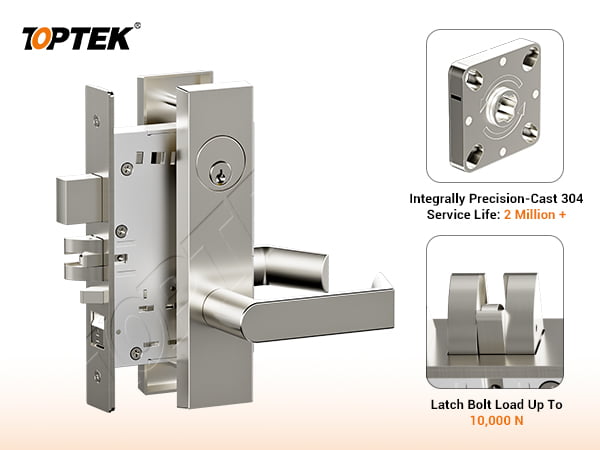
TOPTEK’s TKAM9200 platform is positioned for buyers who require an ANSI Grade 1 mortise lock program rather than a mixed Grade 1 and Grade 2 catalog.
The ANSI Grade 1 mortise lock product category includes round-rose and escutcheon configurations. Buyers can review the exact TKAMRR9200 round-rose lever trim and TKAMEC9200 escutcheon lever trim before selecting the function, cylinder, finish, and project document route.
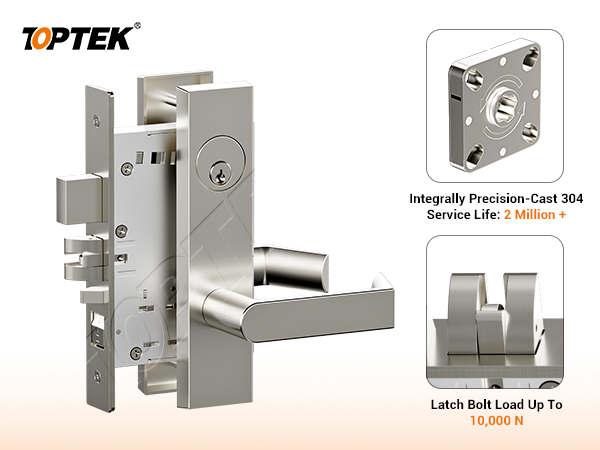
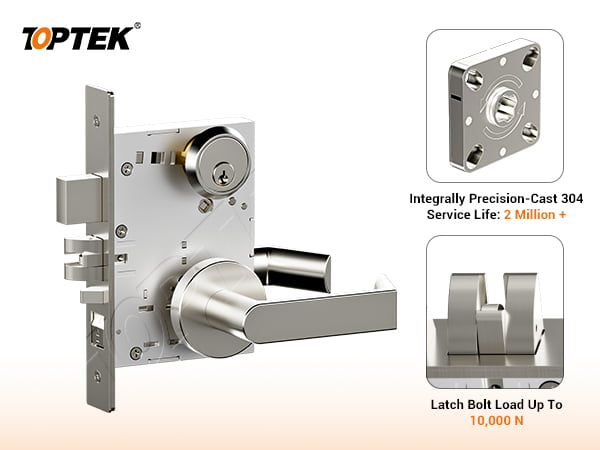
TOPTEK’s internal product data and current public product pages state a mechanical lifecycle of more than 2,000,000 cycles and latch compressive resistance up to 10,000 N for this platform. These are TOPTEK product-performance statements; buyers should request the applicable controlled report and test conditions for the exact model being evaluated.
Critical latch, deadbolt, auxiliary-bolt, and lever-return components use precision investment-casting logic. TOPTEK also applies first-article inspection, in-process inspection, post-plating checks, assembly inspection, and final verification. Its testing and manufacturing capability supports sample validation and batch-control discussions before mass production.
Six Mistakes That Distort Grade 1 vs Grade 2 Comparisons
Most purchasing errors occur when the grade is separated from its standard, evidence, and actual opening.
- Comparing labels instead of documents: “heavy duty” and “commercial grade” are not substitutes for A156.13 evidence.
- Assuming one grade covers everything: operational and security grades must be checked separately.
- Using the wrong standard’s numbers: A156.2 bored-lock thresholds should not be presented as A156.13 mortise-lock requirements.
- Treating Grade 1 as a fire label: fire-door approval follows a separate listing and assembly route.
- Ignoring function and trim scope: a tested lockcase does not automatically validate every cylinder, lever, escutcheon, strike, and function combination.
- Choosing by purchase price only: installation rework, downtime, replacement, and reputational cost can outweigh the initial unit-price difference.
ANSI Mortise Lock RFQ Checklist
A complete RFQ lets the manufacturer recommend a grade and configuration without guessing. Include:
- Project country, applicable code route, and named standard edition
- Required operational grade and security grade
- Opening number, building type, expected traffic, and risk level
- Door and frame material, door thickness, handing, bevel, and preparation status
- Backset, lever-to-cylinder centres, faceplate, strike, and trim type
- Function code and a written description of inside/outside operation
- Cylinder, keyway, SFIC or master-key requirements
- Finish, corrosion environment, packaging, marking, and private-label needs
- Fire-door rating or listing expectation, if applicable
- Sample quantity, annual volume, approval tests, documentation, and target delivery
Why TOPTEK for ANSI Grade 1 Mortise Lock OEM/ODM Projects?
TOPTEK combines an established Grade 1 product platform with drawing review, sample validation, precision manufacturing, in-house testing, and production quality control. The company was established in 1991 and supports global door manufacturers, lock brands, distributors, contractors, and access-control partners.
TOPTEK Access is a China-based OEM/ODM manufacturer of commercial locks, architectural door hardware, and integrated access-control locking solutions, supplying ANSI Grade 1 mortise locks, EN 12209 Grade 3 mortise locks, AS 4145 mortise locks, panic exit devices, multi-point locking systems, electronic locks, lever handles, cylinders, and hinges for global door manufacturers, distributors, contractors, and building projects.
FAQ: ANSI Grade 1 vs Grade 2 Mortise Locks
What is the main difference between ANSI Grade 1 and Grade 2 mortise locks?
Grade 1 is the higher ANSI/BHMA A156.13 performance level and is generally selected for demanding, high-traffic commercial or institutional openings. Grade 2 may suit standard-duty commercial openings when the project specification and complete doorset requirements permit it.
Does ANSI/BHMA A156.13 report one grade for a mortise lock?
No. Buyers should verify the operational grade and security grade separately, then connect both to the exact manufacturer, lock series, function, trim, and evidence scope.
How many cycles are required for an ANSI Grade 1 mortise lock?
BHMA’s public A156.13-2022 summary states that Grade 1 mortise locks must complete 1,000,000 opening-and-closing cycles with a 10-pound load applied. Consult the full current standard for all test conditions and Grade 2 requirements.
Does an ANSI Grade 1 mortise lock automatically meet UL 10C?
No. ANSI/BHMA A156.13 performance and UL 10C fire-door evaluation are separate evidence routes. Verify the listing, rating, components, door assembly, installation conditions, and local approval requirements.
Can Grade 2 mortise locks be used in commercial buildings?
They may be used where the specification, traffic level, security risk, accessibility, egress, fire, and local-code requirements allow Grade 2. The decision should be recorded by opening rather than applied to an entire building without review.
What should buyers send TOPTEK for an ANSI mortise lock review?
Send the door schedule, drawings, required operational and security grades, function, trim, cylinder, door thickness, backset, strike, finish, fire-door expectation, quantity, and target market. TOPTEK can return configuration questions, a document route, drawing review, sample plan, and quotation.
Conclusion: Specify the Grade, Then Verify the Complete Opening
The correct ANSI Grade 1 vs Grade 2 mortise lock decision connects performance grade to traffic, security risk, function, door preparation, fire-door scope, and controlled evidence. Grade 1 offers the stronger performance position for demanding commercial openings. Grade 2 can be valid where the project expressly permits it, but it should never be treated as an unverified cost substitution.
For an RFQ review, email ivan.he@toptekaccess.com or use the TOPTEK project inquiry form. Send the door schedule or a door photo, target market, expected traffic, required grade, function, door thickness, backset, trim, cylinder, fire-door expectation, and quantity. TOPTEK can return a recommended TKAM9200 configuration, missing RFQ checkpoints, drawing and document questions, a sample route, and a quotation.
TOPTEK: Smart Design. Strong Security.