

Automatic Multipoint Lock System: How It Works and What Door Manufacturers Must Check
An automatic multipoint lock system can project several locking points when the door closes, but reliable operation depends on far more than the lock case. Trigger position, strike geometry, door alignment, gasket compression, profile space and the straightness of the long faceplate all influence whether the sequence works on every door. This guide gives door manufacturers a practical method for reviewing the mechanism, building a representative sample and controlling the approved configuration in production.
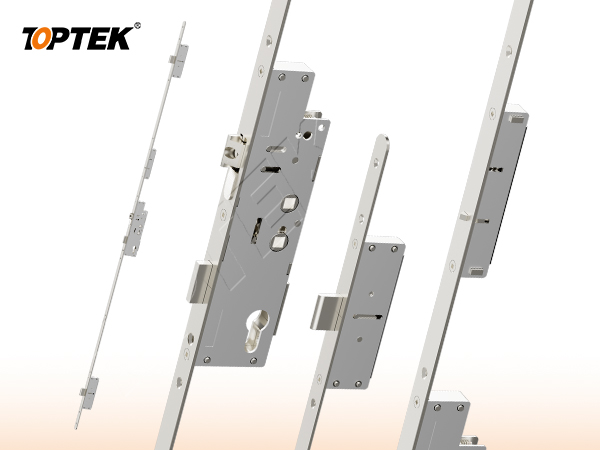
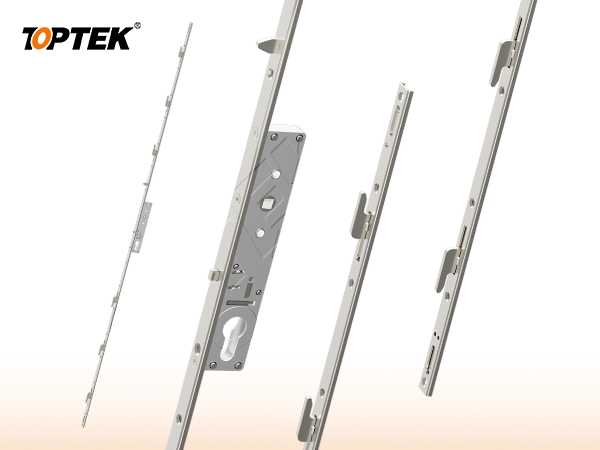
For product context, start with TOPTEK’s multi-point locking systems range. Then treat the selected lock, door leaf, frame and keeps as one interacting system rather than four separate purchases.
TL;DR
An automatic multipoint lock should release its locking points only after the door reaches the intended closed position, and it must repeat that sequence under realistic door and frame conditions.
- Automatic engagement is a mechanical operating sequence; it does not by itself prove electrical control, panic escape, fire performance or third-party certification.
- Approve the trigger, strike positions, backset, centres, faceplate, remote-lock coordinates and door preparation as one controlled drawing set.
- Test with the intended profile, gasket, hinges, closer, cylinder and handles—not only with the lock lying on a bench.
- Protect long multipoint assemblies against bending during handling and shipment, then inspect straightness at incoming control.
- Do not release mass production until a representative door sample passes an agreed operating-sequence checklist.
Quick Answer: How Does an Automatic Multipoint Lock System Work?
When the door closes, a trigger or auxiliary latch meets the frame-side component and releases the mechanism, allowing the central and remote locking points to project. Unlocking retracts the locking points and resets the mechanism for the next closing cycle. The exact deadlocking, handle and cylinder sequence varies by model, so the buyer must approve a written function description instead of assuming that all “automatic” locks behave alike.
Key Takeaways for Door Manufacturers
The door manufacturer controls many of the interfaces that decide whether the lock will trigger at the correct time.
- Freeze the intended operating sequence before finalizing the door machining.
- Reference every lock and keep position from common door and frame datums.
- Validate the worst credible gasket pressure and alignment condition.
- Record sample settings so production does not depend on installer adjustment alone.
- Separate internal validation, supplier declarations and independent certification in the approval file.
What Is an Automatic Multipoint Lock System?
It is a door-edge locking assembly in which closing action triggers more than one locking point without requiring the user to lift the handle or turn the key to project those points. A central lock case coordinates with remote hooks, bolts or other locking elements through a long faceplate or connecting mechanism. The word “automatic” describes the engagement sequence; it should not be treated as a promise about every other function.
The mechanism can reduce the chance that a user leaves a door held only by a latch. It can also support engagement along the door height. However, those benefits exist only when the trigger reaches its designed position, the remote locking points meet their keeps, and the door closes against the actual seals without excessive resistance.
Early engineering CTA: Send TOPTEK the door profile section, door height, handing and required inside/outside operation before tooling or machining is frozen. A sequence review can expose interface risks while changes are still inexpensive. Email ivan.he@toptekaccess.com.
Automatic Multipoint Lock Operating Sequence
A useful approval document describes the whole closing, triggering, locking, unlocking and reset sequence in observable steps. The following sequence is typical, but the selected model’s approved drawing and function statement remain controlling.
1. The door approaches the frame
The latch, trigger and remote points should be in their reset positions. Hinges, closer speed, door mass and seal pressure determine how the leaf reaches the final closing zone. If the door stops short, an otherwise correct lock cannot complete its sequence.
2. The latch and trigger meet their frame interfaces
The latch enters its opening while the trigger or auxiliary element contacts the intended strike surface. This interface must be positioned carefully. A trigger that releases too early can project locking points before they are aligned with their keeps; one that is too far from the strike may never release.
3. The automatic mechanism releases
Once the trigger reaches the designed travel, stored mechanical movement is released through the central case and linkage. Door manufacturers should verify that normal dimensional variation does not put the release point at the edge of its usable range.
4. Central and remote locking points project
Hooks, deadbolts or auxiliary points move toward their frame keeps. Their coordinate positions and available clearances matter across the full door height. A single misaligned keep can increase resistance, interrupt travel or make the door appear locked when one point has not fully engaged.
5. Any secondary deadlocking function is applied
Some configurations use a cylinder or another action after automatic engagement. Others use a different deadlocking logic. Therefore, “the points came out” and “the door has reached the specified security state” are not always identical statements. Approve both conditions separately.
6. Unlocking retracts and resets the system
The permitted inside and outside actions must retract the required points and reset the trigger for the next closing cycle. Test each authorized operation, including key, thumbturn, handle or access-control interface when they are actually part of the selected configuration. Do not infer escape or electrically controlled behavior from the term automatic.
Automatic vs Lift-Lever vs Cylinder-Driven Multipoint Locks
The three mechanical architectures differ mainly in what action projects the locking points and what the user must do after closing. This distinction should appear in the product specification and sample checklist.
| Architecture | How locking points project | Primary integration risk | Buyer must confirm |
|---|---|---|---|
| Automatic | Closing activates a trigger and releases the points | Trigger timing and keep alignment | Closed position, release point and secondary deadlocking sequence |
| Lift-lever | The user lifts the handle to project the points | Operating effort, handle travel and user behavior | Lift direction, cylinder deadlocking and retraction sequence |
| Cylinder-driven | The key or cylinder action drives the points | Cylinder travel, torque and function selection | Turns, key withdrawal, inside/outside access and emergency requirements |
What Door Manufacturers Must Check Before Approval
The safest approach is to approve the lock, door preparation and frame-side keeps in one interface-control package. The table below turns that principle into reviewable evidence.
| Check | Why it matters | Approval evidence |
|---|---|---|
| Door profile and lock pocket | The case, linkage and fasteners need clearance without weakening or distorting the profile. | Section drawing, pocket dimensions and screw locations |
| Backset, handle/cylinder centres and handing | Incorrect interfaces can make the selected trim or cylinder unusable. | Signed dimensional drawing and hardware schedule |
| Trigger and strike geometry | It determines when the automatic mechanism releases. | Door-closed section, trigger travel and strike position |
| Remote lock and keep coordinates | Several points must enter their keeps without cumulative misalignment. | Common-datum coordinate drawing for door and frame |
| Faceplate length, width and straightness | A bent long faceplate can add friction or jam the linkage. | Drawing tolerance, packing method and incoming gauge |
| Gasket compression and door closing energy | Seal pressure or poor closer setup can stop the leaf before the trigger position. | Representative seals, closer settings and door-rig test |
| Hinge condition and permissible door movement | Door sag changes the relationship between each point and its keep. | Alignment limits and inspection method |
| Operating sequence and force | A lock may engage but still be difficult to release under preload. | Written sequence checklist and agreed measurement method |
Why Trigger Timing Is the Critical Automatic-Lock Interface
The trigger must release after the locking points are aligned with their keeps but before the door reaches a condition where the mechanism cannot complete its travel. This usable window is affected by both component dimensions and door behavior.
TOPTEK’s multipoint-lock engineering experience includes cases in which nonstandard dimensions prevented hooks from releasing and cases in which the mechanism released before the door was fully closed. The lesson is not to “adjust until it works” on one sample. Instead, define datums, measure the trigger relationship, test normal dimensional variation and record the accepted settings.
Repeat the sequence slowly and at representative closing speeds. Test with the real strike, keeps and gaskets. Add plausible door movement rather than using a perfectly aligned laboratory leaf as the only condition. If the lock works only at one narrow adjustment, the production design has insufficient margin.
Sample Approval and Mass-Production Control
A production-representative, door-mounted sample should be the bridge between a working lock prototype and a repeatable door program. Bench operation is useful for mechanism checks but cannot prove the combined door-and-frame interfaces.
- Drawing review: Freeze function, handing, backset, centres, faceplate, locking-point positions, keeps and fasteners.
- Engineering sample: Confirm the intended sequence and identify changes before production tooling or door machining is committed.
- Representative door rig: Install the intended profile, seals, hinges, closer, cylinder and handles. Record alignment and adjustment.
- Sequence validation: Observe closing, trigger release, projection, deadlocking where applicable, unlocking, retraction and reset.
- Boundary checks: Test agreed alignment, seal-pressure and closing-energy conditions. Use measurable acceptance criteria.
- Production controls: Convert approved critical dimensions and functional checks into incoming, in-process and final inspection records.
- Change control: Reassess changes to materials, friction pairs, dimensions, strikes, door preparation, gaskets, packaging or manufacturing route.
EN 15685 and Evidence Boundaries
EN 15685 is a product-standard reference for multipoint locks, latches and locking plates, but citing it is not the same as holding third-party certification for every model or door project. BSI lists BS EN 15685:2024 as published on 31 January 2025. BSI separately lists 26/30555908 DC, published on 7 May 2026 and identified as a draft corresponding to EN 15685:2024/prA1. Buyers should verify the final amendment status, applicable edition, national adoption, product scope and project requirement at the time of approval.
TOPTEK uses EN 15685 as an engineering and internal test reference for applicable multipoint projects. Prototypes and tooling samples are checked in TOPTEK’s internal laboratory before bulk production. These internal activities support development control; they must not be described as independent certification. When a tender requires a certificate, listing or accredited report, confirm the exact model, revision, issuing body, scope and authorized mark separately.
Common Automatic Multipoint Lock Mistakes
Most avoidable failures start with an assumption that was never converted into a drawing, test or acceptance record.
Mistake 1: Treating “automatic” as a complete function description
Automatic projection does not explain secondary deadlocking, inside release, outside access, electrical integration or escape behavior. Write and approve every user action and resulting lock state.
Mistake 2: Machining the door before approving trigger geometry
Moving a strike after production begins can affect the frame, seals and appearance. Approve the door-closed section and trigger travel first.
Mistake 3: Checking only the central case
The remote points and keeps can create cumulative resistance. Inspect the full height and verify complete engagement at every point.
Mistake 4: Ignoring material compatibility at sliding interfaces
TOPTEK has reviewed designs where a zinc-alloy part rubbed directly against steel, creating a foreseeable wear risk. Review load, contact, lubrication, hardness and wear path instead of approving material names in isolation.
Mistake 5: Shipping a long assembly like a short lock case
In TOPTEK’s project experience, multipoint faceplates are often longer than 1.7 metres. Bending in handling or transport can cause friction and jamming even when the mechanism passed before shipment.
Mistake 6: Applying one report to every configuration
A report or certificate belongs to its stated product and conditions. Changes to the lock, keeps, door material, installation or intended route may require technical review or new evidence.
Project Risk Summary
The highest project risks are mistimed release, misaligned keeps, insufficient closing energy, faceplate deformation, uncontrolled wear interfaces and unsupported evidence claims.
- Functional risk: the door looks closed while one or more locking points have not reached the intended state.
- Installation risk: field adjustment cannot compensate for incompatible door and frame preparation.
- Production risk: a hand-tuned sample works but tolerance accumulation causes inconsistent batches.
- Logistics risk: a straight assembly leaves the factory but arrives bent or inadequately protected.
- Compliance risk: marketing language exceeds the exact scope of available reports or project approval.
TOPTEK Evidence and Manufacturing Information Gain
TOPTEK combines more than five years of direct multipoint-lock production and development experience with a lock-manufacturing base established in 1991. The company uses project drawing review, prototype and tooling-sample validation, controlled production and internal laboratory checks to move from mechanism concept to repeatable supply.
For long multipoint assemblies, TOPTEK specifies individual product protection and wooden-case packing to reduce bending risk in transport. Engineering reviews also examine friction pairs rather than considering material labels alone. These controls address real failure paths: early or missing trigger release, faceplate deformation, wear and loss of repeatability.
TOPTEK’s broader manufacturing resources include a 13,000 m² facility, a 20+ person R&D team, precision machining and stamping capability, and ISO 9001, ISO 14001 and ISO 45001 management systems. These facts support an engineering workflow; they do not replace model-specific test evidence or the buyer’s complete-door approval.
Product Scope and Selection Boundary
TOPTEK’s multipoint range supports different mechanical architectures, so selection must begin with the required door behavior rather than with appearance alone. The Auto Lock range is the relevant starting point for closing-triggered engagement. PD1000 and other configurations should be reviewed against their own approved operating sequence, dimensions and intended application.
For a broader sourcing framework—including supplier questions that are intentionally outside this article’s narrow automatic-function focus—read the existing guide on how to choose a European multipoint locking system supplier. For model-specific certificates and reports that TOPTEK has made public, use the certification resource centre and still verify the exact scope before specification.
Automatic Multipoint Lock RFQ Checklist
A useful RFQ gives the supplier enough door, frame and function information to identify incompatibilities before quotation and sampling.
- Door material, profile section, leaf thickness, height, width and weight.
- Opening direction, handing and inward/outward operation.
- Required automatic closing and locking sequence, including any secondary cylinder action.
- Inside and outside handle, key, thumbturn or access-control behavior.
- Backset, handle/cylinder centres, spindle and cylinder format.
- Faceplate length, width, thickness, finish and mounting details.
- Remote hook/bolt coordinates and proposed frame-keep drawings.
- Gasket type, compression, hinge system and closer specification.
- Applicable market, standard, certification or complete-door evidence route.
- Target quantity, sample stages, inspection plan, packaging and delivery conditions.
Why TOPTEK for Automatic Multipoint Lock Projects?
TOPTEK can support the engineering questions that sit between a multipoint lock drawing and a door that repeats the intended sequence in production. The team reviews function logic, dimensional interfaces, materials, sample validation, manufacturing controls and transport protection. OEM/ODM work can include project-specific drawing review and private-label development within an agreed evidence and approval route.
The practical objective is not simply to supply a long lock. It is to help the buyer define an approvable interface and then control the items that can change it.
Frequently Asked Questions
These concise answers cover the questions buyers most often need to settle before sample approval.
What is an automatic multipoint lock system?
An automatic multipoint lock system uses the door-closing action to trigger several locking points, typically through a central case linked to remote hooks or bolts.
Does an automatic multipoint lock fully deadlock the door without a key?
Not necessarily. Automatic engagement and secondary deadlocking are separate functions; buyers must confirm the exact sequence for the selected model.
What causes an automatic multipoint lock to release too early?
Early release usually comes from incorrect trigger geometry, strike position, door alignment, gasket pressure, or accumulated dimensional variation. Test the lock on the intended door configuration.
Which dimensions must a door manufacturer provide?
Provide the door profile, leaf thickness and height, backset, handle and cylinder centres, faceplate dimensions, locking-point coordinates, handing, strike positions and relevant hardware interfaces.
Is EN 15685 certification automatic for every multipoint lock?
No. EN 15685 can be a relevant product-standard route, but certification or test evidence must identify the exact product, edition, scope and issuing body required by the project.
What should be approved before mass production?
Approve a production-representative door-mounted sample, the complete operating sequence, controlled drawings, acceptance criteria, inspection plan, packaging method and change-control process.
Conclusion: Approve the Sequence, Not Just the Lock
An automatic multipoint lock system succeeds when the trigger, door, frame, remote points and user actions form one repeatable sequence. Door manufacturers should freeze the interface drawings, validate a representative door and convert the approved settings into production and incoming controls. This makes the automatic function measurable rather than assumed.
Primary CTA: Send your door profile, operating sequence, target market, required evidence and forecast quantity to ivan.he@toptekaccess.com. TOPTEK will review the application inputs for an RFQ or sample discussion.
Secondary CTA: Use the TOPTEK contact page to start a project review and attach the latest controlled drawings.
TOPTEK — High-End Architectural Door Hardware OEM/ODM Manufacturer.
Product scope: multipoint locks, mortise locks, electronic locks, panic exit devices, door levers, cylinders, hinges, door closers and related architectural door hardware.