
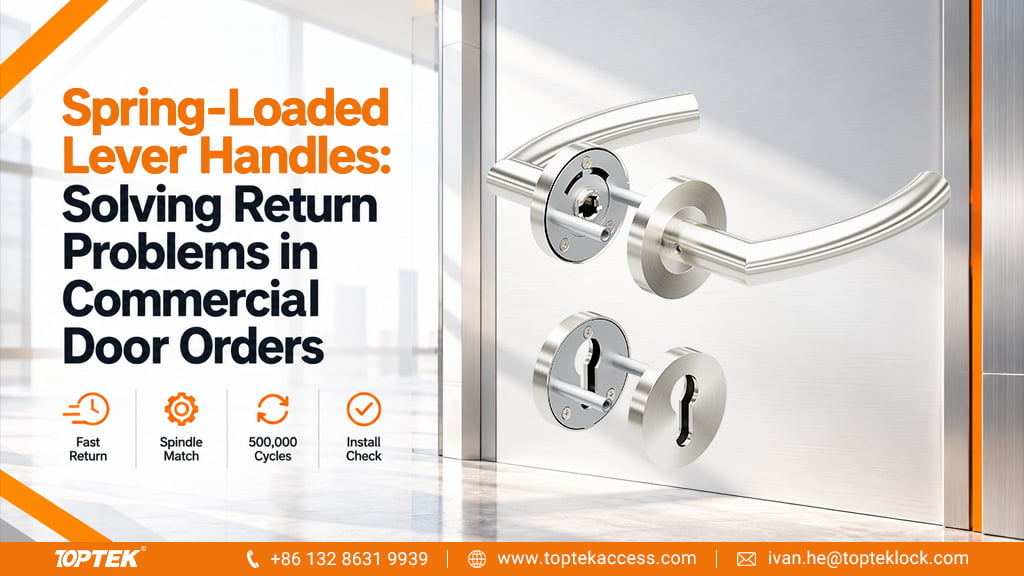

A spring loaded lever handle uses a return mechanism in the furniture to bring the lever back towards its resting position. For a commercial door buyer, the useful question is whether that mechanism works smoothly with the specified spindle, lock follower and fixings after installation. TOPTEK supplies spring-loaded lever furniture for this combination, including the LHEU001 platform with documented EN 1906 mechanical test results.
A handle that drops or returns slowly does not automatically need a stronger spring. Finding the resistance first can prevent an unnecessary replacement order and the same problem appearing across the next batch of doors.
What TOPTEK offers for commercial handle projects
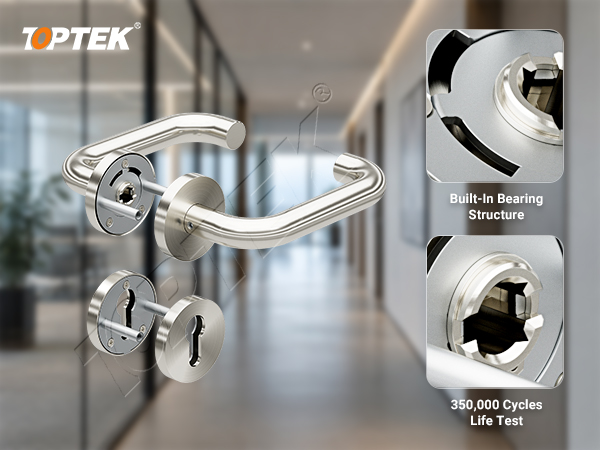
The LHEU001 configuration uses an SS304 handle and rose cover, an iron base plate and an SS304 spindle core. Its handle length is 140 mm, with 53 mm or 55 mm cover options and 7 mm, 8 mm or 9 mm square spindle options. Select the spindle section to suit the actual lock follower; these are alternatives, not interchangeable sizes within one assembled set.
The TOPTEK lever handle range gives door manufacturers and hardware distributors a starting point for selecting appearance and function together. Agree the quoted model, rose, spindle and fixing pack as one combination so purchasing does not have to reconstruct it from separate descriptions.
Mechanical evidence that answers the return question
TOPTEK’s LHEU001 was the full-test model in report 260618137GZU-001, dated 7 August 2026, covering EN 1906:2012 mechanical performance. The report records a category-of-use Grade 4 result and an extended 500,000-cycle test with no defects recorded after that test. This gives buyers a specific model and result to discuss, rather than relying on a general promise that a handle will never sag.
The result applies to the documented test configuration. For procurement, request the corresponding model documents with the quotation and match them to the supplied set. A commercial product reference such as EUG4001 spring-loaded furniture should be identified against the quotation and supporting model documentation; appearance alone is insufficient to transfer a test result.
Find the cause before changing the handle
| Symptom | Useful first check | What it helps distinguish |
|---|---|---|
| Lever sits low even when separated from the lock | Furniture return mechanism and hub condition | A furniture issue from resistance elsewhere |
| Returns freely alone but slowly when assembled | Spindle alignment and lock-follower movement | Connection or lock resistance |
| Movement tightens as screws are secured | Base seating, fixing alignment and interference | Clamping distortion or rubbing |
| Only one side behaves poorly | Spindle engagement and trim clearance on both sides | An asymmetric installation problem |
A competent installer should follow the product instructions when separating the components. Record the original symptom, change one condition at a time and compare the result. Do not leave the furniture loose to make it feel smoother: the finished set must operate correctly with its fixings properly secured.
Match the spindle to the complete door assembly
Door thickness is only part of spindle selection. The bases, roses, lever hubs and required engagement also affect the working length. An incorrect section can introduce play or prevent fitting; an unsuitable length can compromise engagement or create interference.
For a new door range, send the lock reference and door section with the handle enquiry. For a replacement, include photographs of the existing base, spindle and follower. This lets the supplier answer the actual interface question before you commit to a batch.
Use the installed sample to reduce repeat-order problems
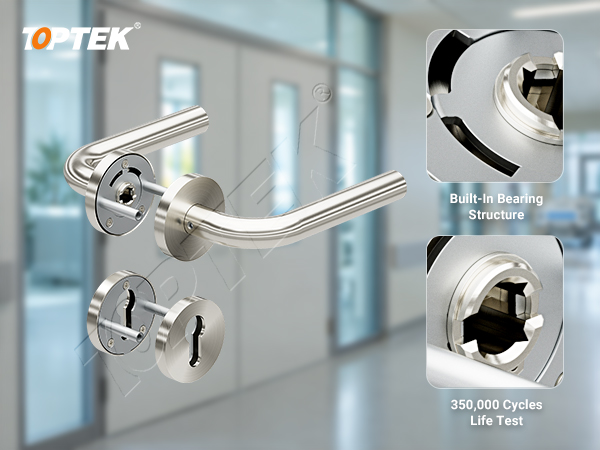
Fit a representative set with the intended lock and final fixing arrangement. Operate it from both sides, observe the resting position and check that the latch retracts and returns without rubbing. Compare operation before and after final tightening. Where an upward operating function is required, include that function in the enquiry and sample check.
TOPTEK’s production quality controls include first-article and in-process inspections against drawings. Keeping the selected hardware combination on the order connects those controls to the set the customer actually approved. Our OEM handle sample guide explains the wider sample-order process.
Request a matched handle quotation
For an initial selection, send the lock model, door section and preferred lever shape. For a formal quotation, add quantities, spindle section, rose size, finish, fixing requirements and the model-specific documents required by your project. TOPTEK’s commercial door hardware manufacturing service supports coordination of these details for OEM orders.
Send your handle and lock combination to TOPTEK to discuss a sample set. The aim is a handle that returns properly on the intended door and a purchasing description that can be repeated accurately.
Frequently asked questions
Does a spring loaded lever handle prevent every sag problem?
No. The return mechanism must work with the spindle, lock follower and fixings. Misalignment or rubbing can still affect the installed lever.
What is the documented endurance result for LHEU001?
Report 260618137GZU-001, dated 7 August 2026, records an extended 500,000-cycle test with no defects after that test for the documented LHEU001 configuration.
Can I choose spindle length from door thickness alone?
No. Include the furniture bases, roses, lever hubs and required engagement, then match the length and section to the selected lock and handle.
What should a distributor send for a repeat order?
Send the agreed model and sample reference, spindle and fixing specification, finish, quantities and any changes to the receiving lock or door construction.