
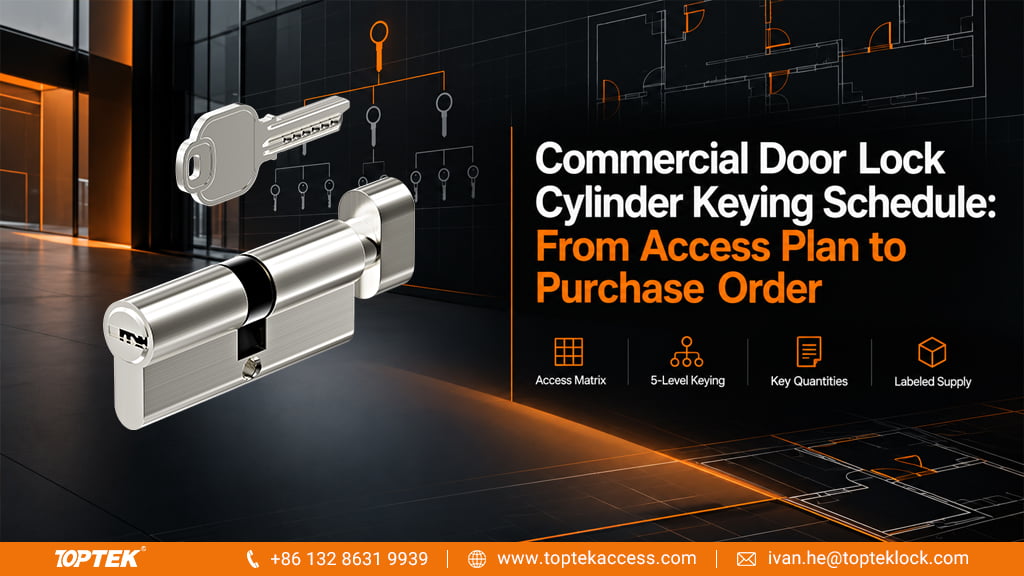

A commercial door lock cylinder keying schedule turns a building’s access requirements into an orderable list. Each door needs a stable number, a cylinder specification, an authorised key relationship and separate cylinder and key quantities. TOPTEK uses the agreed key chart to assemble, identify and package factory-assembled systems, helping project buyers connect the access plan to the hardware delivered to site.
This is especially valuable when one order covers offices, shared spaces and restricted rooms. A cylinder can fit perfectly while accepting the wrong key. The schedule must therefore describe both physical fit and who should be able to enter.
Begin with a door list that purchasing can use
Use the same opening numbers in the door schedule, cylinder order and installation labels. Record the receiving lock or housing, cylinder format, length and actuator. Keep quantities visible: a door count does not always equal a cylinder count, and a cylinder count does not determine the number of keys.
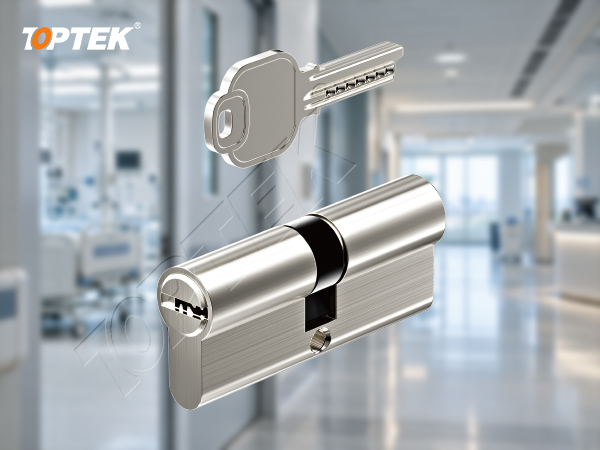
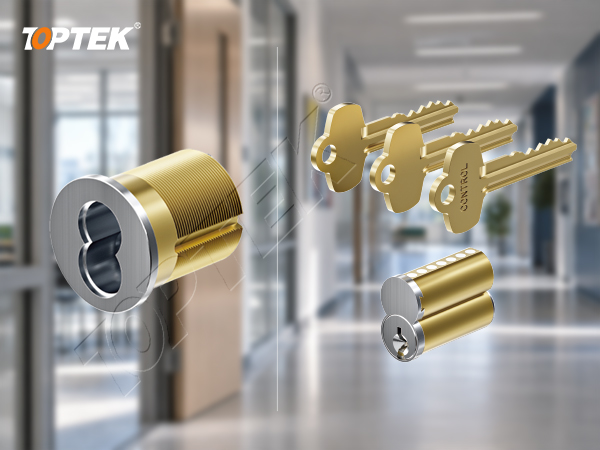
The TOPTEK construction cylinder range covers Euro profile, SFIC, American mortise and other regional formats. When a project uses several formats, list each interface separately and agree the compatible key-system design. A shared master-key requirement does not make unrelated cylinders mechanically interchangeable.
Define the key relationships in plain language
Keyed different means separate operating keys for the specified cylinders. Keyed alike means the same operating key serves an agreed group. A master-key arrangement adds a higher-level key that opens a defined group while individual keys retain narrower permissions.
TOPTEK supports systems with up to five levels of keying hierarchy for commercial buildings and multi-site projects. Use only the levels the project needs. An access matrix should show the doors each key may open, including any shared-room exceptions, before the manufacturer turns the plan into a production key chart.
For example, a department key may open its own office and a shared meeting room while remaining excluded from a records room. Write that relationship explicitly. A label such as “department master” on its own cannot communicate the exception.
A simple schedule example for an office project
The following is an illustrative permission schedule, not a real customer project or a manufacturing key code. Add the exact cylinder dimensions and lock references to your own order.
| Opening | Cylinder configuration | Keys permitted | Order quantities |
|---|---|---|---|
| D101: Office A | Selected Euro profile, keyed different | Office A key; agreed building master | 1 cylinder; 3 Office A keys |
| D102: Office B | Selected Euro profile, keyed different | Office B key; agreed building master | 1 cylinder; 3 Office B keys |
| D103: Shared meeting room | Selected cylinder within the designed system | Office A key; Office B key; agreed building master | 1 cylinder; no extra office keys |
| D104: Records room | Selected cylinder within the designed system | Records key; agreed building master | 1 cylinder; 2 Records keys |
In this example, order the building-master keys as a separate line, rather than adding one to every door. The shared-room relationship must be checked as part of the proposed system design. The table expresses the buyer’s required access policy; it is not proof that an existing cylinder can be repinned to deliver it.
How TOPTEK turns the agreed plan into supply
For factory-assembled systems, TOPTEK assembles against the agreed key chart, checks key relationships and supplies labelled packaging with system diagrams, door labels and key tags. This helps a door manufacturer or project contractor distribute the correct cylinders to the correct openings.
For distributors with local locksmith capability, TOPTEK also offers pre-machined components, key blanks and pins for assembly against the project chart. The cylinder assembly supply guide explains how to choose the appropriate supply arrangement. In either arrangement, specify who controls the chart and who can authorise changes.
Prevent the three expensive scheduling mistakes
Changing door numbers without updating the order: a correctly assembled cylinder can arrive with the wrong site label. Use one current revision and identify additions or deletions clearly.
Counting keys per cylinder without checking users: this can produce excess master keys or too few individual keys. Order key quantities by authorised user group and include controlled reserves separately.
Circulating sensitive manufacturing information with general drawings: the broad project schedule should use key symbols and permissions. Keep bitting, pinning and other sensitive system information within the authorised key-control process.
Why a manufacturer-supported schedule helps procurement
TOPTEK combines cylinder manufacturing with factory assembly and component supply options. Its drawing-based production checks provide a practical connection between the specified cylinder and the manufactured parts. For a physical format reference, review the EPCHK7P Euro profile cylinder alongside your required lock interface.
A clear schedule also makes phased purchasing easier. List the buildings or floors required in each batch, keep the agreed key relationships consistent and state expected future additions early. Expansion capacity depends on the chosen system design; it should be planned rather than assumed.
Send your schedule for a cylinder quotation
For an initial discussion, send the opening list and a plain-language access matrix. For a formal order proposal, add exact cylinder formats and dimensions, lock references, cylinder quantities, key quantities by level, delivery phases, labels, packaging and the authorised decision-maker.
Explore TOPTEK’s commercial locking manufacturing capabilities, or request a project cylinder quotation. A useful keying schedule gives the supplier enough detail to price the system and gives the site team a reliable way to identify what arrives.
Frequently asked questions
What belongs in a commercial door lock cylinder keying schedule?
Include door numbers, receiving locks, cylinder formats and dimensions, key permissions, cylinder and key quantities, delivery phases and labelling requirements.
Can TOPTEK provide five levels of master keying?
Yes. TOPTEK supports up to five levels of keying hierarchy. The exact access relationships, cylinder formats and future expansion requirements are agreed for the project.
Should master-key quantities be repeated on every door line?
No. Order master keys as separate controlled quantities by authorised group or recipient, so a key that opens multiple doors is not unintentionally duplicated per opening.
Can one schedule include Euro profile and SFIC cylinders?
Yes, a project schedule can list both formats. A shared mechanical key system requires a compatible design; the schedule alone does not establish interchangeability.