
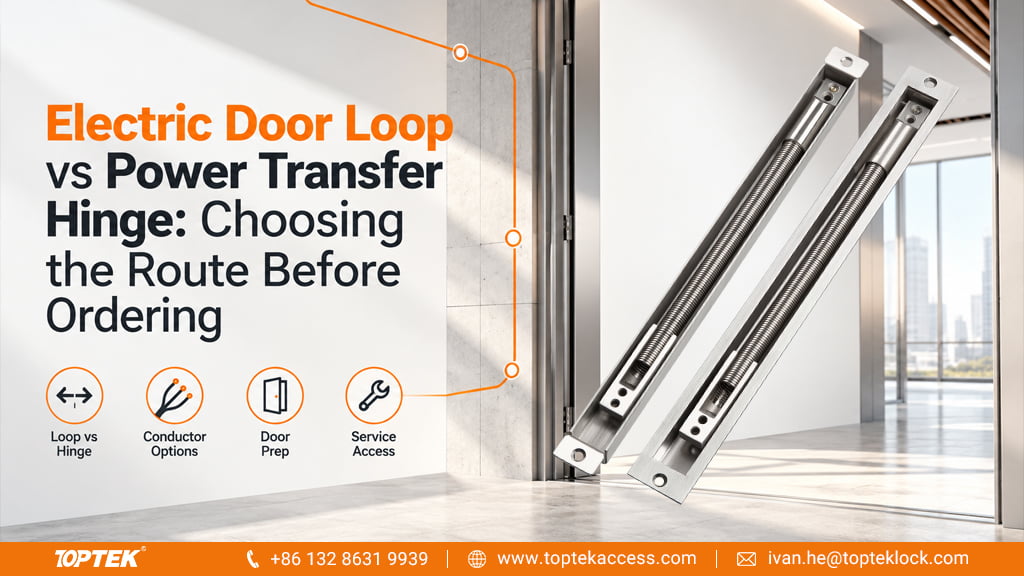

Choosing an electric door loop vs power transfer hinge starts with where the cable can cross from the frame into the moving door. A power transfer hinge carries conductors through a hinge position. A separate door loop provides a protected flexible route without making that route part of the load-bearing hinge. Either approach needs to suit the door preparation, electrical circuits and maintenance access.
Concealment is not an automatic reason to select a hinge: TOPTEK also offers concealed armoured door loops. For door manufacturers and access-control integrators, the better choice is the one that fits the complete opening and can be ordered with a clear cable and preparation specification.
Compare the two architectures before choosing a model
| Decision | Separate door loop | Power transfer hinge |
|---|---|---|
| Cable route | Flexible protected path separate from the hinge | Conductors integrated through the hinge |
| Preparation | Dedicated loop recess or mounting positions, depending on model | Matching hinge mortise and cable access |
| Mechanical support | Door remains supported by its specified hinges | Transfer device also forms part of the hinge schedule |
| Appearance | Surface or concealed designs exist | Cable concealed within the hinge route |
| Service planning | Access to the separate transfer and cable entries | Access to connections and safe support if a hinge is removed |
For a new factory-prepared door, both routes can be considered while the machining details are still being selected. For an existing opening, inspect the available recesses, reinforcement and cable access first. An electrical accessory should not force an unplanned change to the door’s mechanical support.
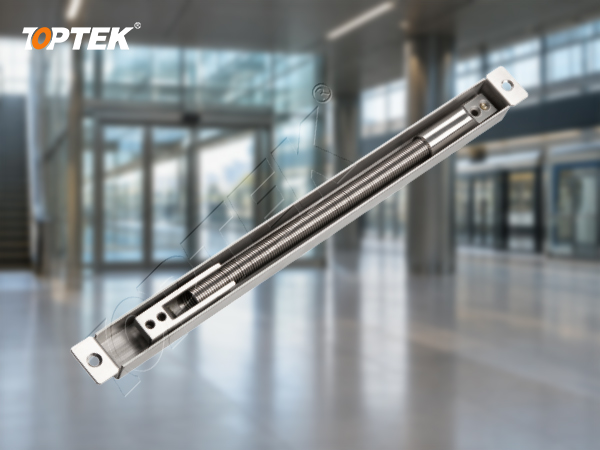
TOPTEK concealed armoured loop options
TOPTEK’s DL001 and DL002 use SS304 construction and are designed as concealed armoured door loops. DL001 has a stated size of 24 × 326 × 10 mm; DL002 is 35 × 332 × 10 mm. These dimensions help buyers identify the product envelope, but machining should follow the selected model’s installation drawing.
The Electric Door Loop 01 product page shows this separate cable-transfer approach. It is useful when the project needs a dedicated transfer position while retaining a separately specified mechanical hinge arrangement. Include the cable specification in the enquiry; the protective housing’s dimensions do not determine the cable’s electrical rating.
TOPTEK electrified hinge choices
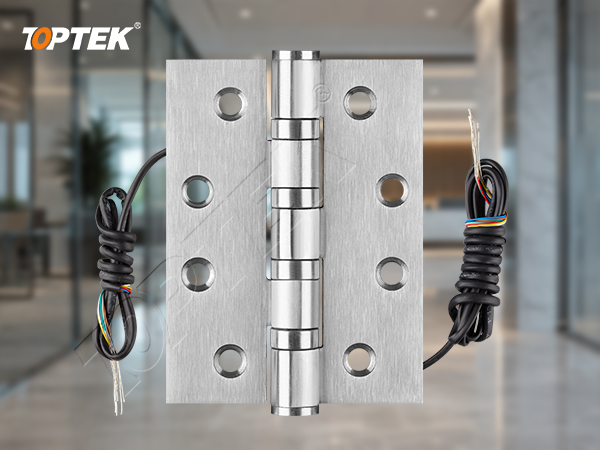
TOPTEK offers electric two-ball-bearing and four-ball-bearing butt hinges in SS304. The range includes configurations with two 18 AWG conductors, or four, eight or twelve 28 AWG conductors. Choose the conductor arrangement alongside the actual lock load and monitoring requirements; a higher wire count does not mean a higher power capacity.
As one dimensional reference, the electric 4BB4545 is 4.5 × 4.5 inches with a 4.6 mm leaf thickness. Review the electric four-bearing hinge range with the complete hinge schedule. Leaf dimensions, screw pattern, door weight and reinforcement still matter when the hinge also carries wiring.
Count functions, then select the conductors
List every circuit crossing into the leaf: lock power, any separate control input and each monitoring contact. Identify the required conductor size, working voltage, current and connector arrangement. Reserve spare conductors only where the system designer has included them in the plan.
A two-wire power feed is not the same specification as a monitored lock needing several signal circuits. Equally, four thin conductors should not be treated as a substitute for a larger power pair without an approved electrical design. The load, cable length and allowable voltage drop must be considered together.
Once the transfer type is selected, the power transfer hinge wiring guide can help organise the next interface discussion. This comparison addresses the device choice; the final wiring follows the particular lock and transfer documentation.
Check movement and service access in the prepared door
Check the transfer through the intended opening arc, with the actual cable routing. Look for pinching, sharp-edge contact, excessive tension and interference with seals or adjacent hardware. A loop needs room for its intended movement; a hinge route needs appropriate access and strain relief at its connections.
Plan how the component will be reached for replacement before finishing the door. If servicing requires removing a load-bearing hinge, include safe support for the leaf. For a fire-rated opening, retain the door manufacturer’s permitted preparation and hardware requirements; changing the cable route is not just an aesthetic adjustment.
Why source the transfer with the door hardware package?
TOPTEK’s hinge and door power transfer range offers both architectures for comparison. Buyers can discuss the hinge dimensions, separate transfer envelope and finish within the same hardware enquiry instead of leaving the moving cable connection until installation.
TOPTEK’s production quality process includes component checks against drawings and inspections during assembly. The purchasing benefit comes from specifying the agreed model and conductor arrangement consistently on the sample request, quotation and order.
Request a transfer option for your opening
For an initial selection, send a door-and-frame section, hinge locations, required opening angle and the electric lock reference. For a quotation, add quantities, exact hinge preparation, conductor schedule, electrical load, connector needs, finish and any doorset documentation requirements.
Ask TOPTEK to quote a door loop or electrified hinge configuration. Select the route that suits the opening, then match the cable and mechanical details before production. That sequence reduces the risk of an otherwise suitable lock arriving without a usable power connection.
Frequently asked questions
Is an electric door loop always visible?
No. Door loops include surface and concealed designs. TOPTEK’s DL001 and DL002 are concealed armoured options that use a separate transfer position.
Does a power transfer hinge replace the entire hinge schedule?
No. It is one component within the specified hinge arrangement. The complete door support, preparation and cable requirements must still be coordinated.
Does a twelve-wire hinge carry more power than a two-wire hinge?
Not necessarily. Wire count and conductor size describe different things. TOPTEK lists two-wire 18 AWG and multi-wire 28 AWG configurations; electrical suitability depends on the selected configuration and load.
What should an access-control integrator provide for selection?
Provide the lock and monitoring circuits, electrical load, cable requirements, door preparation, hinge arrangement and required movement, together with quantities and service-access needs.