
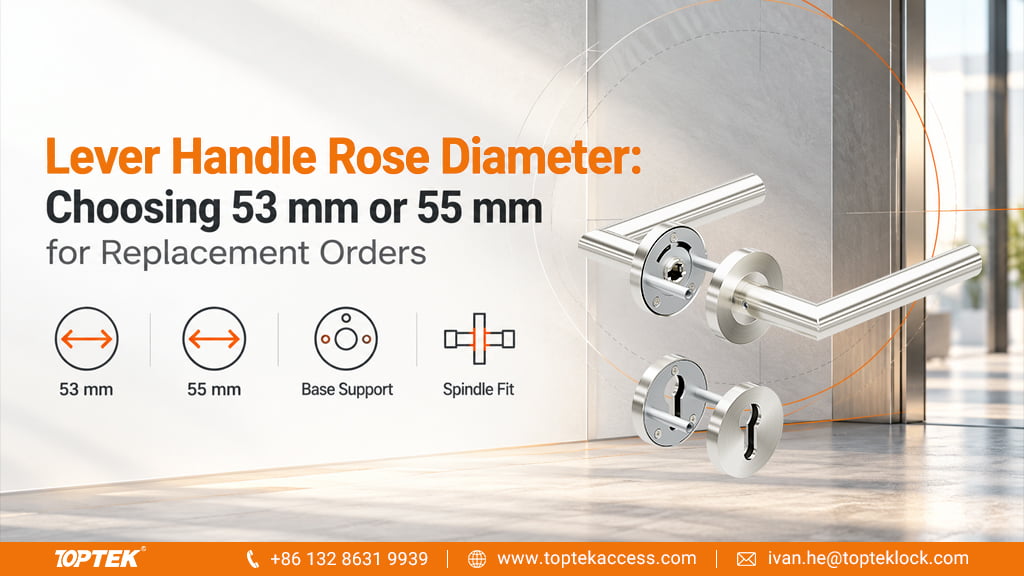

Quick answer: which lever handle rose diameter should you order?
Choose a lever handle rose diameter that covers the existing opening and leaves the mounting base properly supported. TOPTEK LHEU001 offers 53 mm and 55 mm cover plate options, but cover size alone does not define the drilling pattern or maximum permissible hole. Check the opening from the spindle centre, the base footprint, fixing centres and clearance to the cylinder escutcheon. For distributors buying replacement handles, this turns a visual preference into a complete assembly specification.
Before comparing prices: group doors by preparation, identify the required cover size and include the base, spindle and fixing kit in the same enquiry. This makes competing quotations easier to compare.
What 53 mm versus 55 mm actually changes
A 55 mm circular cover extends just 1 mm further in every direction than a 53 mm cover when both share the same centre. The 2 mm difference in diameter is not 2 mm of extra coverage on each side. That small distinction matters when an installer is trying to conceal an old paint line or an enlarged opening.
| Illustrative centred opening | 53 mm cover | 55 mm cover |
|---|---|---|
| 49 mm diameter | 2 mm overlap per side | 3 mm overlap per side |
| 51 mm diameter | 1 mm overlap per side | 2 mm overlap per side |
These are geometric examples, not minimum installation allowances. An off-centre opening reduces coverage on one side. The mounting base may also need a different supporting area from the decorative cover. A positive overlap therefore does not, by itself, establish a suitable installation.
Specify the TOPTEK assembly, not an isolated rose
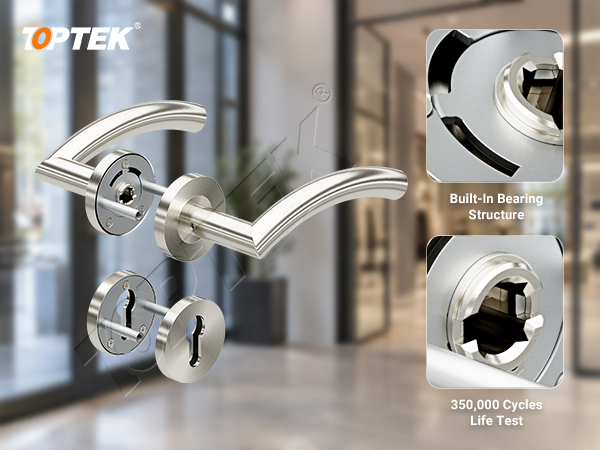
Within the TOPTEK lever handle range, LHEU001 provides a concrete starting point: a 140 mm lever, 53/55 mm cover plate options, SS304 handle and rose components, and 7 mm, 8 mm or 9 mm square spindle options. Select one compatible spindle section for the lock follower; these are alternatives, not interchangeable parts for every lock.
The LHEU001 specification separates the 1.0 mm SS304 rose from its 1.5 mm iron base plate. This explains why the visible finish and the hidden mounting interface must be specified together. It also avoids describing the whole assembly as stainless steel when different components use different materials.
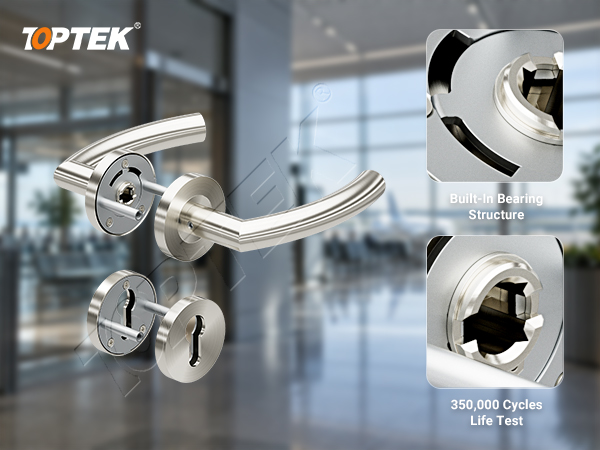
EU003 and EU004 images illustrate other designs in the family, not LHEU001 dimensions. For a complete supply programme, discuss the chosen configuration with TOPTEK as your commercial door hardware manufacturer.
Measure from the spindle centre on both faces
The most useful survey records the furthest exposed edge above, below and beside the spindle centre. For example, if a damaged edge extends 28 mm from that centre, a 55 mm cover with a 27.5 mm radius will not conceal it. Measuring only the narrowest width across the hole could miss the problem.
Record old screw holes and finish shadows separately from the opening itself. Then inspect the sound supporting surface beneath the proposed base. A larger cover can hide a mark; it cannot restore missing timber or provide reinforcement behind a thin door skin.
- Photograph both door faces with a scale and identify the door number.
- Measure opening limits from the spindle centre and note damaged areas.
- Record existing fixing centres and the lock case occupying the fixing route.
- Measure clearance to the cylinder escutcheon, door edge and nearby trim.
Make the fixing and spindle choices part of the order
Two roses with the same external diameter can conceal different mounting plates. Check the fixing pattern against the door and lock, including where through bolts can pass. Tightening screws harder will not correct an unsupported or distorted base.
Door thickness and spindle engagement remain separate choices. Use the lever spindle length guide to prepare those measurements. A replacement may cover the old holes neatly yet bind if the spindle is unsuitable or the fixing arrangement pulls the assembly out of alignment.
How TOPTEK supports repeatable replacement orders
TOPTEK’s OEM/ODM process connects requirements, drawings, sample development and production inspection. Its quality management process includes first article and in-process inspections. For a rose-size order, make cover diameter, fixing centres, material and the selected finish explicit inspection items.
Door manufacturers can agree one preparation for a production run. Distributors serving refurbishments can divide the order into door groups with different openings. In both cases, retaining the matched drawing and sample helps prevent a later batch from arriving with a similar-looking but different mounting kit.
Where an opening needs repair or a different adaptor, agree that work with the responsible door supplier before bulk ordering. Any modification to a rated doorset must follow its applicable instructions and permitted configuration. Rose diameter is a fit dimension, not a fire-performance claim.
Prepare a useful handle enquiry
Send the preferred handle reference, door material and thickness, opening measurements, fixing centres, spindle section, finish and quantities by door group. Include photographs with the existing trim removed where a qualified installer can safely obtain them. Ask for the matching assembly drawing and a sample with the intended fixing kit.
For private-label supply, add marking and packaging requirements to the same specification. This keeps the OEM quotation tied to the handle the installer will actually receive, rather than a cover diameter alone.
Frequently asked questions
Does a 55 mm rose cover 2 mm more on each side than a 53 mm rose?
No. With the same centre, the radius increases by 1 mm, so the cover extends 1 mm further on each side.
Can rose diameter determine the door drilling size?
No. Use the assembly installation drawing for the opening, mounting base and fixing holes. The decorative cover diameter is a separate dimension.
Which rose sizes are specified for TOPTEK LHEU001?
LHEU001 specifies 53 mm and 55 mm cover plate options. Confirm the selected cover, base, spindle and fixing kit together on the order drawing.
What if a larger rose hides damaged material?
Check the support beneath the base and agree any necessary repair with the responsible door supplier. Concealing damage does not restore fixing support.
Request a matched handle quotation
Choose the cover for appearance and coverage, then confirm the base and fixing arrangement for the real door. Send TOPTEK your measurements and preferred model to discuss the assembly drawing and sample. Once the configuration is agreed, provide quantities and delivery requirements for a formal quotation.