
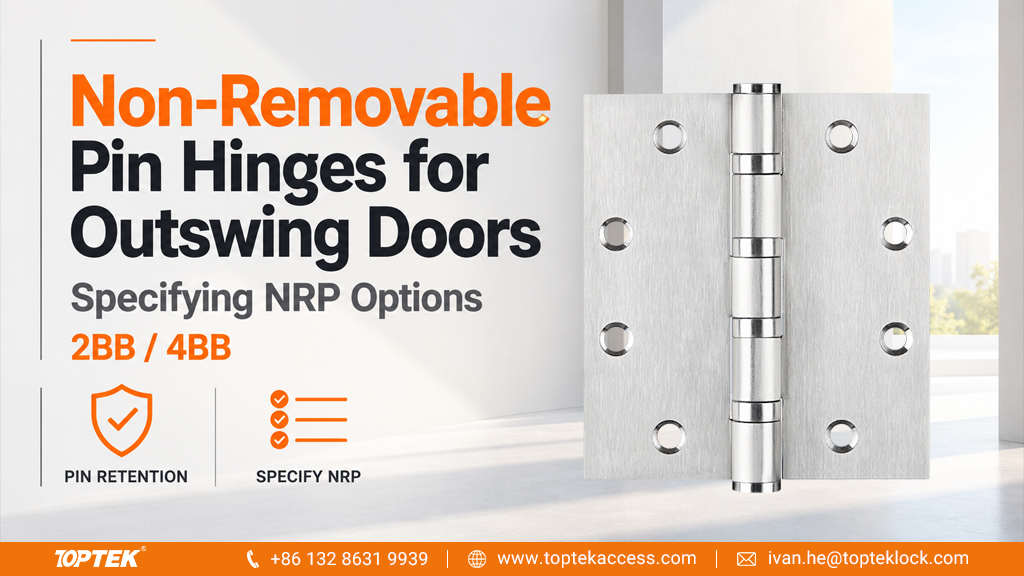

A non-removable pin hinge is worth specifying when an outswing door leaves its hinge knuckles accessible from the less-secure side. TOPTEK offers the NRP option on its SS304 full-mortise 2BB and 4BB hinge ranges, allowing buyers to include pin retention in the hinge order instead of leaving it as an installation-stage question.
The procurement decision is straightforward: identify the exposed hinge condition, select the suitable hinge model, and state NRP explicitly. Bearing count and pin retention are separate choices, so a 2BB or 4BB description alone does not confirm that the order includes NRP.
How TOPTEK’s NRP feature works
TOPTEK’s NRP arrangement uses a set screw in the hinge barrel that engages a groove in the hinge pin. The screw is positioned so that it cannot be reached with the door closed. This retains the pin against withdrawal in that condition while allowing authorised maintenance according to the product instructions.
This is a specific hardware feature with a clear purpose. It does not, by itself, establish a complete forced-entry rating for the door. The door leaf, frame, fixings and lock still need to suit the opening’s security requirement.
Which TOPTEK hinges can be specified with NRP?
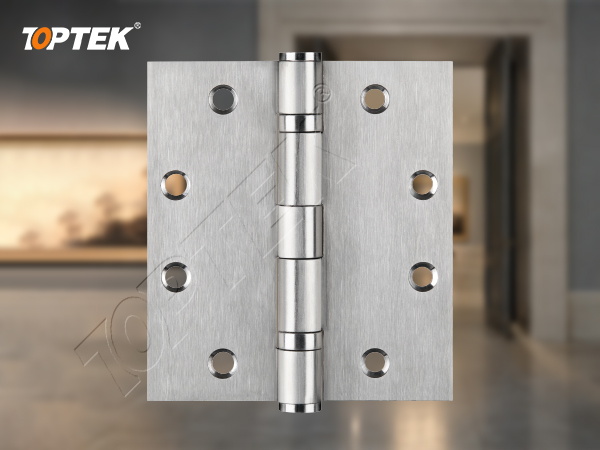
Both the 2BB full-mortise hinge range and the 4BB full-mortise hinge range list SS304 construction and an optional non-removable pin. These are five-knuckle hinge families with different dimensional choices.
| Example model | Listed dimensions | Thickness | Ordering decision |
|---|---|---|---|
| 2BB4040 | 4 × 4 inches | 3.0 mm | Specify NRP when required |
| 4BB4545 | 4.5 × 4.5 inches | 4.6 mm | Specify NRP when required |
These examples identify available configurations; they are not a door-weight selection table. Choose the hinge size, thickness, quantity and fixing arrangement for the actual door and frame. Changing from one model to another may require different preparation, even when both have the NRP option.
For door manufacturers, specifying the pin arrangement alongside the dimensional drawing keeps preparation and hardware purchasing aligned. For distributors, separate product references for the required pin option make repeat orders and replacement enquiries clearer.
Mark the swing and exposure before ordering
Provide a simple elevation showing the door swing, secure side and hinge position. Check whether the knuckles are exposed when the door is closed. This is more useful than describing the opening only as an “external door,” because hinge exposure depends on its arrangement.
Then identify the door material, dimensions, mass, closer and expected use. Include the hinge recesses, hole pattern and reinforcement details for both the door and frame. The NRP feature addresses pin retention; suitable fixings and preparation allow the hinge assembly to perform its supporting role.
If you are still selecting the hinge family, send the elevation and door information first. The TOPTEK hinges and door power transfer range provides a starting point for the discussion.
Check the ordered feature on the fitted sample
Ask for the sample and quotation to identify the NRP option explicitly. Confirm that the delivered hinge matches the agreed drawing and that the leaves sit correctly in the prepared door and frame. Operate the door through its intended swing and check for binding or interference.
The TOPTEK quality management process includes drawing-based component checks and production inspections. Connecting the NRP designation to the model and sample gives the buyer a practical feature to verify during incoming inspection.
Keep the maintenance instructions with the selected hardware. Do not assume that “non-removable” means the hinge is permanently sealed or should be modified on site. Where fire-door use is required, select the hinge and installation from the applicable doorset documentation.
Avoid three common purchasing errors
- Ordering by bearing count alone. “4BB” identifies the bearing arrangement, not the pin option. Add the NRP requirement to the model description.
- Copying dimensions without checking preparation. Confirm thickness, hole positions and reinforcement as well as the nominal hinge size.
- Treating NRP as a complete security rating. Coordinate it with the door, frame, lock and project security specification.
Resolving these points before production helps avoid receiving a visually similar hinge with the wrong feature or preparation. It also makes incoming inspection more useful: the team checks the ordered configuration instead of relying on a product photograph.
Request TOPTEK NRP hinges for your door package
TOPTEK supplies mechanical hinges alongside commercial door hardware, giving buyers a way to discuss hinge configuration and the surrounding hardware package with the manufacturer. Our commercial door hardware team can review the proposed model, finish and purchasing quantities.
For a quotation, send the door elevation, dimensions and mass, hinge preparation, preferred model, NRP requirement, quantity and finish. Include fixing requirements and any project-specific documentation. Request an NRP hinge quotation with the pin option shown as part of the supplied configuration.
Frequently asked questions
When should I consider a non-removable pin hinge?
Consider it when the closed door exposes hinge knuckles to the less-secure side and the opening requires protection against hinge-pin withdrawal.
Does TOPTEK offer NRP on both 2BB and 4BB hinges?
Yes. TOPTEK lists NRP as an option on both full-mortise hinge ranges. Specify the exact model, dimensions and NRP requirement in the order.
Does NRP mean the hinge cannot be serviced?
No. TOPTEK’s set-screw arrangement retains the pin with the door closed. Authorised maintenance should follow the instructions for the selected hinge.
Does an NRP hinge determine the door’s security rating?
No. NRP is a pin-retention feature. The complete opening’s performance also depends on the door, frame, fixings, lock and applicable tested configuration.