
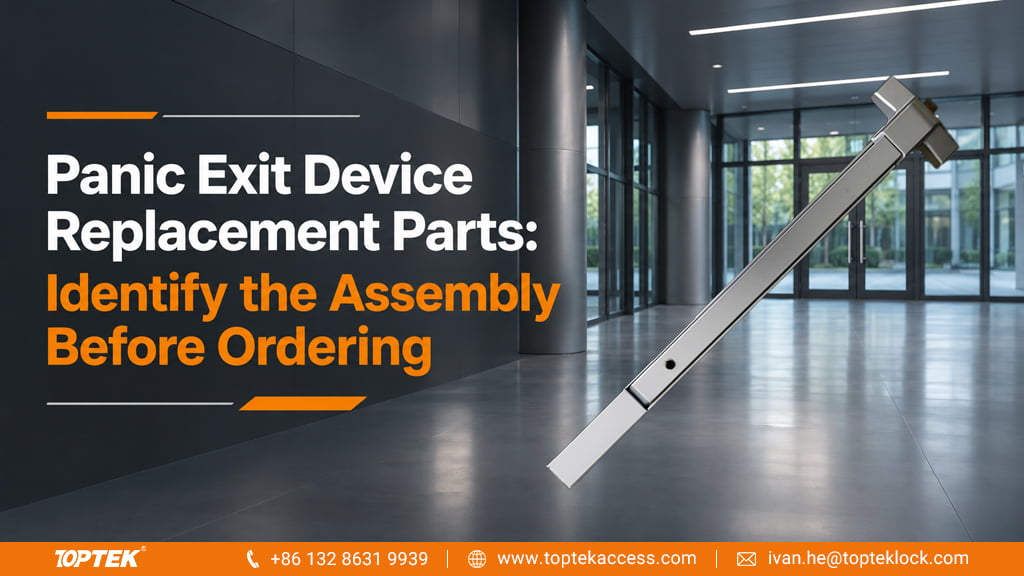

To order panic exit device replacement parts, identify the installed device and its configuration before selecting the component. A similar cover, push bar or fixing pattern does not establish interchangeability. Distributors and service buyers should connect three things in the enquiry: the complete device reference, the component requiring attention, and the assembly in which the replacement will operate.
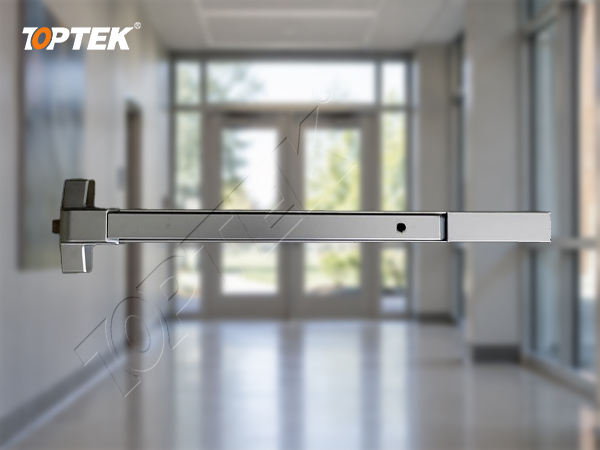
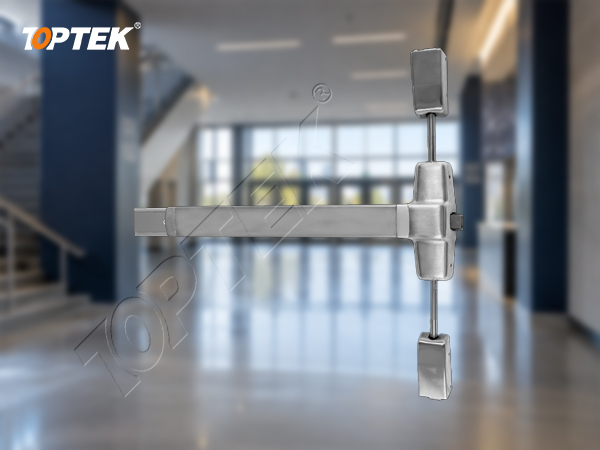
TOPTEK offers rim and vertical-rod exit-device arrangements. That range makes the first distinction practical: a rim-latch enquiry needs different matching information from a rod, guide or top-latch enquiry. Start with the TOPTEK panic exit device range, then identify the installed version rather than ordering from the family photograph alone.
Record the whole assembly, then the part
Keep one photograph of the complete inside face of the door, one of the device identification, and one close-up of the component. Include the outside trim and strike when either affects the fault or replacement. A close-up without an assembly view can hide whether a similar-looking component belongs to a different operating arrangement.
TOPTEK’s F5000 and F5600 series illustrate why the full reference matters. Their documented arrangements differ at the latching interface, and their references also distinguish versions within each series. Preserve the complete suffix from the label, original order or drawing. Do not translate a broad description such as “stainless panic bar” into a replacement reference.
| Enquiry concerns | Information that changes the selection |
|---|---|
| Cover or end cap | Device series, exact cover profile, fixing positions and finish. |
| Latch or strike | Device type, matching strike reference, door/frame relationship and observed engagement. |
| Rod, guide or top/bottom latch | Complete rod arrangement, connection details and installed door dimensions. |
| Outside trim | Required entry function, device interface and door preparation. |
This is an identification checklist. The supplier’s confirmed part or kit reference should become the purchase-order description.
Separate a replacement component from a complete kit
A quotation for an end cap is not necessarily a quotation for its fixings. A latch assembly may include associated components that a loose part does not. Ask the supplier to state the supply contents explicitly: the identified component, included fixings, any matched parts, and the installation instructions that apply.
TOPTEK’s exit-device documentation shows accessories such as end caps, screw packs, through-bolts and strike components against specific arrangements. Use those relationships to prepare the enquiry; confirm which items can be supplied separately for the installed version. A family-level accessory illustration is not a universal spare-parts list.
For a rim-device project, the PEDAM002 product page provides a useful starting point for identifying the arrangement. Compare the actual door with the documented product before asking for a component quotation.
Keep the symptom separate from the assumed cause
“The latch does not engage” describes an observation. “The latch needs replacement” is a diagnosis. If a strike has moved or the door has dropped, changing the latch alone may leave the same problem. Give the service technician the observed behaviour, photographs and relevant dimensions before deciding the replacement scope.
Record whether the symptom occurs with the door open, during closing, or only after the door is closed. Include any recent change to the door, closer, trim or strike. The door-preparation and strike coordination guide explains the interfaces that should be checked alongside the device.
Where the opening has fire or escape requirements, the replacement must preserve the documented assembly and function. Use the applicable manufacturer instructions and qualified installation support; a successful fit alone does not establish suitability for that opening.
Make the confirmed reference reusable for future orders
For distributors supporting repeated projects, retain the supplier-confirmed component or kit reference with the original device model, drawing revision and installation photographs. Record a later substitution against that reference instead of silently changing the stock description. The next branch or service buyer can then order against an identified assembly rather than repeat the same investigation.
TOPTEK’s commercial door hardware manufacturing support provides a route for discussing product configuration and follow-on supply. Agree the spare-parts scope when establishing the original device order, including the information needed for later identification.
Request a replacement-parts match
Send TOPTEK the complete device reference, assembly photograph and component close-up, together with the required quantity and delivery market. Include the original order or drawing if available. Ask for the proposed part or kit reference, supply contents and applicable fitting information before placing the order.
Frequently Asked Questions
Can I order a replacement part from a photograph alone?
A photograph can start identification, but include the full device reference, assembly view and relevant dimensions. Confirm the exact part or kit reference before ordering.
Can rim and vertical-rod devices use the same replacement parts?
Some appearances may be similar, but compatibility depends on the exact series and component. Match the replacement to the documented assembly; do not assume cross-series interchangeability.