
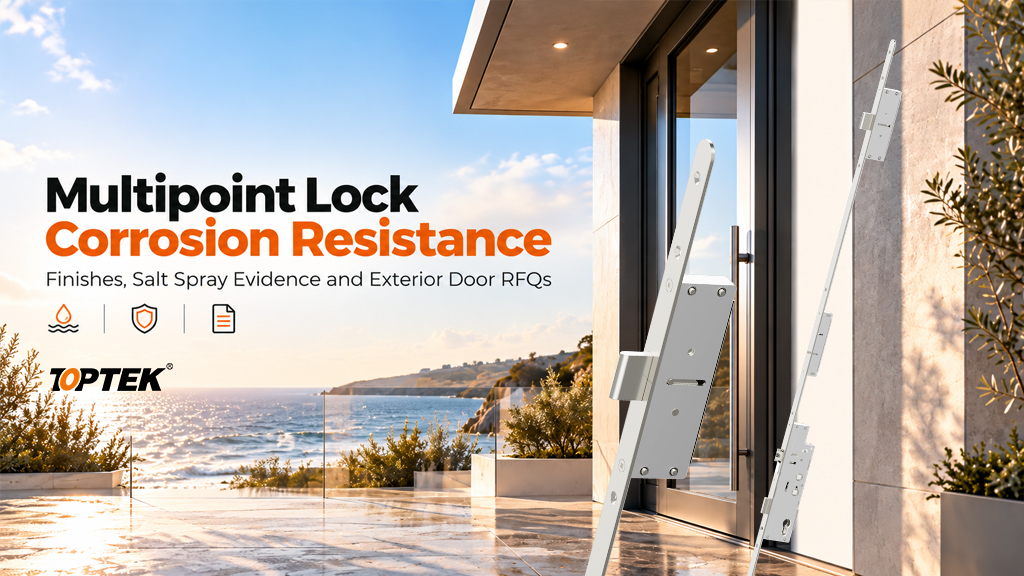

TL;DR
- Describe exposure before choosing a material or surface treatment.
- Compare reports using the same method, specimen scope and acceptance criteria.
- Include keeps, fasteners, moving parts and protected internal components in the review.
- Preserve the approved finish and packaging requirements from sample through production.
Quick Answer
To evaluate multipoint lock corrosion resistance, match the proposed materials and finish to the door environment, then request a report identifying the exact specimens, test method, exposure duration and acceptance criteria. Check whether the assessment covers appearance, operation or both. A test on a faceplate or coating sample does not automatically describe the full lock and its keeps. For exterior projects, also review installation damage, contact with other materials, drainage, cleaning and storage. Use the resulting specification to compare quotations and define a representative sample review.
Describe the environment before requesting a coating
“Outdoor use” covers different conditions. A sheltered entrance, an exposed coastal opening and a regularly washed service door do not present the same exposure. Record where the lock sits, which surfaces can become wet and whether moisture can enter the door edge or profile. Describe the environment without assuming that the door material protects every component.
Ask the project team about airborne salts, cleaning products, persistent condensation and nearby processes that may affect the hardware. Include expected cleaning practices and access for maintenance. If those details are unknown, record the questions in the RFQ so that a material recommendation does not rest on a vague location description.
TOPTEK’s multi-point locking systems include different configurations for coordinated door locking. Corrosion selection must follow the specific assembly being considered. It should not be inferred from the general product family or transferred from an unrelated model.
| Exposure question | Information to collect | Why it affects selection |
|---|---|---|
| Where can water reach? | Door edge, keeps, fasteners and profile cavities | Hidden parts may face different conditions from the visible faceplate. |
| What contaminants are present? | Salt, cleaning chemicals or process residues | The finish must be assessed for the relevant exposure. |
| How is the door maintained? | Cleaning method, frequency and access | Care requirements must be practical for the site. |
| How will goods be stored? | Storage duration, moisture protection and handling | Damage or contamination can occur before installation. |
Review every component that affects operation
A multipoint lock combines a long faceplate, a central mechanism, remote locking points and matching keeps. Its visible finish may be only one part of the material specification. Ask for a component-level description of relevant substrates and treatments, including fasteners and mating parts supplied separately.
Material selection should also consider the interfaces between parts. Contact conditions, trapped moisture and coating damage can influence performance. The designer should assess the actual material combination instead of assuming that a stainless-looking exterior makes the complete assembly suitable for every environment.
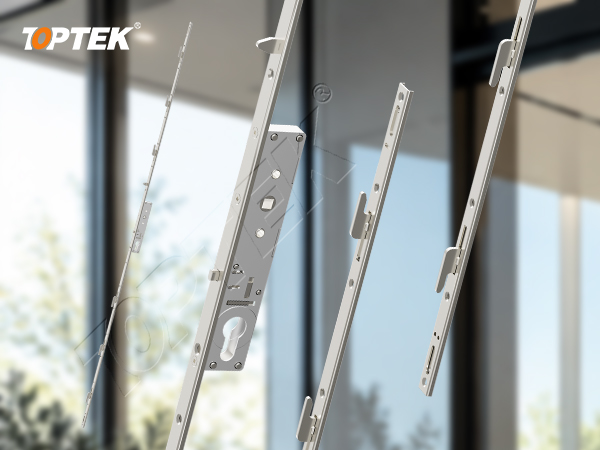
TOPTEK’s multipoint development approach considers material choice and production precision alongside reliable movement. Deformation of a long faceplate can cause binding. Corrosion review therefore belongs beside dimensional and functional review: a surface treatment cannot correct a bent assembly or a misaligned keep.
For the Auto Lock product, request the current configuration drawing and finish schedule when discussing a project. Use the confirmed order reference to connect the proposed assembly to the evidence package.
Read salt spray evidence as a defined test
ISO 9227:2022 describes salt spray test methods for metallic materials with or without corrosion protection. Its published record also identifies an amendment. A project test specification should identify the applicable edition and method rather than using “salt spray tested” as a complete description.
Request the specimen identification, pretreatment, exposure method, duration, observations and assessment criteria. Establish whether the specimen was a coating panel, a component or a complete assembly. If the report records only visible corrosion on selected surfaces, do not treat it as evidence that every locking point operated correctly afterward.
Salt spray duration is not a direct calendar-life guarantee. ISO’s 2026 technical report on neutral salt spray testing discusses limitations in correlations across test materials and corrosive media. For buyers, the practical lesson is to define comparable test conditions and use the result within its stated scope.
Two reports showing different hour totals cannot be ranked fairly until their methods and acceptance criteria are understood. A longer exposure with a permissive assessment is not automatically a better match for the project. Ask the supplier to explain what a successful result means for the exact specimen.
Separate finish appearance from functional performance
Appearance and mechanical operation answer different questions. A purchaser may need a defined cosmetic finish on visible surfaces and reliable movement at the lock points. Write both expectations explicitly. If functional checks after exposure are required, identify the operating sequence and the approved procedure for that assessment.
For an automatic mechanism, review trigger action and return of the moving parts. For a lift-lever or key-operated configuration, identify the specified operating sequence and the parts involved. Do not apply an automatic-lock checklist to every multipoint design. The assessment must follow the configuration actually ordered.
Ask whether specimens are tested assembled or separately and what preparation or treatment follows exposure before evaluation. Record any cleaning, lubrication or recovery period stated in the test method. Comparing a cleaned specimen with an untouched one can conceal a meaningful difference in the evidence.
TOPTEK offers surface-treatment options and uses internal validation during multipoint development. Discuss the finish in relation to the intended environment and assembly. A quotation should still identify the exact treatment and supporting test scope, rather than converting a general capability statement into a universal product rating.
Protect the approved surface through installation
A finish can be damaged after a sample passes inspection. Include handling, storage and installation instructions in the handover package. Keep components away from grinding debris and inappropriate chemicals, and follow the manufacturer’s approved cleaning procedure. Do not specify an abrasive cleaning method simply because it removes visible marks.
Check how site machining affects protected surfaces. If cutting, drilling or modification is necessary, obtain instructions that cover the changed area and the effect on the product evidence. An installer should not improvise a repair coating and assume that it restores the originally assessed performance.

TOPTEK uses protective packing for long multipoint assemblies. For an order, define the actual packing method, supports and identification with the supplier. Protection against bending and protection against moisture serve different purposes, so request both where the shipping and storage conditions require them.
- Confirm the finish name and revision on the purchase order.
- Inspect packaging and record visible damage before unpacking.
- Store assemblies according to the agreed moisture and handling instructions.
- Separate finish damage from dimensional or alignment problems in receiving records.
- Retain specimen and batch identification for any investigation.
Compare suppliers without overstating the evidence
A useful comparison sheet includes the proposed model, substrate and treatment, tested specimen, method, duration, criteria and report identity. Add a column for the project exposure. The supplier can then show how the evidence supports the offered configuration instead of supplying a disconnected collection of certificates.
Common errors include copying a coating result to a complete lock, treating a corrosion claim as a fire or security approval, and assuming one finish applies to all available models. A product standard classification also needs a clear link to the model and configuration. Request the underlying document where a quotation uses a grade or class.
Another mistake is changing a visible finish after sample approval without assessing the effect on mating components or the production process. Record material and treatment changes as controlled changes. Decide which checks must be repeated before the substitute becomes the production reference.
The main project risks are premature surface deterioration, restricted movement, disputed acceptance and replacement work. They are easier to manage when the supplier and buyer agree on evidence and criteria before placing the order. For the broader handover process, use the multipoint sample approval guide alongside the finish schedule.
Build a corrosion specification for the RFQ
Why TOPTEK? TOPTEK combines multipoint product development with internal testing and manufacturing control. Its engineering approach addresses operating sequence, material selection, dimensional precision and transport protection. These areas are relevant when a door manufacturer needs a finish decision that remains consistent through samples, assembly and shipment.
For a preliminary review, send the door location, material, exposure photographs and cleaning information. For a formal quotation, add the model or required configuration, quantity, finish expectations, nominated test method, specimen scope, acceptance criteria, documentation requirements and packing conditions. Ask the supplier to identify any assumptions that affect its recommendation.
Use TOPTEK’s commercial door hardware manufacturing resources to begin the project discussion. Request a proposed material and finish schedule with supporting documents. This creates a practical basis for comparison without demanding an unsupported promise about universal outdoor life.
Frequently asked questions
Does a longer salt spray test guarantee a longer service life?
No. Compare the test method, specimen and acceptance criteria, and assess the actual environment. Test hours should not be converted directly into years of outdoor service.
Is a faceplate test enough for the complete multipoint lock?
Not automatically. Establish whether the evidence covers the relevant internal parts, remote locking points, keeps and fasteners, and whether functional checks are included.
Can the same finish be used for every exterior door?
The suitability depends on exposure, component materials, installation conditions and maintenance. Describe those conditions before choosing the finish.
Should a finish change require another sample review?
Assess the change against the approved material specification, manufacturing process and evidence. Repeat the affected checks before accepting the new production reference.
What should I send for an initial corrosion review?
Send the proposed lock configuration, door environment, exposure photographs, cleaning method and any required test or acceptance criteria.
Specify a complete and traceable finish solution
Multipoint lock corrosion resistance is a purchasing decision about exposure, components and evidence. Define the environment, compare like-for-like reports and preserve the approved treatment through production and installation. That approach gives door manufacturers a clearer basis for selection and a more useful record if the hardware later needs attention.