

TL;DR
- Approve the lever and its adjacent visible components together, under agreed lighting.
- Identify the finish process, substrate and reference sample; a colour name alone leaves important decisions open.
- Keep appearance acceptance separate from corrosion, cleaning and mechanical performance requirements.
- Preserve labelled reference samples and batch records so replacement orders have a stable comparison point.
Quick Answer
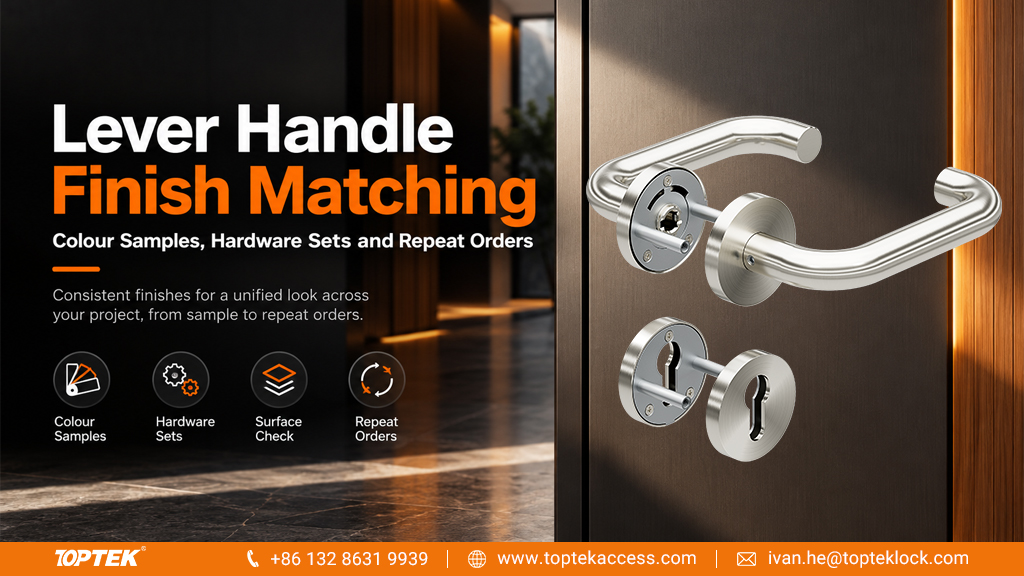
For lever handle finish matching, first identify every visible component in the door hardware set. Agree the intended colour, gloss and texture, then compare physical samples in a consistent viewing arrangement. Record which component is the controlling reference and how differences between flat roses and curved levers will be judged. Confirm cleaning requirements and the exact finish available on each model before ordering. Approve both the appearance and the functional assembly: a matching surface cannot compensate for an incorrect spindle, fixing pattern or return action.
For an early configuration review, send the visible component list and the intended finish reference to ivan.he@toptekaccess.com. Ask TOPTEK to identify the information needed for a configuration-specific proposal.

Define what must match before comparing samples
Start with a door elevation and mark the surfaces visible when the door is open and closed. The lever and rose are obvious, but an escutcheon, cylinder face, hinge knuckle, closer cover or exposed screw may also enter the same view. Separate components that must closely match from those intentionally specified in a contrasting finish. Otherwise, purchasing may interpret every metallic surface as part of one matching requirement.
Describe the comparison in terms the supplier can reproduce. “Match the sample on door set D12” is more useful when it includes a sample identifier, date, component list and photographs showing the intended arrangement. Photographs help identify the reference but should not become the sole basis for colour approval, because cameras and screens can change the apparent result.
Use the TOPTEK lever handle range to identify the candidate designs. Confirm the actual ordered model and finish separately. An image name, catalogue family name and test-report identifier can serve different purposes; keep their relationship explicit on the quotation and sample label.
Separate colour, material and surface process
A metallic colour description does not fully identify what is being purchased. The underlying material, preparation method and surface treatment can affect appearance and the care instructions. Two parts may look similar initially while requiring different cleaning methods. Buyers should request a description of each component’s construction instead of treating the colour name as proof that the materials are identical.
| Approval field | What the buyer records | Why it matters |
|---|---|---|
| Colour reference | Supplier code and retained physical sample | Reduces ambiguity between similar names |
| Surface appearance | Gloss, texture and grain direction where applicable | Controls more than the apparent colour |
| Component construction | Substrate and specified finish process | Connects appearance with care and suitability |
| Matching boundary | Lever, rose, escutcheon and other included parts | Prevents accidental omissions |
| Inspection conditions | Lighting, viewing arrangement and acceptance owner | Makes comparisons more repeatable |
| Repeat-order reference | Sample revision, supplier reference and batch | Supports future replacement decisions |
Do not assign a universal numeric colour tolerance without agreeing the measurement method and the surfaces to be measured. Curved, brushed and reflective parts can be difficult to compare with one measurement approach. Where instrumental readings are required, ask the finishing specialist to define the method alongside the visual reference. A number without its measurement conditions can create disagreement rather than resolve it.
Build a practical finish approval set
Place the candidate lever, rose and escutcheon next to the agreed reference in their intended orientation. Compare them under the project’s representative lighting and under a consistent inspection light. Record whether the concern is hue, brightness, gloss, texture or visible direction of brushing. “Looks wrong” is difficult to investigate; “rose appears glossier than the approved reference” identifies a useful observation.
Use at least one complete assembly as the approval object. A small flat finish coupon can support discussion, but it does not show how the surface appears around a curved lever neck or at the junction between handle and rose. Confirm that the quoted process applies to all included pieces and that small accessories have not been silently substituted.
The approval record should also identify acceptable variation. Different geometry can produce a different reflection even when the intended finish is consistent. Buyers and suppliers should agree the result they are judging rather than repeatedly changing parts to chase a camera image. Keep the approved sample protected, labelled and available to both parties through the purchasing process.

Check cleaning and environmental requirements
A hospital corridor, sheltered office and coastal entrance can present different cleaning and exposure conditions. Describe the actual location, cleaning products, cleaning frequency and contact with moisture. Ask for the care instructions applicable to the selected finish. Do not turn a general stainless-steel description or a photograph of a dark finish into a promise about corrosion resistance.
Manufacturer guidance illustrates why the surface matters: HOPPE’s hardware care instructions distinguish between stainless steel and other finishes, and warn against abrasive cleaning. Those instructions apply to HOPPE hardware; obtain the corresponding TOPTEK instructions for the quoted configuration instead of transferring a treatment or warranty between suppliers.
If the project specifies a corrosion test, request the method, result, specimen identification and finish configuration. Keep this evidence alongside the appearance record, not in place of it. A satisfactory test result does not tell the architect whether the handle and escutcheon match, while a visually accepted sample does not establish a test classification.
Protect matching through production and delivery
TOPTEK’s company process description includes retaining approved colour samples with supplier information, comparing finished parts against those references and inspecting returned electroplated components for appearance and colour consistency. These are first-party process descriptions, not a claim that every finish has the same test result or that variation is impossible.
For a specific order, connect that process to a manageable inspection record. Identify the approved sample, order revision, component references, inspection stage and decision owner. Review the TOPTEK quality management approach with the relevant acceptance criteria. The useful evidence is the traceable relationship between the ordered finish and the inspected parts.
Packaging also needs a clear purpose. Ask how the finished surfaces are separated from other components and protected during transit and installation. On receipt, check representative sets before distributing cartons across the building. If an appearance difference is found, retain the labels and affected samples so the supplier can compare the same components and investigate the relevant production records.
Common mistakes and project risks
A frequent procurement mistake is ordering “satin” or “black” without identifying the supplier’s finish code and physical reference. Another is approving the handle alone, then expecting independently purchased escutcheons to match it automatically. These choices can leave several acceptable individual products that do not form an acceptable architectural set.
A second risk is changing the finish after the functional sample has been approved without reviewing the completed assembly. Inspect clearances, fixing engagement and free movement on the finished sample. Do not permit coating build-up, cleaning residue or installation damage to be dismissed as a purely cosmetic issue when the handle’s operation is affected.
For mechanical interfaces, use the commercial lever handle specification guide alongside the finish record. The EUG4001 product page provides a specific handle reference; the project still needs the correct variant, spindle, door thickness and fixing details. Finish approval does not replace those checks.
RFQ checklist and why TOPTEK
TOPTEK’s lever handle and wider architectural hardware scope allows buyers to discuss visible components together. That is useful when a door manufacturer or distributor needs one coordinated appearance across repeated door sets. The request should identify the actual set and the purchasing responsibility for each item, so any externally supplied component can be considered explicitly.
- State the market, building environment and opening or hardware-set references.
- List the lever model, rose, escutcheon and all additional parts included in the matching requirement.
- Provide the finish code, physical reference sample and intended colour, gloss and texture.
- Describe cleaning agents, exposure conditions and any project-specific evidence requirement.
- Confirm the functional interfaces, sample quantity and person authorised to accept appearance.
- State production quantity, packaging needs, replacement stock and repeat-order expectations.
- Request a written response identifying exceptions, sample references and the quoted finish scope.
For an initial selection review, send photographs of the intended door set and identify the components that must match. For a formal quotation, provide the complete reference set and agreed acceptance record to the TOPTEK commercial door hardware team. This gives the supplier a defined appearance target and gives the buyer a practical basis for comparing offers.
Frequently asked questions
Can a product photograph be used as the final finish reference?
A photograph helps identify the intended appearance, but final acceptance should use agreed physical samples and viewing conditions because lighting, cameras and screens can change the perceived result.
Does the same finish name guarantee a match across suppliers?
No. Confirm each supplier’s finish code, process and physical reference, then compare the actual components together before approving the door hardware set.
Should the rose and lever be approved separately?
Record their individual references, but judge the complete visible assembly as well. Geometry, gloss and texture can affect how the parts appear next to each other.
Does colour approval prove corrosion performance?
No. Appearance approval and corrosion evidence answer different questions. Request the relevant test scope for the exact material and finish configuration when the project requires it.
What should be retained for replacement orders?
Keep the approved physical sample, finish code, model and component references, sample revision, supplier information and original order records.
Conclusion
Successful lever handle finish matching depends on a shared reference and a clear inspection method. Define the visible set, compare complete samples, agree the care requirements and preserve the result for production and reorders. A documented finish decision helps purchasing, engineering and installation teams work from the same expectation.